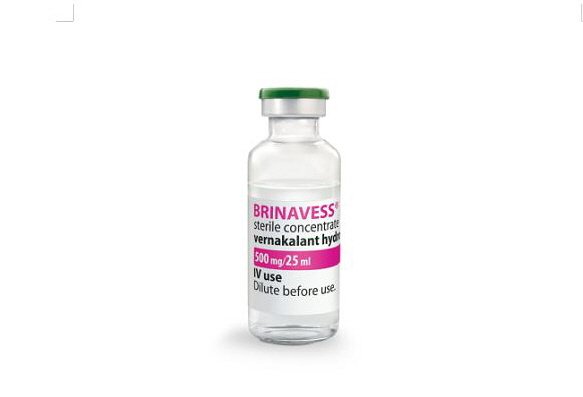
Vernakalant (Brinavess) is a sodium and Potassium channel blocker. The action of vernakalant is heart rate and membrane potential-dependent.
It is used for the treatment of:
-
Atrial fibrillation (pharmacologic cardioversion):
-
Rapid conversion of a recent-onset atrial fibrillation to sinus rhythm for nonsurgical (atrial fibrillation duration: ≤7 days) and postcardiac surgery patients (atrial fibrillation duration: ≤3 days)
-
Vernakalant Dose in Adults
Dose in the treatment of Atrial fibrillation (pharmacologic cardioversion):
- Start with 3 mg/kg intravenous (max dose: 339 mg) over 10 minutes.
- If conversion to sinus rhythm does not occur within 15 minutes after the end of the initial infusion, the second infusion of 2 mg/kg (maximum dose: 226 mg) over 10 minutes may be administered.
- If hemodynamically stable atrial flutter is observed after the first infusion, the second infusion may be administered to convert to sinus rhythm.
- Cumulative doses >5 mg/kg should not be administered within 24 hours.
Note: Stop the infusion and do not administer further doses if the following occurs:
- A sudden drop in blood pressure or heart rate
- with or without symptomatic hypotension or bradycardia
- hypotension
- bradycardia
- ECG changes
Vernakalant Dose in Childrens2
Not recommended.
Pregnancy Risk factor: C
- Studies on animals have shown that adverse effects can be observed.
- Other agents are also available.
Vernakalant use during breastfeeding:
- It is unknown if vernakalant can be found in breast milk.
- Not recommended.
Vernakalant Dose in Renal Disease:
No dosage adjustment necessary.
Vernakalant Dose in Liver Disease:
- No dosage adjustment necessary.
- use caution in advanced hepatic impairment.
Common Side Effects of Vernakalant Include:
- Cardiovascular:
- Hypotension
- Gastrointestinal:
- Dysgeusia
- Respiratory:
- Sneezing
Less Common Side Effects of Vernakalant Include:
- Cardiovascular:
- Atrial Flutter
- Bradycardia
- Ventricular Arrhythmia
- Hypertension
- First Degree Atrioventricular Block
- Ventricular Tachycardia
- Central Nervous System:
- Paresthesia
- Dizziness
- Fatigue
- Feeling Hot
- Infusion Site Pain
- Dermatologic:
- Hyperhidrosis
- Pruritus
- Gastrointestinal:
- Nausea
- Oral Paresthesia
- Vomiting
- Diarrhea
- Respiratory:
- Cough
- Nasal Discomfort
- Dyspnea
Contraindication to Vernakalant Include:
- Hypersensitivity to vernakalant and any other component of the formulation
- Grave aortic stenosis
- Systolic blood pressure of 100 mm Hg
- NYHA III and NYHA IV heart failure classes
- Acute decompensated or acute coronary syndrome within the last 30 day
- Significant prolonged QT at baseline (eg uncorrected >440msec)
- Congenital or acquired long QT Syndrome
- severe bradycardia, sinus node dysfunction
- In the absence of a functioning pacemaker, second- and third-degree heart blocks can occur
- Use intravenous class I and class III antiarrhythmics less than 4 hours before or after vernakalant administration.
Warnings and Precautions
- Atrial flutter
- This may be linked to a greater incidence of atrial flutter conversion within the first two hours after the dose.
- Patients who take antiarrhythmics of class I are at greater risk.
- Pay attention to your patients.
- Stopping treatment should be considered if atrial flutter is associated with hemodynamic instability, or the development of 1:1 atrioventricular conduction.
- Bradycardia
- Bradycardia grave has been reported following or during infusion. Most often, this occurs soon after conversion to sinus rhythm.
- Bradycardia should be treated immediately. However, it is possible to discontinue therapy if bradycardia develops.
- CNS effects
- CNS depression can lead to mental or physical impairment.
- It is important to warn patients about tasks that require mental alertness, such as driving or operating machinery.
- Hypotension
- During and immediately after infusion, hypotension has been reported as severe and/or serious.
- Observe patients closely, monitoring vital signs, and continuously monitoring cardiac rhythm, both during and after infusion.
- Stop immediately if hypotension, sudden drops in blood pressure, heart rate, or both, occurs.
- Only if the resources and equipment to place a temporary pacemaker for resuscitation are available.
- Patients with a systolic (SBP) 105mm Hg at infusion start should be supervised. This patient has a three-fold higher incidence of hypotension.
- A systolic blood sugar of less than 100mmHg is contraindicated.
- Hypotension risk is higher in people with heart disease. Use caution in patients with stable NYHA class I to II symptoms.
- Extension of QT
- It is possible for QT interval to be extended.
- Patients with a family history or long QT syndrome are not advised to use this medication unless they have been diagnosed.
- If ECG changes occur (eg, clinically significant sinus pauses, complete heart blocks, new bundle branch blocks, significant prolongation or QT intervals, changes consistent with ischemia and infarction, ventricular rhythmia), discontinue use immediately.
- Cardiovascular disease
- Patients with HF class NYHA II or III should be cautious.
- Patients with a previously documented LVEF =35% are not advised to use it.
- Patients with valvular disease should be cautious as there is a higher incidence of bradycardia and ventricular arrhythmia within the first two hours after taking the medication.
- Patients with clinically significant hypertrophic obstructive or restrictive cardiomyopathy or constrictive pericarditis should not use this medication.
- NYHA Class III-IV heart failure patients are advised not to use this medication.
- Hepatic impairment
- Advanced hepatic impairment is not recommended (not sufficiently studied).
- Hypokalemia
- Patients with uncorrected Hypokalemia should have their potassium levels corrected (i.e., serum potassium must be 3.5mmol/L).
|
Lacosamide |
Antiarrhythmic Agents (Class III) may enhance the adverse/toxic effect of Lacosamide. Specifically the risk for bradycardia, ventricular tachyarrhythmias, or a prolonged PR interval may be increased. |
|
Lidocaine (Topical) |
|
|
QT-prolonging Agents (Indeterminate Risk - Avoid) |
May enhance the QTc-prolonging effect of QT-prolonging Agents (Highest Risk). Management: Monitor for QTc interval prolongation and ventricular arrhythmias when these agents are combined. Patients with additional risk factors for QTc prolongation may be at even higher risk. |
|
QT-prolonging Agents (Indeterminate Risk - Caution) |
May enhance the QTc-prolonging effect of QT-prolonging Agents (Highest Risk). Management: Monitor for QTc interval prolongation and ventricular arrhythmias when these agents are combined. Patients with additional risk factors for QTc prolongation may be at even higher risk. |
|
Risk Factor D (Consider therapy modification) |
|
|
Amiodarone |
QT-prolonging Class III Antiarrhythmics (Highest Risk) may enhance the QTcprolonging effect of Amiodarone. Management: Consider alternatives to this drug combination. If combined, monitor for QTc interval prolongation and ventricular arrhythmias. Patients with additional risk factors for QTc prolongation may be at even higher risk. |
|
Amisulpride |
QT-prolonging Agents (Highest Risk) may enhance the QTc-prolonging effect of Amisulpride. Management: Consider alternatives to this combination. Patients with other risk factors (eg, older age, female sex, bradycardia, hypokalemia, hypomagnesemia, heart disease, and higher drug concentrations) are likely at greater risk for these toxicities. |
|
Azithromycin (Systemic) |
QT-prolonging Agents (Highest Risk) may enhance the QTc-prolonging effect of Azithromycin (Systemic). Management: Consider alternatives to this combination. Patients with other risk factors (eg, older age, female sex, bradycardia, hypokalemia, hypomagnesemia, heart disease, and higher drug concentrations) are likely at greater risk for these toxicities. |
|
Ceritinib |
QT-prolonging Class III Antiarrhythmics (Highest Risk) may enhance the QTcprolonging effect of Ceritinib. Ceritinib may enhance the QTc-prolonging effect of QT-prolonging Class III Antiarrhythmics (Highest Risk). Management: Consider alternatives to this drug combination. If combined, monitor for QTc interval prolongation and ventricular arrhythmias. Patients with additional risk factors for QTc prolongation may be at even higher risk. |
|
Chloroquine |
QT-prolonging Agents (Highest Risk) may enhance the QTc-prolonging effect of Chloroquine. Management: Consider alternatives to this combination. If combined, monitor for QTc interval prolongation and ventricular arrhythmias. Patients with additional risk factors for QTc prolongation may be at even higher risk. |
|
Clofazimine |
QT-prolonging Agents (Highest Risk) may enhance the QTc-prolonging effect of Clofazimine. Management: Consider alternatives to this combination. If combined, monitor for QTc interval prolongation and ventricular arrhythmias. Patients with additional risk factors for QTc prolongation may be at even higher risk. |
|
CloZAPine |
QT-prolonging Agents (Highest Risk) may enhance the QTc-prolonging effect of CloZAPine. Management: Consider alternatives to this combination. Patients with other risk factors (eg, older age, female sex, bradycardia, hypokalemia, hypomagnesemia, heart disease, and higher drug concentrations) are likely at greater risk for these toxicities. |
|
Dasatinib |
QT-prolonging Agents (Highest Risk) may enhance the QTc-prolonging effect of Dasatinib. Management: Consider alternatives to this combination. Patients with other risk factors (eg, older age, female sex, bradycardia, hypokalemia, hypomagnesemia, heart disease, and higher drug concentrations) are likely at greater risk for these toxicities. |
|
Doxepin-Containing Products |
QT-prolonging Agents (Highest Risk) may enhance the QTcprolonging effect of Doxepin-Containing Products. Management: Consider alternatives to this combination. Patients with other risk factors (eg, older age, female sex, bradycardia, hypokalemia, hypomagnesemia, heart disease, and higher drug concentrations) are likely at greater risk for these toxicities. |
|
Droperidol |
QT-prolonging Agents (Highest Risk) may enhance the QTc-prolonging effect of Droperidol. Management: Consider alternatives to this combination. Patients with other risk factors (eg, older age, female sex, bradycardia, hypokalemia, hypomagnesemia, heart disease, and higher drug concentrations) are likely at greater risk for these toxicities. |
|
Encorafenib |
May enhance the QTc-prolonging effect of QT-prolonging Agents (Highest Risk). Management: Consider alternatives to this combination. Patients with other risk factors (eg, older age, female sex, bradycardia, hypokalemia, hypomagnesemia, heart disease, and higher drug concentrations) are likely at greater risk for these toxicities. |
|
Escitalopram |
QT-prolonging Agents (Highest Risk) may enhance the QTc-prolonging effect of Escitalopram. Management: Consider alternatives to this combination. Patients with other risk factors (eg, older age, female sex, bradycardia, hypokalemia, hypomagnesemia, heart disease, and higher drug concentrations) are likely at greater risk for these toxicities. |
|
Flecainide |
QT-prolonging Agents (Highest Risk) may enhance the QTc-prolonging effect of Flecainide. Management: Consider alternatives to this combination. Patients with other risk factors (eg, older age, female sex, bradycardia, hypokalemia, hypomagnesemia, heart disease, and higher drug concentrations) are likely at greater risk for these toxicities. |
|
Gadobenate Dimeglumine |
QT-prolonging Agents (Highest Risk) may enhance the QTcprolonging effect of Gadobenate Dimeglumine. Management: Consider alternatives to this combination. If combined, monitor for QTc interval prolongation and ventricular arrhythmias. Patients with additional risk factors for QTc prolongation may be at even higher risk. |
|
Gilteritinib |
May enhance the QTc-prolonging effect of QT-prolonging Agents (Highest Risk). Management: Consider alternatives to this combination. If use is necessary, monitor for QTc interval prolongation and arrhythmias. |
|
Halofantrine |
QT-prolonging Agents (Highest Risk) may enhance the QTc-prolonging effect of Halofantrine. Management: Consider alternatives to this combination. If combined, monitor for QTc interval prolongation and ventricular arrhythmias. Patients with additional risk factors for QTc prolongation may be at even higher risk. |
|
Haloperidol |
QT-prolonging Class III Antiarrhythmics (Highest Risk) may enhance the QTcprolonging effect of Haloperidol. Management: Consider alternatives to this drug combination. If combined, monitor for QTc interval prolongation and ventricular arrhythmias. Patients with additional risk factors for QTc prolongation may be at even higher risk. |
|
Inotuzumab Ozogamicin |
QT-prolonging Agents (Highest Risk) may enhance the QTc-prolonging effect of Inotuzumab Ozogamicin. Management: Consider alternatives to this combination. If combined, monitor for QTc interval prolongation and ventricular arrhythmias. Patients with additional risk factors for QTc prolongation may be at even higher risk. |
|
Lofexidine |
|
|
Methadone |
QT-prolonging Class III Antiarrhythmics (Highest Risk) may enhance the QTcprolonging effect of Methadone. Management: Consider alternatives to this drug combination. If combined, monitor for QTc interval prolongation and ventricular arrhythmias. Patients with additional risk factors for QTc prolongation may be at even higher risk. |
|
Midostaurin |
QT-prolonging Agents (Highest Risk) may enhance the QTc-prolonging effect of Midostaurin. Management: Consider alternatives to this combination. If combined, monitor for QTc interval prolongation and ventricular arrhythmias. Patients with additional risk factors for QTc prolongation may be at even higher risk. |
|
OLANZapine |
QT-prolonging Agents (Highest Risk) may enhance the QTc-prolonging effect of OLANZapine. Management: Consider alternatives to this combination. Patients with other risk factors (eg, older age, female sex, bradycardia, hypokalemia, hypomagnesemia, heart disease, and higher drug concentrations) are likely at greater risk for these toxicities. |
|
Ondansetron |
QT-prolonging Class III Antiarrhythmics (Highest Risk) may enhance the QTcprolonging effect of Ondansetron. Management: Consider alternatives to this combination. If combined, monitor for QTc interval prolongation and ventricular arrhythmias. Patients with additional risk factors for QTc prolongation may be at even higher risk. |
|
Osimertinib |
QT-prolonging Agents (Highest Risk) may enhance the QTc-prolonging effect of Osimertinib. Management: Consider alternatives to this combination. Patients with other risk factors (eg, older age, female sex, bradycardia, hypokalemia, hypomagnesemia, heart disease, and higher drug concentrations) are likely at greater risk for these toxicities. |
|
Pentamidine (Systemic) |
QT-prolonging Agents (Highest Risk) may enhance the QTc-prolonging effect of Pentamidine (Systemic). Management: Consider alternatives to this combination. If combined, monitor for QTc interval prolongation and ventricular arrhythmias. Patients with additional risk factors for QTc prolongation may be at even higher risk. |
|
Pilsicainide |
QT-prolonging Agents (Highest Risk) may enhance the QTc-prolonging effect of Pilsicainide. Management: Consider alternatives to this combination. If combined, monitor for QTc interval prolongation and ventricular arrhythmias. Patients with additional risk factors for QTc prolongation may be at even higher risk. |
|
Propafenone |
May enhance the QTc-prolonging effect of QT-prolonging Class III Antiarrhythmics (Highest Risk). Management: Consider alternatives to this drug combination. If combined, monitor for QTc interval prolongation and ventricular arrhythmias. Patients with additional risk factors for QTc prolongation may be at even higher risk. |
|
QT-prolonging Kinase Inhibitors (Highest Risk) |
May enhance the QTc-prolonging effect of QTprolonging Class III Antiarrhythmics (Highest Risk). Management: Consider alternatives to this drug combination. If combined, monitor for QTc interval prolongation and ventricular arrhythmias. Patients with additional risk factors for QTc prolongation may be at even higher risk. |
|
QT-prolonging Miscellaneous Agents (Highest Risk) |
QT-prolonging Class III Antiarrhythmics (Highest Risk) may enhance the QTc-prolonging effect of QT-prolonging Miscellaneous Agents (Highest Risk). Management: Consider alternatives to this drug combination. If combined, monitor for QTc interval prolongation and ventricular arrhythmias. Patients with additional risk factors for QTc prolongation may be at even higher risk. |
|
QT-prolonging Moderate CYP3A4 Inhibitors (Moderate Risk) |
QT-prolonging Class III Antiarrhythmics (Highest Risk) may enhance the QTc-prolonging effect of QT-prolonging Moderate CYP3A4 Inhibitors (Moderate Risk). QT-prolonging Moderate CYP3A4 Inhibitors (Moderate Risk) may increase the serum concentration of QT-prolonging Class III Antiarrhythmics (Highest Risk). Management: Consider alternatives to this drug combination. If combined, monitor for QTc interval prolongation and ventricular arrhythmias. Patients with additional risk factors for QTc prolongation may be at even higher risk. Exceptions: Ceritinib; Erythromycin (Systemic); Nilotinib; Ribociclib. |
|
QT-prolonging Strong CYP3A4 Inhibitors (Moderate Risk) |
QT-prolonging Class III Antiarrhythmics (Highest Risk) may enhance the QTc-prolonging effect of QT-prolonging Strong CYP3A4 Inhibitors (Moderate Risk). QT-prolonging Strong CYP3A4 Inhibitors (Moderate Risk) may increase the serum concentration of QT-prolonging Class III Antiarrhythmics (Highest Risk). Management: Consider alternatives to this drug combination. If combined, monitor for QTc interval prolongation and ventricular arrhythmias. Patients with additional risk factors for QTc prolongation may be at even higher risk. Exceptions: Clarithromycin. |
|
RisperiDONE |
QT-prolonging Agents (Highest Risk) may enhance the CNS depressant effect of RisperiDONE. QT-prolonging Agents (Highest Risk) may enhance the QTc-prolonging effect of RisperiDONE. Management: Consider alternatives to this drug combination. If combined, monitor for QTc interval prolongation and ventricular arrhythmias. Patients with additional risk factors for QTc prolongation may be at even higher risk. |
|
Sodium Stibogluconate |
QT-prolonging Agents (Highest Risk) may enhance the QTc-prolonging effect of Sodium Stibogluconate. Management: Consider alternatives to this combination. If combined, monitor for QTc interval prolongation and ventricular arrhythmias. Patients with additional risk factors for QTc prolongation may be at even higher risk. |
|
Vemurafenib |
QT-prolonging Agents (Highest Risk) may enhance the QTc-prolonging effect of Vemurafenib. Management: Consider alternatives to this combination. Patients with other risk factors (eg, older age, female sex, bradycardia, hypokalemia, hypomagnesemia, heart disease, and higher drug concentrations) are likely at greater risk for these toxicities. |
|
Risk Factor X (Avoid combination) |
|
|
Citalopram |
QT-prolonging Agents (Highest Risk) may enhance the QTc-prolonging effect of Citalopram. |
|
Clarithromycin |
QT-prolonging Agents (Highest Risk) may enhance the QTc-prolonging effect of Clarithromycin. |
|
Domperidone |
QT-prolonging Agents (Highest Risk) may enhance the QTc-prolonging effect of Domperidone. |
|
Erythromycin (Systemic) |
QT-prolonging Class III Antiarrhythmics (Highest Risk) may enhance the QTc-prolonging effect of Erythromycin (Systemic). Erythromycin (Systemic) may enhance the QTc-prolonging effect of QT-prolonging Class III Antiarrhythmics (Highest Risk). Erythromycin (Systemic) may increase the serum concentration of QT-prolonging Class III Antiarrhythmics (Highest Risk). Management: Use of erythromycin with dronedarone is contraindicated in dronedarone US prescribing information and is represented in a separate interaction monograph. |
|
Fingolimod |
May enhance the QTc-prolonging effect of QT-prolonging Class III Antiarrhythmics (Highest Risk). |
|
Flupentixol |
QT-prolonging Agents (Highest Risk) may enhance the QTc-prolonging effect of Flupentixol. |
|
Gemifloxacin |
May enhance the QTc-prolonging effect of QT-prolonging Class III Antiarrhythmics (Highest Risk). |
|
Levofloxacin-Containing Products (Systemic) |
May enhance the QTc-prolonging effect of QTprolonging Class III Antiarrhythmics (Highest Risk). |
|
Moxifloxacin (Systemic |
QT-prolonging Agents (Highest Risk) may enhance the QTc-prolonging effect of Moxifloxacin (Systemic). |
|
Nilotinib |
QT-prolonging Agents (Highest Risk) may enhance the QTc-prolonging effect of Nilotinib. |
|
Pimozide |
QT-prolonging Agents (Highest Risk) may enhance the QTc-prolonging effect of Pimozide. Management: Consider alternatives to this combination. Patients with other risk factors (eg, older age, female sex, bradycardia, hypokalemia, hypomagnesemia, heart disease, and higher drug concentrations) are likely at greater risk for these toxicities. |
|
Piperaquine |
QT-prolonging Agents (Highest Risk) may enhance the QTc-prolonging effect of Piperaquine. |
|
Probucol |
QT-prolonging Agents (Highest Risk) may enhance the QTc-prolonging effect of Probucol. |
|
QT-prolonging Class IA Antiarrhythmics (Highest Risk) |
May enhance the QTc-prolonging effect of QT-prolonging Class III Antiarrhythmics (Highest Risk). |
|
QT-prolonging Class III Antiarrhythmics (Highest Risk) |
May enhance the QTc-prolonging effect of other QT-prolonging Class III Antiarrhythmics (Highest Risk). |
|
QUEtiapine |
QT-prolonging Agents (Highest Risk) may enhance the QTc-prolonging effect of QUEtiapine. |
|
Ribociclib |
QT-prolonging Agents (Highest Risk) may enhance the QTc-prolonging effect of Ribociclib. |
|
Sparfloxacin |
QT-prolonging Agents (Highest Risk) may enhance the QTc-prolonging effect of Sparfloxacin. |
|
Thioridazine |
QT-prolonging Agents (Highest Risk) may enhance the QTc-prolonging effect of Thioridazine. |
Monitor:
- Decrease in blood pressure or heart rate
- significant QT prolongation for the duration of the first infusion
- assessment of vital signs
- continuous cardiac rhythm monitoring
- potassium levels(prior to initiation of therapy)
How to administer Vernakalant?
- Given as an IV infusion.
- Do not administer by IV push or bolus.
- Must dilute concentrate before use.
- Infuse over 10 minutes using an infusion pump (preferred) or a syringe pump.
- If conversion to sinus rhythm occurs during either the first or second infusion, continue the infusion to completion.
Mechanism of action of Vernakalant:
- It is an anti-arrhythmic medication that acts only on the atrial, with very few effects on the ventricular tissues.
- It is a multi-ion channel blocker, which inhibits the potassium and sodium currents.
- This causes atrial refractoriness to prolong and rate-dependently slow down atrial conduction to suppress atrial entry.
- It has very little effect on currents that are involved in ventricular depolarization.
Onset of action: Rapid
Distribution:extensively and rapidly distributed in the body
Protein binding: 37% to 47%
Metabolism: Hepatic
Half-life elimination: about 3 - 5.5 hrs
International Brands of Vernakalant:
- Brinavess
Vernakalant Brands in Pakistan:
No brands available in Pakistan.
.png)


