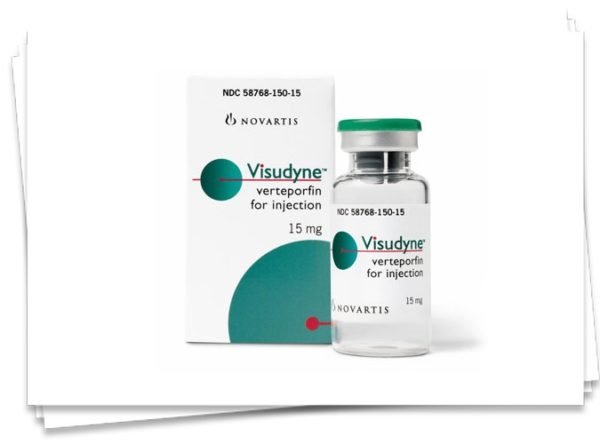
Verteporfin (visudyne) is used for the treatment of classic subfoveal choroidal neovascularization due to:
-
Pathologic myopia
-
Age-related macular degeneration, or
-
Presumed ocular histoplasmosis.
Limitations of use:
- There is insufficient evidence to indicate verteporfin for the treatment of predominantly occult subfoveal choroidal neovascularization.
Verteporfin dose in Adults
Therapy is a two-step process:
- First the infusion of verteporfin,
- Then the activation of verteporfin with a nonthermal diode laser.
Dose in the treatment of Subfoveal choroidal neovascularization:
- 6 mg/m² Intravenous body surface area; may repeat at 3-month intervals (if evidence of choroidal neovascular leakage)
Note:
- Treatment in more than one eye:
- Patients who have eligible lesions in both eyes should be evaluated and treatment should first be done to the more aggressive lesion.
- Following safe and acceptable treatment, the second eye can be treated one week later.
- Patients who have had previous verteporfin therapy, with an acceptable safety profile, may then have both eyes treated concurrently (~3 months after the initial treatment).
- Treat the more aggressive lesion followed immediately with the second eye. The light treatment to the second eye should begin no later than 20 minutes from the start of the infusion.
Verteporfin Dose in Childrens
Not applicable
Pregnancy Risk Factor C
- Some adverse events have been observed in animal reproduction studies.
Verteporfin use during breastfeeding:
- Breast milk contains verteporfin as well as its metabolite.
- After infusion, milk concentrations reached 66% of plasma levels in one woman; the metabolite could still be detected 48 hours later.
- Nursing infants can experience serious adverse reactions. It is important to stop nursing or postpone treatment.
Verteporfin Dose in Renal Disease:
- No dose adjustment required since elimination is predominantly via the feces.
Verteporfin Dose in Liver Disease:
- Mild impairment:
- There are no dosage adjustments provided in the manufacturer’s labeling; however, the half-life is increased by 20% with mild hepatic impairment.
- Moderate-to-severe impairment:
- Dose adjustments for moderate to severe liver impairment has not been studied.
Common Side Effects of Verteporfin Include:
- Local:
- Injection Site Reaction Including
- Extravasation
- Inflammation At Injection Site
- Local Discoloration
- Local Edema
- Local Hemorrhage
- Pain At Injection Site
- Rash At Injection Site
- Injection Site Reaction Including
- Ophthalmic:
- Blurred Vision
- Decreased Visual Acuity
- Photopsia
- Visual Field Defect (Including Scotoma)
Less Common Side Effects of Verteporfin Include:
- Cardiovascular:
- Atrial Fibrillation
- Hypertension
- Peripheral Vascular Disease
- Varicose Veins
- Central Nervous System:
- Disturbed Sleep
- Hypoesthesia
- Myasthenia
- Vertigo
- Dermatologic:
- Eczema
- Skin Photosensitivity
- Endocrine & Metabolic:
- Albuminuria
- Gastrointestinal:
- Constipation
- Nausea
- Genitourinary:
- Prostatic Disease
- Hematologic & Oncologic:
- Anemia
- Gastrointestinal Carcinoma
- Leukocytosis
- Leukopenia
- Hepatic:
- Increased Liver Enzymes
- Neuromuscular & Skeletal:
- Arthralgia
- Arthropathy
- Back Pain (Primarily During Infusion)
- Weakness
- Ophthalmic:
- Abnormal Lacrimation
- Blepharitis
- Cataract
- Conjunctivitis
- Conjunctival Injection
- Diplopia
- Eye Pruritus
- Severe Vision Loss
- Xerophthalmia
- Otic:
- Hearing Loss
- Renal:
- Increased Serum Creatinine
- Respiratory:
- Cough
- Flu-Like Symptoms
- Pharyngitis
- Pneumonia
- Miscellaneous:
- Fever
Frequency Not Defined:
- Cardiovascular:
- Chest Pain
- Vasodepressor Syncope
- Hypersensitivity:
- Hypersensitivity Reaction
- Neuromuscular & Skeletal:
- Musculoskeletal Pain (During Infusion)
- Ophthalmic:
- Retinal Detachment (Nonrhegmatogenous)
- Retinal Ischemia (Retinal Or Choroidal Vessel Nonperfusion)
- Retinal Pigment Epithelium Tear
Contraindication to Verteporfin Include:
- Allergy reactions to any component of the formulation or verteporfin
- Porphyria
- Hepatic impairment severe
Warnings and Precautions
- Extravasation:
- If the area is not protected from light, it can cause severe pain, discoloration or swelling at the injection site.
- To avoid extravasation, standard precautions should be taken (eg, free flowing intravenous line, use largest arm vein [antecubital], if possible). Avoid small veins at the back of your hand.
- Extravasation can be prevented by stopping the infusion immediately. Protect the area from direct sunlight until swelling and discoloration subside; cold compresses or oral pain medication may also be used if necessary.
- Infusion reactions
- Rarely have chest pain, dyspnea and flushing occurred.
- Ophthalmic effects
- Eye problems such as blurred vision, reduced vision or vision field defects can occur.
- These effects can affect your ability to drive and use machinery.
- Photosensitivity
- For five days after treatment, avoid direct sunlight and bright indoor lighting. Ambient indoor lighting is encouraged.
- If you need emergency surgery, make sure to protect the inner tissue from any intense light.
- For five days following administration, avoid prolonged exposure to light from light emitting medical devices (eg pulse oximeter).
|
Aminolevulinic Acid (Topical) |
Photosensitizing Agents may enhance the photosensitizing effect of Aminolevulinic Acid (Topical). |
|
Photosensitizing Agents |
May enhance the photosensitizing effect of Verteporfin. |
|
Porfimer |
Photosensitizing Agents may enhance the photosensitizing effect of Porfimer. |
|
Aminolevulinic Acid (Systemic) |
Photosensitizing Agents may enhance the photosensitizing effect of Aminolevulinic Acid (Systemic). |
Monitor:
Monitor intravenous site during infusion, to avoid extravasation.
- Fluorescein angiography every 3 months to monitor choroidal neovascular leakage (if detected, repeat therapy)
How to administer Verteporfin?
- Infuse at 3 mL/minute (over 10 minutes) using a syringe pump and an in-line filter (a standard 1.2-micron filter was used in studies).
- A free-flowing intravenous line should be established prior to starting the infusion. Use of the largest arm vein, especially in elderly patients, is suggested.
- Avoid small veins in the back of the hand.
- Avoid extravasation. If extravasation occurs, protect the infusion site from light.
Extravasation management:
- Stop the infusion. To decrease the chance of a severe burn, protect the area of extravasation from direct light until swelling and discoloration have faded. Apply cold compresses to the injection site.
- Avoid contact with skin and eyes during preparation and administration. If contact occurs, protect the contact area from bright light.
- Any spill should be wiped with a damp cloth (the use of rubber gloves is recommended); dispose of all materials properly.
Light administration:
- Following intravenous infusion, verteporfin must be light-activated using a nonthermal diode laser.
- The system must provide a stable power output at a wavelength of 689 ± 3 nm.
- Approved laser systems are listed in the manufacturer's package insert.
- Light delivery should begin 15 minutes following the start of the 10-minute infusion.
- The light dose is 50 J/cm of neovascular lesion administered over 83 seconds at an intensity of 600 mW/cm.
- Detailed instructions for determining lesion size, treatment spot size, and light administration may be found in the manufacturer’s labeling.
Mechanism of action of Verteporfin:
- After transfusion, verteporfin can be transported to the Neovascular Endothelium via lipoproteins from the affected eye(s), which include the retina and choroidal neovasculature.
- Verteporfin then requires activation by nonthermal red light, which results in local damage to the endothelium, leading to temporary choroidal vessel occlusion.
Metabolism:
- Diacid metabolite - Hepatic and plasma esterases
Half-life elimination
- Terminal: 5-6 hours, biexponential
Excretion:
- Urine (0.01%); feces (predominantly);
International Brands of Verteporfin:
- Visudine
- Visudyne
Verteporfin Brands in Pakistan:
|
Verteporfin [Inf 15 mg] |
|
| Visudyne | Novartis Pharma (Pak) Ltd |
.png)


