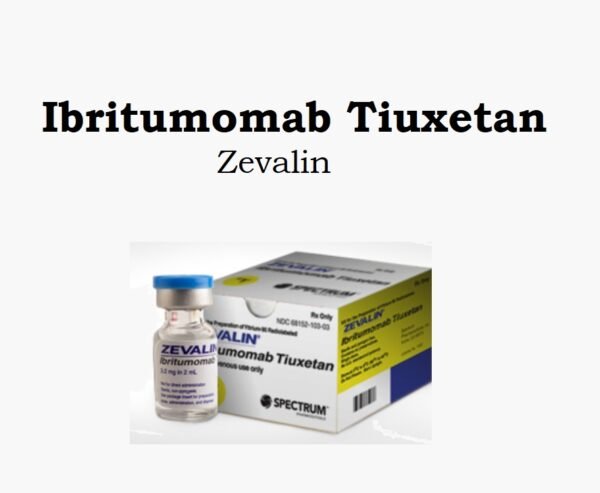
Ibritumomab tiuxetan (Zevalin) is a monoclonal antibody that is linked with a radioactive isotope Yttrium-90 (Y90). The monoclonal antibody acts as a vehicle for the radioactive isotope to reach the target site.
Ibritumomab tiuxetan (Zevalin) Uses:
-
Non-Hodgkin lymphoma:
- Used for treatment of relapsed or refractory, low-grade or follicular B-cell no Hodgkin lymphoma (NHL)
- Also used to treat previously untreated follicular NHL in patients who achieve a partial or complete response to first-line chemotherapy
Ibritumomab tiuxetan (Zevalin) Dose in Adults:
Note:
- Prior to each rituximab infusion premedication should be done with oral acetaminophen 650 mg and oral diphenhydramine 50 mg.
- Following the 1st line, chemotherapy allow at least 6 weeks, but no more than 12 weeks before starting the treatment
- Before starting treatment regimen platelets should recover to ≥150,000/mm³.
Ibritumomab tiuxetan (Zevalin) Dose in the treatment of Non-Hodgkin lymphoma:
- Ibritumomab is administered only as part of the Zevalin therapeutic regimen (a combined treatment regimen with rituximab).
- The regimen consists of two steps:
-
Day 1:
- Rituximab: IV:
- 250 mg/m² at an initial rate of 50 mg/hour. If there is no hypersensitivity or infusion-related event, the infusion should be increased in increments of 50 mg/hour every half an hour, to a maximum dose of 400 mg/hour.
- If severe infusion reactions occur, stop rituximab, and discontinue regimen.
- For less severe infusion reactions, the infusion should be temporarily slowed or interrupted and upon the improvement of symptoms, the infusion may be resumed at one-half the previous rate.
- Rituximab: IV:
-
Day 7, 8, or 9 of treatment:
- Rituximab: IV:
- 250 mg/m² at an initial rate of 100 mg/hour (50 mg/hour if infusion-related events occurred with the day 1 infusion).
- If there is no hypersensitivity or infusion-related event, the infusion should be increased in increments of 100 mg/hour every half an hour, to a maximum of 400 mg/hour, as tolerated (increase in 50 mg/hour increments every 30 minutes if initial infusion rate was 50 mg/hour).
- Y-90 ibritumomab (within 4 hours after completion of the rituximab infusion): IV:
- Platelet count ≥150,000 cells/mm³:
- 0.4 mCi/kg (14.8 MBq/kg) actual body weight over 10 minutes;
- The maximum dose: 32 mCi (1184 MBq)
- Platelet count between 100,000 to 149,000 cells/mm³ (in relapsed or refractory patients):
- 0.3 mCi/kg (11.1 MBq/kg) actual body weight over 10 minutes;
- The maximum dose: 32 mCi (1184 MBq)
- Platelet count <100,000 cells/mm³:
- Do not administer
- Platelet count ≥150,000 cells/mm³:
- Maximum dose:
- The prescribed, measured and administered dose of Y-90 ibritumomab must not exceed 32 mCi (1184 MBq), irrespective of the patient's body weight
- Rituximab: IV:
-
Use in Children:
Not indicated.
Ibritumomab tiuxetan (Zevalin) Pregnancy Risk Category: D
- Due to its radioactivity, Y-90 ibritumomab can cause harm to the fetus if given during pregnancy.
- Additionally, ibritumomab Tiuxetan (Humanized Monoclonal Antibody) (IgG) is also available.
- The potential placental transfer human IgG depends on the IgG subclass and the gestational year. It generally increases with each pregnancy.
- The lowest possible exposure is expected during the period of organogenesis.
- Before starting therapy, it is important to determine if you are pregnant.
- Women with reproductive potential should avoid tiuxetan pregnancy during treatment with ibritumomab.
- Effective contraception must be used during treatment as well as for at least 12 month following the last dose.
- This applies to male partners with female reproductive potential and females of reproductive capacity.
Ibritumomab Tiuxetan is used during breastfeeding
- It is unknown if breast milk contains ibritumomab.
- Many immunoglobulins can be found in milk so ibritumomab Tiuxetan should be excreted from breast milk
- Do not breastfeed during treatment or for six months afterward due to the possibility of serious side effects.
Ibritumomab tiuxetan (Zevalin) Dose in Kidney Disease:
No dosage adjustments provided in the manufacturer's labeling.
Ibritumomab tiuxetan (Zevalin) Dose in Liver disease:
No dosage adjustments provided in the manufacturer's labeling.
Common Side Effects of Ibritumomab tiuxetan (Zevalin):
-
Central Nervous System:
- Fatigue
-
Gastrointestinal:
- Nausea
- Abdominal Pain
- Diarrhea
-
Hematologic & Oncologic:
- Thrombocytopenia
- Neutropenia
- Anemia
- Leukopenia
- Lymphocytopenia
- Metastases
-
Infection:
- Infection
-
Neuromuscular & Skeletal:
- Weakness
-
Respiratory:
- Nasopharyngitis
- Cough
Less Common Side Effects Of Ibritumomab tiuxetan (Zevalin):
-
Cardiovascular:
- Hypertension
-
Central Nervous System:
- Dizziness
-
Dermatologic:
- Night Sweats
- Pruritus
- Skin Rash
-
Gastrointestinal:
- Anorexia
-
Genitourinary:
- Urinary Tract Infection
-
Hematologic & Oncologic:
- Petechia
- Bruise
- Severe Cytopenia
-
Immunologic:
- Antibody Development
-
Neuromuscular & Skeletal:
- Myalgia
-
Respiratory:
- Bronchitis
- Flu-Like Symptoms
- Rhinitis
- Pharyngolaryngeal Pain
- Sinusitis
- Epistaxis
-
Miscellaneous:
- Fever
- Biodistribution Altered
Contraindications to Ibritumomab tiuxetan (Zevalin):
- There are no contraindications in the labeling.
Canadian labeling:
- Patients with type I hypersensitivity, anaphylactic reactions to ibritumomab, murine proteins or any component of this formulation (yttrium chloride, rituximab) are contraindicated
- Pregnancy
- Breastfeeding
Warnings and precautions
-
Suppression of bone marrow: [US Boxed Warning]
- Common causes of severe, delayed, and prolonged cytopenias (thrombocytopenia, neutropenia) are:
- Patients with lymphoma marrow involvement greater than 25%, patients with impaired bone marrow reserves (eg, prior myeloablative therapy, platelet count 100,000./mm3, neutrophil count >1,500/mm3, hypocellular cell marrow) and patients who have had stem cell collection failure prior to this procedure should not be given.
- The median platelet, ANC and hemoglobin nadir for studies were respectively 49 to 53, 61 and 62, and 68 and 69 days.
- The persistence of cytopenias can last beyond twelve weeks.
- The median durations of thrombocytopenia, neutropenia, and ANC recovery were respectively 24 to 35 and 22 to 29, respectively.
- Patients with mild baseline thrombocytopenia (100,000. to 149,000/mm3) might experience more severe neutropenia or thrombocytopenia.
- Hemorrhage can occur from thrombocytopenia, which may cause hemorhage. Therefore, it is important to avoid the use of any medications that interfere with coagulation and platelet function.
- CBC and platelets should both be checked weekly until they are fully recovered or as indicated by a physician.
- For complications such as hemorhage or febrile neutropenia, strict monitoring should be performed for at least 3 months.
-
Cutaneous or mucocutaneous reactions: [US-Bound Warning]
- There have been reports of severe cutaneous and mucocutaneous skin reactions that led to fatalities.
- Patients with severe cutaneous and mucocutaneous skin reactions should stop using any component of the therapeutic regimen, including Stevens-Johnson Syndrome, Stevens-Johnson Syndrome, toxic epidermal Necrolysis, bullous Dermatitis, exfoliative dermatitis, or erythema multiforme.
- Infusions may cause symptoms within days or up to four months.
-
Radiation necrosis/extravasation:
- Extravasation has been associated with erythema and ulceration at the infusion site.
- Monitor the infusion site.
- Terminate infusion immediately if you feel the need to.
- A case report of delayed erythema, and ulceration has been reported. It is described as radiation necrosis after yttrium 90 ibritumomab exavasation.
-
Infusion reactions: [US Boxed Warning]
- Infusion reactions that can be fatal may occur when the Rituximab component is used in the therapeutic regimen.
- If you experience severe reactions to infusions, stop immediately and discontinue any therapeutic components.
- Fatalities from rituximab injections were caused by hypoxia, acute respiratory distress syndrome, pulmonary infiltrates and cardiogenic shock. 80% of fatalities were due to the first rituximab injection.
- You should be administered immediately in an area with access to resuscitative procedures.
- Infusion reactions are most common with the first infusion (onset within 30-60 minutes).
- Hypotension, angioedema and bronchospasm are some other possible reactions.
- You can manage milder reactions by temporarily stopping or slowing down infusion.
-
Radiation injury
- Radiation injury that has been delayed (up to one month) in areas with lymphomatous involvement or close to it has occurred.
-
Secondary malignancies
- Radiation doses from therapeutic exposure can cause malignancies.
- Secondary malignancies, such as acute myelogenous lymphoma and/or myelodysplastic disorder, have been also reported. The median time it took to diagnose secondary malignancy after ibritumomab was 1.9 years. There were a variety of 0.4-6.3 years.
Ibritumomab tiuxetan: Drug Interaction
|
Agents with Antiplatelet Properties (e.g., P2Y12 inhibitors, NSAIDs, SSRIs, etc.) |
May enhance the adverse/toxic effect of Ibritumomab Tiuxetan. Both agents may contribute to impaired platelet function and an increased risk of bleeding. |
|
Anticoagulants |
May enhance the adverse/toxic effect of Ibritumomab Tiuxetan. Both agents may contribute to an increased risk of bleeding. |
|
Chloramphenicol (Ophthalmic) |
May enhance the adverse/toxic effect of Myelosuppressive Agents. |
|
CloZAPine |
Myelosuppressive Agents may enhance the adverse/toxic effect of CloZAPine. Specifically, the risk for neutropenia may be increased. |
|
Coccidioides immitis Skin Test |
Immunosuppressants may diminish the diagnostic effect of Coccidioides immitis Skin Test. |
|
Denosumab |
May enhance the adverse/toxic effect of Immunosuppressants. Specifically, the risk for serious infections may be increased. |
|
Mesalamine |
May enhance the myelosuppressive effect of Myelosuppressive Agents. |
|
Ocrelizumab |
May enhance the immunosuppressive effect of Immunosuppressants. |
|
Pidotimod |
Immunosuppressants may diminish the therapeutic effect of Pidotimod. |
|
Promazine |
May enhance the myelosuppressive effect of Myelosuppressive Agents. |
|
Siponimod |
Immunosuppressants may enhance the immunosuppressive effect of Siponimod. |
|
Smallpox and Monkeypox Vaccine (Live) |
Immunosuppressants may diminish the therapeutic effect of Smallpox and Monkeypox Vaccine (Live). |
|
Tertomotide |
Immunosuppressants may diminish the therapeutic effect of Tertomotide. |
|
Trastuzumab |
May enhance the neutropenic effect of Immunosuppressants. |
|
Risk Factor D (Consider therapy modification) |
|
|
Baricitinib |
Immunosuppressants may enhance the immunosuppressive effect of Baricitinib. Management: Use of baricitinib in combination with potent immunosuppressants such as azathioprine or cyclosporine is not recommended. Concurrent use with antirheumatic doses of methotrexate or nonbiologic disease modifying antirheumatic drugs (DMARDs) is permitted. |
|
Deferiprone |
|
|
Echinacea |
May diminish the therapeutic effect of Immunosuppressants. |
|
Fingolimod |
Immunosuppressants may enhance the immunosuppressive effect of Fingolimod. Management: Avoid the concomitant use of fingolimod and other immunosuppressants when possible. If combined, monitor patients closely for additive immunosuppressant effects (eg, infections). |
|
Leflunomide |
Immunosuppressants may enhance the adverse/toxic effect of Leflunomide. Specifically, the risk for hematologic toxicity such as pancytopenia, agranulocytosis, and/or thrombocytopenia may be increased. Management: Consider not using a leflunomide loading dose in patients receiving other immunosuppressants. Patients receiving both leflunomide and another immunosuppressant should be monitored for bone marrow suppression at least monthly. |
|
Nivolumab |
Immunosuppressants may diminish the therapeutic effect of Nivolumab. |
|
Roflumilast |
May enhance the immunosuppressive effect of Immunosuppressants. |
|
Sipuleucel-T |
Immunosuppressants may diminish the therapeutic effect of Sipuleucel-T. Management: Evaluate patients to see if it is medically appropriate to reduce or discontinue therapy with immunosuppressants prior to initiating sipuleucel-T therapy. |
|
Tofacitinib |
Immunosuppressants may enhance the immunosuppressive effect of Tofacitinib. Management: Concurrent use with antirheumatic doses of methotrexate or nonbiologic disease modifying antirheumatic drugs (DMARDs) is permitted, and this warning seems particularly focused on more potent immunosuppressants. |
|
Vaccines (Inactivated) |
Immunosuppressants may diminish the therapeutic effect of Vaccines (Inactivated). Management: Vaccine efficacy may be reduced. Complete all age-appropriate vaccinations at least 2 weeks prior to starting an immunosuppressant. If vaccinated during immunosuppressant therapy, revaccinate at least 3 months after immunosuppressant discontinuation. |
|
Risk Factor X (Avoid combination) |
|
|
BCG (Intravesical) |
Immunosuppressants may diminish the therapeutic effect of BCG (Intravesical). |
|
BCG (Intravesical) |
Myelosuppressive Agents may diminish the therapeutic effect of BCG (Intravesical). |
|
Cladribine |
May enhance the immunosuppressive effect of Immunosuppressants. |
|
Cladribine |
May enhance the myelosuppressive effect of Myelosuppressive Agents. |
|
Dipyrone |
May enhance the adverse/toxic effect of Myelosuppressive Agents. Specifically, the risk for agranulocytosis and pancytopenia may be increased |
|
Natalizumab |
Immunosuppressants may enhance the adverse/toxic effect of Natalizumab. Specifically, the risk of concurrent infection may be increased. |
|
Pimecrolimus |
May enhance the adverse/toxic effect of Immunosuppressants. |
|
Tacrolimus (Topical) |
May enhance the adverse/toxic effect of Immunosuppressants. |
|
Upadacitinib |
Immunosuppressants may enhance the immunosuppressive effect of Upadacitinib. |
|
Vaccines (Live) |
Immunosuppressants may enhance the adverse/toxic effect of Vaccines (Live). Immunosuppressants may diminish the therapeutic effect of Vaccines (Live). Management: Avoid use of live organism vaccines with immunosuppressants; live-attenuated vaccines should not be given for at least 3 months after immunosuppressants. Exceptions: Smallpox and Monkeypox Vaccine (Live). |
Monitoring parameters:
- CBC with differentials and platelet counts every week until recovery has occurred or as clinically necessary.
- You must have a platelet count before day 7, 8 or 9.
- For up to three months, you should be monitored for cytopenias and related complications.
Hepatitis B screening recommendations (ASCO provisional Clinical Opinion Update [Hwang 2015]).:
- Before starting treatment, screen for hepatitis B virus infection (HBV).
- To screen for chronic or recurrent HBV infection, either a total anti HBc test (with both IgG/IgM) or an anti-HBc IgG (do not use anti HBc IgM because it may only confirm acute HBV infections).
- Monitor patients with HBsAg and anti-HBc negative status for HBV reactivation by HBV DNA testing every three months.
- Monitor for symptoms of active hepatitis B infection during and up to 12 months following treatment.
- Monitor for infusion-related allergic reaction (typically within 30 to 60 minutes of administration), extravasation during intramuscular infusion, and severe cutaneous or mucocutaneous reactions.
How to administer Ibritumomab tiuxetan?
- Initial doses of rituximab should not exceed 50 mg/hour.
- Infusion rates should be increased in increments of 50 mg/hour every 30 minutes to avoid hypersensitivity and other infusion-related events.
- Infusions should be stopped immediately for severe reactions (discontinue ibritumomab treatment). Less severe reactions can be managed by stopping or slowing down infusions.
- Infusions may be continued at half the rate of usual when there are no severe reactions. Patients with milder symptoms will likely experience a decrease in their need for continuous treatment.
- Infusion reactions can not occur in the initial rituximab injection. The rate can then be increased to 400 mg/hour at 30-minute intervals.
- Infusion reactions may occur after initial Rituximab infusion. Start at 50 mg/hour, increasing by 50 mg/hour every 30 minutes.
Y-90 Ibritumomab
- Within four hours after rituximab injection is completed, you can start. __S.9__
- Slowly inject the 0.22-micron low-protein binding in-line filter for 10 minutes. This filter is placed between the syringe port and infusion port.
- The line should be flushed using at least 10mL of normal saline after injection.
- Extravasation should not be allowed and the infusion site must be monitored closely.
- Extravasation symptoms can be detected and treated immediately.
Mechanism of action of Ibritumomab tiuxetan (Zevalin):
- Ibritumomab, a monoclonal antibody that targets the CD20 antigen on pre-B lymphocytes and mature B lymphocytes (normal or malignant), is available.
- In vitro, Ibritumomab binding induces apoptosis of B lymphocytes. It is combined with the chelator tiuxetan which acts as a specific chelation spot for Yttrium 90 (Y90).
- Monoclonal antibodies act as a delivery system for radioactive isotopes to targeted cells.
- However, binding has been observed in lymphoid lymphoid nodules in large and small intestines as well as in lymphoid cells throughout your body.
- Beta-emission is the formation of free radicals in target cells. This causes cellular damage.
Duration:
- B cell began to recover in ~12 weeks and generally reach in normal range within 9 months
Distribution:
- To lymphoid cells throughout the body and in lymphoid nodules in organs such as the large and small intestines, spleen, testes, and liver
Metabolism:
- Has not been characterized;
- the product of yttrium-90 radioactive decay is zirconium-90 (nonradioactive)
Half-life elimination:
- Y-90 ibritumomab: 30 hours
- Yttrium-90 decays with a physical half-life of 64 hours
Excretion:
- A median of 7.2% of the radiolabeled activity was excreted in urine over 7 days
International Brands of Ibritumomab tiuxetan:
- Zevalin Y-90
- Zevalin
- Zevamab
Ibritumomab tiuxetan Brand Names in Pakistan:
No Brands Available in Pakistan.
.png)


