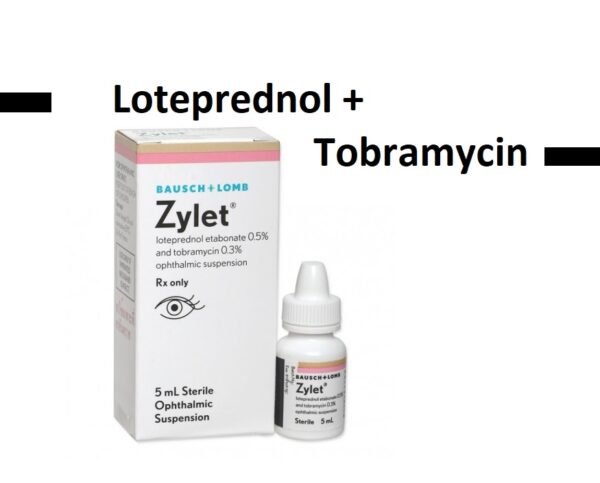
Zylet eye drops contain Loteprednol and tobramycin. It is a combination of a topical corticosteroid (loteprednol) and an aminoglycoside (tobramycin). It is used to treat ocular inflammatory conditions where the risk of bacterial infection exists.
Loteprednol and tobramycin (Zylet eye drops) Uses:
-
Ocular inflammatory conditions:
- It is indicated for the treatment of steroid-responsive inflammatory conditions of the eyes where a risk of a superficial bacterial infection exists.
- It may be used in patients with:
- inflammation of the palpebral and bulbar conjunctiva, cornea, and the anterior segment of the eyeglobe
- allergic conjunctivitis,
- acne rosacea,
- herpes zoster keratitis,
- iritis,
- superficial punctate keratitis,
- cyclitis,
- chronic anterior uveitis;
- corneal injury from chemical,
- radiation or thermal burns;
- penetration of foreign bodies.
- where the inherent risk of steroid use may result in a reduction in the edema and inflammation of the eye.
Loteprednol and tobramycin (Zylet eye drops) Dose in Adults:
Loteprednol and tobramycin (Zylet eye drops) Dose in the treatment of Ocular inflammatory conditions:
-
Ophthalmic:
- Instill 1 - 2 drops into the affected eye every 4 to 6 hourly;
- The dosing frequency may be increased during the first 24 to 48 hours to every 1 to 2 hours.
- The dosing frequency should be reduced if the clinical signs and symptoms improve.
- Patients should be evaluated if greater than 20 ml of the drug has been used.
Use in Children:
Refer to adults dosing.
Pregnancy Risk Category: C
- Talk to individual agents.
- The drug has not yet been tested in pregnancy studies with humans or animals.
Breastfeeding: Loteprednol or tobramycin
- The systemic absorption of topical applications is very minimal.
- It is unknown whether breastmilk contains sufficient drug to detect its presence.
- However, the manufacturer recommends that breastfeeding mothers use the drug with caution.
- Talk to individual agents.
Dose in Kidney Disease:
- Dosage adjustments have not been provided in the manufacturer's labeling.
- However, since the drug has minimal systemic absorption, dosage adjustment is unlikely in patients with kidney disease.
Dose in Liver Disease:
- Dosage adjustments have not been provided in the manufacturer's labeling.
- However, since the drug has minimal systemic absorption, dosage adjustment is unlikely in patients with liver disease.
Common Side Effects of Loteprednol and tobramycin (Zylet eye drops):
-
Central nervous system:
- Headache
-
Ophthalmic:
- Eye redness
- Superficial punctate keratitis
Less Common Side Effects of Loteprednol and tobramycin (Zylet eye drops):
-
Ophthalmic:
- Intraocular pressure increased
- Eye discomfort
- Stinging of eyes
- Corneal deposits
- Disease of the lacrimal apparatus
- Eye discharge
- Eye disease
- Eyelid disease
- Eye pruritus
Contraindications to Loteprednol and tobramycin (Zylet eye drops):
- Allergy reactions to loteprednol, tobramycin, and other corticosteroids or any component of this formulation
- Viral infections of the cornea, conjunctiva and eye including epithelial and conjunctival herpes simplex, vaccinia and varicella
- Mycobacterial infections in the eye
- Fungal infections in the eye and surrounding structures.
Warnings and precautions
-
Immunosuppression:
- Long-term use of corticosteroids, including topical ocular corticosteroids, may cause immunosuppression.
- This can lead to secondary ocular infections and fungal infections.
- It can also mask symptoms of acute ocular infection and may worsen the infective process.
- Patients with persistent corneal ulceration and who are taking topical ocular steroids should be examined for fungal infections.
-
Ocular effects
- Long-term use of the drug can lead to ocular hypertension and glaucoma.
- Ocular steroids should be used with caution in patients with glaucoma as they can cause an increase in intraocular pressure.
- Steroids can cause corneal or scleral tears if used in conditions that thin the cornea and sclera.
- Steroids can also slow down wound healing and increase the likelihood of bleb formation.
- Patients who have been taking the drug for longer than ten days must have intraocular pressure measured.
-
Sensitivity reactions
- Tobramycin may cause sensitivity in some patients. If sensitivity reactions develop, treatment may be stopped.
- Cross-sensitivity reactions may occur to other aminoglycoside antimicrobials.
-
Ocular herpes simplex
- Patients with ocular herpes complex infection should avoid it.
- Patients who have had a history of ocular hispes simplex infections should be warned.
Loteprednol and tobramycin: Drug Interaction
|
Ritodrine |
Corticosteroids may enhance the adverse/toxic effect of Ritodrine. |
Monitoring parameters:
- Patients who have persistent signs and symptoms after 48 hours of initiating treatment may need re-evaluation.
- If the treatment is prolonged beyond 10 days, the intraocular pressure should be assessed.
- Patients on long term treatment may need evaluation for fungal infections if they have persistent eye swelling and discharge.
- After the cumulative dose exceeds 20 ml, the patient should be re-examined. Eye examination must include magnification and fluoroscein staining.
How to administer Loteprednol and tobramycin (Zylet eye drops)?
- During treatment, remove contact lenses.
- Shake the eye solution before instilling it.
- Tilt the head back and instill the suspension in the conjunctival sac and close the eyes.
- Avoid touching the tip of the dropper to eyes or other surfaces.
- Following instillation, apply a light pressure on the lacrimal sac for one minute.
Mechanism of action of Loteprednol and tobramycin (Zylet eye drops):
- Zylet eye drops are made with loteprednol, tobramycin and a combination of both.
- Loteprednol acts as an anti-inflammatory drug and a corticosteroid.
- It decreases ocular swelling, edema and capillary dilation.
- Loteprdenol, which is very fat-soluble, penetrates cells easily to induce the production of lipocortins.
- Lipocortins, proteins that regulate the activity of prostaglandins and leukotrienes, are also known as lipocortins.
- Tobramycin, an aminoglycoside antibiotic, interferes with bacterial protein production by inducing the 30-S subunit of the ribosomal ribosomal ribosomal.
- This causes a deficient bacterial cell membrane, and the death of the bacteria.
- Refer to individual agents (Loteprednol, Tobramycin).
International Brand Names of Loteprednol and tobramycin:
- Zylet
- Lotemycin
- Lotrel T
- Olopred Plus
- Tobrabiotic Soft
Loteprednol and tobramycin Brand Names in Pakistan:
Loteprednol Eye Drops 0.5 %w/v in Pakistan |
|
| Lotepred-T | Elko Organization (Pvt) Ltd. |
.png)


