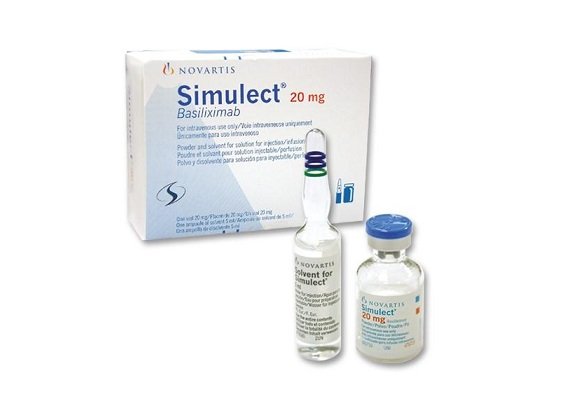
Basiliximab (Simulect) is a chimeric monoclonal antibody that inhibits the binding of IL-2 to its receptors. It is primarily used as an immunosuppressant in patients with organ transplantation. It is used in the following conditions:
-
For the prophylactic treatment of acute Renal transplant rejection in combination with cyclosporin and corticosteroids.
- KDIGO guidelines recommend the use of interleukin 2 receptor antagonist (basiliximab/ simulect) as the first-line induction agent for the prophylactic treatment of acute renal transplant rejection except in patients at high immunologic risk.
-
It is also used as an Off Label medicine in the following conditions:
-
For the treatment of refractory acute graft-versus-host disease
-
For the prophylactic treatment of acute rejection of Heart transplant
-
For the prophylactic treatment of acute rejection of a liver transplant
-
For the prophylactic treatment of acute rejection of lung transplant
-
Basiliximab Dose in Adults
Note: Re-exposure is associated with severe anaphylactic reactions and should be used with extreme caution.
Dose in the prophylactic treatment of acute Renal transplant rejection:
- 20 mg intravenous within two hours before the transplant surgery, followed by a second 20 mg dose after four days of transplantation.
- Patients who develop severe allergic reactions to the first dose should not be given the second dose.
Dose in the treatment of refractory acute graft-versus-host disease (aGVHD) as off-label use:
- 20 mg intravenous on days 1 and 4.
- The dose may be repeated.
Off label use in the prophylactic treatment of acute Heart transplant rejection:
- 20 mg intravenous on the day of the transplant, immediately and preferably within one hour after the transplant.
- The second 20 mg dose is administered on the fourth day after transplantation in combination with other immunosuppressants.
Off label use in the prophylactic treatment of acute rejection of Liver transplant:
- 20 mg intravenous on the day of the transplant, administered during the procedure after securing hemostasis, or immediately after the transplant, or within 6 hours of organ perfusion.
- The second dose is given as 20 mg intravenous on the fourth day after transplantation in combination with other immunosuppressants.
Off label use in the prophylactic treatment of acute rejection of lung transplant:
- 20 mg intravenous before the transplant.
- A second dose of 20 mg should be administered 4 days after the transplant in combination with other immunosuppressants.
Basiliximab Dose in Childrens
Note: Re-exposure is associated with severe anaphylactic reactions and should be used with extreme caution.
Dose in the treatment of Heart transplantation:
- Patient weighing less than 35 kgs:
- The first dose:
- 10 mg administered immediately before the surgery or within 6 hours of organ perfusion
- Second dose:
- 10 mg administered intravenously after four days of transplantation
- The first dose:
- Patient weighing more than 35 kgs:
- The first dose:
- 20 mg administered intravenously immediately before the surgery or within 6 hours of perfusion.
- Second dose:
- 20 mg administered intravenously after four days of transplantation
- The first dose:
Dose in the treatment of Liver transplantation:
- Patient weighing less than 35 kgs:
- The first dose:
- 10 mg administered intravenously within six hours of organ perfusion
- Second dose:
- 10 mg administered after four days of transplantation
- Third dose:
- Patients with ascites of more than 5 liters or loss of ascitic fluid volume of greater than 70 ml/kg may be administered a third dose of 10 mg intravenously 8 - 10 days after the transplantation.
- The first dose:
- Patient weighing more than 35 kgs:
- The first dose:
- 20 mg administered intravenously within six hours of organ perfusion
- Second dose:
- 20 mg administered after four days of transplantation
- Third dose:
- Patients with ascites of more than 5 liters or loss of ascitic fluid volume of greater than 70 ml/kg may be administered a third dose of 20 mg intravenously 8 - 10 days after the transplantation.
- The first dose:
Dose in the treatment of Renal transplantation:
- Children and Adolescents:
- Patient weighing less than 35 kgs:
- The first dose:
- 10 mg administered intravenously within two hours before the renal transplant surgery
- Second dose:
- 10 mg administered after four days of transplantation.
- The first dose:
- Patient weighing more than 35 kgs:
- The first dose:
- 20 mg administered intravenously within two hours before the renal transplant surgery
- Second dose:
- 20 mg administered after four days of transplantation.
- The first dose:
- Patient weighing less than 35 kgs:
Pregnancy Risk Factor: B
- It is a monoclonal chimeric IgG antibody which targets IL-2 receptors.
- IgG antibodies cross over the placental boundary, but adverse fetal events were not observed in animal studies.
- The manufacturer suggests that effective contraception be used before and for at least 4 months following the last dose.
Use Basiliximab while breastfeeding
- It is unknown if the drug can be absorbed into breastmilk.
- There is a risk of serious adverse events due to the fact that immunoglobulins can be found in breastmilk.
- During the treatment, it is important to stop breastfeeding.
Basiliximab Dose in Renal Disease:
Adjustment is the dose has not been recommended by the manufacturer in patients with renal disease.
Basiliximab Dose in Liver Disease:
Adjustment is the dose has not been recommended by the manufacturer in patients with liver disease.
Common Side Effects of Basiliximab Include:
- Cardiovascular:
- Hypertension
- Peripheral Edema
- Central Nervous System:
- Headache
- Insomnia
- Pain
- Dermatologic:
- Acne Vulgaris
- Endocrine & Metabolic:
- Hypercholesterolemia
- Hyperglycemia
- Hyperkalemia
- Hyperuricemia,
- Hypokalemia
- Hypophosphatemia
- Gastrointestinal:
- Abdominal Pain
- Constipation
- Diarrhea
- Dyspepsia
- Nausea
- Vomiting
- Genitourinary:
- Urinary Tract Infection
- Hematologic & Oncologic:
- Anemia
- Infection:
- Viral Infection
- Neuromuscular & Skeletal:
- Tremor
- Respiratory:
- Dyspnea
- Upper Respiratory Infection
- Miscellaneous:
- Fever
- Postoperative Wound Complication
Less Common Side Effects Of Basiliximab include:
- Cardiovascular:
- Abnormal Heart Sounds
- Angina Pectoris
- Atrial Fibrillation
- Cardiac
- Arrhythmia
- Cardiac Failure
- Chest Pain
- Hypotension
- Tachycardia
- Thrombosis
- Central Nervous System:
- Agitation
- Anxiety
- Depression
- Dizziness
- Fatigue
- Hypoesthesia
- Malaise
- Rigors
- Dermatologic:
- Dermal Ulcer
- Dermatological Disease
- Hypertrichosis
- Pruritus
- Skin Rash
- Endocrine & Metabolic:
- Acidosis
- Albuminuria
- Anasarca
- Dehydration
- Diabetes Mellitus
- Hypercalcemia
- Hyperlipidemia
- Hypertriglyceridemia
- Hypervolemia
- Hypocalcemia
- Hypoglycemia
- Hypomagnesemia
- Hyponatremia
- Increased Nonprotein Nitrogen
- Increased
- Serum Glucocorticoids
- Weight Gain
- Gastrointestinal:
- Enlargement Of Abdomen
- Esophagitis
- Flatulence
- Gastroenteritis
- Gastrointestinal Hemorrhage
- Gi Moniliasis
- Gingival Hyperplasia
- Hernia
- Melena
- Stomatitis
- Genitourinary:
- Bladder Dysfunction
- Dysuria
- Genital Edema (Male)
- Hematuria
- Impotence
- Oliguria
- Ureteral Disease
- Urinary Frequency
- Urinary Retention
- Hematologic & Oncologic:
- Hematoma
- Hemorrhage
- Hypoproteinemia
- Leukopenia
- Polycythemia
- Purpura
- Thrombocytopenia
- Infection:
- Cytomegalovirus Disease
- Herpes simplex and herpes Zoster Virus Infection
- Infection
- Sepsis
- Neuromuscular & Skeletal:
- Arthralgia
- Arthropathy
- Back Pain
- Bone Fracture
- Leg Pain
- Muscle
- Cramps
- Myalgia
- Neuropathy
- Paresthesia
- Weakness
- Ophthalmic:
- Cataract
- Conjunctivitis
- Visual Disturbance
- Renal:
- Renal Insufficiency
- Renal Tubular Necrosis
- Respiratory:
- Bronchitis
- Bronchospasm
- Cough
- Pharyngitis
- Pneumonia
- Pulmonary Edema
- Rhinitis
- Sinusitis
- Miscellaneous:
- Accidental Injury
- Cyst
Contraindication to Basiliximab include:
- Allergies to basiliximab and any component of the formulation
Warnings and precautions
- Anaphylactoid reactions and hypersensitivity reactions
- Within 24 hours, severe allergic reactions can occur.
- After the first or re-exposure, allergic reactions can occur (even months later).
- Patients who have been previously exposed to basiliximab should be cautious when using it.
- If you notice serious adverse reactions, it should be stopped immediately.
- Anaphylactic reactions such as epinephrine, should be treated with medication.
- Diabetes:
- NODAT (New-onset Diabetes Mellitus after Transplant) and PTDM (Post-Transplant Diabetes Mellitus), are well-known entities.
- It could be due to the transplant or drugs such as basiliximab plus prednisone and cyclosporine.
- Anti-human antibodies against murine (HAMA)
- Although HAMA may be developed through its use, it is not yet known if HAMA has any clinical value.
- Lymphoproliferative diseases:
- An increase in lymphoproliferative disorders may be a result of immunosuppressive therapy.
- Opportunistic Infections
- Use of immunosuppressive therapy can lead to opportunistic infections that could be potentially life-threatening.
Monitoring Parameters:
- Monitor for allergic reactions during the infusion and clinical features of rejection.
How to administer Basiliximab?
- It should only be administered via the intravenous route.
- It may be infused over 20 - 30 minutes as a bolus through a peripheral or a central venous line.
- Bolus infusion may be associated with pain at the injection site, nausea, and vomiting.
Mechanism of action of Basiliximab:
- Basiliximab, a monoclonal immunosuppressant monoclonal anti-immune suppressant chimeric (combined human and murine antibody), is called.
- It blocks the alpha-chain in the interleukin-2 receptor complex (IL-2).
- On activated T lymphocytes, the Interleukin-2 receptor can be found.
- It is one of the key steps that results in cell-mediated rejection.
It has a medianDuration of the actionof 36 days +/- 14 days. The age of the patient will determine the duration of the drug's elimination. It has a half life of 5-13 days for children, and 4-10 days for adults. A significant amount of drug is lost in the liver of patients undergoing liver transplants. This increases the total body clearance and decreases the duration of CD 25 (IL-2R) receptor saturation. These cases may require that the dose be adjusted.
International Brands of Basiliximab:
- Simulect
Basiliximab Brands in Pakistan:
|
Basiliximab [Inj 20 mg/vial] |
|
| Simulect | Novartis Pharma (Pak) Ltd |
.png)


