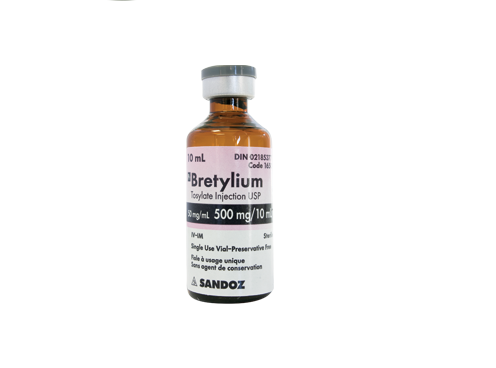
Bretylium is a class III anti-arrhythmic drug that prolongs the duration of action potential and the effective refractory period of ventricular tissues and Purkinje fibers. It is used in the treatment of life-threatening ventricular arrhythmias, primarily ventricular fibrillation and ventricular tachycardia, that is resistant to conventional anti-arrhythmic drugs. It has not been marketed since 2000 because of the lack of efficacy and unavailability of raw material. It is currently in the FDA list of discontinued drugs.
Bretylium Dose in Adults
Note: It should be used for a short-term (3 - 5 days). The onset of action may be delayed, it should, therefore, be used as a last resort and should not be used as a substitute for the rapidly acting anti-arrhythmic drugs.
-
Dose in the treatment of life-threatening Ventricular arrhythmia as in ventricular fibrillation:
- 5 mg/kg intravenous as a rapid injection
- If ventricular arrhythmias persist, the dose may be increased to 10 mg/kg and repeated at 15 to 30 minutes intervals up to a maximum dose of 30 mg/kg.
-
Other ventricular arrhythmias:
- 5 - 10 mg/kg intravenous over more than 8 minutes
- The dose may be repeated in 1 - 2 hours if arrhythmia persists, OR
- 5 - 10 mg/kg intramuscular.
- The dose may be repeated in 1 - 2 hours if arrhythmia persists
- The same dose may be maintained every 6 - 8 hours.
-
Maintenance dosing:
- Intermittent infusion:
- 5 to 10 mg/kg intravenous over more than 8 minutes every 6 hours
- Continuous infusion:
- 1 - 2 mg intravenous per minute
- If indicated, other antiarrhythmic agents should be given
- The dose may be reduced and discontinued in 3 - 5 days after initiation.
- Intermittent infusion:
Bretylium Dose in Childrens
Efficacy and safety not established.
Pregnancy Risk Factor: C
- It has not yet been used in human reproduction studies.
- Manufacturers advise that you weigh the risks and benefits for your child.
Use during breastfeeding:
- It has not yet been tested in lactating mothers.
Bretylium Dose in Renal Disease:
- Dose adjustment has not been recommended, however, dose should be reduced in patients with renal impairment.
Bretylium Dose in Liver Disease:
- Dose adjustment has not been recommended in patients with liver disease.
Side Effects of Bretylium
Nausea, vomiting, dizziness, light-headedness, and local reaction at the injection site.
Contraindication to Bretylium Include:
- Patients with a recent myocardial injury should not take it.
Warnings and Precautions
- Hypertension:
- It can cause hypertension transiently or increase the risk of arrhythmias and premature ventricular contractions, particularly when combined with inotropic drugs.
- Hypotension
- Even at lower doses, it can cause orthostatic hypotension.
- To develop tolerance, patients should be in a supine posture until they become comfortable.
- Vasopressors may be used if clinically indicated.
- Cardiovascular disease
- Due to the risk of severe hypotension, patients with severe aortic and severe pulmonary hypertension should not use it.
- Bradycardia patients should be advised to avoid it.
- Renal impairment
- Dose reduction may be necessary for patients with renal impairment. You should use it with caution.
Bretylium (United States: Not available): Drug Interaction
|
Alfuzosin |
May enhance the hypotensive effect of Blood Pressure Lowering Agents. |
|
Antipsychotic Agents (Second Generation [Atypical]) |
Blood Pressure Lowering Agents may enhance the hypotensive effect of Antipsychotic Agents (Second Generation [Atypical]). |
|
Barbiturates |
May enhance the hypotensive effect of Blood Pressure Lowering Agents. |
|
Benperidol |
May enhance the hypotensive effect of Blood Pressure Lowering Agents. |
|
Blood Pressure Lowering Agents |
May enhance the hypotensive effect of HypotensionAssociated Agents. |
|
Bradycardia-Causing Agents |
Bretylium may enhance the bradycardic effect of BradycardiaCausing Agents. Bretylium may also enhance atrioventricular (AV) blockade in patients receiving AV blocking agents. |
|
Brimonidine (Topical) |
May enhance the hypotensive effect of Blood Pressure Lowering Agents. |
|
Diazoxide |
May enhance the hypotensive effect of Blood Pressure Lowering Agents. |
|
DULoxetine |
Blood Pressure Lowering Agents may enhance the hypotensive effect of DULoxetine. |
|
Herbs (Hypotensive Properties) |
May enhance the hypotensive effect of Blood Pressure Lowering Agents. |
|
Hypotension-Associated Agents |
Blood Pressure Lowering Agents may enhance the hypotensive effect of Hypotension-Associated Agents. |
|
Levodopa-Containing Products |
Blood Pressure Lowering Agents may enhance the hypotensive effect of Levodopa-Containing Products. |
|
Lormetazepam |
May enhance the hypotensive effect of Blood Pressure Lowering Agents. |
|
Molsidomine |
May enhance the hypotensive effect of Blood Pressure Lowering Agents. |
|
Naftopidil |
May enhance the hypotensive effect of Blood Pressure Lowering Agents. |
|
Nicergoline |
May enhance the hypotensive effect of Blood Pressure Lowering Agents. |
|
Nicorandil |
May enhance the hypotensive effect of Blood Pressure Lowering Agents. |
|
Nitroprusside |
Blood Pressure Lowering Agents may enhance the hypotensive effect of Nitroprusside. |
|
Pentoxifylline |
May enhance the hypotensive effect of Blood Pressure Lowering Agents. |
|
Pholcodine |
Blood Pressure Lowering Agents may enhance the hypotensive effect of Pholcodine. |
|
Phosphodiesterase 5 Inhibitors |
May enhance the hypotensive effect of Blood Pressure Lowering Agents. |
|
Prostacyclin Analogues |
May enhance the hypotensive effect of Blood Pressure Lowering Agents. |
|
Quinagolide |
May enhance the hypotensive effect of Blood Pressure Lowering Agents. |
|
Risk Factor D (Consider therapy modification) |
|
|
Amifostine |
Blood Pressure Lowering Agents may enhance the hypotensive effect of Amifostine. Management: When amifostine is used at chemotherapy doses, blood pressure lowering medications should be withheld for 24 hours prior to amifostine administration. If blood pressure lowering therapy cannot be withheld, amifostine should not be administered. |
|
Obinutuzumab |
|
|
Risk Factor X (Avoid combination) |
|
|
Bromperidol |
Blood Pressure Lowering Agents may enhance the hypotensive effect of Bromperidol. Bromperidol may diminish the hypotensive effect of Blood Pressure Lowering Agents. |
Monitor:
- Electrocardiogram
- Blood pressure
- Renal function
Ho to administer Bretylium?
- Intramuscular administration:
- It should be injected as an intramuscular injection undiluted. The injection sites should be rotated. Administration of more than 5 ml or injection close to a nerve should be avoided.
- Intravenous injection:
- For immediate life-threatening ventricular arrhythmia like ventricular fibrillation, an intravenous undiluted injection should be administered.
- It may also be given as an intravenous infusion or as an intermittent bolus infusion diluted and injected over more than 8 minutes.
- Rapid administration of the drug may result in severe nausea & vomiting and should be avoided unless necessary as in ventricular fibrillation.
Mechanism of action of Bretylium:
- It is a antiarrhythmic drug of class III. It prolongs the duration of the action potential and the effective refractory time in the ventricular tissue.
- It can also accumulate in the postganglionic-adrenergic neurones and the sympathetic ganglia. B
- retylium reduces norepinephrine release by decreasing adrenergic terminal excitability following the initial sympathomimetic effects of norepinephrine.
It has beenThe beginning of actionbetween 20 minutes and 6 hours, with less than 5% of drug.protein-bound. It has been ahalf-life eliminationBetween 5-10 hours, and more than 80% of drug isexcretedVia urine
International Brands of Bretylium:
- Bretylate
- Bretylol
Bretylium Brands in Pakistan:
No brands available in Pakistan
.png)


