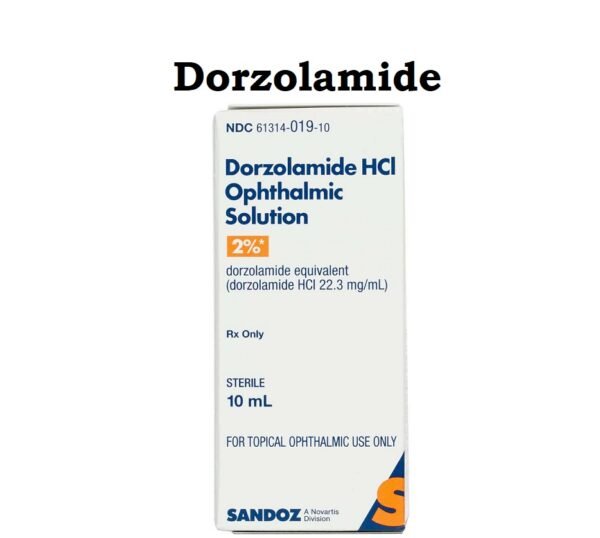
Dorzolamide (Trusopt) is a carbonic anhydrase inhibitor that is used to reduce intraocular pressure (in patients with ocular hypertension and open-angle glaucoma).
Dorzolamide Uses:
-
Elevated intraocular pressure:
- Treatment of elevated intraocular pressure (IOP) in patients with ocular hypertension or open-angle glaucoma
Adult dose:
Dorzolamide dose for elevated intraocular pressure:
- Ophthalmic: Instill 1 drop in the affected eye(s) 3 times a day
Dose in children:
Dorzolamide Dose for the reduction of intraocular pressure:
-
Infants, Children, and Adolescents:
- Ophthalmic: 1 drop to affected eye(s) 3 times/daily
Pregnancy Risk Factor C
- Systemic administration has been associated with adverse events in animal reproduction.
- During pregnancy, the IOP is often lower.
- Topical medication for glaucoma treatment during pregnancy should not be stopped because it is difficult to tolerate small increases in IOP.
- Punctual occlusion should be used to reduce exposure to the fetus.
Dorzolamide use during breastfeeding:
- It is unknown if dorzolamide can be found in breast milk.
- The drug manufacturer warns that serious adverse reactions could occur in nursing infants.
- They suggest that a decision is made about whether to stop nursing or discontinue using the drug.
Renal dose:
Dorzolamide Dose in Kidney disease:
-
CrCl ≥30 mL/minute:
- There are no dosage adjustments provided in the drug manufacturer’s labeling.
-
CrCl <30 mL/minute:
- Use is not recommended (has not been studied).
Dose in Liver disease:
There are no dosage adjustments provided in the drug manufacturer’s labeling (have not been studied); use with caution.
Side effects of Dorzolamide:
-
Dermatologic:
- Skin Rash
-
Gastrointestinal:
- Bitter Taste
- Fatigue
- Headache
- Nausea
-
Genitourinary:
- Urolithiasis
-
Hypersensitivity:
- Local Ocular Hypersensitivity Reaction
-
Neuromuscular & Skeletal:
- Weakness
-
Ocular:
- Burning Sensation Of Eyes
- Eye Discomfort
- Stinging Of Eyes
- Superficial Punctate Keratitis
- Blurred Vision
- Conjunctivitis
- Eyelid Irritation
- Eye Redness
- Lacrimation
- Photophobia
- Xerophthalmia
- Iridocyclitis
Contraindications to Dorzolamide:
- Hypersensitivity to dorzolamide and any component of the formulation
Warnings and precautions
-
Bacterial Keratitis
- Bacterial keratitis has been caused by accidental contamination of multiple-dose ophthalmic solution.
-
Ocular effects
- Chronic administration was associated with local ocular adverse reactions (primarily conjunctivitis or lid reactions). Many of these effects were resolved by discontinuation.
- After filtration, choroidal detachment was reported.
-
Allergy to sulfonamide ("sulfa")
- Dorzolamide, a sulfonamide, can be administered orally. However, systemic absorption could occur which could lead to hypersensitivity.
- If you experience signs of hypersensitivity, severe reactions, stop using the product.
-
Systemic effects
- Ophthalmic use may cause systemic absorption and other adverse effects similar to sulfonamides.
-
Corneal endothelium
- Patients with low endothelial cells counts should be cautious; they may be at greater risk for corneal edema.
-
Hepatic impairment
- Patients with hepatic impairment should be cautious (has not been tested).
-
Renal impairment
- Patients with severe renal impairment (CrCl 30mL/minute) are not advised to use (has not been tested).
Dorzolamide: Drug Interaction
Note: Drug Interaction Categories:
- Risk Factor C: Monitor When Using Combination
- Risk Factor D: Consider Treatment Modification
- Risk Factor X: Avoid Concomitant Use
Risk Factor C (Monitor therapy). |
|
| Indirect-Acting Alpha-/Beta Agonists | Carbonic Anhydrase inhibitors may increase the serum level of Alpha/Beta Agonists (Indirect Acting). |
| Amantadine | Carbonic Anhydrase Inhibitors could increase serum Amantadine concentrations. |
Risk Factor X (Avoid Combination) |
|
| Carbonic Anhydrase inhibitors | This may increase the toxic/adverse effects of other Carbonic Anhydrase Inhibitors. It has been reported that acid-base disorders can be caused by concurrent use of oral and ophthalmic carbonic anhydrase inhibiters. Management: If possible, avoid concurrent use of different carbonic acidase inhibitors. Patients should be closely monitored for kidney stones and metabolic acidosis. |
Monitoring parameters:
- Ophthalmic exams and IOP periodically
How to administer Dorzolamide?
Ophthalmic:
- If more than one topical ophthalmic drug is being used, administer the drugs at least 5 minutes apart.
- Remove contact lens prior to administration and wait 15 minutes before reinserting.
- Avoid allowing the tip of the dispensing container to contact the eye or surrounding structures.
Mechanism of action of Dorzolamide:
- Reversible inhibition by the enzyme carbonicanhydrase results in a reduction in hydrogen ion production at the renal tubule, increased renal excretion sodium, potassium and bicarbonate to decrease the production aqueous humor. Also inhibits carbonicanhydrase within the central nervous system to reduce abnormal and excessive discharges from the CNS neurons.
Duration of action:
- 8 to 12 hours
Absorption:
- Topical: Reaches systemic circulation where it accumulates in RBCs during chronic dosing as a result of binding to CA-II
Distribution:
- In RBCs during chronic administration
Protein binding:
- ~33%
Metabolism:
- To N-desethyl metabolite (less potent than parent drug)
Half-life elimination:
- Terminal RBC half-life: 147 days; washes out of RBCs nonlinearly, resulting in a rapid decline of drug concentration initially, followed by a slower elimination phase with a half-life of about 4 months
Excretion:
- Urine (as unchanged drug and metabolite, N-desethyl)
International Brands of Dorzolamide:
- Trusopt
- APO-Dorzolamide
- RIVA-Dorzolamide
- SANDOZ Dorzolamide
- Trusopt (Preservative Free)
- Apisopt
- Biodrop
- Bolano
- Ciplamide
- Citol Dorzo
- Dorsamed
- Dorsopt
- Dorzolam
- Dorzox
- Glaucotensil D
- Lamisopt
- Nodom
- Oftidor
- Sefson
- Strigdar
- Trusopt
- Xola
- Zolichek
Dorzolamide Brand Names in Pakistan:
Dorzolamide Injection 20 mg/ml |
|
| Dasura | Mediate Pharmaceuticals (Pvt) Ltd |
Dorzolamide Eye Drops 20 mg |
|
| Isdorz | Isis Pharmaceutical |
Dorzolamide Eye Drops 2 %w/v |
|
| Timozol | Valor Pharmaceuticals |
| Trusopt | Obs |
.png)


