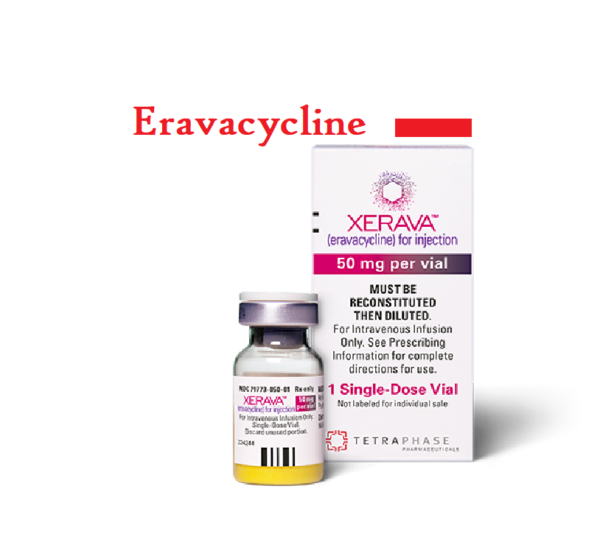
Eravacycline (Xerava) is an injectable antibiotic of the tetracycline class that acts by inhibiting bacterial protein synthesis. It is used in the treatment of complicated intraabdominal infections.
Eravacycline (Xerava) Uses:
-
Complicated intra-abdominal infections:
- It is indicated for the treatment of complicated intra-abdominal infections in adults caused by susceptible microorganisms:
- Escherichia coli,
- Klebsiella pneumoniae,
- Citrobacter freundii,
- Enterobacter cloacae,
- Klebsiella oxytoca,
- Enterococcus faecalis,
- Enterococcus faecium,
- Staphylococcus aureus,
- Streptococcus anginosus group,
- Clostridium perfringens,
- Bacteroides species, and
- Parabacteroides distasonis
- It is indicated for the treatment of complicated intra-abdominal infections in adults caused by susceptible microorganisms:
- Limitations of use:
- It should not be used in patients younger than 18 years of age and for the treatment of complicated urinary tract infections.
Eravacycline (Xerava) Dose in Adults
Eravacycline (Xerava) Dose in the treatment of complicated Intra-abdominal infections:
- 1 mg/kg administered intravenously twice a day for 4 to 14 days.
-
Dosage adjustment with concomitant strong CYP3A inducers (eg, rifampin):
- Increase the dose to 1.5 mg/kg IV twice daily.
Use in Children:
Not indicated.
Pregnancy Category: N (Not assigned)
- Tetracyclines may cross the placental boundary.
- Tetracyclines can also accumulate in the developing teeth or long bones, especially if administered during the third trimester.
- It can cause irreversible inhibition of bone development.
- Exposure to it in utero for long periods or repeatedly can cause permanent discoloration of teeth (yellow or gray).
Use during breastfeeding:
- It is unknown whether the drug can be excreted into breastmilk. Breastmilk may also contain other tetracyclines.
- Due to the possibility of serious and permanent adverse drug reactions in infants, the manufacturer suggests that you avoid the drug during breastfeeding and for at least four days following the last dose.
- These adverse drug reactions can include the inability to grow bone and discoloration of teeth.
Dose in Kidney disease:
No dosage adjustment is necessary.
Dose in Liver disease:
-
Mild to moderate impairment (Child-Pugh class A or B):
- No dosage adjustment is necessary
-
Severe impairment (Child-Pugh class C):
- 1 mg/kg twice daily on day 1, then 1 mg/kg once daily.
Side Effects of Eravacycline (Xerava):
-
Cardiovascular:
- Hypotension
-
Gastrointestinal:
- Nausea
- Vomiting
- Diarrhea
-
Local:
- Infusion site reaction
-
Miscellaneous:
- Wound dehiscence
Contraindications to Eravacycline (Xerava):
Hypersensitivity to eravacycline or tetracycline antibacterial drugs class, or any component.
Warnings and precautions
-
Anaphylactic and hypersensitivity reactions:
- It is possible for anaphylactic reactions to occur, which could be life-threatening.
- It is important to stop using the drug immediately. Patients who have had anaphylactic reactions in the past should not be given tetracyclines or structurally similar drugs.
-
Antianabolic effects
- Tetracyclines have shown antianabolic effects, manifesting in raised BUN, azotemia and hyperphosphatemia.
-
Hepatotoxicity:
- Hepatotoxicity can manifest as anorexia, jaundice and abdominal pain. If hepatotoxicity is detected, treatment must be stopped immediately.
-
Pancreatitis
- Pancreatitis may be caused by structurally similar drugs and tetracyclines.
- Patients should be closely monitored for symptoms such as nausea, vomiting, or new-onset abdominal pain.
-
Photosensitivity
- Photosensitivity can be caused by photosensitivity-causing antibiotics such as tetracyclines or structurally similar ones.
-
Pseudotumor cerebri:
- Patients should be closely monitored for signs and symptoms of benign intracranial Hypertension due to the association of tetracyclines with the development of the disease.
-
Superinfection
- Superinfection can occur from prolonged antibiotic use. Superinfections can be fungal or bacterial, including colitis and Clostridium difficile (formerly Clostridium) infection (CDI).
- CDI can occur up to 2 months after the last anti-biotic dose.
-
Hepatic impairment
- Patients with severe liver impairment should be cautious when taking the drug. Dosage adjustment is recommended for severe hepatic impairment.
Eravacycline: Drug Interaction
Note: Drug Interaction Categories:
- Risk Factor C: Monitor When Using Combination
- Risk Factor D: Consider Treatment Modification
- Risk Factor X: Avoid Concomitant Use
Risk Factor C (Monitor therapy) |
|
| Aminolevulinic Acid (Topical) | Photosensitizing Agents may enhance the photosensitizing effect of Aminolevulinic Acid (Topical). |
| BCG Vaccine (Immunization) | Antibiotics may diminish the therapeutic effect of BCG Vaccine (Immunization). |
| Lactobacillus and Estriol | Antibiotics may diminish the therapeutic effect of Lactobacillus and Estriol. |
| Mipomersen | Tetracyclines may enhance the hepatotoxic effect of Mipomersen. |
| Neuromuscular-Blocking Agents | Tetracyclines may enhance the neuromuscular-blocking effect of Neuromuscular-Blocking Agents. |
| Porfimer | Photosensitizing Agents may enhance the photosensitizing effect of Porfimer. |
| Verteporfin | Photosensitizing Agents may enhance the photosensitizing effect of Verteporfin. |
| Vitamin K Antagonists (eg, warfarin) | Tetracyclines may enhance the anticoagulant effect of Vitamin K Antagonists. |
Risk Factor D (Consider therapy modification) |
|
| CYP3A4 Inducers (Strong) | May decrease the serum concentration of Eravacycline. Management: Increase the eravacycline dose to 1.5 mg/kg every 12 hours when combined with strong CYP3A4 inducers. |
| Penicillins | Tetracyclines may diminish the therapeutic effect of Penicillins. |
| Sodium Picosulfate | Antibiotics may diminish the therapeutic effect of Sodium Picosulfate. Management: Consider using an alternative product for bowel cleansing prior to a colonoscopy in patients who have recently used or are concurrently using an antibiotic. |
| Typhoid Vaccine | Antibiotics may diminish the therapeutic effect of Typhoid Vaccine. Only the live attenuated Ty21a strain is affected. Management: Vaccination with live attenuated typhoid vaccine (Ty21a) should be avoided in patients being treated with systemic antibacterial agents. Use of this vaccine should be postponed until at least 3 days after cessation of antibacterial agents. |
Risk Factor X (Avoid combination) |
|
| Aminolevulinic Acid (Systemic) | Photosensitizing Agents may enhance the photosensitizing effect of Aminolevulinic Acid (Systemic). |
| BCG (Intravesical) | Antibiotics may diminish the therapeutic effect of BCG (Intravesical). |
| Cholera Vaccine | Antibiotics may diminish the therapeutic effect of Cholera Vaccine. Management: Avoid cholera vaccine in patients receiving systemic antibiotics, and within 14 days following the use of oral or parenteral antibiotics. |
| Mecamylamine | Tetracyclines may enhance the neuromuscular-blocking effect of Mecamylamine. |
| Methoxyflurane | Tetracyclines may enhance the nephrotoxic effect of Methoxyflurane. |
| Retinoic Acid Derivatives | Tetracyclines may enhance the adverse/toxic effect of Retinoic Acid Derivatives. The development of pseudotumor cerebri is of particular concern. Exceptions: Adapalene; Bexarotene (Topical); Tretinoin (Topical). |
Monitoring parameters:
- Liver function tests should be monitored at periodic intervals.
- Patients should be monitored for features of hepatic dysfunction and signs of anaphylactic reactions (when the drug is administered).
How to administer Eravacycline (Xerava)?
- It is administered as an intravenous infusion over an hour or more via a Y-site or a dedicated IV line.
- If concomitant medications are to be infused via the same line, the IV line should be flushed before and after the infusion with an NS. The drug should not be mixed with other medications
Mechanism of action of Eravacycline (Xerava):
- Fluorocycline antibiotic of the tetracycline family.
- It prevents amino acids from being incorporated into long peptide chains through binding to the 30S subunit of the ribosomal ribosomal.
- It inhibits bacterial protein synthesis.
Protein binding:
- 79% to 90% (increases with increasing plasma concentrations)
Metabolism:
- Primarily by CYP3A4- and FMO-mediated oxidation
Half-life elimination:
- 20 hours
Excretion:
- Urine: ~34% (20% as unchanged drug);
- Feces: 47% (17% as unchanged drug)
International Brand Names of Eravacycline:
- Xerava
Eravacycline Brand Names in Pakistan:
No Brands Available in Pakistan.
.png)


