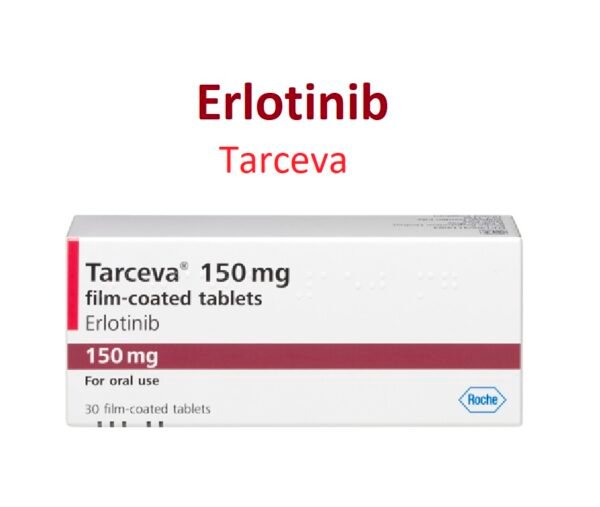
Erlotinib (Tarceva) is a Tyrosine kinase inhibitor that targets EGFR (epidermal growth factor receptors) mutated cancer cells.
Erlotinib (Tarceva) Uses:
-
Metastatic Non-small cell lung cancer:
- Used in the treatment of metastatic non-small cell lung cancer (NSCLC) in tumors with epidermal growth factor receptor (EGFR) exon 19 deletions or exon 21 (L858R) substitution mutations as detected by an approved test either as first-line, maintenance, or as second or greater line treatment after progression following at least 1 prior chemotherapy regimen.
- Limitations of use:
- Use in combination with platinum-depended chemotherapy is not recommended.
- Safety and efficacy of treatment for metastatic NSCLC with EGFR mutations other than exon 19 deletion or exon 21 (L858R) substitution have not been established.
-
Pancreatic cancer:
- First-line treatment of locally advanced, unresectable, or metastatic pancreatic cancer (in combination with gemcitabine)
Erlotinib (Tarceva) Dose in Adults
Erlotinib (Tarceva) Dose in the treatment of metastatic Non-small cell lung cancer (NSCLC), in patients with EGFR exon 19 deletions or exon 21 (L858R) substitution mutations:
- Oral: 150 mg once in a day until disease progression or unacceptable toxicity.
Erlotinib (Tarceva) Dose in the treatment of Pancreatic cancer:
- Oral: 100 mg once in a day (in combination with gemcitabine);
- continue until disease progression or unacceptable toxicity (Moore 2007).
Erlotinib (Tarceva) Dosage adjustment for concomitant CYP inhibitors/inducers:
-
- CYP3A4 inhibitors (strong):
- Restrict concurrent use if possible;
- reduce erlotinib dose for severe adverse reactions if erlotinib is administered concomitantly with strong CYP3A4 inhibitors.
- Dose reduction should be done in decrements of 50 mg (after toxicity has resolved to baseline or ≤ grade 1).
- Concomitant CYP3A4 and CYP1A2 inhibitor (eg, ciprofloxacin):
- Restrict concurrent use if possible;
- if concomitant use cannot be avoided, reduce dose in decrements of 50 mg if severe adverse reactions occur (after toxicity has resolved to baseline or ≤ grade 1).
- CYP3A4 inducers:
- Restrict concurrent use if possible;
- if concomitant administration with CYP3A4 inducers cannot be Restricted, increase erlotinib dose in 50 mg increments at 2-week intervals to a maximum of 450 mg;
- reduce erlotinib dose to the recommended starting dose when the CYP3A4 inducer is discontinued.
- CYP1A2 inducers:
- Restrict concurrent moderate CYP1A2 inducers if possible.
- If unavoidable, increase dose at 2-week intervals in 50 mg increments to a maximum dose of 300 mg (with careful monitoring);
- Immediately reduce erlotinib dose to the recommended starting dose (based on indication) upon discontinuation of the moderate CYP1A2 inducer.
- CYP3A4 inhibitors (strong):
-
Erlotinib (Tarceva) Dosage adjustment for concomitant smoking:
- Restrict tobacco smoking if possible.
- If unavoidable, increase dose at 2-week intervals in 50 mg increments to a max dose of 300 mg (with careful monitoring);
- immediately reduce erlotinib dose to the recommended starting dose (based on indication) upon smoking cessation.
Use in Children:
Not indicated
Erlotinib (Tarceva) Pregnancy Risk Category: D
- In animal reproduction studies, adverse events were noted.
- Erlotinib crosses over the placenta.
- Limited information is available on the pregnancy use of erlotinib.
- Recommend to all females with reproductive potential to use effective contraception throughout treatment and for at most 30 days following the last dose of erlotinib.
- Because of its mechanism of action, erlotinib can cause harm to fetus if given during pregnancy.
Use of Erlotinib (Tarceva), while breastfeeding
- It is unknown if erlotinib can be found in breast milk.
- Nursing infants may experience serious adverse reactions (such as bullous and exfoliative dermatology, interstitial lung disease and diarrhea, microangiopathic hemolytic and thrombocytopenia and ocular disorders), so it is important that breastfeeding mothers refrain from breastfeeding during treatment. This also applies to 14 days after the last erlotinib dosage.
Erlotinib (Tarceva) Dose in Kidney Disease:
-
Renal impairment at treatment initiation:
- Manufacturer’s labeling doesn't provide any dosage adjustments (has not been studied), although less than 9 percent of a single dose is excreted in the urine.
-
Renal toxicity during treatment:
- Grades 3/4 renal toxicity:
- Withhold treatment and consider discontinuing. If treatment is resumed, reinitiate with a 50 mg dose reduction after toxicity has resolved to baseline or ≤ grade 1.
- Renal failure associated with a hepatorenal syndrome or due to dehydration:
- Withhold treatment until renal toxicity is resolved. If treatment is resumed, reinitiate with a 50 mg dose reduction after toxicity has resolved.
- Grades 3/4 renal toxicity:
Erlotinib (Tarceva) Dose in Liver disease:
-
Hepatic impairment at treatment initiation:
- Total bilirubin > ULN or Child-Pugh classes A, B, and C:
- Manufacturer’s labeling doesn't provide any dosage adjustments; use with caution and monitor closely during the treatment.
- Total bilirubin >3 times ULN:
- Use extreme caution.
- Total bilirubin > ULN or Child-Pugh classes A, B, and C:
-
The following adjustments have also been studied:
- A reduced starting dose (75 mg once in a day) has been recommended in patients with hepatic dysfunction (AST ≥3 times ULN or direct bilirubin 1 to 7 mg/dL), with individualized dosage escalation if tolerated;
- another study determined that pharmacokinetic and safety profiles were similar between patients with normal hepatic function and moderate hepatic impairment.
-
Hepatotoxicity during treatment:
- Patients with normal hepatic function at baseline:
- If total bilirubin longer than 3 times ULN and/or transaminases longer than 5 times ULN:
- Interrupt therapy and consider discontinuing. If treatment is resumed, reinitiate with a 50 mg dose reduction after bilirubin and transaminases return to baseline.
- If total bilirubin longer than 3 times ULN and/or transaminases longer than 5 times ULN:
- Patients with baseline hepatic impairment or biliary obstruction:
- If bilirubin doubles or transaminases triple over baseline:
- Interrupt therapy and consider discontinuing.
- If treatment is resumed, reinitiate with a 50 mg dose reduction after bilirubin and transaminases return to baseline.
- If bilirubin doubles or transaminases triple over baseline:
- Patients with normal hepatic function at baseline:
-
Severe hepatotoxicity that does not significantly improve or resolve within 3 weeks:
- Stop the treatment.
Common Side Effects of Erlotinib (Tarceva):
-
Cardiovascular:
- Chest Pain
-
Central Nervous System:
- Fatigue
-
Dermatologic:
- Skin Rash
- Xeroderma
- Acne Vulgaris
- Pruritus
- Paronychia
- Alopeciaa
-
Gastrointestinal:
- Diarrhea
- Anorexia
- Abdominal Pain
- Constipation
- Nausea
- Decreased Appetite
- Vomiting
- Mucositis
- Stomatitis
-
Genitourinary:
- Urinary Tract Infection
-
Hematologic & Oncologic:
- Anemia
-
Infection:
- Increased Susceptibility To Infection
-
Neuromuscular & Skeletal:
- Back Pain
- Arthralgia
- Musculoskeletal Pain
- Weakness
-
Ophthalmic:
- Conjunctivitis
- Keratoconjunctivitis Sicca
-
Respiratory:
- Cough
- Dyspnea
-
Miscellaneous:
- Fever
Less Common Side Effects Of Erlotinib (Tarceva):
-
Cardiovascular:
- Peripheral Edema
-
Central Nervous System:
- Pain
- Headache
- Anxiety
- Voice Disorder
- Dizziness
- Insomnia
- Neurotoxicity
- Paresthesiaz
-
Dermatologic:
- Folliculitis
- Nail Disease
- Exfoliative Dermatitis
- Palmar-Plantar Erythrodysesthesia
- Bullous Dermatitis
- Hypertrichosis
- Skin Fissure
- Acneiform Eruption
- Erythema
- Dermatitis
- Erythematous Rash
-
Endocrine & Metabolic:
- Weight Loss
-
Gastrointestinal:
- Dyspepsia
- Taste Disorder
- Xerostomia
-
Hematologic & Oncologic:
- Leukopenia
- Thrombocytopenia
- Lymphocytopenia
-
Hepatic:
- Increased Serum ALT
- Increased Gamma-Glutamyl Transferase
- Hepatic Failure
- Hyperbilirubinemia
-
Neuromuscular & Skeletal:
- Muscle Spasm
- Musculoskeletal Chest Pain
- Ostealgia
-
Otic:
- Tinnitus
-
Renal:
- Increased Serum Creatinine
- Renal Failure,
-
Respiratory:
- Nasopharyngitis
- Epistaxis
- Pulmonary Fibrosis
- Pulmonary Embolism
- Respiratory Tract Infection
- Pneumonitis
Adverse Reactions Reported With Combination Therapy:
Common Side Effects Of Erlotinib (Tarceva):
-
Cardiovascular:
- Edema
- Thrombosis
-
Central Nervous System:
- Fatigue
- Anxiety
- Depression
- Dizziness
- Headachez
-
Dermatologic:
- Skin Rash
- Alopecia
-
Gastrointestinal:
- Nausea
- Anorexia
- Flatulence
- Diarrhea
- Abdominal Pain
- Vomiting
- Weight Loss
- Stomatitis
- Dyspepsia
-
Hepatic:
- Increased Serum ALT
- Increased Serum AST
- Hyperbilirubinemia
-
Infection:
- Increased Susceptibility To Infection
-
Neuromuscular & Skeletal:
- Ostealgia
- Rigors
- Myalgia
- Neuropathy
-
Respiratory:
- Dyspnea
- Cough
-
Miscellaneous:
- Fever
Less Common Side Effects Of Erlotinib (Tarceva):
-
Cardiovascular:
- Cardiac Arrhythmia
- Syncope
- Deep Vein Thrombosis
- Cerebrovascular Accident
- Myocardial Infarction
-
Gastrointestinal:
- Intestinal Obstruction
- Pancreatitis
-
Hematologic & Oncologic:
- Hemolytic Anemia
- Microangiopathic Hemolytic Anemia With Thrombocytopenia
-
Renal:
- Renal Insufficiency
- Renal Failure
-
Respiratory:
- Interstitial Pulmonary Disease
Contraindications to Erlotinib (Tarceva):
US labeling does not list any contraindications.
Canadian labeling
- Hypersensitivity to erlotinib and any component of the formulation
Warnings and precautions
-
Cardiovascular events
- There have been reports of myocardial ischemia, MI, and cerebrovascular accidents (some fatal).
-
Dermatologic toxicities:
- The severity of skin rashes may be related to treatment response and long survival. If you have skin rashes, use alcohol-free lotions. Or, if needed, topical corticosteroids and oral antibiotics.
- Avoid direct sunlight. Some cases of bullous, blistering, or exfoliating skin conditions have been reported, some even fatal.
- A common sign of acne is a rash that appears on the upper chest, back, and face.
- It is possible to get a severe, erythematous or maculopapular rash.
- For severe skin reactions, reduce or discontinue treatment temporarily. Stop treatment for bullous, blistering or exfoliative skin toxicities.
-
Perforation of the gastrointestinal (GI),
- Reports of GI perforation (including fatalities), have been made
- Concurrent anti-angiogenic drugs, corticosteroids and NSAIDs increase the risk of perforation. Patients with peptic ulcers history or diverticular disease are at increased risk.
- Perforated patients should be permanently discontinued
-
Hematologic effects
- Rarely, microangiopathic hemolyticanemia (MAHA), with thrombocytopenia, has been reported with erlotinib and gemcitabine.
-
Hemorrhage
- When erlotinib was given concomitantly to warfarin, elevated INRs and bleeding events (including fatal hemorhage) were reported.
- Keep an eye on INR and prothrombin times.
-
Hepatotoxicity
- Patients with baseline hepatic impairment have had hepatic failure and hepatorenal symptoms reported, some of which have been fatal. However, they have also been seen in patients with normal hepatic function.
- You should monitor liver function (bilirubin and transaminases) and patients with any hepatic impairments (total bilirubin greater than ULN; Child Pugh class A, C, or C) should also be closely monitored. This includes those suffering from hepatic disease caused by tumor burden.
- For changes in liver function, it may be necessary to reduce, interrupt, or discontinue dosage.
- Patients with biliary obstruction or preexisting liver disease need to be monitored more closely.
- Patients with total bilirubin greater than 3 times the ULN should be cautious.
- If total bilirubin exceeds 3x ULN, or transaminases exceed 5x ULN in patients with no preexisting hepatic impairment, interrupt therapy.
- Patients with baseline hepatic dysfunction and biliary obstruction should stop therapy if their bilirubin or transaminases double or triple from baseline.
-
Ocular toxicities:
- Patients who present with eye pain, or any other acute or worsening symptoms of the eye should be stopped or interrupted.
- Reports of corneal perforation or ulceration have been made. Keratitis, decreased tear production, abnormal eyelash growth, keratoconjunctivitis sicca and keratitis are all known risk factors for corneal injury/perforation.
- Take a baseline exam of your eyes and assess for ocular toxicities 4-8 weeks after treatment begins.
-
Toxicity in the lungs:
- Rare and sometimes fatal interstitial lung disease (ILD), has been reported.
- Interstitial pneumonia, obliterative Bronchitis, acute respiratory distress Syndrome, pneumonitis (including radio and hypersensitivity), pulmonary Fibrosis and pulmonary Infiltrates are some of the symptoms.
- The onset symptoms can occur within five days to nine months of treatment initiation (median: 39 Days).
- For ILD, discontinue treatment if you have unexplained pulmonary symptoms that are new or worsening (cough, dyspnea and fever).
-
Renal impairment
- Patients with renal impairment or at high risk of developing it should be cautious.
- Stop treatment if severe renal impairment occurs.
- Watch out for signs of dehydration and monitor electrolytes and renal function in those at high risk.
-
NSCLC
- Patients who have never smoked and those with EGFR mutation are some of the factors that correlate positively to a response to EGFR tyrosine kinase inhibitor therapy (TKI) in NSCLC.
- K-ras mutations are associated with a worse outcome when EGFR-TKI therapy is administered to patients with NSCLC.
- Patients with NSCLC who have EGFR mutations (exon 19 deletions or exon 21 mutation (L858R) are more likely to respond to erlotinib.
- Patients with NSCLC and K-ras mutations should not be treated with erlotinib. They are unlikely to receive any benefit from the treatment.
- To detect EGFR mutations for NSCLC treatment, the Cobas EGFR test has been approved.
Erlotinib: Drug Interaction
Note: Drug Interaction Categories:
- Risk Factor C: Monitor When Using Combination
- Risk Factor D: Consider Treatment Modification
- Risk Factor X: Avoid Concomitant Use
Risk Factor C (Monitor therapy) |
|
| Aprepitant | May increase the serum concentration of CYP3A4 Substrates (High risk with Inhibitors). |
| Bosentan | May decrease the serum concentration of CYP3A4 Substrates (High risk with Inducers). |
| Clofazimine | May increase the serum concentration of CYP3A4 Substrates (High risk with Inhibitors). |
| CYP3A4 Inducers (Moderate) | May decrease the serum concentration of CYP3A4 Substrates (High risk with Inducers). |
| CYP3A4 Inhibitors (Moderate) | May decrease the metabolism of CYP3A4 Substrates (High risk with Inhibitors). |
| Deferasirox | May decrease the serum concentration of CYP3A4 Substrates (High risk with Inducers). |
| Duvelisib | May increase the serum concentration of CYP3A4 Substrates (High risk with Inhibitors). |
| Erdafitinib | May decrease the serum concentration of CYP3A4 Substrates (High risk with Inducers). |
| Erdafitinib | May increase the serum concentration of CYP3A4 Substrates (High risk with Inhibitors). |
| Fosaprepitant | May increase the serum concentration of CYP3A4 Substrates (High risk with Inhibitors). |
| Fosnetupitant | May increase the serum concentration of CYP3A4 Substrates (High risk with Inhibitors). |
| Ivosidenib | May decrease the serum concentration of CYP3A4 Substrates (High risk with Inducers). |
| Larotrectinib | May increase the serum concentration of CYP3A4 Substrates (High risk with Inhibitors). |
| Netupitant | May increase the serum concentration of CYP3A4 Substrates (High risk with Inhibitors). |
| Palbociclib | May increase the serum concentration of CYP3A4 Substrates (High risk with Inhibitors). |
| Sarilumab | May decrease the serum concentration of CYP3A4 Substrates (High risk with Inducers). |
| Siltuximab | May decrease the serum concentration of CYP3A4 Substrates (High risk with Inducers). |
| Simeprevir | May increase the serum concentration of CYP3A4 Substrates (High risk with Inhibitors). |
| Tocilizumab | May decrease the serum concentration of CYP3A4 Substrates (High risk with Inducers). |
| Warfarin | Erlotinib may increase the serum concentration of Warfarin. |
Risk Factor D (Consider therapy modification) |
|
| Antacids | May decrease the serum concentration of Erlotinib. Management: Separate the administration of erlotinib and any antacid by several hours in order to minimize the risk of a significant interaction. |
| Ciprofloxacin (Systemic) | May increase the serum concentration of Erlotinib. Management: Avoid use of this combination when possible. When the combination must be used, monitor the patient closely for the development of severe adverse reactions, and if such severe reactions occur, reduce the erlotinib dose (in 50 mg decrements). |
| CYP3A4 Inducers (Strong) | May decrease the serum concentration of Erlotinib. Management: Avoid combination if possible. If combination must be used, increase erlotinib dose by 50 mg increments every 2 weeks as tolerated, to a maximum of 450 mg/day. |
| CYP3A4 Inhibitors (Strong) | May increase the serum concentration of Erlotinib. Management: Avoid use of this combination when possible. When the combination must be used, monitor the patient closely for the development of severe adverse reactions, and if such severe reactions occur, reduce the erlotinib dose (in 50 mg decrements). |
| Dabrafenib | May decrease the serum concentration of CYP3A4 Substrates (High risk with Inducers). Management: Seek alternatives to the CYP3A4 substrate when possible. If concomitant therapy cannot be avoided, monitor clinical effects of the substrate closely (particularly therapeutic effects). |
| Enzalutamide | May decrease the serum concentration of CYP3A4 Substrates (High risk with Inducers). Management: Concurrent use of enzalutamide with CYP3A4 substrates that have a narrow therapeutic index should be avoided. Use of enzalutamide and any other CYP3A4 substrate should be performed with caution and close monitoring. |
| FluvoxaMINE | May increase the serum concentration of Erlotinib. Management: Avoid use of this combination when possible. When the combination must be used, monitor the patient closely for the development of severe adverse reactions, and if such severe reactions occur, reduce the erlotinib dose (in 50 mg decrements). |
| Grapefruit Juice | May increase the serum concentration of Erlotinib. Management: Avoid use of this combination when possible. When the combination must be used, monitor the patient closely for the development of severe adverse reactions, and if such severe reactions occur, reduce the erlotinib dose (in 50 mg decrements). |
| Histamine H2 Receptor Antagonists | May decrease the serum concentration of Erlotinib. Management: Avoid H2-antagonists in patients receiving erlotinib when possible. If concomitant treatment cannot be avoided, erlotinib should be dosed once daily, 10 hours after and at least 2 hours before H2-antagonist dosing. |
| Leflunomide | May decrease the serum concentration of Erlotinib. Management: Avoid the concomitant use of erlotinib and leflunomide if possible. If concomitant use is unavoidable, increase the erlotinib dose by 50 mg increments at 2-week intervals to a maximum of 300 mg. |
| Lorlatinib | May decrease the serum concentration of CYP3A4 Substrates (High risk with Inducers). Management: Avoid concurrent use of lorlatinib with any CYP3A4 substrates for which a minimal decrease in serum concentrations of the CYP3A4 substrate could lead to therapeutic failure and serious clinical consequences. |
| MiFEPRIStone | May increase the serum concentration of CYP3A4 Substrates (High risk with Inhibitors). Management: Minimize doses of CYP3A4 substrates, and monitor for increased concentrations/toxicity, during and 2 weeks following treatment with mifepristone. Avoid cyclosporine, dihydroergotamine, ergotamine, fentanyl, pimozide, quinidine, sirolimus, and tacrolimus. |
| Mitotane | May decrease the serum concentration of CYP3A4 Substrates (High risk with Inducers). Management: Doses of CYP3A4 substrates may need to be adjusted substantially when used in patients being treated with mitotane. |
| Pitolisant | May decrease the serum concentration of CYP3A4 Substrates (High risk with Inducers). Management: Combined use of pitolisant with a CYP3A4 substrate that has a narrow therapeutic index should be avoided. Other CYP3A4 substrates should be monitored more closely when used with pitolisant. |
| Rifabutin | May decrease the serum concentration of Erlotinib. Management: Avoid combination if possible. If combination must be used, increase erlotinib dose by 50 mg increments every 2 weeks as tolerated, to a maximum of 450 mg/day. |
| Rifapentine | May decrease the serum concentration of Erlotinib. Management: Avoid combination if possible. If combination must be used, increase erlotinib dose by 50 mg increments every 2 weeks as tolerated, to a maximum of 450 mg/day. |
| St John's Wort | May decrease the serum concentration of Erlotinib. Management: Avoid combination if possible. If combination must be used, increase erlotinib dose by 50 mg increments every 2 weeks as tolerated, to a maximum of 450 mg/day. |
| Stiripentol | May increase the serum concentration of CYP3A4 Substrates (High risk with Inhibitors). Management: Use of stiripentol with CYP3A4 substrates that are considered to have a narrow therapeutic index should be avoided due to the increased risk for adverse effects and toxicity. Any CYP3A4 substrate used with stiripentol requires closer monitoring. |
| Teriflunomide | May decrease the serum concentration of Erlotinib. Management: Avoid the concomitant use of erlotinib and teriflunomide if possible. If concomitant use is unavoidable, increase the erlotinib dose by 50 mg increments at 2-week intervals to a maximum of 300 mg. |
| Tobacco (Smoked) | May decrease the serum concentration of Erlotinib. Management: Avoid cigarette smoking during treatment with erlotinib whenever possible. If combined, increase erlotinib dose by 50 mg increments at 2-week intervals to a maximum of 300 mg daily. |
Risk Factor X (Avoid combination) |
|
| Conivaptan | May increase the serum concentration of CYP3A4 Substrates (High risk with Inhibitors). |
| Fosphenytoin-Phenytoin | Erlotinib may increase the serum concentration of FosphenytoinPhenytoin. Fosphenytoin-Phenytoin may decrease the serum concentration of Erlotinib. Management: Avoid use of erlotinib with phenytoin when possible. If required, increase erlotinib dose by 50 mg increments at 2 week intervals, as tolerated, to a max of 450 mg/day. |
| Fusidic Acid (Systemic) | May increase the serum concentration of CYP3A4 Substrates (High risk with Inhibitors). |
| Idelalisib | May increase the serum concentration of CYP3A4 Substrates (High risk with Inhibitors). |
| Proton Pump Inhibitors | May decrease the serum concentration of Erlotinib. |
Monitoring parameters:
- Tests of liver function (bilirubin and transaminases as well as alkalinephosphatase [periodic], more frequent monitoring for worsening liver function).
- Periodic renal function tests and periodic serum electrolytes testing (in patients at high risk of dehydration; periodic);
- Prothrombin time (in patients receiving concomitant Warfarin therapy);
- EGFR mutation status in patients suffering from NSCLC adenocarcinoma. The cobas EGFR Mutation Test has been approved to determine EGFR mutation for the first-line treatment of NSCLC.
- Smoking status
- Take a baseline exam of your eyes and assess for ocular toxicities 4-8 weeks after treatment begins.
- Check your hydration status.
- Monitor for signs and symptoms of pulmonary toxicity, dermatologic toxic toxicity, or ocular toxicity.
How to administer Erlotinib (Tarceva)?
- Manufacturers recommend that you take your medication on an empty stomach at least one hour before or two hours after eating.
- If possible, avoid concomitant use of proton pump inhibitors. If you are taking erlotinib with an H-2 antagonist (eg ranitidine), do so at least 10 hours after your H-2 receptor antagonist dose.
- Separate dosing may be required if an antacid needs to be taken.
- Tablets can be disintegrated in 100mL of water to be administered orally or via a tube (silicone-based) to patients who are unable swallow whole.
- For maximum effectiveness, rinse the container with 40mL of water. After rinsing, apply any residue to the container and rinse again.
- After preparation, administer immediately. An oral suspension can be prepared if necessary.
Mechanism of action of Erlotinib (Tarceva):
- Reversibly inhibits overall epidermal Growth Factor receptor (HER1/EGFR). - Tyrosine kinase activation. Inhibiting intracellular phosphorylation results in cell death.
- Erlotinib exhibits a higher binding affinity to EGFR exon 19 deletions or exon 21 L858R mutants than the wild type receptor.
Absorption:
- Oral: ~60 percent on an empty stomach; food increases to ~100 percent.
Distribution:
- 232 L
Protein binding:
- 93 percent to albumin and alpha -acid glycoprotein
Metabolism:
- CYP1A1 (minor), CYP1A2 (minor),Hepatic, via CYP3A4 (major), and CYP1C (minor)
Bioavailability:
- ~100% when given with food; ~60% without food
Half-life elimination:
- 36.2 hours
Time to peak,
- plasma: 4 hours
Excretion:
- Primarily as metabolites:
- Feces (83 percent; 1 percent as unchanged drug);
- urine (8 percent; less than 1 percent as unchanged drug)
International Brand Names of Erlotinib:
- Tarceva
- Etopul
- Lungitinib
- Orlicert
- Tarcenib
- APO-Erlotinib
- PMS-Erlotinib
- TEVA-Erlotinib
- Birlotib
- Erlocip-E
- Erlonib
- Erlonix
- Erlotaz
Erlotinib Brand Names in Pakistan:
Erlotinib Tablets 25 mg in Pakistan |
|
| Tarceva | Roche Pakistan Ltd. |
Erlotinib Tablets 100 mg in Pakistan |
|
| Tarceva | Roche Pakistan Ltd. |
Erlotinib Tablets 150 mg in Pakistan |
|
| Tarceva | Roche Pakistan Ltd. |
.png)


