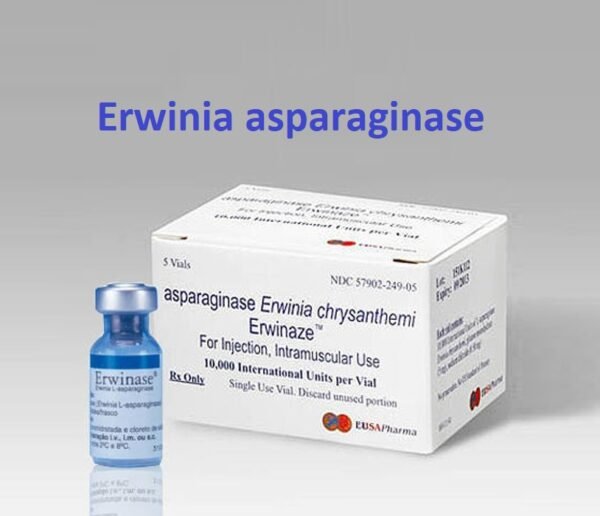
Erwinia asparaginase is an anticancer (chemotherapeutic) drug that is used to treat acute lymphoblastic leukemia in combination with other chemotherapeutic drugs.
Erwinia asparaginase Uses:
-
Acute lymphoblastic leukemia:
- Used in treatment (in combination with other chemotherapy) of acute lymphoblastic leukemia (ALL) in patients with hypersensitivity to E. coli-derived asparaginase.
Erwinia asparaginase Dose in adults
Note: If administering IV, consider monitoring nadir serum asparaginase activity (NSAA) levels; if desired levels are not achieved, change to IM administration.
Erwinia asparaginase Dose in the treatment of Acute lymphoblastic leukemia (ALL): IM, IV:
- As a substitute for pegaspargase:
- 25,000 units per m² thrice in a weak (Mon, Wed, Fri) for 6 doses for each planned pegaspargase dose
- As a substitute for asparaginase (E. coli):
- 25,000 units per m² for each scheduled asparaginase (E. coli) dose.
Erwinia asparaginase Dose in Childrens
Note: If administering IV, consider monitoring nadir serum asparaginase activity (NSAA) levels; if desired levels are not achieved, change to IM administration.
Erwinia asparaginase Dose in the treatment of Acute lymphoblastic leukemia (ALL):
-
Children and Adolescents:
- As a substitute for pegaspargase:
- IM, IV: 25,000 units per m² per dose thrice in a weak (Mon, Wed, Fri) for 6 doses for each planned pegaspargase dose
- As a substitute for asparaginase (E. coli):
- IM, IV: 25,000 units per m² per dose for each scheduled asparaginase (E. coli) dose
- As a substitute for pegaspargase:
Erwinia asparaginase Dose in the treatment of Acute lymphoblastic leukemia (ALL) induction:
-
Canadian labeling:
-
Infants, Children, and Adolescents <14 years:
- IM: 6,000 units per m² 3 thrice in a weak for 9 doses beginning day 4 of week 1 (in combination with allopurinol, methotrexate, vincristine, prednisone, and daunorubicin)
-
Erwinia asparaginase Dosage adjustment for toxicity:
-
Manufacturer's labeling:
-
Children and Adolescents:
- Hemorrhagic or thrombotic event:
- Stops the treatment;
- may resume treatment upon symptom resolution.
-
Pancreatitis:
- Mild pancreatitis:
- Withhold treatment until signs and symptoms subside and amylase returns to normal;
- may resume after resolution.
- Severe or hemorrhagic pancreatitis (abdominal pain >72 hours and amylase ≥2 x ULN):
- Stops the treatment; further use is contraindicated.
- Serious hypersensitivity:
- Discontinue treatment.
- Mild pancreatitis:
- Hemorrhagic or thrombotic event:
-
The following adjustments have also been recommended for asparaginase products:
-
Older Adolescents:
- Hyperammonemia-related fatigue:
- Continue therapy for grade 2 toxicity.
- If grade 3 toxicity occurs, reduce dose by 25 percent;
- resume full dose when toxicity ≤ grade 2 (make up for missed doses).
- If grade 4 toxicity occurs, reduce dose by 50 percent;
- resume full dose when toxicity ≤ grade 2 (make up for missed doses).
- Hyperglycemia:
- Continue therapy for uncomplicated hyperglycemia.
- If hyperglycemia requires insulin therapy, hold asparaginase (and any concomitant corticosteroids) until blood glucose controlled; resume dosing at the prior dose level.
- For life-threatening hyperglycemia or toxicity requiring urgent intervention, hold asparaginase (and corticosteroids) until blood glucose is controlled with insulin; resume asparaginase and do not make up for missed doses.
- Hypersensitivity reactions:
- May continue dosing for urticaria without edema, bronchospasm, hypotension, or need for parenteral intervention.
- If wheezing or another symptomatic bronchospasm with or without angioedema, hypotension, urticaria, and/or life-threatening hypersensitivity reactions occur, discontinue asparaginase.
- Hypertriglyceridemia:
- If serum triglyceride level less than 1,000 mg/dL, continue asparaginase but monitor closely for pancreatitis.
- If triglyceride level longer than 1,000 mg per dL, hold asparaginase and monitor; resume therapy at prior dose level after triglyceride level returns to baseline.
- Pancreatitis:
- Asymptomatic amylase or lipase longer than thrice ULN (chemical pancreatitis) or radiologic abnormalities only:
- Continue asparaginase and monitor levels closely.
- Symptomatic amylase or lipase longer than thrice time ULN:
- Hold asparaginase until enzyme levels stabilize or are declining.
- Symptomatic pancreatitis or clinical pancreatitis (abdominal pain with amylase or lipase longer than thrice time ULN for more than 3 days and/or development of pancreatic pseudocyst):
- Permanently discontinue asparaginase.
- Asymptomatic amylase or lipase longer than thrice ULN (chemical pancreatitis) or radiologic abnormalities only:
- Thrombosis and bleeding, CNS:
- Thrombosis:
- Continue therapy for abnormal laboratory findings without a clinical correlate.
- If grade 3 toxicity occurs, discontinue therapy; if CNS signs/symptoms are fully resolved and further asparaginase doses are required, may resume therapy at a lower dose and/or longer intervals between doses.
- Discontinue therapy for grade 4 toxicity.
- Hemorrhage:
- Discontinue therapy;
- do not withhold therapy for abnormal laboratory findings without a clinical correlate.
- If grade 3 toxicity occurs, discontinue therapy; if CNS signs or symptoms are fully resolved and further asparaginase doses are required, may resume therapy at a lower dose and/or longer intervals between doses.
- Discontinue therapy for grade 4 toxicity.
- Thrombosis:
- Thrombosis and bleeding, non-CNS:
- Thrombosis:
- Continue therapy for abnormal laboratory findings without a clinical correlate.
- If grade 3 or 4 toxicity occurs, withhold therapy until acute toxicity and clinical signs resolve and anticoagulant therapy is stable or completed.
- Do not withhold therapy for abnormal laboratory findings without clinical correlate.
- Hemorrhage:
- If grade 2 bleeding in conjunction with hypofibrinogenemia occurs, withhold therapy until bleeding grade 1 or less than grade 1.
- Do not withhold therapy for abnormal laboratory findings without clinical correlate.
- For grade 3 or 4 bleeding, withhold therapy until bleeding grade 1 or less than grade 1 and until acute toxicity and clinical signs, resolve and coagulant replacement therapy is stable or completed.
- Thrombosis:
- Hyperammonemia-related fatigue:
Pregnancy Risk Factor C
- In animal reproduction studies, adverse events were noted.
Use of Erwinia paraginase during breastfeeding
- The manufacturer suggests that the mother decide whether to stop breastfeeding or discontinue using the drug.
- This is in consideration of the risk of serious adverse reactions in breastfed babies.
- It is unknown if breast milk contains asparaginase Erwinia.
Erwinia asparaginase Dose in Kidney Disease:
The manufacturer's labeling doesn't provide any dosage adjustments.
Erwinia asparaginase Dose in Liver disease:
- Manufacturer's labeling doesn't provide any dosage adjustments; however, the following adjustments have been recommended for other asparaginase products for hepatotoxicity during treatment:
- ALT/AST >3 to 5 times ULN:
- Continue therapy
- ALT/AST >5 to 20 times ULN:
- Delay next dose until transaminases <3 times ULN
- ALT/AST >20 times ULN:
- Discontinue therapy if takes longer than 1 week for transaminases to return to <3 times ULN.
- Direct bilirubin <3 mg/dL:
- Continue therapy
- Direct bilirubin 3.1 to 5 mg/dL:
- Hold asparaginase and resume when direct bilirubin <2 mg/dL;
- consider switching to alternate asparaginase products.
- Direct bilirubin >5 mg/dL:
- Discontinue asparaginase; do not substitute other asparaginase products;
- Do not make up for missed doses.
- ALT/AST >3 to 5 times ULN:
Common Side Effects of Erwinia asparaginase:
-
Hypersensitivity:
- Hypersensitivity reaction includes
- Anaphylaxis
- Urticaria
- Hypersensitivity reaction includes
Less Common Side Effects of Erwinia asparaginase:
-
Cardiovascular:
- Thrombosis includes
- Pulmonary embolism and cerebrovascular accident
- Thrombosis includes
-
Endocrine & metabolic:
- Abnormal transaminase
- Decreased glucose tolerance
- Hyperglycemia
-
Gastrointestinal:
- Vomiting
- Pancreatitis
- Abdominal pain
- Diarrhea
- Nausea
- Mucositis
-
Local:
- Injection site reaction
-
Miscellaneous:
- Fever
Contraindications to Erwinia asparaginase:
- History of severe hypersensitivity reactions, including anaphylaxis of asparaginase or any component of its formulation
- Grave thrombosis
- A history of severe pancreatitis or hemorhagic events that were related to prior asparaginase therapy.
Canadian labeling: Additional contraindications not in the US labeling
- Women who may or are pregnant
Warnings and precautions
-
Glucose intolerance
- During treatment, monitor glucose levels (baseline, periodic)
- Clinical trials showed that 5 percent of patients had glucose intolerance. This could be irreversible.
- May need insulin administration.
-
Hypersensitivity reactions
- During treatment, hypersensitivity reactions must be treated immediately.
- In clinical trials, 5 percent of patients experienced severe hypersensitivity reactions (grades 3 and 4), which included anaphylaxis.
- If you have severe hypersensitivity reactions, discontinue use and seek appropriate treatment.
-
Pancreatitis
- Clinical trials have shown that 4 percent of patients with pancreatitis were diagnosed.
- Mild pancreatitis: Do not start treatment until symptoms subside. Amylase levels will return to normal. Treatment may be resumable after resolution.
- Assess immediately for symptoms that suggest pancreatitis.
- For severe or hemorhagic pancreatitis, characterized by abdominal pain lasting more than 72 hours and amylase >=2x ULN, discontinue use.
- If severe pancreatitis has been diagnosed, further use is not recommended.
-
Hemorrhage and thrombosis:
- Asparaginase formulations have been linked to serious thrombotic events such as sagittal sinus embolism and pulmonary embolism.
- If you have a thrombotic episode, discontinue treatment. You may resume treatment once the problem is resolved.
- For hemorhagic events, discontinue
- You may be able to resume treatment if you have resolved any hemorhagic or serious thrombosis.
- After intramuscular treatment for 2 weeks, there were decreases in fibrinogen and protein C activity as well as antithrombin III.
Erwinia asparaginase: Drug Interaction
Note: Drug Interaction Categories:
- Risk Factor C: Monitor When Using Combination
- Risk Factor D: Consider Treatment Modification
- Risk Factor X: Avoid Concomitant Use
Risk Factor C (Monitor therapy) |
|
| Dexamethasone (Systemic) | Asparaginase (Erwinia) may increase the serum concentration of Dexamethasone (Systemic). This is thought to be due to an asparaginase-related decrease in hepatic proteins responsible for dexamethasone metabolism. |
Monitoring parameters:
- CBC with differential,
- triglycerides,
- amylase and lipase,
- liver enzymes,
- blood glucose (baseline and periodically during treatment),
- coagulation parameters;
- for IV administration, consider monitoring nadir serum asparaginase activity (NSAA) levels.
- Monitor for symptoms of hypersensitivity, thrombosis, symptoms of pancreatitis, or hemorrhage.
How to administer Erwinia asparaginase?
Note:
- Vials from certain batches should only be administered intramuscularly or require the use of a 0.2-micron filter if administered intravenously.
IM:
- The volume of each single injection site should be limited to 2 mL;
- Use multiple injections for volumes of more than 2 mL.
IV:
- Infuse over 1 to 2 hours;
- Do not infuse other medications through the same IV line.
Mechanism of action of Erwinia asparaginase:
- Asparaginase is responsible for the reduction of asparagine levels by converting it to ammonia and aspartic acid.
- Leukemia cells lack the ability to synthesize asparagine and lack asparagine synthetase.
- Cytotoxicity is specific to leukemic cell lines because asparaginase decreases the exogenous source of asparagine for the leukemic.
Half-life elimination:
- IM: ~16 hours;
- IV: ~7.5 hours
International Brand Names of Erwinia asparaginase:
- WErwinase
- Erwinaze
Erwinia asparaginase Brand Names in Pakistan:
There is no brand available in Pakistan.
.png)


