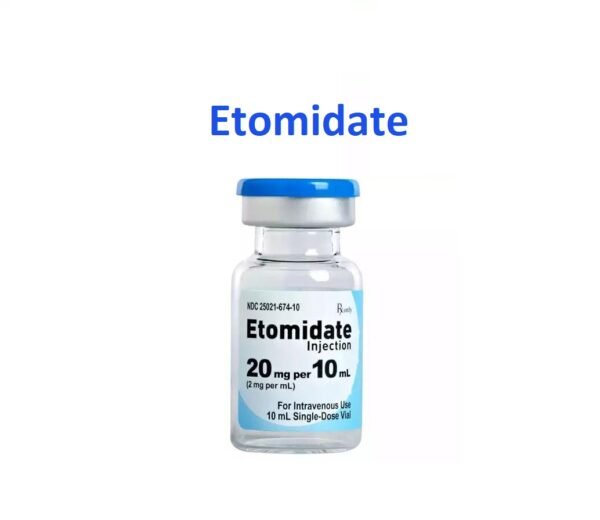
Etomidate is an ultrashort acting nonbarbiturate hypnotic drug that also blocks the adrenal enzyme, 11-Beta hydroxylase. It is used as an anesthetic for short procedures such as joint dislocation and endotracheal intubation.
Etomidate Uses:
-
General anesthesia:
- Induction of general anesthesia; as a supplement to sub potent anesthetic agents during maintenance of anesthesia for short operative procedures (eg, dilation and curettage, cervical conization).
-
Off Label Use of Etomidate in Adults:
- Procedural sedation
- Cushing syndrome
Etomidate Dose in Adults
Etomidate Dose in General anesthesia:
- IV: Initial: 0.3 mg/kg (range: 0.2 to 0.6 mg/kg) over 30 to 60 seconds for induction of anesthesia.
Etomidate Dose as Supplementation to sub potent anesthetic agents:
- IV: Administer smaller increments during short operative procedures to supplement sub potent anesthetic agents, such as nitrous oxide; individualize dosage (usually smaller than the original induction dose).
Etomidate Dose in the treatment of Cushing syndrome (off-label):
- IV: Initial: 0.04 to 0.05 mg/kg/hour (usually equates to ~2.5 to 3 mg per hour).
- Titrate to serum cortisol of 18 to 29 mcg/dL (500 to 800 nmol/L) in a physiologically stressed patient or 5.5 to 11 mcg/dL (150 to 300 nmol/L) in a non-physiologically stressed patient.
- For complete blockade, titrate the infusion rate to achieve a cortisol level of less than 5.5 mcg/dL (<150 nmol/L).
- Hydrocortisone IV is required if complete blockade desired rather than partial blockade (‘block and replace’).
Note:
- Studies have not reported sedation at these etomidate doses; however, patients should be managed in an intensive care unit with sedation scoring every 2 hours initially for the first 24 hours, then every 12 hours.
- Cortisol levels should be measured every 4 to 6 hours.
Etomidate Dose in the Procedural sedation (off-label):
- IV: Initial: 0.1 to 0.2 mg/kg, followed by 0.05 mg/kg every 3 to 5 minutes as needed.
Etomidate Dose in Childrens
Etomidate Dose in the Anesthesia for induction:
-
Infants: Very limited data available:
- IV: 0.2 to 0.3 mg/kg/dose as a single dose;
- dosing based on a prospective, observational trial and two pharmacokinetic studies.
-
Children less than 10 years:
- IV: 0.2 to 0.3 mg/kg/dose as a single dose.
-
Children of 10 years and more than 10 years and Adolescents:
- Usual dose: IV: 0.3 mg/kg/dose as a single dose;
- range: 0.2 to 0.6 mg/kg/dose
Etomidate Dose in the Procedural sedation:
-
Infants 6 months and more than 6 months, Children, and Adolescents:
- IV: Usual initial dose: 0.2 mg/kg/dose prior to procedure (reported range: 0.1 to 0.4 mg/kg/dose);
- repeat doses may be required depending on patient response and duration of the procedure;
- repeat doses vary in the literature and range from 0.1 to 0.2 mg/kg/dose;
- reported total dose ranged from 0.3 to 0.6 mg/kg/procedure;
- dosing based on several prospective and retrospective studies primarily in the ED setting; procedures included orthopedic reductions and sedation for CT scans.
- Note:
- Etomidate does not have analgesic properties;
- additional therapy (eg, fentanyl) may be required for painful procedures.
Etomidate Dose in the Rapid sequence intubation (RSI):
-
Infants, Children, and Adolescents:
- IV, Intraosseous: 0.2 to 0.4 mg/kg/dose as a single dose;
- maximum dose: 20 mg per dose.
- Note: Not recommended for patients in septic shock due to an association between transient adrenocortical suppression and increased mortality rate.
Etomidate Pregnancy Risk Category: C
- The placenta is crossed by Etomidate
- Human fetuses could be at their most vulnerable during the third-trimester.
- According to animal data, brain development may be affected by repeated or prolonged use general anesthetics and sedation drugs that block N-methyl D- aspartate receptors/or potentiate GABA activities.
- It is important to evaluate the risks and benefits of maternal treatment with etomidate in pregnancy, particularly for prolonged procedures that last more than three hours.
- It has been reported that etomidate can be used to induce anesthesia before cesarean delivery.
- Other agents might be used more often.
- Non-urgent surgery should not be performed during the second trimester.
- ACOG recommends pregnant women not to be denied medically-indicated surgery or procedures, regardless if they are in their third trimester.
- If it is elective, the procedure should be postponed until after delivery.
Use of etomidate during breastfeeding
- The breast milk contains etomidate.
- Etomidate was used as an induction agent for 40 women who had to have cesarean deliveries. It was found in the colostrum both 30 minutes after maternal injection and 2 hours later.
- After the maternal dose, etomidate was absent from breast milk four hours later.
- Although caution is recommended when giving etomidate as a medication to breastfeeding women, it is acceptable.
- The Academy of Breast Feeding Medicine suggests that elective surgery be delayed until the child is more mature and established in breastfeeding.
- If the child is fully-term and healthy, breastfeeding can be resumed. Milk may also be given once the mother is awake after a period of recovery.
- When possible, it is best to express milk before any surgery.
- Milk may be saved for later use by children at lower risk.
Dose in Kidney Disease:
In the manufacturer's labeling there are no dosage adjustments provided ; use it with caution, risk of toxicity is greater in patients with renal impairment.
Dose in Liver disease:
In the manufacturer's labeling, there are no dosage adjustments provided.
Common Side Effects of Etomidate:
-
Central nervous system:
- Myoclonus
-
Endocrine & metabolic:
- Adrenal suppression
-
Gastrointestinal:
- Nausea
- Vomiting (on emergence from anesthesia)
-
Local:
- Pain at injection site
-
Neuromuscular & skeletal:
- Musculoskeletal disease (transient skeletal movements)
-
Ophthalmic:
- Nystagmus
Less Common Side Effects of Etomidate:
-
Gastrointestinal:
- Hiccups
Contraindications to Etomidate:
- Hypersensitivity to etomidate and any component of the formulation
Warnings and precautions
-
Production of adrenal steroid:
- Patients may be less able to cope with stress if they are given etomidate in continuous infusions in the ICU.
- Manufacturers do not recommend continuous infusion.
- A single dose of induction of anesthesia has not been shown to cause any increase in mortality.
- Etomidate inhibits 11B-hydroxylase, which is an important enzyme in adrenal steroid production.
- One induction dose can block the normal stress-induced rise in adrenal cortisol for 6-8 hours or up to 24 hours for elderly and disabled patients.
-
Heart Failure:
- According to the American Heart Association's scientific statement, etomidate may be an agent that can exacerbate myocardial dysfunction.
-
Renal impairment
- Patients with impaired renal function are at greater risk of toxic effects.
- Take care and keep track of your renal function.
Etomidate: Drug Interaction
Note: Drug Interaction Categories:
- Risk Factor C: Monitor When Using Combination
- Risk Factor D: Consider Treatment Modification
- Risk Factor X: Avoid Concomitant Use
Risk Factor X (Avoid combination) |
|
| Benznidazole | May enhance the adverse/toxic effect of Products Containing Propylene Glycol. |
| MetroNIDAZOLE (Systemic) | May enhance the adverse/toxic effect of Products Containing Propylene Glycol. A disulfiram-like reaction may occur. |
Monitoring parameters:
- Cardiac monitoring;
- blood pressure;
- renal function (in renal impairment)
How to administer Etomidate?
IV:
- Administer IV push over 30 to 60 seconds.
- The solution is highly irritating; avoid administration into small vessels; In some cases, preadministration of lidocaine may be considered.
Mechanism of action of Etomidate:
The ultra-short acting nonbarbiturate general sedative (benzylimidazole), is used to induce anesthesia quickly with minimal cardiovascular side effects. It causes EEG burst suppression high in the High doses.
The onset of action:
- 30 to 60 seconds
Peak effect:
- 1 minute
Duration:
- Dose-dependent:
- 2 to 3 minutes (0.15 mg/kg dose);
- 3 to 5 minutes (0.3 mg/kg dose);
- rapid recovery is due to rapid redistribution.
Protein binding:
- 76%; decreased protein binding resulting in an increased percentage of “free” etomidate in patients with renal failure or hepatic cirrhosis
Metabolism:
- Hepatic and plasma esterases
Half-life elimination:
- Terminal: 2.6 to 3.5 hours
Time to peak,
- serum: 7 minutes
Excretion:
- Urine ~75% (80% as metabolite; 2% as unchanged drug)
International Brand Names of Etomidate:
- Etomidat-Lipuro
- Etomidato-Lipuro
- Hypnomidate
- Amidate
- Endata
- Etomid
Etomidate Brand Names in Pakistan:
Etomidate Injection 2 mg/ml |
|
| Etomidate Lipuro | Usmanco International |
.png)


