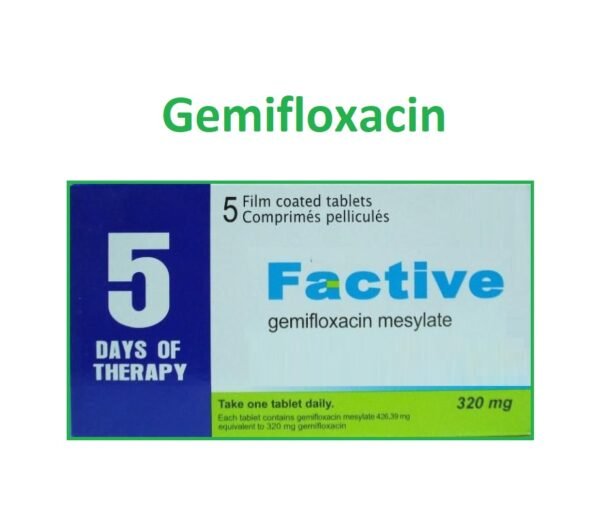
Gemifloxacin (Factive, Grat) is an orally available fourth-generation fluoroquinolone that has a broad-spectrum of activity against a variety of bacterial infections. It is used in the treatment of acute bronchitis, community-acquired pneumonia including multi-drug-resistant strains of streptococcus pneumonia, and gonococcal infections.
Gemifloxacin Uses:
It is indicated in the following conditions:
- Acute exacerbation of chronic bronchitis;
- Community-acquired pneumonia (CAP), including pneumonia caused by multidrug-resistant strains of S. pneumoniae (MDRSP).
- Limitations of use:
- Fluoroquinolones may cause serious and potentially irreversible serious side effects e.g. tendinitis and tendon rupture, peripheral neuropathy, and CNS effects).
- It should be given to patients who have no alternative treatment options for acute bacterial exacerbation of chronic bronchitis.
-
Use: Off-Label: Adult
- Gonococcal, uncomplicated urogenital infections (For patients who has cephalosporin allergy)
Gemifloxacin Dose in Adults
Note: Factive is no longer available in the United States.
Gemifloxacin Dose in adults for Susceptible infections:
- Oral: 320 mg once a day
Gemifloxacin Dose in the treatment of acute exacerbations of chronic bronchitis:
- Oral: 320 mg once a day for 5 days
Gemifloxacin Dose in the treatment of Gonococcal, uncomplicated urogenital infections:
(alternative therapy in patients with cephalosporin allergy, off-label):
- Oral: 320 mg as a single dose combined with oral azithromycin.
Gemifloxacin Dose in the treatment of community-acquired pneumonia (CAP):
- Oral: 320 mg once a day.
- Duration: Minimum of 5 days and duration depends on disease severity and response to therapy; discontinue once the patient is afebrile for ≥48 hours and clinically stable.
Use in Children:
Not indicated.
Gemifloxacin Pregnancy Category: N
- Studies on animal reproduction have shown adverse effects.
Gemifloxacin use during breastfeeding:
- It excretes from breast milk.
- Breast milk can cause non-dose-related changes in bowel flora. Be sure to monitor infants for any gastrointestinal disturbances
- Breastfeeding mothers should consider alternative antibiotics. However, it can be used in situations where other agents are not possible.
- Gemifloxacin should be used during breastfeeding based on the benefits for the mother as well as the risk to infants.
Gemifloxacin Dose in Kidney Disease:
Note: Renal function may be estimated using the Cockcroft-Gault formula for dosage adjustment purposes.
- CrCl >40 mL/minute:
- No dose adjustment required.
- CrCl ≤40 mL/minute:
- 160 mg once a day
- Hemodialysis:
- Dialyzable (20% - 30%): 160 mg once daily (Dose should be given after hemodialysis on dialysis days).
- CAPD:
- 160 mg once a day
Dose in Liver disease:
No dosage adjustment is necessary.
Side Effects of Gemifloxacin:
-
Central Nervous System:
- Headache
- Dizziness
-
Dermatologic:
- Skin Rash
-
Gastrointestinal:
- Diarrhea
- Nausea
- Abdominal Pain
- Vomiting
-
Hematologic:
- Increased Platelets
-
Hepatic:
- Increased Serum Alanine Aminotransferase
- Increased Serum Aspartate Aminotransferase
Less common side effects of Gemifloxacin:
-
Central Nervous System:
- Agitation
- Anxiety
- Confusion
- Delirium
- Depression
- Disorientation
- Disturbance In Attention
- Hallucination
- Memory Impairment
- Paranoia
- Pseudotumor Cerebri
- Restlessness
- Seizure
- Suicidal Ideation
- Suicidal Tendencies
- Toxic Psychosis
Contraindications to Gemifloxacin:
Hypersensitivity
Warnings and precautions
-
Modified cardiac conduction
- Fluoroquinolones are associated with a longer QT interval
- Patients who have a history or are at high risk of developing it should avoid it
- Extension of QT
- Torsades de pointes
- Hypokalemia and hypomagnesemia are two examples of uncorrected electrolyte problems.
- Cardiac disease (heart attack, myocardial injury, bradycardia, heart failure) or
- Concurrent administration of antipsychotics and tricyclic antidepressants, including Class Ia, Class III, erythromycin and cisapride.
-
Regulation of Glucose
- Fluoroquinolone may cause severe hyperglycemia or hypoglycemia, especially in patients who are on insulin or sulfonylureas.
- Monitoring for signs and symptoms of disordered sugar regulation
-
Hypersensitivity reactions
- There are many reactions that can occur, from the common allergic symptoms (itching and urticaria), to severe idiosyncratic reactions (Stevens Johnson, toxic epidermal necrlysis), to life-threatening anaphylaxis reactions
- In some cases, there might be organ involvement.
- Vessel: vasculitis
- Lungs: pneumonitis
- Renal: nephritis
- Necrosis or hepatic failure of the liver
- Hematologic: Cytopenias and anemia
- CVS: Hypotension, Shock, angioedema
- If you experience any symptoms or signs of an allergic reaction, stop using the drug immediately.
-
Phototoxicity:
- Fluoroquinolones can cause phototoxicity reactions ranging from moderate to severe. These reactions may manifest as sunburn symptoms.
- If you develop photosensitivity, discontinue using the product.
-
Warning: Serious adverse reactions
- Fluoroquinolone, including gatifloxacin, can cause serious adverse reactions that could be irreversible.
- In the following situations, it is important to immediately stop any therapy:
-
CNS effects
- Fluoroquinolones may cause seizures, lightheadedness, tremors, and increased intracranial pressure.
- Patients with CNS disorders or other risk factors for seizures should be treated cautiously.
- If you experience a reaction, stop immediately.
-
Peripheral neuropathy:
- Peripheral neuropathy can occur shortly after therapy is initiated. It is irreversible
- If you experience symptoms of sensorimotor or sensory neuropathy, stop using the drug immediately.
- Patients with a history of peripheral neuropathy should avoid it.
-
Psychiatric reactions
- Fluoroquinolones may cause toxic psychosis, hallucinations or paranoia.
- They can also cause agitation, restlessness, delirium and attention disturbances, agitation, restlessness, delirium or delirium, insomnia, anxiety memory impairment, confusion depression, suicidal thoughts, or actions.
-
Tendinitis/tendon rupture:
- Fluoroquinolones have been linked to tendinitis and tendon rupture at all ages.
- Patients over 60 years old and patients who have received solid organ transplants may be at greater risk. However, this has also been observed in patients with no risk factors.
- The Achilles tendon is the most commonly affected, and it may rupture. Other tendon may also be affected, either unilaterally or bilaterally.
- Tendon involvement can occur within hours or days of drug initiation and may continue for several months.
-
Superinfection
- The prolonged use of this medication can lead to fungal and bacterial superinfections, such as Clostridioides difficile -associated diarrhea (CDAD), pseudomembranous colitis.
-
Cardiovascular disease
- Avoid severe bradycardia and acute MI.
-
Myasthenia gravis: [US Boxed Warning]:
- Myasthenia Gravis can cause muscle weakness; it is best to avoid myasthenia gravis patients.
- There have been cases of severe exacerbations that progressed to ventilatory support and death.
-
Renal impairment
- If CrCl is less than 40 mL/minute dose adjustment required.
- Tendon rupture can be triggered by impaired renal function.
-
Rheumatoid arthritis:
- Patients with rheumatoid arthritis are advised to be cautious as there is a greater risk of tendon rupture.
Gemifloxacin: Drug Interaction
|
Risk Factor C (Monitor therapy) |
|
|
Aminolevulinic Acid (Topical) |
Photosensitizing Agents may enhance the photosensitizing effect of Aminolevulinic Acid (Topical). |
|
BCG Vaccine (Immunization) |
Antibiotics may diminish the therapeutic effect of BCG Vaccine (Immunization). |
|
Blood Glucose Lowering Agents |
Quinolones may enhance the hypoglycemic effect of Blood Glucose Lowering Agents. Quinolones may diminish the therapeutic effect of Blood Glucose Lowering Agents. Specifically, if an agent is being used to treat diabetes, loss of blood sugar control may occur with quinolone use. |
|
Corticosteroids (Systemic) |
May enhance the adverse/toxic effect of Quinolones. Specifically, the risk of tendonitis and tendon rupture may be increased. |
|
Haloperidol |
May enhance the QTc-prolonging effect of QT-prolonging Quinolone Antibiotics (Moderate Risk). Management: Monitor for QTc interval prolongation and ventricular arrhythmias when these agents are combined. Patients with additional risk factors for QTc prolongation may be at even higher risk. |
|
Heroin |
Quinolones may enhance the adverse/toxic effect of Heroin. |
|
Lactobacillus and Estriol |
Antibiotics may diminish the therapeutic effect of Lactobacillus and Estriol. |
|
Mycophenolate |
Quinolones may decrease the serum concentration of Mycophenolate. Specifically, quinolones may decrease concentrations of the active metabolite of mycophenolate. |
|
Nonsteroidal Anti-Inflammatory Agents |
May enhance the neuroexcitatory and/or seizurepotentiating effect of Quinolones. Nonsteroidal Anti-Inflammatory Agents may increase the serum concentration of Quinolones. |
|
Ondansetron |
May enhance the QTc-prolonging effect of QT-prolonging Quinolone Antibiotics (Moderate Risk). Management: Monitor for QTc interval prolongation and ventricular arrhythmias when these agents are combined. Patients with additional risk factors for QTc prolongation may be at even higher risk. |
|
Pentamidine (Systemic) |
May enhance the QTc-prolonging effect of QT-prolonging Quinolone Antibiotics (Moderate Risk). Management: Monitor for QTc interval prolongation and ventricular arrhythmias when these agents are combined. Patients with additional risk factors for QTc prolongation may be at even higher risk. |
|
Porfimer |
Photosensitizing Agents may enhance the photosensitizing effect of Porfimer. |
|
Probenecid |
May increase the serum concentration of Gemifloxacin. |
|
QT-prolonging Antidepressants (Moderate Risk) |
QT-prolonging Quinolone Antibiotics (Moderate Risk) may enhance the QTc-prolonging effect of QT-prolonging Antidepressants (Moderate Risk). Management: Monitor for QTc interval prolongation and ventricular arrhythmias when these agents are combined. Patients with additional risk factors for QTc prolongation may be at even higher risk. |
|
QT-prolonging Antipsychotics (Moderate Risk) |
QT-prolonging Quinolone Antibiotics (Moderate Risk) may enhance the QTc-prolonging effect of QT-prolonging Antipsychotics (Moderate Risk). Management: Monitor for QTc interval prolongation and ventricular arrhythmias when these agents are combined. Patients with additional risk factors for QTc prolongation may be at even higher risk. Exceptions: Pimozide. |
|
QT-prolonging Class IC Antiarrhythmics (Moderate Risk) |
QT-prolonging Quinolone Antibiotics (Moderate Risk) may enhance the QTc-prolonging effect of QT-prolonging Class IC Antiarrhythmics (Moderate Risk). Management: Monitor for QTc interval prolongation and ventricular arrhythmias when these agents are combined. Patients with additional risk factors for QTc prolongation may be at even higher risk. |
|
QT-prolonging Kinase Inhibitors (Moderate Risk) |
QT-prolonging Quinolone Antibiotics (Moderate Risk) may enhance the QTc-prolonging effect of QT-prolonging Kinase Inhibitors (Moderate Risk). Management: Monitor for QTc interval prolongation and ventricular arrhythmias when these agents are combined. Patients with additional risk factors for QTc prolongation may be at even higher risk. |
|
QT-prolonging Miscellaneous Agents (Moderate Risk) |
May enhance the QTc-prolonging effect of QT-prolonging Quinolone Antibiotics (Moderate Risk). Management: Monitor for QTc interval prolongation and ventricular arrhythmias when these agents are combined. Patients with additional risk factors for QTc prolongation may be at even higher risk. Exceptions: Domperidone. |
|
QT-prolonging Moderate CYP3A4 Inhibitors (Moderate Risk) |
QT-prolonging Quinolone Antibiotics (Moderate Risk) may enhance the QTc-prolonging effect of QT-prolonging Moderate CYP3A4 Inhibitors (Moderate Risk). Management: Monitor for QTc interval prolongation and ventricular arrhythmias when these agents are combined. Patients with additional risk factors for QTc prolongation may be at even higher risk. |
|
QT-prolonging Quinolone Antibiotics (Moderate Risk) |
May enhance the QTc-prolonging effect of other QT-prolonging Quinolone Antibiotics (Moderate Risk). Management: Monitor for QTc interval prolongation and ventricular arrhythmias when these agents are combined. Patients with additional risk factors for QTc prolongation may be at even higher risk. |
|
QT-prolonging Strong CYP3A4 Inhibitors |
(QT-prolonging Quinolone Antibiotics (Moderate Risk) may enhance the QTc-prolonging effect of QT-prolonging Strong CYP3A4 Inhibitors (Moderate Risk). Management: Monitor for QTc interval prolongation and ventricular arrhythmias when these agents are combined. Patients with additional risk factors for QTc prolongation may be at even higher risk. |
|
Moderate Risk) |
Quinolones may increase the serum concentration of Varenicline. Management: Monitor for increased varenicline adverse effects with concurrent use of levofloxacin or other quinolone antibiotics, particularly in patients with severe renal impairment. International product labeling recommendations vary. Consult appropriate labeling. |
|
Varenicline |
Photosensitizing Agents may enhance the photosensitizing effect of Verteporfin. |
|
Verteporfin |
Quinolones may enhance the anticoagulant effect of Vitamin K Antagonists. |
|
Risk Factor D (Consider therapy modification) |
|
|
Antacids |
May decrease the absorption of Quinolones. Of concern only with oral administration of quinolones. Management: Avoid concurrent administration of quinolones and antacids to minimize the impact of this interaction. Recommendations for optimal dose separation vary by specific quinolone. Exceptions: Sodium Bicarbonate. |
|
Calcium Salts |
May decrease the absorption of Quinolones. Of concern only with oral administration of both agents. Exceptions: Calcium Chloride. |
|
Delamanid |
May enhance the QTc-prolonging effect of QT-prolonging Quinolone Antibiotics (Moderate Risk). QT-prolonging Quinolone Antibiotics (Moderate Risk) may enhance the QTcprolonging effect of Delamanid. Management: Avoid concomitant use of delamanid and quinolone antibiotics if possible. If coadministration is considered to be unavoidable, frequent monitoring of electrocardiograms throughout the full delamanid treatment period should occur. |
|
Didanosine |
Quinolones may decrease the serum concentration of Didanosine. Didanosine may decrease the serum concentration of Quinolones. Management: Administer oral quinolones at least 2 hours before or 6 hours after didanosine. Monitor for decreased therapeutic effects of quinolones, particularly if doses cannot be separated as recommended. This does not apply to unbuffered enteric coated didanosine. |
|
Domperidone |
QT-prolonging Agents (Moderate Risk) may enhance the QTc-prolonging effect of Domperidone. Management: Consider alternatives to this drug combination. If combined, monitor for QTc interval prolongation and ventricular arrhythmias. Patients with additional risk factors for QTc prolongation may be at even higher risk. |
|
Iron Salts |
May decrease the serum concentration of Quinolones. Management: Give oral quinolones at least several hours before (4 h for moxi- and sparfloxacin, 2 h for others) or after (8 h for moxi-, 6 h for cipro/dela-, 4 h for lome-, 3 h for gemi-, and 2 h for levo-, nor-, oflox-, pefloxacin, or nalidixic acid) oral iron salts Exceptions: Ferric Carboxymaltose; Ferric Gluconate; Ferric Hydroxide Polymaltose Complex; Ferric Pyrophosphate Citrate; Ferumoxytol; Iron Dextran Complex; Iron Isomaltoside; Iron Sucrose. |
|
Magnesium Salts |
May decrease the serum concentration of Quinolones. Management: Administer oral quinolones several hours before (4 h for moxi/pe/spar-, 2 h for others) or after (8 h for moxi-, 6 h for cipro/dela-, 4 h for lome/pe-, 3 h for gemi-, and 2 h for levo-, nor-, or ofloxacin or nalidixic acid) oral magnesium salts. |
|
Methadone |
Gemifloxacin may enhance the QTc-prolonging effect of Methadone. Management: Consider alternatives to this drug combination. If combined, monitor for QTc interval prolongation and ventricular arrhythmias. Patients with additional risk factors for QTc prolongation may be at even higher risk |
|
Multivitamins/Minerals (with ADEK, Folate, Iron) |
May decrease the serum concentration of Quinolones. Specifically, polyvalent cations in multivitamin products may decrease the absorption of orally administered quinolone antibiotics. Management: Interactions can be minimized by administering the oral quinolone at least 2 hours before, or 6 hours after, the dose of a multivitamin that contains polyvalent cations (i.e., calcium, iron, magnesium, selenium, zinc). |
|
Multivitamins/Minerals (with AE, No Iron) |
May decrease the serum concentration of Quinolones. Specifically, minerals in the multivitamin/mineral product may impair absorption of quinolone antibiotics. Management: Interactions can be minimized by administering the oral quinolone at least 2 hours before, or 6 hours after, the dose of a multivitamin that contains polyvalent cations (i.e., calcium, iron, magnesium, selenium, zinc). |
|
QT-prolonging Kinase Inhibitors (Highest Risk) |
May enhance the QTc-prolonging effect of Gemifloxacin. Management: Consider alternatives to this drug combination. If combined, monitor for QTc interval prolongation and ventricular arrhythmias. Patients with additional risk factors for QTc prolongation may be at even higher risk. |
|
QT-prolonging Miscellaneous Agents (Highest Risk) |
Gemifloxacin may enhance the QTcprolonging effect of QT-prolonging Miscellaneous Agents (Highest Risk). Management: Consider alternatives to this drug combination. If combined, monitor for QTc interval prolongation and ventricular arrhythmias. Patients with additional risk factors for QTc prolongation may be at even higher risk. Exceptions: Delamanid. |
|
Quinapril |
May decrease the serum concentration of Quinolones. Management: Separate doses of quinapril and oral quinolones by at least 2 hours in order to reduce the risk of interaction. Monitor for reduced efficacy of the quinolone if these products are used concomitantly. |
|
Sevelamer |
May decrease the absorption of Quinolones. Management: Administer oral quinolones at least 2 hours before or 6 hours after sevelamer. |
|
Sodium Picosulfate |
Antibiotics may diminish the therapeutic effect of Sodium Picosulfate. Management: Consider using an alternative product for bowel cleansing prior to a colonoscopy in patients who have recently used or are concurrently using an antibiotic. |
|
Sucralfate |
May decrease the serum concentration of Quinolones. Management: Administer oral quinolones at least 2 hours before or 6 hours after the sucralfate dose. Greater separation of doses may further lessen the risk for a significant interaction. |
|
Typhoid Vaccine |
Antibiotics may diminish the therapeutic effect of Typhoid Vaccine. Only the live attenuated Ty21a strain is affected. Management: Vaccination with live attenuated typhoid vaccine (Ty21a) should be avoided in patients being treated with systemic antibacterial agents. Use of this vaccine should be postponed until at least 3 days after cessation of antibacterial agents. |
|
Zinc Salts |
May decrease the serum concentration of Quinolones. Management: Give oral quinolones at least several hours before (4 h for moxi- and sparfloxacin, 2 h for others) or after (8 h for moxi-, 6 h for cipro/dela-, 4 h for lome-, 3 h for gemi-, and 2 h for levo-, nor-, pe- or ofloxacin or nalidixic acid) oral zinc salts. Exceptions: Zinc Chloride. |
|
Risk Factor X (Avoid combination) |
|
|
Aminolevulinic Acid (Systemic) |
Photosensitizing Agents may enhance the photosensitizing effect of Aminolevulinic Acid (Systemic). |
|
Amiodarone |
Gemifloxacin may enhance the QTc-prolonging effect of Amiodarone. |
|
BCG (Intravesical) |
Antibiotics may diminish the therapeutic effect of BCG (Intravesical). |
|
Cholera Vaccine |
Antibiotics may diminish the therapeutic effect of Cholera Vaccine. Management: Avoid cholera vaccine in patients receiving systemic antibiotics, and within 14 days following the use of oral or parenteral antibiotics. |
|
Nadifloxacin |
May enhance the adverse/toxic effect of Quinolones. |
|
Pimozide |
May enhance the QTc-prolonging effect of QT-prolonging Agents (Moderate Risk). |
|
QT-prolonging Class IA Antiarrhythmics (Highest Risk) |
Gemifloxacin may enhance the QTcprolonging effect of QT-prolonging Class IA Antiarrhythmics (Highest Risk). |
|
QT-prolonging Class III Antiarrhythmics (Highest Risk) |
Gemifloxacin may enhance the QTcprolonging effect of QT-prolonging Class III Antiarrhythmics (Highest Risk). |
|
Strontium Ranelate |
May decrease the serum concentration of Quinolones. Management: In order to minimize any potential impact of strontium ranelate on quinolone antibiotic concentrations, it is recommended that strontium ranelate treatment be interrupted during quinolone therapy. |
Monitoring parameters:
- WBC
- Signs and symptoms of infection
- Renal functions
- Blood sugar level
- Feature of tendinitis
How to administer Gemifloxacin?
- Oral: Can be taken with or without food.
- It should not be administered with calcium-fortified juices and dairy products like milk and yogurt, however, meals containing these dairy products can be taken.
- Multivitamins or other products that contain iron, zinc, or magnesium should not be taken before 3 hours or 2 hours after gemifloxacin.
Mechanism of action of Gemifloxacin:
- It inhibits DNA gyrase and topoisomerase IV.
- Topoisomerase IV, also known as DNA gyrase, is vital for bacterial survival because it is responsible to maintain the superhelical DNA structure.
- The DNA gyrase is required for DNA replication, transcription, DNA repair and transposition It is a bactericidal medication.
Absorption:
- Well absorbed from the GI tract
Protein binding:
- ~60% to 70%
Metabolism:
- Hepatic (minor); forms metabolites (CYP isoenzymes are not involved)
Bioavailability:
- ~71%
Half-life elimination:
- 7 hours (range 4-12 hours)
Time to peak, plasma:
- 0.5 - 2 hours
Excretion:
- Feces (61%);
- urine (36%)
International Brand Names of Gemifloxacin:
- Factive
- Factive-5
- Furfact
- Gemone
- Spektrel
- Weptonal
Gemifloxacin Brand Names in Pakistan:
Gemifloxacin 320 mg Tablets in Pakistan |
|
| Actigem | Ferozsons Laboratoies Ltd. |
| Agemix | Alliance Pharmaceuticals (Pvt) Ltd. |
| Arigem | Aries Pharmaceuticals (Pvt) Ltd |
| Arja | Unimark Pharmaceuticals |
| Bactigen | Pharmethics |
| Bio-Gem | Medera Pharmaceuticals (Pvt) Ltd. |
| Dugram | Pharmix Laboratories (Private) Limited. |
| Factiflox | Envoy Pharma |
| Factim | Hansel Pharmacueutical Pvt (Ltd) |
| Floxigem | Agp (Private) Ltd. |
| G-Active | Azron Pharmaceuticals (Pvt) Ltd |
| G-Cim | Semos Pharmaceuticals (Pvt) Ltd. |
| Gamibro | Albro Pharma |
| Gamiflet | Pulse Pharmaceuticals |
| Ganiflo | Medisearch Pharmacal(Pvt) Ltd |
| Gemacin | Nexpharm |
| Geman | Amson Vaccines & Pharma (Pvt) Ltd. |
| Gemap | Maple Pharmaceuticals (Pvt) Ltd |
| Gemcid | Crest Pharmaceuticals |
| Gemex | Raazee Theraputics (Pvt) Ltd. |
| Gemgen | Biogen Pharma |
| Gemglow | Searle Pakistan (Pvt.) Ltd. |
| Gemi | Shawan Pharmaceuticals |
| Gemi-Med | Mediate Pharmaceuticals (Pvt) Ltd |
| Gemibac | Gray`S Pharmaceuticals |
| Gemicin | Bryon Pharmaceuticals (Pvt) Ltd. |
| Gemicon | S.J. & G. Fazul Ellahie (Pvt) Ltd. |
| Gemiflox | Platinum Pharmaceuticals (Pvt.) Ltd. |
| Gemiflox | Platinum Pharmaceuticals (Pvt.) Ltd. |
| Gemiloc | Danas Pharmaceuticals (Pvt) Ltd |
| Gemilox | Shrooq Pharmaceuticals |
| Geminex | Nexus Pharma (Pvt) Ltd |
| Gemisaf | Saaaf Pharmaceuticals |
| Gemiver | Florence Farmaceuticals (Pvt) Ltd |
| Gemiwood | W.Woodward Pakistan (Pvt) Ltd. |
| Gemix | Medizan Labs (Pvt) Ltd |
| Gemixa | Bosch Pharmaceuticals (Pvt) Ltd. |
| Gemizak | Schazoo Zaka |
| Gemlin | Xenon Pharmaceuticals (Pvt) Ltd. |
| Gemlon | Paramount Pharmaceuticals |
| Gemo | Pharmatec Pakistan (Pvt) Ltd. |
| Gemox | Genome Pharmaceuticals (Pvt) Ltd |
| Gemoxin | Fassgen Pharmaceuticals |
| Gems | Medicure Laboratories |
| Gemwel | Welmark Pharmaceuticals |
| Genflox | High - Q International |
| Gesimz | Simz Pharmaceuticals |
| Getec | Sante (Pvt) Limited |
| Gexin | Valor Pharmaceuticals |
| Gezlin | Shaigan Pharmaceuticals (Pvt) Ltd |
| Gimlox | Panacea Pharmaceuticals |
| Grat | Genix Pharma (Pvt) Ltd |
| Jamicid | Himont Chemical (Pvt) Ltd. |
| Jayquin | Akson Pharmaceuticals (Pvt) Ltd. |
| Lagem | Kurative Pak (Pvt) Ltd |
| Lebgal | Cirin Pharmaceuticals (Pvt) Ltd. |
| Mccure | Alfalah Pharma (Pvt) Ltd. |
| Milox | English Pharmaceuticals Industries |
| Precious | Everest Pharmaceuticals |
| Qflox | The Schazoo Laboratories Ltd. |
| Qupric | Navegal Laboratories |
| Renova | Sami Pharmaceuticals (Pvt) Ltd. |
| Siflogem | Siza International (Pvt) Ltd. |
| Zemi | Macter International (Pvt) Ltd. |
| Zeorax | Noa Hemis Pharmaceuticals |
Gemifloxacin 320 mg Capsules in Pakistan |
|
| Glamix | Wns Field Pharmaceuticals |
.png)