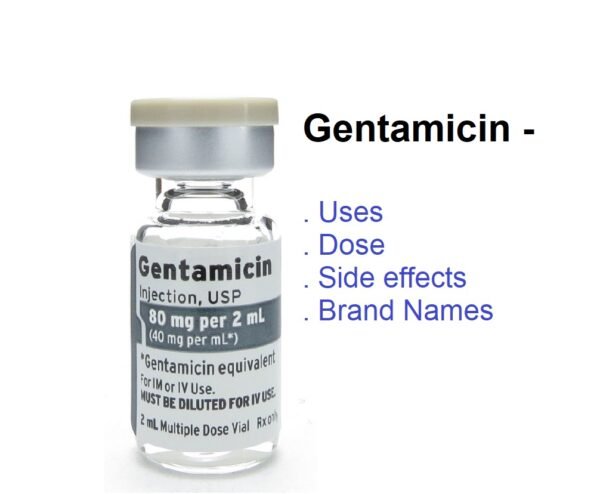
Gentamicin (Bacticid) is an aminoglycoside antibiotic that is used to treat a variety of infections of the gastrointestinal, urinary, and pelvic tract. It is also used in the treatment of endocarditis and augment the action of penicillin and vancomycin.
Gentamicin (Garamycin) Uses:
-
Serious infections:
- Gentamicin used in the treatment of serious infections (eg, sepsis, meningitis, urinary tract infections, respiratory tract infections, peritonitis, bone infections, skin, and soft tissue infections) caused by susceptible strains of the following microorganisms:
- P. aeruginosa,
- Proteus species (indole-positive and indole-negative),
- Escherichia coli,
- Klebsiella species,
- Enterobacter species,
- Serratia species,
- Citrobacter species, and
- Staphylococcus species (coagulase-positive and coagulase-negative).
- Can be used in the treatment of infective endocarditis caused by enterococci, in combination with other antibiotics (see endocarditis guidelines: Infective Endocarditis Treatment Guidelines - AHA/ IDSA
- Gentamicin used in the treatment of serious infections (eg, sepsis, meningitis, urinary tract infections, respiratory tract infections, peritonitis, bone infections, skin, and soft tissue infections) caused by susceptible strains of the following microorganisms:
-
Off Label Use of Gentamicin in Adults:
- Brucellosis
- Endocarditis, treatment (viridans group streptococcus [VGS] and S. bovis [native or prosthetic valve]) (adults)
- Uncomplicated Gonococcal infection (patients with severe cephalosporin allergy)
- Granuloma inguinale (donovanosis)
- Pelvic inflammatory disease
- Peritoneal dialysis associated peritonitis
- Plague, treatment
- Surgical prophylaxis (preoperative)
- Tularemia
Gentamicin (Garamycin) Dose in Adults
- In underweight and nonobese patients, the use of total body weight (TBW) instead of ideal body weight for determining the initial mg/kg/dose is widely accepted.
- For patients who are neither underweight nor obese Ideal body weight (IBW) also may be used to determine doses.
- Initial and periodic plasma drug levels (eg, peak and trough with conventional dosing, the post-dose level at a prespecified time with extended-interval dosing) should be determined, particularly in critically ill patients with serious infections or in disease states known to significantly alter aminoglycoside pharmacokinetics (eg, cystic fibrosis, burns, or major surgery).
Gentamicin (Garamycin) Usual dosage ranges:
-
Conventional:
- IM, IV: 3 to 5 mg/kg/day in divided doses 8 hourly
-
Once-daily (extended-interval dosing [EID]):
- IV: 5 to 7 mg/kg/day once a day.
- This is not recommended in patients with ascites, burns covering >20% of the total body surface area, cystic fibrosis, end-stage renal disease (eg, requiring hemodialysis), endocarditis, infants, mycobacterial infections, or pregnancy.
Indication-specific dosing:
Gentamicin (Garamycin) Dose in the treatment of Brucellosis (off-label):
- 5 mg/kg once a day for 7 days (range: 5 to 14 days).
- Can be administered in combination with 6 weeks of doxycycline.
Gentamicin Dose in the treatment of Cerebrospinal fluid (CSF) shunt infection (as an adjunct to systemic therapy) (off-label route):
-
Intraventricular (use a preservative-free preparation):
- Dose: 4 to 8 mg/day
- Some experts also recommend adjusting the dosage and administration interval based on CSF gentamicin concentration (goal: 10 to 20 times MIC of the causative organism), ventricular size, and daily output from the ventricular drain.
- Whenever intraventricular gentamicin is administered via a ventricular drain, clamp the drain for 15 to 60 minutes after administration (allows the solution to equilibrate in CSF).
- Note: Intraventricular administration is mostly reserved for use in those who fail parenteral therapy despite the removal of CSF shunt or when CSF shunt cannot be removed.
Gentamicin Dose in the treatment of Endocarditis:
-
Enterococcus (native or prosthetic valve) (off-label dose):
- IV, IM: 3 mg/kg/day in 2 or 3 divided doses in combination with a beta-lactam or vancomycin.
- The choice of concomitant antibiotic and treatment duration are dependent on organism sensitivity testing and source of infection.
-
S.aureus (methicillin-susceptible or methicillin-resistant prosthetic valve) (off-label dose):
- IV, IM: 3 mg/kg/day in 2 or 3 divided doses for 2 weeks.
- Can be used in combination with other antibiotics (choice of concomitant antibiotic dependent on organism sensitivity testing)
-
Viridans group streptococcus (VGS) and S. bovis (native or prosthetic valve) (off-label):
- IV, IM: 3 mg/kg/day once a day (preferred) or in 3 divided doses (alternative) in combination with other antibiotics (choice of concomitant antibiotic and treatment duration are dependent on organism sensitivity testing and source of infection)
Gentamicin Dose in the treatment of uncomplicated Gonococcal infection in patients with severe cephalosporin allergy (off-label):
- IM: 240 mg as a single dose in combination with oral azithromycin.
Gentamicin Dose in the treatment of Granuloma inguinale (donovanosis) (off-label):
- IV: 1 mg/kg/dose 8 hourly.
- Gentamicin must be used in addition to the recommended antibiotic agent and only if the improvement is not evident within the first days of therapy.
Gentamicin Dose in the treatment of Bacterial Meningitis (caused by Enterococcus spp, Listeria monocytogenes, Streptococcus agalactiae, or Pseudomonas aeruginosa):
- IV: 5 mg/kg/day in divided doses every 8 hourly (administered with other antimicrobials [varies by a causative organism and susceptibility]).
Gentamicin Dose in the treatment of Intra-abdominal infections (off-label dose):
- IV: 5 to 7 mg/kg once a day for 4 to 7 days (unless it is difficult to achieve source control).
Gentamicin Dose in the treatment of Pelvic inflammatory disease (off-label):
-
Loading dose:
- 2 mg/kg IV or IM, then 1.5 mg/kg IV 8 hourly or 3 to 5 mg/kg IV once daily in combination with clindamycin IV.
- Within 24 to 48 hours of clinical improvement transition from parenteral to oral therapy can usually be initiated for a total treatment duration of 14 days.
Gentamicin Dose in the treatment of Peritoneal dialysis-associated peritonitis (off-label):
Intraperitoneal:
-
Intermittent dosing:
- 6 mg/kg per exchange once a day; allow to dwell ≥6 hours
-
Continuous dosing (all exchanges):
- Loading dose: 8 mg/L.
- Maintenance dose: 4 mg/L
Gentamicin Dose in the treatment of Plague (Yersinia pestis) (off-label):
- IM, IV: 5 mg/kg/dose once daily or 2 mg/kg loading dose, then 1.7 mg/kg/dose 8 hourly;
- The duration of therapy is 10 to 14 days, or until 2 days after the patient is afebrile.
Gentamicin Dose in the treatment of hospital-acquired, or ventilator-associated pneumonia (off-label):
- IV: 5 to 7 mg/kg/day once daily for 7 days;
- may consider for shorter or longer duration depending on rate of clinical improvement.
- Use in combination with an agent active against S. aureus and an additional antipseudomonal agent, when used as empiric therapy.
Note: In patients with hospital-acquired or ventilator-associated pneumonia due to P. aeruginosa aminoglycosides are not recommended as monotherapy.
Gentamicin Dose in the treatment of Sepsis/septic shock (empiric or targeted therapy) (off-label):
- IV: 5 to 7 mg/kg once daily.
- The first dose should be administered as soon as possible or within 1 hour of identifying sepsis/septic shock.
- The duration of therapy of 7 to 10 days is generally adequate for serious infections.
- A variety of factors play a role in determining the optimal duration of therapy; infectious diseases consultation may be necessary.
Gentamicin (Garamycin) Dose in preoperative Surgical prophylaxis (off-label):
- IV: 5 mg/kg within 60 minutes prior to the surgical incision with or without other antibiotics (procedure dependent).
Note: Dose is based on actual body weight unless >20% above ideal body weight, then dosage requirement may best be estimated using a dosing weight of IBW + 0.4 (TBW - IBW) (Bratzler 2013)
Gentamicin Dose in the treatment of Synergy (for gram-positive infections):
- IM, IV: 3 mg/kg/day in 1-3 divided doses (with ampicillin)
Gentamicin Dose in the treatment of Tularemia (off-label):
- IM, IV: 5 mg/kg/dose once daily for 10 days OR
- 5 mg/kg/day in 2 divided doses for ≥10 days.
Gentamicin Dose as an alternative agent in the treatment of complicated Urinary tract infection, (including pyelonephritis):
-
Outpatients:
- IV, IM: 5 mg/kg once, followed by 5 to 14 days of appropriate oral therapy.
Note:
- Can be used as an alternative parenteral agent when fluoroquinolones or beta-lactams cannot be used due to allergy, intolerance, unmodifiable drug interactions, or resistance.
Gentamicin (Garamycin) Dose in Childrens
Note:
- Dosage should be based on an estimate of ideal body weight.
- In morbidly obese children, adolescents, and adults, the dosage requirement may best be estimated using a dosing weight of IBW + 0.4 (TBW - IBW).
- Initial dosing recommendation presented;
- The dosage should be individualized based upon serum concentration monitoring.
- Initial and periodic plasma drug concentrations (eg, peak and trough with conventional dosing, the post-dose level at a prespecified time with extended-interval dosing) should be determined, particularly in critically ill patients with serious infections or in disease states known to significantly alter aminoglycoside pharmacokinetics (eg, cystic fibrosis, burns, or major surgery).
Gentamicin General dosing for susceptible infection:
Note:
- Optimal dose and frequency not established in patients receiving ECMO;
- Patient-specific considerations (eg, the reason for ECMO) and variability with ECMO procedure itself make extrapolation of pharmacokinetic data and dosing to all patients receiving ECMO difficult;
- Closely monitor serum concentrations and determine individual dosing needs in these patients.
-
Conventional dosing:
-
Infants, Children, and Adolescents:
- IM, IV: 2 to 2.5 mg/kg/dose every 8 hourly;
- There are some pediatric patients that may require larger doses (like patients undergoing continuous hemofiltration, patients with major burns, and febrile granulocytopenic patients);
- then modify dose in these patients based on individual patient requirements as determined by renal function, serum drug concentrations, and patient-specific clinical parameters.
-
-
Extended-interval dosing: Limited data available:
-
Weight-directed:
- Infants, Children, and Adolescents:
- IV: 4.5 to 7.5 mg/kg/dose every 24 hours in patients with normal renal function.
- Infants, Children, and Adolescents:
- Age-directed:
- Infants and Children ≥3 months to <2 years:
- IV: 9.5 mg/kg/dose every 24 hours
- Children 2 to <8 years:
- IV: 8.5 mg/kg/dose every 24 hours
- Children ≥8 years and Adolescents:
- IV: 7 mg/kg/dose every 24 hours
- Infants and Children ≥3 months to <2 years:
-
Gentamicin (Garamycin) Dose in the treatment of CNS infection:
-
Meningitis (IDSA):
- Infants and Children:
- IV: 7.5 mg/kg/day divided every 8 hours
- Adolescents:
- IV: 5 mg/kg/day divided every 8 hourly.
- Infants and Children:
-
VP-shunt infection, ventriculitis, including healthcare-associated:
- Limited data available;
- Optimal dose not established
- Intraventricular/intrathecal (use a preservative-free preparation):
- Infants and Children: 1 to 2 mg/day
- Adolescents: Dosing recommendations not reported; however, in adults: 4 to 8 mg/day has been suggested
Gentamicin Dose in the treatment of Cystic fibrosis, pulmonary infection:
-
Infants, Children, and Adolescents:
- Conventional dosing:
- IM, IV: 3.3 mg/kg/dose 8 hourly.
- Extended-interval dosing:
- IV: 10 to 12 mg/kg/dose every 24 hours.
- Note: The CF Foundation recommends extended-interval dosing as preferred over conventional dosing.
- Conventional dosing:
Gentamicin (Garamycin) Dose in the treatment of Endocarditis:
-
Synergy dosing:
-
Children and Adolescents:
- IV: 3 to 6 mg/kg/day divided every 8 hours in combination with other antibiotics;
- Adjust the dose to achieve a target peak concentration of 3 to 4 mcg/mL and trough concentration <1 mcg/mL.
-
-
Staphylococcus aureus (methicillin-resistant), prosthetic valve/material:
-
Infants, Children, and Adolescents:
- IV: 3 mg/kg/day divided every 8 hours in combination with vancomycin and rifampicin.
-
-
Treatment dose (eg, gram-negative organisms):
-
Children and Adolescents:
- IV: 7.5 mg/kg/day divided every 8 hours;
- Adjust the dose to achieve a target peak concentration of 5 to 10 mcg/ml and trough concentration <1 to 1.5 mcg/ml.
-
Gentamicin Dose in the treatment of complicated Intra-abdominal infection:
-
Infants, Children, and Adolescents:
- IV: 3 to 7.5 mg/kg/day divided every 8 to 24 hours.
Gentamicin (Garamycin) Dose in the treatment of Peritonitis (peritoneal dialysis):
-
Infants, Children, and Adolescents:
-
Intermittent: Intraperitoneal:
- Anuric: 0.6 mg/kg/dose every 24 hours in the long dwell
- Nonanuric: 0.75 mg/kg/dose every 24 hours in the long dwell
-
Continuous: Intraperitoneal:
- Loading dose: 8 mg per liter of dialysate.
- Maintenance dose: 4 mg per liter
-
Gentamicin (Garamycin) Dose for Surgical prophylaxis:
-
Infants, Children, and Adolescents:
- IV: 2 to 2.5 mg/kg as a single dose; in children and adolescents, a dose of 2.5 mg/kg is typically suggested.
- Administer within 60 minutes prior to surgical incision with or without other antibiotics (procedure dependent).
Gentamicin (Garamycin) Dose in the treatment of UTI:
- Extended-interval dosing:
- Based on data from 90 patients (ages: 1 month to 12 years), the following age-directed dosing has been suggested:
- Infants and Children <5 years:
- IV: 7.5 mg/kg/dose every 24 hours
- Children 5 to 10 years:
- IV: 6 mg/kg/dose every 24 hours
- Children 11 to 12 years:
- IV: 4.5 mg/kg/dose every 24 hours
Gentamicin Pregnancy Risk Factor D
- [US Boxed Warning] Aminoglycosides can cause fetal harm when administered to pregnant women.
- Multiple reports have indicated that children born to mothers who received an aminoglycoside (streptomycin), during pregnancy may be at risk of bilateral congenital hearing loss.
- While no reports of serious side effects on the infant or fetus have been made following maternal use all aminoglycosides, there is still the possibility of harm.
- Some pharmacokinetic parameters for gentamicin could be affected by pregnancy-induced physiological changes
- The use of Gentamicin has been studied for the treatment and prevention of various infections in pregnant women, including acute pyelonephritis.
Gentamicin use during breastfeeding:
- Breast milk contains gentamicin (Celiloglu 1994).
- The relative infant dose (RID), of gentamicin, is calculated by using the highest concentration of breast milk and comparing it to an infant therapeutic dosage of 7.5 mg/kg/day.
- If the RID of a medication exceeds 10%, breastfeeding is acceptable.
- The RID of Gentamicin was calculated with a milk content of 0.78 mg/mL. This gives an estimated daily infant dose via breastmilk of 0.117 mg/kg/day.
- After 5 days of maternal administration of gentamicin 80 mg IM 3 times per day, this milk concentration was determined.
- Any antibiotic exposure can cause a modification of the bowel flora.
- According to the World Health Organization (WHO), gentamicin is compatible with breastfeeding. It is important to monitor infants for thrush or diarrhea.
Gentamicin (Garamycin) Dose in Kidney disease:
-
Conventional dosing:
-
Manufacturer’s labeling:
- Administer usual dosage for initial dose, then estimate reduced dose by dividing initial dose by patient’s serum creatinine level (in mg/dL) and administer 8 hourly (eg, a 60 kg patient with serum creatinine of 2 mg/dL at a dose of 1 mg/kg would receive an initial dose of 60 mg, followed by 30 mg every 8 hours)
-
Alternate dosing (Aronoff 2007):
- Note: Renally adjusted dose recommendations are based on doses of 1.7 mg/kg/dose 8 hourly or 5 to 7 mg/kg/dose once daily.
- GFR >50 mL/minute:
- No dosage adjustment is necessary.
- GFR 10 to 50 mL/minute:
- Administer every 12 to 48 hours
- GFR <10 mL/minute:
- Administer every 48 to 72 hours
-
Once-daily (extended-interval dosing [EID]):
- Note:
- Base initial dosing interval on the following; adjust interval based on serum levels using institution-specific policies.
- CrCl ≥60 mL/minute:
- Administer every 24 hours
- CrCl 40 to 59 mL/minute:
- Administer every 36 hours
- CrCl 20 to 39 mL/minute:
- Administer every 48 hours
- CrCl <20 mL/minute:
- Monitor serum levels and use conventional dosing or re-dose when gentamicin level is less than 1 mcg/mL.
- Note:
- Note:
- The SSC guidelines do not recommend use of once-daily dosing, in patients with sepsis /septic shock and severe renal impairment.
- Patients with mild renal impairment should still receive once-daily dosing with an extended interval (ie, up to 3 days).
-
Intermittent hemodialysis (IHD) (administer after hemodialysis on dialysis days):
- Dialyzable (~50%; variable; dependent on filter, duration, and type of IHD):
- Loading dose of 2 to 3 mg/kg loading dose followed by:
- Mild UTI or synergy:
- 1 mg/kg/dose every 48 to 72 hours; consider redosing for preHD or post-HD concentrations <1 mg/L
- Moderate-to-severe UTI:
- 1 to 1.5 mg/kg/dose every 48 to 72 hours; consider redosing for pre-HD concentrations <1.5 to 2 mg/L or post-HD concentrations <1 mg/L
- Systemic gram-negative rod infection:
- 5 to 2 mg/kg/dose every 48 to 72 hours; consider redosing for pre-HD concentrations <3 to 5 mg/L or post-HD concentrations <2 mg/L
- Mild UTI or synergy:
- Note: Dosing dependent on the assumption of 3 times/week, complete IHD sessions.
-
Continuous renal replacement therapy (CRRT):
- Drug clearance is highly dependent on the method of renal replacement, filter type, and flow rate.
- Appropriate dosing requires close monitoring of pharmacologic response, signs of adverse reactions due to drug accumulation, as well as target drug concentrations (if appropriate).
- Note:
- The following are general recommendations only (based on dialysate flow/ultrafiltration rates of 1 to 2 L/hour and minimal residual renal function) and should not supersede clinical judgment:
-
CVVH/CVVHD/CVVHDF:
- Mild UTI or synergy:
- Loading dose of 2 to 3 mg/kg/dose followed by 1 mg/kg every 24 to 36 hours (redose when concentration <1 mg/L.
- Moderate to severe UTI:
- Loading dose of 2 to 3 mg/kg/dose followed by 1 to 1.5 mg/kg every 24 to 36 hours (redose when concentration <1.5 to 2 mg/L.
- Systemic gram-negative infection:
- Loading dose of 2 to 3 mg/kg/dose followed by 1.5 to 2.5 mg/kg every 24 to 48 hours (generally accepted to re-dose when concentration <2 mg/L.
- Mild UTI or synergy:
-
Gentamicin (Garamycin) Dose in Liver disease:
Gentamicin does not undergo hepatic metabolism that's why dosage adjustment is not likely to be necessary and no dosage adjustments provided in the manufacturer’s labeling.
Side effects of Gentamicin (Garamycin):
-
Cardiovascular:
- Edema
- Hypertension
- Hypotension
- Phlebitis
- Thrombophlebitis
-
Central Nervous System:
- Abnormal Gait
- Ataxia
- Brain Disease
- Confusion
- Depression
- Dizziness
- Drowsiness
- Headache
- Lethargy
- Myasthenia
- Numbness
- Paresthesia
- Peripheral Neuropathy
- Pseudomotor Cerebri
- Seizure
- Vertigo
-
Dermatologic:
- Alopecia
- Erythema
- Pruritus
- Skin Rash
- Urticaria
-
Endocrine & Metabolic:
- Hypocalcemia
- Hypokalemia
- Hypomagnesemia
- Hyponatremia
- Weight Loss
-
Gastrointestinal:
- Anorexia
- Clostridioides (Formerly Clostridium) Difficile-Associated Diarrhea
- Decreased Appetite
- Enterocolitis
- Nausea
- Sialorrhea
- Stomatitis
- Vomiting
-
Genitourinary:
- Casts In Urine (Hyaline
- Granular)
- Fanconi-Like Syndrome (Infants And Adults; High Dose
- Prolonged Course)
- Oliguria
- Proteinuria
-
Hematologic & Oncologic:
- Agranulocytosis
- Anemia
- Eosinophilia
- Granulocytopenia
- Leukopenia
- Purpura
- Reticulocytopenia
- Reticulocytosis
- Splenomegaly
- Thrombocytopenia
-
Hepatic:
- Hepatomegaly
- Increased Liver Enzymes
-
Hypersensitivity:
- Anaphylaxis
- Anaphylactoid Reaction
- Hypersensitivity Reaction
-
Local:
- Injection Site Reaction
- Pain At Injection Site
-
Neuromuscular & Skeletal:
- Arthralgia
- Muscle Cramps
- Muscle Fatigue (Myasthenia Gravis-Like Syndrome)
- Muscle Twitching
- Tremor
- Weakness
-
Ophthalmic:
- Visual Disturbance
-
Otic:
- Auditory Impairment
- Hearing Loss (Associated With Persistently Increased Serum Concentrations; Early Toxicity Usually Affects High-Pitched Sound)
- Tinnitus
-
Renal:
- Decreased Creatinine Clearance
- Decreased Urine Specific Gravity
- Increased Blood Urea Nitrogen
- Increased Serum Creatinine
- Polyuria
- Renal Failure (High Trough Serum Concentrations)
- Renal Tubular Necrosis
-
Respiratory:
- Dyspnea
- Laryngeal Edema
- Pulmonary Fibrosis
- Respiratory Depression
-
Miscellaneous:
- Fever
Contraindications to Gentamicin (Garamycin):
Hypersensitivity to gentamicin or other aminoglycosides or any component of this formulation.
Warnings and precautions
-
Hypersensitivity
- It is possible to cross-sensitive to other aminoglycosides.
-
Nephrotoxicity: [US Boxed Warning]
- May cause nephrotoxicityConcomitant nephrotoxic medication, preexisting renal impairment and advanced age are all risk factors.
- If you notice signs of nephrotoxicity, discontinue treatment. Renal damage can usually be reversed.
-
Paralysis and neuromuscular blockade
- Can cause respiratory paralysis and neuromuscular blockade, especially if given too soon after anesthesia.
-
Neurotoxicity: [US Boxed Warn]
- May cause neurotoxicityPreexisting renal impairment, concomitant neurotoxic medication, advanced age, and dehydration are all risk factors.
- The amount and duration of treatment will determine the degree of ototoxicity.
- Vertigo and tinnitus could be signs of vestibular injury or impending bilateral irreversible harm.
- If you notice signs of ototoxicity, discontinue treatment.
-
Superinfection
- Extended use can lead to superimposed fungal and bacterial infections, such as C. difficile-associated diarrhea or pseudomembranous collitis. Most commonly, CDAD has been seen >2 months after antibiotic treatment.
-
An abnormality in the electrolyte:
- Patients with hypocalcemia, hypokalemia, and hypomagnesemia should be cautious.
-
Hearing impairment:
- Patients with vertigo, hearing loss, or tinnitus should be cautious.
-
Neuromuscular disorders:
- Patients with neuromuscular disorders (including myasthenia gravis) should be cautious.
-
Renal impairment
- Patients with pre-existing renal impairment should be cautious; dosage modifications may be necessary.
Gentamicin: Drug Interaction
|
Risk Factor C (Monitor therapy) |
|
|
Amphotericin B |
May enhance the nephrotoxic effect of Aminoglycosides. |
|
Arbekacin |
May enhance the nephrotoxic effect of Aminoglycosides. Arbekacin may enhance the ototoxic effect of Aminoglycosides. |
|
BCG Vaccine (Immunization) |
Antibiotics may diminish the therapeutic effect of BCG Vaccine (Immunization). |
|
Bisphosphonate Derivatives |
Aminoglycosides may enhance the hypocalcemic effect of Bisphosphonate Derivatives. |
|
Botulinum Toxin-Containing Products |
Aminoglycosides may enhance the neuromuscularblocking effect of Botulinum Toxin-Containing Products. |
|
Capreomycin |
May enhance the neuromuscular-blocking effect of Aminoglycosides. |
|
CARBOplatin |
Aminoglycosides may enhance the ototoxic effect of CARBOplatin. Especially with higher doses of carboplatin. |
|
Cardiac Glycosides |
Aminoglycosides may decrease the serum concentration of Cardiac Glycosides. This effect has only been demonstrated with oral aminoglycoside administration. |
|
Cefazedone |
May enhance the nephrotoxic effect of Aminoglycosides. |
|
Cephalosporins (2nd Generation) |
May enhance the nephrotoxic effect of Aminoglycosides. |
|
Cephalosporins (3rd Generation) |
May enhance the nephrotoxic effect of Aminoglycosides. |
|
Cephalosporins (4th Generation) |
May enhance the nephrotoxic effect of Aminoglycosides. |
|
Cephalothin |
May enhance the nephrotoxic effect of Aminoglycosides. |
|
Cephradine |
May enhance the nephrotoxic effect of Aminoglycosides. |
|
CISplatin |
May enhance the nephrotoxic effect of Aminoglycosides. |
|
CycloSPORINE (Systemic) |
Aminoglycosides may enhance the nephrotoxic effect of CycloSPORINE (Systemic). |
|
Distigmine |
Aminoglycosides may diminish the therapeutic effect of Distigmine. |
|
Lactobacillus and Estriol |
Antibiotics may diminish the therapeutic effect of Lactobacillus and Estriol. |
|
Loop Diuretics |
May enhance the adverse/toxic effect of Aminoglycosides. Specifically, nephrotoxicity and ototoxicity. |
|
Neuromuscular-Blocking Agents |
Aminoglycosides may enhance the respiratory depressant effect of Neuromuscular-Blocking Agents. |
|
Nonsteroidal Anti-Inflammatory Agents |
May decrease the excretion of Aminoglycosides. Data only in premature infants. |
|
Oxatomide |
May enhance the ototoxic effect of Aminoglycosides. |
|
Tenofovir Products |
Aminoglycosides may increase the serum concentration of Tenofovir Products. Tenofovir Products may increase the serum concentration of Aminoglycosides. |
|
Vancomycin |
May enhance the nephrotoxic effect of Aminoglycosides. |
|
Risk Factor D (Consider therapy modification) |
|
|
Colistimethate |
Aminoglycosides may enhance the nephrotoxic effect of Colistimethate. Aminoglycosides may enhance the neuromuscular-blocking effect of Colistimethate. |
|
Penicillins |
May decrease the serum concentration of Aminoglycosides. Primarily associated with extended spectrum penicillins, and patients with renal dysfunction. Exceptions: Amoxicillin; Ampicillin; Bacampicillin; Cloxacillin; Dicloxacillin; Nafcillin; Oxacillin; Penicillin G (Parenteral/Aqueous); Penicillin G Benzathine; Penicillin G Procaine; Penicillin V Benzathine; Penicillin V Potassium. |
|
Sodium Picosulfate |
Antibiotics may diminish the therapeutic effect of Sodium Picosulfate. Management: Consider using an alternative product for bowel cleansing prior to a colonoscopy in patients who have recently used or are concurrently using an antibiotic. |
|
Typhoid Vaccine |
Antibiotics may diminish the therapeutic effect of Typhoid Vaccine. Only the live attenuated Ty21a strain is affected. Management: Vaccination with live attenuated typhoid vaccine (Ty21a) should be avoided in patients being treated with systemic antibacterial agents. Use of this vaccine should be postponed until at least 3 days after cessation of antibacterial agents. |
|
Risk Factor X (Avoid combination) |
|
|
Agalsidase Alfa |
Gentamicin (Systemic) may diminish the therapeutic effect of Agalsidase Alfa. |
|
Agalsidase Beta |
Gentamicin (Systemic) may diminish the therapeutic effect of Agalsidase Beta. |
|
Ataluren |
May enhance the adverse/toxic effect of Aminoglycosides. Specifically, an increased risk of nephrotoxicity may occur with the concomitant use of ataluren and aminoglycosides. |
|
BCG (Intravesical) |
Antibiotics may diminish the therapeutic effect of BCG (Intravesical). |
|
Cholera Vaccine |
Antibiotics may diminish the therapeutic effect of Cholera Vaccine. Management: Avoid cholera vaccine in patients receiving systemic antibiotics, and within 14 days following the use of oral or parenteral antibiotics. |
|
Foscarnet |
May enhance the nephrotoxic effect of Aminoglycosides. |
|
Mannitol (Systemic) |
May enhance the nephrotoxic effect of Aminoglycosides. |
|
Mecamylamine |
Aminoglycosides may enhance the neuromuscular-blocking effect of Mecamylamine. |
|
Methoxyflurane |
Aminoglycosides may enhance the nephrotoxic effect of Methoxyflurane. |
Monitoring parameters:
- Urinalysis, urine output, BUN, serum creatinine, plasma gentamicin levels (as appropriate to dosing method).
- Levels are typically obtained before and after the third dose in conventional dosing.
- Those who are at risk for ototoxicity or who will be receiving prolonged therapy (>2 weeks) hearing should be tested before, during, and after treatment.
- Some penicillin derivatives may accelerate the degradation of aminoglycosides in vitro.
- This may be clinically-significant for certain penicillin (ticarcillin, piperacillin, carbenicillin) and aminoglycoside (gentamicin, tobramycin) combination therapy in patients with significant renal impairment. Close monitoring of aminoglycoside levels is warranted.
How to administer Gentamicin (Garamycin)?
IM:
- Administer by deep IM route if possible.
IV:
- Infuse over 30 to 120 minutes. Some penicillins (eg, carbenicillin, ticarcillin, and piperacillin) have been shown to inactivate aminoglycosides in vitro.
- This has been observed to a greater extent with tobramycin and gentamicin, while amikacin has shown greater stability against inactivation.
- Concurrent use of these agents may increase the risk of reduced antibacterial efficacy in vivo, particularly in the setting of profound renal impairment.
- However, definitive clinical evidence is lacking.
- In patients with renal dysfunction, if combination penicillin/aminoglycoside therapy is desired, separation of doses (if feasible), and routine monitoring of aminoglycoside levels, CBC, and clinical response should be considered.
Intraventricular (off-label route):
- When administered through a ventricular drain, clamp drain for 15 to 60 minutes before opening the drain to allow the gentamicin solution to equilibrate in the cerebrospinal fluid.
- Must use preservative-free preparations only.
Mechanism of action of Gentamicin (Garamycin):
- Interferes in the synthesis of bacterial proteins by binding to the 30S ribosomal protein subunit, resulting in a defective cell membrane.
Absorption: Distribution:
- Intramuscular: Complete and rapid;
- Oral: Lowly absorbed (1%).
-
- Primarily into extracellular liquid (highly hydrophilic);
- High concentrations in the renal cortex
- The intravenous route allows for minimal penetration of CSF and ocular tissue.
- CSF:blood level ratio:
- Normal meninges: <10%;
- Inflamed meninges: ≤25%
Protein binding:
- <30%
Half-life elimination:
- Neonates: <1 week: 3 to 11.5 hours; 1 week to 1 month: 3 to 6 hours
- Infants: 4 ± 1 hour
- Children: 2 ± 1 hour
- Adolescents: 1.5 ± 1 hour
- Adults: ~2 hours
- Renal failure: mean: 41 ± 24 hours; Range: 6 to 127 hours
Time to peak serum concentrations:
- IM: 30 to 90 minutes.
- IV: 30 minutes after a 30-minute infusion.
Note: Distribution may be prolonged after larger doses. Excretion:
- Urine (≥70% as unchanged drug)
Clearance:
- Directly related to renal function
- Neonates: 0.045 ± 0.01 L/hour/kg
- Infants: 0.1 ± 0.05 L/hour/kg
- Children: 0.1 ± 0.03 L/hour/kg
- Adolescents: 0.09 ± 0.03 L/hour/kg
International Brand Names of Gentamicin:
- Agentam
- Alcomicin
- Apigent
- Azupel
- Bacticid
- Balticin
- Biogaracin
- Cidomycin
- Diakarmon
- Duracoll
- Epigent
- Ethigent
- Evozar
- Gamicin
- Gantalyn
- Garalone
- Garamicin
- Garamicina
- Garamycin
- Garasent
- Garasone
- Garaxil
- Gem
- Gemycin
- Genacin
- Genbexil
- Genmisil
- Genoptic
- Gensumycin
- Genta-590
- Gentabiotic
- Gentabrand
- Gentac
- Gentacare
- Gentaderm
- Gentagram
- Gental
- Gentalline
- Gentalyn
- Gentam
- Gentamax
- Gentamed
- Gentamen
- Gentamina
- Gentamytrex
- Gentapro
- Gentarad
- Gentasil
- Gentasporin
- Gentatrim
- Gentawin
- Genticin
- Genticyn
- Gentocil
- Hexamycin
- Ikagen
- Intagenta
- Jie Li Tai
- Lacromycin
- Lyramycin
- Maxigen
- Miragenta
- Miramycin
- Mycin
- Nelgen
- Obogen
- Ophtagram
- Optimycin
- Provisual
- Qutacin
- Refobacin
- Rigaminol
- Rocy Gen
- Rovixida
- Rupegen
- Servigenta
- Sulmycin
- Versigen
- Vijomicin
Gentamicin Brand Names in Pakistan:
Gentamicin Injection 80 Mg |
|
| Genxat | Surge Laboratories (Pvt) Ltd. |
Gentamicin Injection 5 Mg/Ml |
|
| Gentic | Bosch Pharmaceuticals (Pvt) Ltd. |
| Genticyn Paed | Ray Pharma (Pvt) Ltd |
Gentamicin Injection 10 Mg/Ml |
|
| Cidomycin | Sanofi Aventis (Pakistan) Ltd. |
| Cidomycin | Sanofi Aventis (Pakistan) Ltd. |
| Fortis | Saffron Pharmaceutical Company |
| Genacin | Macter International (Pvt) Ltd. |
| Gentageof 10% | Geofman Pharmaceuticals |
| Gentapath | Lahore Chemical & Pharmaceutical Works (Pvt) Ltd |
| Genticillin | Indus Pharma (Pvt) Ltd. |
| Lirin | Zinta Pharmaceuticals Industries |
| Mygent | Rex Pharmaceuticals Pakistan |
| Refobacin | Merck Private Ltd. |
| Sg | Saydon Pharmaceutical Industries (Pvt) Ltd. |
| Sudocin | Trigon Pharmaceuticals Pakistan (Pvt) Ltd. |
Gentamicin Injection 20 Mg/Ml |
|
| Genacin | Macter International (Pvt) Ltd. |
| Gentasone | Helix Pharma (Private) Limited |
| Gentic | Bosch Pharmaceuticals (Pvt) Ltd. |
| Genzy | Akson Pharmaceuticals (Pvt) Ltd. |
| Mygent | Rex Pharmaceuticals Pakistan |
| Refobacin | Merck Private Ltd. |
| Sg | Saydon Pharmaceutical Industries (Pvt) Ltd. |
| Skycin | Karachi Pharmaceutical Laboratory |
| Sudocin | Trigon Pharmaceuticals Pakistan (Pvt) Ltd. |
Gentamicin Injection 40 Mg/Ml |
|
| B-Genta | Wellborne Pharmachem And Biologicals |
| Cidomycin | Sanofi Aventis (Pakistan) Ltd. |
| Cidomycin | Sanofi Aventis (Pakistan) Ltd. |
| Elkogent | Elko Organization (Pvt) Ltd. |
| Ephagent | Epharm Laboratories |
| Ephagent | Epharm Laboratories |
| Fortis | Saffron Pharmaceutical Company |
| Fortis | Saffron Pharmaceutical Company |
| Genacin | Macter International (Pvt) Ltd. |
| Gencyn | Harmann Pharmaceutical Laboratories (Pvt) Ltd. |
| Genom | Geofman Pharmaceuticals |
| Genom | Geofman Pharmaceuticals |
| Gentalek | Novartis Pharma (Pak) Ltd |
| Gentamark | Welmark Pharmaceuticals |
| Gentamicin | Lahore Chemical & Pharmaceutical Works (Pvt) Ltd |
| Gentamicin | Lahore Chemical & Pharmaceutical Works (Pvt) Ltd |
| Gentamycin | Lawrence Pharma |
| Gentamycin | Orient Laboratories |
| Gentamycin | Orient Laboratories |
| Gentamycin | Venus Pharma |
| Gentamycin | Amros Pharmaceuticals. |
| Gentamycin | Amros Pharmaceuticals. |
| Gentamycin | Amros Pharmaceuticals. |
| Gentamycin | Venus Pharma |
| Gentamycin | Venus Pharma |
| Gentaquin | Global Pharmaceuticals |
| Gentasone | Helix Pharma (Private) Limited |
| Gentasone | Helix Pharma (Private) Limited |
| Gentax | Drugs Inn Pakistan |
| Gentic | Bosch Pharmaceuticals (Pvt) Ltd. |
| Genticillin | Indus Pharma (Pvt) Ltd. |
| Genticillin | Indus Pharma (Pvt) Ltd. |
| Genticyn | Ray Pharma (Pvt) Ltd |
| Genticyn | Ray Pharma (Pvt) Ltd |
| Genzy | Akson Pharmaceuticals (Pvt) Ltd. |
| Lirin | Zinta Pharmaceuticals Industries |
| Mygent | Rex Pharmaceuticals Pakistan |
| Polygenta | Polyfine Chempharma (Pvt) Ltd. |
| Polygenta | Polyfine Chempharma (Pvt) Ltd. |
| Refobacin | Merck Private Ltd. |
| Refobacin | Merck Private Ltd. |
| Sepcin | Elko Organization (Pvt) Ltd. |
| Sg | Saydon Pharmaceutical Industries (Pvt) Ltd. |
| Spegecin | Spencer Pharma |
Gentamicin Injection 50 Mg/Ml |
|
| Gentageof 5% | Geofman Pharmaceuticals |
| Gentamycin | Amros Pharmaceuticals. |
Gentamicin Injection 80 Mg/Ml |
|
| Cidomycin | Sanofi Aventis (Pakistan) Ltd. |
| Genta | Epoch Pharmaceutical |
| Genta | Epoch Pharmaceutical |
| Gentacil | Star Laboratories (Pvt) Ltd. |
| Gentacil | Star Laboratories (Pvt) Ltd. |
| Gentamycin | Amros Pharmaceuticals. |
| Mygent | Rex Pharmaceuticals Pakistan |
| Skycin | Karachi Pharmaceutical Laboratory |
Gentamicin Drops 300 Mg/Ml |
|
| Ephagent | Epharm Laboratories |
Gentamicin Eye Drops 0.3 % W/V |
|
| G-Mycin | Mass Pharma (Private) Limited |
| G-Optin | Festel Lab |
| Genek | Innvotek Pharmaceuticals |
| Genteal | Novartis Pharma (Pak) Ltd |
| Genticol | Neo Medix |
| Genticyn | Ray Pharma (Pvt) Ltd |
| Medigentacin | Medipak Limited |
| Mygent | Rex Pharmaceuticals Pakistan |
| Optagen | Remington Pharmaceutical Industries (Pvt) Ltd. |
| Polygenta | Polyfine Chempharma (Pvt) Ltd. |
| V-Genta | Vega Pharmaceuticals Ltd. |
Gentamicin Eye Drops 3.5 %W/V |
|
| Genicol -Eye Drops | Reko Pharmacal (Pvt) Ltd. |
Gentamicin Ear Drops 0.3 % W/V |
|
| Otogen | Remington Pharmaceutical Industries (Pvt) Ltd. |
Gentamicin Eye Oint 0.3 % W/W |
|
| Genticol | Neo Medix |
Gentamicin E And E Drops 0.3 % V/V |
|
| Gentabact | Nabiqasim Industries (Pvt) Ltd. |
Gentamicin E And E Drops 0.3 % W/V |
|
| Gefcin Eye/Ear | Multinational Buisness Link |
| Genta | Epoch Pharmaceutical |
| Gentamicin | Lahore Chemical & Pharmaceutical Works (Pvt) Ltd |
| Gentamycin | Amros Pharmaceuticals. |
| Gentamycin | Mehran Traders |
| Gentamycin | Amros Pharmaceuticals. |
Gentamicin Oint 0.1 % |
|
| Beclic G | Aims Traders |
Gentamicin Cream 1 % W/W |
|
| Primagent | Prime Labs. (Pvt) Ltd. |
Gentamicin Cream 0.1 % W/W |
|
| Atcogen 0.1% | Atco Laboratories Limited |
| Gentanix | Biogen Pharma |
| H-Neugenta | Neutro Pharma (Pvt) Ltd. |
| Isgent | Isis Pharmaceutical |
| Mecona | Valor Pharmaceuticals |
Gentamicin Cream 0.3 % W/W |
|
| Gentamycin | Krka-Pak Pharmaceutical & Chemical Works |
| Genticyn | Ray Pharma (Pvt) Ltd |
| Swigen | Swiss Pharmaceuticals (Pvt) Ltd. |
Gentamicin Eye Gel 0.3 % W/W |
|
| Genteal | Novartis Pharma (Pak) Ltd |
.png)


