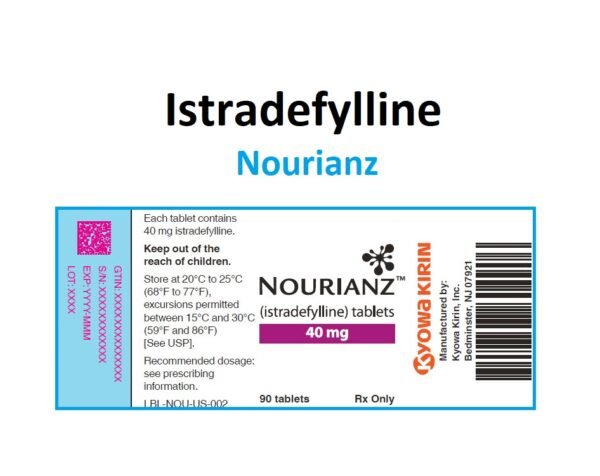
Istradefylline (Nourianz) acts as an adenosine receptor inhibitor. It is used for Parkinson's disease patients who experience the "off" effects.
Istradefylline (Nourianz) Uses:
-
Parkinson disease, "off" episode:
- Metabolite I [norketamine] is N-dealkylated in the liver, where the cyclohexone ring is hydroxylated in metabolites III and IV, conjugated with glucuronic acid, and dehydrated to produce cyclohexene derivative (metabolite II).
Istradefylline (Nourianz) Dose in Adults:
Istradefylline (Nourianz) Dose in the treatment of Parkinson disease, "off" episode:
- 20 mg orally once a day;
- Depending on the patient's response and tolerance, the dose may be increased further up to the maximum amount of 40 mg once daily.
-
Dosage adjustment for concomitant CYP3A4 inhibitors/inducers and tobacco smoking:
- Dosage adjustment for concomitant therapy with strong CYP3A4 inducers:
- Avoid use.
- Dosage adjustment for concomitant therapy with strong CYP3A4 inhibitors:
- 20 mg once a day
- Do not exceed the maximum dose of 20 mg once a day.
- Dosage adjustment for concomitant tobacco smoking (≥20 cigarettes/day or the equivalent amount of another tobacco product):
- 40 mg once a day.
- Dosage adjustment for concomitant therapy with strong CYP3A4 inducers:
Use in Children:
Not indicated.
Pregnancy Risk Category: N (Not assigned)
- Studies on animal reproduction have shown that in utero exposure to the drug can cause harm to fetuses.
- It is important that women undergoing treatment are advised to use effective contraception.
Use while breastfeeding
- The drug's potential for excretion into breastmilk is unknown.
- The manufacturer advises evaluating the advantages and disadvantages of medication therapy for the expectant mother with any possible risks to the baby.
Istradefylline (Nourianz) Dose in Kidney Disease:
- CrCl ≥15 mL/minute:
- Adjustment in the dose is not necessary.
- CrCl <15 mL/minute:
- Patients with a CrCl of less than 15 ml/minute have not been investigated for it.
- End-stage renal disease requiring hemodialysis:
- Not studied in patients on hemodialysis.
Istradefylline (Nourianz) Dose in Liver disease:
- Mild hepatic impairment (Child-Pugh class A):
- Adjustment in the dose is not necessary.
- Moderate hepatic impairment (Child-Pugh class B):
- 20 mg once a day to the maximum dose of 20 mg/day.
- Severe hepatic impairment (Child-Pugh class C):
- Avoid use.
- Not studied in severe hepatic impairment.
Side Effects of Istradefylline (Nourianz):
-
Neuromuscular & skeletal:
- Dyskinesia
Less Common Side Effects of Istradefylline (Nourianz):
-
Central Nervous System:
- Insomnia
- Dizziness
- Auditory Hallucination
- Hallucination
- Visual Hallucination
- Abnormal Behavior
- Abnormality In Thinking
- Aggressive Behavior
- Agitation
- Confusion
- Delirium
- Delusion
- Disorientation
- Mania
- Paranoid Ideation
-
Dermatologic:
- Skin Rash
-
Endocrine & Metabolic:
- Increased Serum Glucose
-
Gastrointestinal:
- Constipation
- Diarrhea
- Decreased Appetite
- Nausea
-
Hepatic:
- Increased Serum Alkaline Phosphatase
-
Renal:
- Increased Blood Urea Nitrogen
-
Respiratory:
- Upper Respiratory Tract Inflammation
Contraindications to Istradefylline (Nourianz):
- The manufacturer's labeling does not contain any contraindications.
Warnings and precautions
-
Dyskinesias
- Patients with dyskinesia should not use it. It can exacerbate or cause dyskinesias.
-
Disorders of impulse control:
- Patients who have used the drug have shown compulsive behavior or loss of impulse control.
- These behaviors can manifest as an increase in libido or compulsive purchasing, binge eating, or pathological gambling.
- These compulsive behaviors can be reversed by discontinuing treatment or decreasing the dosage.
-
Psychotic effects
- Treatment may cause mental and behavioral changes, or worsen a preexisting disorder.
- Psychosis can manifest as paranoid thoughttion, hallucinations and delusions, disorientation or confusion, psychotic-like behaviors, aggressive behavior, agitation and delirium.
- Treatment initiation and/or an increase in dose may cause mental status changes.
- Patients with major psychotic disorders should not be treated.
-
Hepatic impairment
- Hepatic impairment patients should use the medication cautiously.
- The maximum dosage should be decreased for those suffering from moderate hepatic impairment.
- Patients with severe hepatic impairment shouldn't use the medication.
- Patients with significant hepatic impairment have not been tested for it.
Istradefylline: Drug Interaction
|
Risk Factor C (Monitor therapy) |
|
|
ARIPiprazole |
ARIPiprazole's serum levels may rise in response to CYP3A4 Inhibitors (Weak). Management: Keep an eye out for enhanced pharmacologic effects of aripiprazole. Depending on the concurrent therapy and/or the indication, aripiprazole dosage modifications may or may not be necessary. For detailed advice, refer to the complete interaction monograph. |
|
AtorvaSTATin |
The serum concentration of AtorvaSTATin may rise when istradefylline is taken. |
|
Bosentan |
May decrease the serum concentration of CYP3A4 Substrates (High risk with Inducers). |
|
CYP3A4 Inducers (Moderate) |
May decrease the serum concentration of Istradefylline. |
|
Deferasirox |
May decrease the serum concentration of CYP3A4 Substrates (High risk with Inducers). |
|
Digoxin |
Istradefylline may increase the serum concentration of Digoxin. |
|
Dofetilide |
CYP3A4 Inhibitors (Weak) may increase the serum concentration of Dofetilide. |
|
Erdafitinib |
May decrease the serum concentration of CYP3A4 Substrates (High risk with Inducers). |
|
Flibanserin |
CYP3A4 Inhibitors (Weak) may increase the serum concentration of Flibanserin. |
|
Ivosidenib |
May decrease the serum concentration of CYP3A4 Substrates (High risk with Inducers). |
|
NiMODipine |
NiMODipine's serum levels may rise in the presence of CYP3A4 Inhibitors (Weak). |
|
Sarilumab |
May lower the serum level of CYP3A4 substrates (High risk with Inducers). |
|
Siltuximab |
May lower the serum level of CYP3A4 substrates (High risk with Inducers). |
|
Tocilizumab |
May lower the serum level of CYP3A4 substrates (High risk with Inducers). |
|
Risk Factor D (Consider therapy modification) |
|
|
CYP3A4 Inhibitors (Strong) |
Istradefylline serum levels might rise. When taken with potent CYP3A4 inhibitors, the maximum daily dose of istradefylline should be limited to 20 mg, and istradefylline effects and toxicities should be well monitored. |
|
Dabrafenib |
May lower the serum level of CYP3A4 substrates (High risk with Inducers). Management: When possible, look for substitutes for the CYP3A4 substrate. If concurrent therapy cannot be avoided, pay special attention to the substrate's clinical consequences (particularly therapeutic effects). |
|
Lemborexant |
Lemborexant's serum levels may rise in the presence of CYP3A4 Inhibitors (Weak). Management: When used in conjunction with weak CYP3A4 inhibitors, a maximum daily dose of 5 mg of lemborexant is advised. |
|
Lomitapide |
The serum levels of lomitapide may increase when istradefylline is used. When used with weak CYP3A4 inhibitors like istradefylline, the recommended course of treatment for patients taking lomitapide 10 mg or more per day is to cut the initial dose in half (dose of 40 mg daily or more). The daily dose of lomitapide that is allowed is 30 mg. |
|
Lorlatinib |
May decrease the serum concentration of CYP3A4 Substrates (High risk with Inducers). Management: Avoid concurrent use of lorlatinib with any CYP3A4 substrates for which a minimal decrease in serum concentrations of the CYP3A4 substrate could lead to therapeutic failure and serious clinical consequences. |
|
Tobacco (Smoked) |
May decrease the serum concentration of Istradefylline. Management: The recommended dosage of istradefylline in patients who use tobacco in amounts of 20 or more cigarettes per day (or the equivalent of another tobacco product) is 40 mg once daily. |
|
Triazolam |
Triazolam's serum levels may rise in the presence of CYP3A4 Inhibitors (Weak). Management: If a patient is using a concurrent mild CYP3A4 inhibitor, consider reducing the dose of triazolam. |
|
Ubrogepant |
It's possible that CYP3A4 Inhibitors (Weak) will raise the level of ubrogepant in the blood. Treatment: The initial and second doses of ubrogepant in patients using mild CYP3A4 inhibitors should be no more than 50 mg each. |
|
Risk Factor X (Avoid combination) |
|
|
CYP3A4 Inducers (Strong) |
Istradefylline's serum concentration can drop. |
|
Pimozide |
Pimozide's serum levels may rise in response to CYP3A4 Inhibitors (Weak). |
|
St John's Wort |
Istradefylline's serum concentration can drop. |
Monitoring parameters:
- Mental status and behavioral changes;
- dyskinesias.
How to administer Istradefylline (Nourianz)?
It may be taken orally with or without food.
Mechanism of action of Istradefylline (Nourianz):
It is not clear what the drug does. It has been shown to be an antagonist of the adenosine-A receptor in animal studies.
Protein binding:
- About 98%
Metabolism:
- Primarily via CYP1A1 and CYP3A4, with minor contribution from CYP1A2, 2B6, 2C8, CYP2C9, CYP2C18, and 2D6
Half-life elimination:
- About 83 hours
Time to peak:
- Median: 3 to 4 hours
Excretion:
- Feces: ~48%;
- urine: 39%
International Brand Names of Istradefylline:
- Nourianz
- Nouriast
Istradefylline Brand Names in Pakistan:
No Brands Available in Pakistan.
.png)


