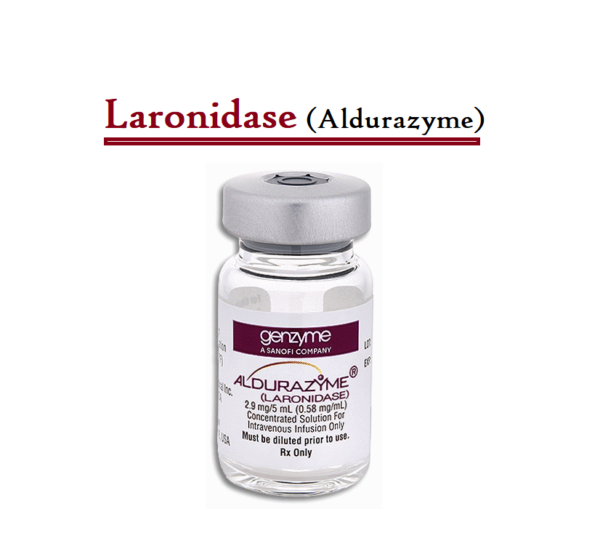
Laronidase (Aldurazyme) is a recombinant alpha-L-iduronidase enzyme that is responsible for the degradation of GAGs (Glycosaminoglycans) within the lysosomes.
Laronidase Uses:
-
Mucopolysaccharidosis I (Hurler syndrome, Hurler-Scheie, and Scheie forms):
- Used for treatment of Hurler and Hurler-Scheie forms of mucopolysaccharidosis I (MPS I); treatment of Scheie form of MPS I in patients with symptoms of moderate to severe intensity
Laronidase (Aldurazyme) Dose in Adults:
Note: Premedicate with antipyretic and/or antihistamines 1 hour prior to the start of infusion.
Laronidase (Aldurazyme) Dose in the treatment of MPS I (Hurler syndrome, Hurler-Scheie, and Scheie forms):
- IV: 0.58 mg/kg once a week; round up the dose to the nearest whole vial
Laronidase (Aldurazyme) Dose in Childrens:
Note: 1 hour prior to the start of infusion patient should be pre-medicated with antipyretics and/or antihistamines.
Laronidase (Aldurazyme) Dose in the treatment of Mucopolysaccharidosis I (Hurler syndrome, Hurler-Scheie, and Scheie forms):
-
Infants ≥6 months, Children, and Adolescents:
- IV: 0.58 mg/kg/dose once a week; round up the dose to the nearest whole vial
Pregnancy Risk Factor B
- There is limited information available about the pregnancy use of laronidase.
- Pregnant patients are encouraged to enroll in the MPS I registry (800-745-4447 or www.registrynxt.com).
Use during breastfeeding:
- It is not known if it is present in breast milk.
- There is limited information available about breastfeeding and laronidase.
- The manufacturer recommends caution when administering laronidase for nursing women.
- Breastfeeding women are encouraged to enroll in the MPS I registry (800-7454447 or www.registrynxt.com).
Dose in Kidney Disease:
No dosage adjustments are provided in the manufacturer's labeling.
Dose in Liver disease:
No dosage adjustments are provided in the manufacturer's labeling.
Unless otherwise noted, adverse reactions were reported in patients more than six years of age.
Common Side Effects of Laronidase (Aldurazyme):
-
Cardiovascular:
- Flushing
- Venous Irritation
-
Central Nervous System:
- Chills
- Hyperreflexia
- Paresthesia
-
Dermatologic:
- Skin Rash
-
Immunologic:
- Antibody Development
-
Local:
- Injection Site Reaction
-
Otic:
- Otitis Media
-
Respiratory:
- Upper Respiratory Tract Infection
-
Miscellaneous:
- Infusion-Related Reaction
- Fever
Less Common Side Effects of Laronidase (Aldurazyme):
-
Cardiovascular:
- Hypertension
- Oxygen Saturation Decreased
- Tachycardia
- Chest Pain
- Edema
- Facial Edema
- Hypotension
- Hot And Cold Flashes
-
Central Nervous System:
- Headache
-
Dermatologic:
- Pallor
- Pruritus
- Urticaria
- Hyperhidrosis
-
Gastrointestinal:
- Abdominal Pain
- Abdominal Distress
- Diarrhea
- Vomiting
-
Hematologic & Oncologic:
- Thrombocytopenia
-
Hepatic:
- Hyperbilirubinemia
-
Hypersensitivity:
- Severe Hypersensitivity
-
Local:
- Abscess At Injection Site
- Pain At Injection Site
-
Neuromuscular & Skeletal:
- Tremor
- Arthralgia
- Back Pain
- Musculoskeletal Pain
-
Ophthalmic:
- Corneal Opacity
-
Respiratory:
- Rales
- Respiratory Distress
- Wheezing
- Bronchospasm
- Cough
- Dyspnea
Contraindications to Laronidase (Aldurazyme):
- The US labeling of the manufacturer does not contain any contraindications.
Canadian labeling:
- Hypersensitivity severe
Warnings and precautions
-
Hypersensitivity/anaphylactoid reactions: [US Boxed Warning]:
- Infusion reactions can be severe. If you have hypersensitivity reactions, immediate treatment should be given.
- Patients suffering from compromised pulmonary function and acute respiratory disease may need additional monitoring.
- They may be at greater risk of acute exacerbation or worsening of their symptoms due to an infusion reaction.
- The most common reactions are airway obstruction, bradycardia and bronchospasm as well as hypotension, hypoxia and hypotension. These can all occur within the first three hours after administration.
- Infusions should be stopped immediately if severe reactions occur. During administration, medical assistance should be available.
- After a severe hypersensitivity reaction, it is important to carefully weigh the risks and benefits of re-administration.
- Patients who have severe reactions may need to be monitored for a longer time.
- Consider caution when considering the use of epinephrine for anaphylaxis. Many patients with MPSI may already have a cardiac condition.
-
Infusion reactions
- Patients with acute febrile/respiratory illnesses should exercise caution and delay treatment as they may experience infusion-related reactions.
- Pre-medicate with antipyretics or antihistamines.
- Infusion reactions can be managed by reducing the rate of infusion, temporarily discontinuing infusions, and/or using additional antipyretics or antihistamines.
-
Fluid overload:
- Patients at high risk of fluid overload, or those with compromised cardiac and/or respiratory function should be cautious.
- Extended observation may be required for some patients
-
MPS-I
- Patients with mild symptoms of the Scheie type of MPS-I have not been recommended for use.
- It is not recommended for the CNS manifestations.
-
Sleep Apnea
- Patients with sleep apnea should not use it. Before initiating therapy, patients should be evaluated.
- Infusions or the use of sedating Antihistamines should provide treatment options for apnea such as CPAP and supplemental oxygen.
Monitoring parameters:
- Vital signs
- FVC
- Height
- Weight
- Range of motion
- Serum antibodies to alpha-L-iduronidase
- Urine levels of glycosaminoglycans (GAG)
- Changes in liver size
How to administer Laronidase (Aldurazyme)?
IV:
- Use an infusion set with low protein-binding and 0.2-micrometer in-line filter for administration.
- Administer antipyretics and/or antihistamines 60 minutes prior to infusion.
- Volume and infusion rate are body weight-based; infusion should be delivered over almost 3 to 4 hours.
- An initial 10 mcg/kg/hour infusion rate may be increased incrementally every fifteen minutes during the 1st hour if tolerated (see below); the rate should be increased to a maximum infusion rate of 200 mcg/kg/hour which should be maintained for the rest of the infusion (~3 hours).
- If stable monitor vital signs every 15 minutes.
- Decrease the rate of infusion, temporarily discontinue the infusion, and/or administer additional antipyretics/antihistamines in case of infusion-related reaction in any patient.
The manufacturer has provided the following infusion rate information for patients receiving usual preparation:
- ≤20 kg: Total infusion volume: 100 mL
- 2 mL/hour for 15 minutes
- 4 mL/hour for 15 minutes
- 8 mL/hour for 15 minutes
- 16 mL/hour for 15 minutes
- 32 mL/hour for remainder of infusion (~3 hours)
- >20 kg: Total infusion volume: 250 mL
- 5 mL/hour for 15 minutes
- 10 mL/hour for 15 minutes
- 20 mL/hour for 15 minutes
- 40 mL/hour for 15 minutes
- 80 mL/hour for the remainder of infusion (~3 hours)
Note: For patients with cardiac or respiratory compromise who weigh up to 30 kg, a total infusion volume of 100 mL Normal saline and slower infusion rate may be considered.
Mechanism of action of Laronidase (Aldurazyme):
- It is generated from Chinese hamster cells and is a recombinant form (replacement version) of alpha-Liduronidase.
- Alpha-L-iduronidase, an enzyme that degrades endogenous glycosaminoglycans within lysosomes, is a lysosomal enzyme.
- A deficiency in alpha-Liduronidase can lead to accumulation of GAGs that cause cellular, tissue and organ dysfunction.
- Patients with Hurler, Hurler Scheie, or Scheie have had their pulmonary function and walking ability improve by administering laronidase.
Half-life elimination:
- Infants and children 6 months to 5 Years: 0.3-1.9 Hours
- 1.5 to 3.6 hours for adults and children >= 6 years
Excretion
- Clearance for Infants and Children 6 Months to 5 Years: 2.2-7.7 ML/min/kilogram
- Clearance for children older than 6 years old and adults: Clearance: 1.7 to 2.7 mL/min/kilogram.
- The amount of antibodies that a patient develops against laronidase during the first 12 weeks of treatment will affect the rate at which the enzyme is cleared.
- Clearance of laronidase is not affected by antibody titers if the treatment lasts for more than 26 weeks.
International Brand Names of Laronidase:
- Aldurazyme
Laronidase Brand Names in Pakistan:
No Brands Available in Pakistan.
.png)


