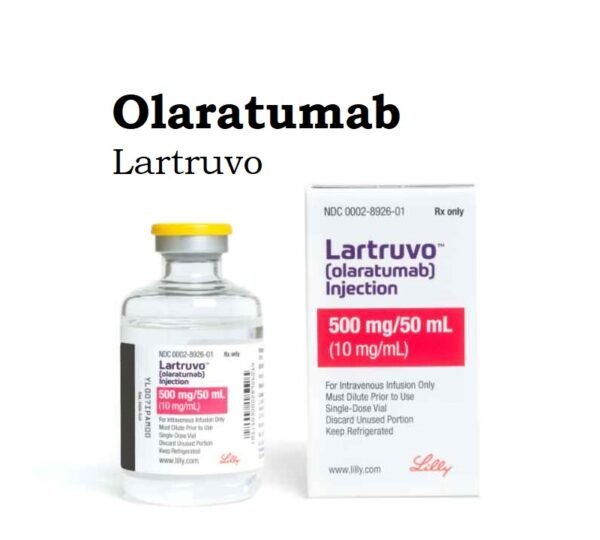
Lartruvo (Olaratumab) inhibits platelet-derived growth factor-alpha. It was used in the treatment of soft tissue sarcomas, however, because of minimal clinical advantage, the drug is being withdrawn from the market [Ref].
Lartruvo (Olaratumab) Uses:
-
Soft tissue sarcoma:
- With soft tissue sarcoma (STS) treatment (in combination with doxorubicin) of adults with a histologic subtype for which an anthracycline-containing regimen is appropriate & which is not amenable to curative treatment with radiotherapy or surgery.
Note:
- In patients, a phase III confirmatory trial with unresectable locally advanced or metastatic STS comparing olaratumab plus doxorubicin to placebo plus doxorubicin found no improvement in overall survival due to the addition of olaratumab to doxorubicin.
- The manufacturer is withdrawing olaratumab from the market due to the trial results.
Lartruvo (Olaratumab) Dose in Adults
Note:
- In patients, a phase III confirmatory trial with unresectable locally advanced or metastatic soft tissue sarcoma comparing olaratumab plus doxorubicin to placebo plus doxorubicin found no improvement in overall survival due to the addition of olaratumab to doxorubicin.
- The manufacturer is withdrawing olaratumab from the market due to the trial results.
Lartruvo (Olaratumab) Dose in the treatment of Soft tissue sarcoma:
- IV:
- For 8 cycles, 15 milligram/kilogram on days 1 and 8 every 3 weeks (in combination with doxorubicin) .
- After 8 cycles are completed, until disease progression or unacceptable toxicity,
- Continue olaratumab (as a single agent) .
- To reduce the potential for doxorubicin-related cardiotoxicity, Dexrazoxane was allowed on day 1 of cycles 5 to 8 (Tap 2016).
-
Premedications:
- On day 1 of cycle 1, prior to olaratumab, premedicate with diphenhydramine (25 to 50 milligram IV) and dexamethasone (10 to 20 milligram IV) .
Lartruvo (Olaratumab) Dose in Childrens
The safety and efficacy of the drug in children have not been established
Olaratumab Pregnancy Risk Category: N (Not assigned)
- Based on the mechanism of action, Olaratumab could cause fetal harm to a pregnant woman.
- Females with reproductive potential should use effective contraception during therapy and for at most 3 months following the last olaratumab treatment.
Use of Olaratumab while breastfeeding
- It is unknown if olaratumab can be found in breast milk.
- The manufacturer does not recommend breastfeeding during therapy or for three months after the last dose. This is because of the risk of serious adverse reactions in breastfed babies.
Lartruvo Dose in Kidney Disease:
-
CrCl 30 to 89 mL/minute:
- In the manufacturer’s labeling, there are no dosage adjustments provided.
- However, on olaratumab pharmacokinetics, mild to moderate impairment has no clinically relevant impact.
-
CrCl <30 mL/minute:
- In the manufacturer’s labeling, there are no dosage adjustments provided (has not been studied).
Lartruvo Dose in Liver Disease:
- Mild (total Bilirubin within normal limits and AST greater than 1.5 times the upper limit of normal [ULN]) to moderate (totalbilirubin>1.5 to 3 times the ULN or any AST) impairment
- There are no dosage adjustments in the manufacturer's labeling.
- Mild to moderate impairment is not clinically relevant, according to olaratumab's pharmacokinetics.
-
Severe impairment (total Bilirubin >3x ULN or any AST)
- There are no dosage adjustments in the manufacturer's labeling (has not been tested).
Common Side Effects of Olaratumab (Lartruvo):
-
Central Nervous System:
- Fatigue
- Neuropathy
- Headache
- Anxiety
-
Dermatologic:
- Alopecia
-
Endocrine & Metabolic:
- Hyperglycemia
- Hypokalemia
- Hypophosphatemia
- Hypomagnesemia
-
Gastrointestinal:
- Nausea
- Mucositis
- Vomiting
- Diarrhea
- Decreased Appetite
- Abdominal Pain
-
Hematologic & Oncologic:
- Lymphocytopenia
- Neutropenia
- Thrombocytopenia
- Prolonged Partial Thromboplastin Time
-
Hepatic:
- Increased Serum Alkaline Phosphatase
-
Neuromuscular & Skeletal:
- Musculoskeletal Pain
-
Ophthalmic:
- Xerophthalmia
-
Miscellaneous:
- Infusion Related Reaction
Less Common Side Effects of Olaratumab (Lartruvo):
-
Immunologic:
- Development of IgG antibodies
Contraindications to Olaratumab (Lartruvo):
- There are no contraindications in the US manufacturer's labeling.
Canadian labeling:
- Hypersensitivity to olaratumab and any component of the formula
Warnings and precautions
-
Toxicity to the GI:
- Patients treated with olaratumab or doxorubicin have a higher rate of Nausea and vomiting, diarrhea, mucositis and abdominal pain than patients who were only given doxorubicin.
-
Hematologic toxicities:
- Patients treated with olaratumab or doxorubicin had a higher incidence for grade 3 and 4 lymphopenia, respectively, than patients who received doxorubicin only.
- The combination arm had an even higher incidence than all grades.
-
Infusion reaction
- Infusion reactions are associated with Olaratumab.
- The 2nd or 1st cycle was the most common for infusion reactions.
- Grade 3 and higher reactions, including a fatal case, have been reported.
- Infusion reactions can cause fever/chills, flushing, dyspnea and bronchospasm.
- Hypotension, anaphylactic shock or cardiac arrest are all possible severe cases.
- It is highly recommended to use diphenhydramine and dexamethasone for medication.
- You should look out for signs/symptoms that indicate infusion reactions, both during and after the infusion. Resuscitation equipment should always be available.
- You may need to interrupt treatment (followed up by a rate reduction) or discontinue your medication.
Olaratumab: Drug Interaction
|
Risk Factor C (Monitor therapy) |
|
|
Chloramphenicol (Ophthalmic) |
May enhance the adverse/toxic effect of Myelosuppressive Agents. |
|
CloZAPine |
Myelosuppressive Agents may enhance the adverse/toxic effect of CloZAPine. Specifically, the risk for neutropenia may be increased. |
|
Mesalamine |
May enhance the myelosuppressive effect of Myelosuppressive Agents. |
|
Promazine |
May enhance the myelosuppressive effect of Myelosuppressive Agents. |
|
Risk Factor D (Consider therapy modification) |
|
|
Deferiprone |
Myelosuppressive Agents may enhance the neutropenic effect of Deferiprone. Management: Avoid the concomitant use of deferiprone and myelosuppressive agents whenever possible. If this combination cannot be avoided, monitor the absolute neutrophil count more closely. |
|
Risk Factor X (Avoid combination) |
|
|
BCG (Intravesical) |
Myelosuppressive Agents may diminish the therapeutic effect of BCG (Intravesical). |
|
Cladribine |
May enhance the myelosuppressive effect of Myelosuppressive Agents. |
|
Dipyrone |
May enhance the adverse/toxic effect of Myelosuppressive Agents. Specifically, the risk for agranulocytosis and pancytopenia may be increased |
Monitoring Parameters:
- CBC with differential.
- Examine for signs/symptoms of infusion reactions.
How to administer Olaratumab (Lartruvo)?
Intravenous:
- For more than 60 minutes, infuse.
- You should not use an IV push or bolus.
- After infusion is complete, flush the IV line using normal saline.
- Do not administer electrolytes or any other medication through the same IV line.
- If refrigerated, allow infusion solution to reach room temp before administering.
- If the solution is properly stored, infusion must be completed within 28-hours.
Mechanism of action of Olaratumab (Lartruvo):
- Olaratumab, a human (recombinant IgG1 antibody, binds to platelet derived growth receptor alpha. (PDGFRa). This prevents binding of PDGFAA, PDGFBB, & PDGFCC & blocks receptor activation & disrupts PDGF receptor signaling.
- The PDGF alpha receptor plays a key role in cell growth and differentiation and has been shown to have antitumor properties in sarcomas.
Half-life, elimination:
- ~11 days (range: 6 to 24 days)
International Brands of Olaratumab:
- Lartruvo
Olaratumab Brand Names in Pakistan:
No Brands Available in Pakistan.
.png)


