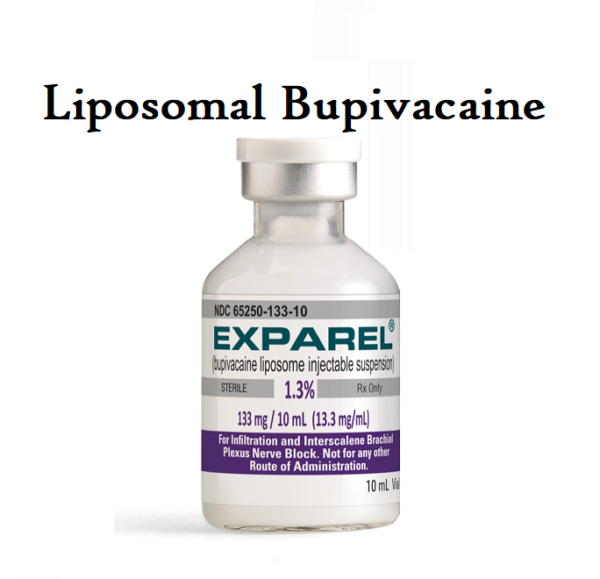
Liposomal bupivacaine (Exparel) is a long-acting anesthetic drug that is used to relieve post-surgical pain when injected directly into the surgical site.
Liposomal bupivacaine Uses:
-
Postsurgical Analgesia:
- Single-dose infiltration is done in adults to produce postsurgical local analgesia and as an interscalene brachial plexus nerve block to produce postsurgical regional analgesia.
Liposomal bupivacaine (Exparel) Dose in Adults:
Note: Bupivacaine (liposomal) is not bioequivalent to bupivacaine hydrochloride; dosing conversion from bupivacaine hydrochloride to bupivacaine (liposomal) or vice versa is not possible.
Liposomal bupivacaine (Exparel) Dose in postsurgical Analgesia:
-
Local anesthesia:
- Infiltration: Single dose: Dose is based on the following
- Surgical site size
- The volume required to cover the area
- Individual patient factors (maximum dose: 266 mg [20 mL])
- General dosage guidance for bunionectomy and hemorrhoidectomy is given below:
- Infiltration: Single dose: Dose is based on the following
-
Bunionectomy:
- In the tissues surrounding the osteotomy, 7 mL of undiluted bupivacaine (liposomal) infiltrated, and in the subcutaneous tissue of the surgical site, 1 mL of undiluted bupivacaine (liposomal) infiltrated (total dose = 106 mg [8 mL])
-
Hemorrhoidectomy:
- Around the anal sphincter, 30 mL of diluted bupivacaine (liposomal) (20 mL diluted with 10 mL NS) divided and infiltrated as 6 injections of 5 mL each (total dose = 266 mg [20 mL]).
Liposomal bupivacaine (Exparel) Dose in Regional analgesia:
- Interscalene brachial plexus nerve block: Single dose:
- Total shoulder arthroplasty or rotator cuff repair: 133 mg (10 mL)
Use in Children:
Not indicated.
Pregnancy Risk Category: C
- Animal reproduction studies have seen adverse events.
- Bupivacaine crosses the placenta.
- It is not recommended for pregnant women.
- Contraindicated in obstetrical paracervical anesthesia. May cause bradycardia or death of the foetus.
Use during breastfeeding:
- Breast milk contains buprevacaine.
- These points are recommended by the manufacturer when deciding whether to continue breastfeeding or stop it during therapy.
- Infant exposure is a risk
- Breastfeeding is good for the infant
- Mothers can reap the benefits of mother-to-child treatment
Dose in Kidney Disease:
No dosage adjustments have been provided in the manufacturer’s labeling; use cautiously; bupivacaine metabolism may be reduced in severe renal impairment and systemic exposure and the risk of adverse effects or toxicities may be increased.
Dose in Liver disease:
No dosage adjustments have been provided in the manufacturer’s labeling; use cautiously; bupivacaine metabolism may be reduced in severe hepatic impairment and systemic exposure and the risk of adverse effects or toxicities may be increased.
Common Side Effects of Liposomal bupivacaine (Exparel):
-
Central nervous system:
- Motor dysfunction
-
Gastrointestinal:
- Nausea
- Vomiting
- Constipation
-
Miscellaneous:
- Fever
Less Common Side Effects of Liposomal bupivacaine (Exparel):
-
Cardiovascular:
- Hypertension
- Hypotension
- Procedural Hypotension
- Tachycardia
- Peripheral Edema
- Sinus Tachycardia
- Atrial Fibrillation
- Bradycardia
- Bundle Branch Block
- Cardiac Arrhythmia
- Deep Vein Thrombosis
- Edema
- First Degree Atrioventricular Block
- Oxygen Saturation Decreased
- Orthostatic Hypotension
- Palpitations
- Presyncope
- Prolonged QT Interval On ECG
- Sinus Bradycardia
- Supraventricular Extrasystole
- Syncope
- Ventricular Premature Contractions
- Ventricular Tachycardia
-
Central Nervous System:
- Insomnia
- Procedural Pain
- Headache
- Dizziness
- Confusion
- Fatigue
- Drowsiness
- Hypoesthesia
- Anxiety
- Sensation Of Cold
- Falling
- Feeling Hot
- Mobility Disorder
- Sensation Disorder
- Agitation
- Chills
- Delirium
- Depression
- Hyperthermia
- Myasthenia
- Pain
- Paresthesia
- Restlessness
- Sedation
- Lethargy
-
Dermatologic:
- Hyperhidrosis
- Pruritus
- Cellulitis
- Diaphoresis
- Erythema
- Increased Wound Secretion
- Pallor
- Pruritic Rash
- Skin Blister
- Skin Rash
- Urticaria
-
Gastrointestinal:
- Dysgeusia
- Oral Hypoesthesia
- Hiccups
-
Genitourinary:
- Urinary Retention
- Dysuria
- Urinary Incontinence
-
Hematologic & Oncologic:
- Acute Post Hemorrhagic Anemia
- Anemia
- Bruise
- Hematoma
- Leukocytosis
- Postoperative Hematoma
-
Hepatic:
- Increased Liver Enzymes
- Increased Serum Aspartate Aminotransferase
- Increased Serum Alanine Aminotransferase
-
Hypersensitivity:
- Fixed Drug Eruption
- Hypersensitivity Reaction
-
Infection:
- Fungal Infection
-
Local:
- Localized Edema
-
Neuromuscular & Skeletal:
- Back Pain
- Muscle Spasm
- Muscle Twitching
- Arthralgia
- Asthenia
- Joint Swelling
- Laryngospasm
- Musculoskeletal Pain
- Neck Pain
- Tremor
-
Ophthalmic:
- Blurred Vision
- Decreased Visual Acuity
-
Otic:
- Auditory Impairment
- Tinnitus
-
Renal:
- Increased Serum Creatinine
-
Respiratory:
- Hypoxia
- Apnea
- Atelectasis
- Cough
- Dyspnea
- Pulmonary Infiltrates
- Pneumonia
- Pulmonary Infection
- Respiratory Depression
- Respiratory Failure
-
Miscellaneous:
- Procedural Complications
- Dehiscence
Contraindications to Liposomal bupivacaine (Exparel):
Anesthesia for obstetrical paracervical blocks
Warnings and precautions
-
CNS effects
- CNS effects, including excitation and/or depression, may cause convulsions, unconsciousness and/or respiratory arrest.
- CNS effects can be caused by the following:
- The total amount of medication taken
- Route of administration
- The patient's physical condition
- After each injection, the patient should be closely monitored for any CNS-related changes.
- Local anesthesia may also cause irreversible neurologic effects due to infiltration of soft tissues (persistent Anesthesia, Paresthesia Weakness, Paralysis).
-
CNS toxicity:
- Monitor the patient's consciousness after each local anesthetic injection.
- The signs of CNS toxicities include restlessness, anxiety and lightheadedness.
- Temporary motor and sensory loss can occur. It may last for up to five days.
-
Cardiovascular toxicity:
- Toxic concentrations can cause serious and fatal cardiovascular system reactions, such as decreased cardiac output, arterial blood pressure, ventricular arrhythmias and cardiac arrest.
-
Hypersensitivity reactions
- These include:
- Allergy-type reactions include dizziness, hyperthermia, increased temperature, excessive sweating and nausea.
- An allergy like symptoms (including severe hypotension, rare)
- Cross-sensitivity between amide-type local anesthetics
- These include:
-
Infusion-related intra-articular chondrolysis
- Continuous intra-articular injection of local anesthetics after arthroscopic surgery or other procedures is not permitted. Infusions chondrolysis, which occurs primarily in the shoulder joint, may require arthroplasty.
-
Methemoglobinemia:
- Methemoglobinemia has been reported in cases following the administration of local anesthetics.
- In the case of clinically significant methemoglobinemia, immediate treatment is necessary.
- After anesthesia exposure, there may be an immediate (or delayed) onset.
- Patients in the following groups are more vulnerable and should be monitored closely for signs and symptoms such as cyanosis and headaches.
- Patients suffering from G6PD deficiency
- Congenital and idiopathic methemoglobinemia
- Cardiac and pulmonary compromise
- Exposition to oxidizing agents and their metabolites
- Infants younger than 6 months
-
Respiratory arrest
- After the administration of local anesthetics, a sudden respiratory arrest can occur (rarely).
-
Seizures:
- Convulsions due systemic toxicities leading to cardiac arrest can be caused by local anesthesia.
-
Cardiovascular disease
- Patients with heart disease should be cautious; bupivacaine can prolong AV conduction, which causes functional changes that are less compensable in patients with impaired cardiovascular function.
-
Hepatic impairment
- Patients with severe hepatic impairment should be cautious. There may be an increased risk of toxicities in these patients.
-
Renal impairment
- Patients with impaired renal function should be cautious; there could be an increased risk of toxicities.
Liposomal bupivacaine: Drug Interaction
Note: Drug Interaction Categories:
- Risk Factor C: Monitor When Using Combination
- Risk Factor D: Consider Treatment Modification
- Risk Factor X: Avoid Concomitant Use
Risk Factor C (Monitor therapy). |
|
| Hyaluronidase | Local anesthetics can have toxic or adverse effects that may be increased. |
| Methemoglobinemia associative Agents | Local anesthetics can have more harmful/toxic side effects. Methemoglobinemia risk may increase. |
| Neuromuscular-Blocking Agents | The neuromuscular-blocking effect of Neuromuscular-Blocking Agents may be enhanced by Local Anesthetics. |
| Technetium Tc 99m Tilmanocept | Technetium Tc99m Tilmanocept can be reduced by local anesthetics. Management: Avoid simultaneous co-injecting technetium Tc99m tilmanocept and local anesthetics. This interaction appears to not apply to other combinations of these agents. |
Risk Factor D (Consider therapy modifications) |
|
| Bupivacaine | Liposomal Bupivacaine can have toxic or adverse effects. Management: Bupivacaine may be administered immediately prior to or in the same admixture syringe with liposomal bupivacaine. However, the ratio of the milligram dosage of bupivacaine and liposomal bupivacaine must not exceed 1:1. |
| Lidocaine (Systemic) | Bupivacaine (Liposomal), may have more toxic/adverse effects. Management: Avoid using topical lidocaine with Liposomal Buvacaine. After lidocaine administration, Liposomal buvacaine may be administered for up to 20 minutes. |
Risk Factor X (Avoid Combination) |
|
| Local Anesthesia | Liposomal Bupivacaine can have toxic or adverse effects that may be increased. Management: Avoid administering Liposomal Bupinacaine with local anesthetics. You may administer Liposomal bupivacaine for up to 20 minutes after administration of lidocaine. However, the optimal time to separate doses of other local anesthetics such as Benzocaine or Benzydamine is not known. |
Monitoring parameters:
- Cardiovascular status
- Respiratory status (adequacy of ventilation)
- State of consciousness
- Signs of CNS toxicity
- Pain relief
How to administer Liposomal bupivacaine (Exparel)?
- It may be administered undiluted or diluted. Should be injected slowly (1 to 2 mL per injection) into the surgical site using a ≥25 gauge needle and frequent aspirations should be done prior to and during administration; should not be filtered.
- It should not be administered epidurally, intrathecally, intravascularly, intra-articularly, or as a regional nerve block (except interscalene brachial plexus nerve block).
- Bupivacaine should not be allowed (liposomal) to come into contact with antiseptics (eg, povidone-iodine) in solution; when a topical antiseptic is applied, the application site should be allowed to dry prior to injection.
- Non-bupivacaine-based local anesthetics may cause bupivacaine (liposomal) to release immediately if administered together locally; therefore, after injection of lidocaine, administer bupivacaine no sooner than 20 minutes.
- Other local anesthetics or other formulations of bupivacaine should not be administered within 96 hours following bupivacaine (liposomal) administration; ma administer bupivacaine hydrochloride simultaneously in the same syringe or injected immediately before bupivacaine (liposomal) as long as the milligram ratio of bupivacaine hydrochloride to bupivacaine (liposomal) does not exceed 1:2.
Mechanism of action of Liposomal bupivacaine (Exparel):
- After the administration of liposomal buprevaine, the initiation and conduction nerve impulses are blocked by decreasing the neuronal membrane’s permeability for sodium ions.
- This causes inhibition of depolarization and conduction blockade.
Initial:
- Action is quick.
Time:
- 72 hours when administered locally. In the case of systemic, plasma levels may persist for up to 96 hours after local administration. 120 hours after interscalenebrachial plexus nerve blocking.
Absorption
- Systemic absorption can vary depending on the dosage, route and vascularity at the site of administration.
Protein binding:
- Highly protein-bound (95%)
Metabolism:
- Via conjugation reaction within the liver; pipecoloxylidine is the major metabolite (PPX; inactive).
Half-life elimination:
- 13 to 34 hours
Time to peak, plasma:
- Initial peak is within 1 hour while the second peak is within 12 to 36 hours
Excretion:
- Via Urine (~6% unchanged)
International Brand Names of Liposomal bupivacaine:
- Exparel
Liposomal bupivacaine Brand Names in Pakistan:
No Brands Available in Pakistan.
.png)