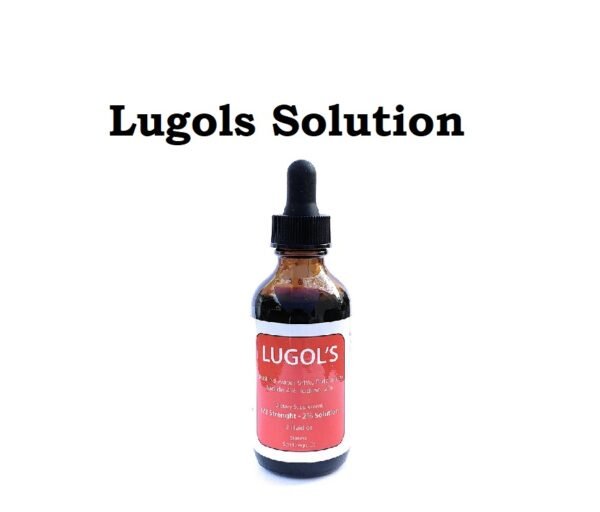
Lugols Solution contains elemental Iodine and Potassium iodide. It is used in the management of thyroid storm and thyrotoxic crises.
Potassium iodide and iodine Uses:
-
Antiseptic:
- Topical antiseptic
-
Thyroidectomy preparation:
- Treatment of hyperthyroidism in the immediate preoperative period in patients who are undergoing thyroidectomy.
Note:
- Iodine therapy is not recommended in the preoperative setting in patients with thyrotoxicosis caused by a toxic adenoma or toxic multinodular goiter due to the risk of exacerbating hyperthyroidism.
-
Thyroid storm:
- Treatment of thyroid storm (as part of a multimodality treatment approach).
Note:
- The American Thyroid Association and American Association of Clinical Endocrinologists guidelines for the management of hyperthyroidism and other causes of thyrotoxicosis suggest potassium iodide and iodine (Lugol's solution) as an acceptable replacement to a saturated solution of potassium iodide (SSKI) in the treatment of adults with thyrotoxic crisis and thyroid storm.
-
Off Label Use of Potassium iodide and iodine Adults:
- Thyroid gland protection during radiopharmaceutical use
Lugols Solution Dose in Adults
Note:
- Lugol's 5% solution (potassium iodide 10% and iodine 5%) contains about ~6.25 mg iodine/iodide per drop.
Lugols Solution Dose as Antiseptic:
- Topical: Apply directly to area(s) requiring antiseptic.
Lugols Solution Dose in treatment of Thyroidectomy preparation in patients with Graves disease: Lugol's 5% solution:
- Oral:
- 5 to 7 drops (0.25 to 0.35 mL) 3 times a day;
- administer for 10 days before surgery;
- if not euthyroid before surgery, consider concurrent beta-blockade (eg, propranolol) in the immediate preoperative period to reduce the risk of thyroid storm.
Lugols Solution Dose in the treatment of Thyroid gland protection during radiopharmaceutical use (off-label): Lugol's 5% solution:
- Oral:
- Regimens/protocols vary by radiopharmaceutical.
- Generally, about ~100 mg/day of iodine/iodide is required for thyroid block.
- This dose can be achieved with approximately ~16 drops/day of Lugol's 5% solution (eg, 16 drops x 6.25 mg iodine/iodide per drop = 100 mg iodine/iodide).
- The following product-specific recommendations are provided in the drug manufacturer's labeling:
- Iodine I-123 radiopharmaceuticals: 100 mg/day of iodine/iodide (drug manufacturer's labeling.
- Iodine I-125 and I-131 radiopharmaceuticals: 10 drops 3 times a day (drug manufacturer's labeling).
- The manufacturer's labeling for Azedra does not provide specific dosing recommendations.
Note:
- Initiate 1 to 48 hours before radio-pharmaceutical exposure and continue after radio-pharmaceutical administration til risk of exposure has diminished (treatment initiation time and duration are dependent on the radiopharmaceutical agent used, consult specific protocol or labeling.
Lugols Solution Dose in the treatment of Thyrotoxic crisis and thyroid storm: Lugol's 5% solution:
- Oral:
- 4 to 8 drops 3-4 times a day;
- initiate therapy at least 1 hour after the initial dose of anti-thyroid drug therapy (eg, propylthiouracil, methimazole)
Lugols Solution Dose in Childrens
Note:
- Dosing is listed in terms of drops/dose; check instructions carefully before dispensing or administering.
Lugols Solution Dose in the treatment of Thyrotoxic crisis and Thyroid storm:
-
Children and Adolescents:
-
Lugol's solution:
- Oral: 4 to 10 drops 3 times a day; begin therapy preferably 2 hours following the initial dose of either propylthiouracil or methimazole.
-
Lugols Solution Pregnancy Risk Factor D
- Iodide can cross the placenta (may lead to hypothyroidism or goiter in the fetus/newborn).
- Prophylaxis for thyroid carcinomas secondary radioactive iodine radiation exposure is acceptable.
- This assessment considers the risk to benefit ratio, taking into account the dose and duration.
- If possible, avoid repeat dosing.
- For more information, see Iodine
Use of potassium iodide or iodine during breastfeeding
- The maternal intake of potassium isodide has been linked to skin rash in nursing infants.
- For more information, refer to the Iodine monograph
Lugols solution Dose in Kidney disease:
- There are no dosage adjustments provided in the drug manufacturer's labeling.
Lugols Solution Dose in Liver disease:
- There are no dosage adjustments provided in the drug manufacturer's labeling.
Side effects of Lugols solution:
-
Cardiovascular:
- Cardiac Arrhythmia
- Myxedema
-
Central Nervous System:
- Confusion
- Fatigue
- Metallic Taste
- Numbness
- Tingling Sensation
-
Dermatologic:
- Skin Rash
-
Endocrine & Metabolic:
- Goiter
- Hyperthyroidism
- Hypothyroidism
-
Gastrointestinal:
- Diarrhea
- Enlargement Of Salivary Glands
- Gastric Distress
- Gastrointestinal Hemorrhage
- Nausea
- Salivary Gland Disease (Tenderness)
- Stomach Pain
- Vomiting
-
Hematologic & Oncologic:
- Adenopathy
- Thyroid Adenoma
-
Hypersensitivity:
- Hypersensitivity Reaction (Angioedema
- Cutaneous And Mucosal Hemorrhage
- Serum Sickness-Like Symptoms)
-
Neuromuscular & Skeletal:
- Arthralgia
- Weakness
-
Respiratory:
- Pharyngeal Edema
-
Miscellaneous:
- Drug Overdose (With Prolonged Treatment/High Doses)
- Fever
- Iodism
Contraindications to Lugols Solution (Potassium iodide and iodine):
- Hypersensitivity/Allergy to iodine or any component of the formulation;
- Active tuberculosis
- dermatitis herpetiformis;
- Hypocomplementemic vasculitis
- Nodular thyroid disease and heart disease
Warnings and precautions
-
Hypothyroidism:
- Hypothyroidism can result from prolonged use.
-
Reactions to skin:
- It can lead to acne flare-ups or dermatitis.
-
Insufficiency of the adrenals:
- Patients with Addison’s disease should be cautious.
-
Bronchitis
- Patients with acute bronchitis should be cautious.
-
Cardiac disease
- Patients with heart disease should be cautious.
-
Myotonia congenita:
- Patients with myotonia congenita should be cautious.
-
Renal impairment
- Patients with impaired renal function should be cautious.
-
Thyroid disease:
- Patients with hyperthyroidism should be cautious. Use caution if you have heart disease or nodular thyroid conditions.
-
Tuberculosis
- Patients with tuberculosis should be cautious.
Potassium iodide and iodine (Lugol solution): Drug Interaction
|
Aliskiren |
Potassium Salts may enhance the hyperkalemic effect of Aliskiren. |
|
Angiotensin II Receptor Blockers |
Potassium Salts may enhance the hyperkalemic effect of Angiotensin II Receptor Blockers. |
|
Angiotensin-Converting Enzyme Inhibitors |
Potassium Salts may enhance the hyperkalemic effect of Angiotensin-Converting Enzyme Inhibitors. |
|
Cardiac Glycosides |
Antithyroid Agents may increase the serum concentration of Cardiac Glycosides. |
|
Drospirenone |
Potassium Salts may enhance the hyperkalemic effect of Drospirenone. |
|
Heparin |
May enhance the hyperkalemic effect of Potassium Salts. |
|
Heparins (Low Molecular Weight) |
May enhance the hyperkalemic effect of Potassium Salts. |
|
Lithium |
Potassium Iodide may enhance the hypothyroid effect of Lithium. |
|
Nicorandil |
May enhance the hyperkalemic effect of Potassium Salts. |
|
Theophylline Derivatives |
Antithyroid Agents may increase the serum concentration of Theophylline Derivatives. Exceptions: Dyphylline. |
|
Eplerenone |
May enhance the hyperkalemic effect of Potassium Salts. Management: This combination is contraindicated in patients receiving eplerenone for treatment of hypertension. |
|
Potassium-Sparing Diuretics |
Potassium Salts may enhance the hyperkalemic effect of Potassium-Sparing Diuretics. |
|
Vitamin K Antagonists (eg, warfarin) |
Antithyroid Agents may diminish the anticoagulant effect of Vitamin K Antagonists. |
|
Sodium Iodide I131 |
Antithyroid Agents may diminish the therapeutic effect of Sodium Iodide I131. Management: Discontinue antithyroid therapy 3-4 days prior to sodium iodide I-131 administration. |
Monitoring parameters:
- Thyroid function tests,
- signs/symptoms of hyperthyroidism;
- following radioiodine exposure, thyroid function should be monitored in pregnant women, neonates, and young infants if repeat doses are required.
How to administer Lugols solution (Potassium iodide and iodine)?
- Topical: Apply topically directly to area(s) requiring antiseptic.
- Oral: Dilute with water or juice.
Mechanism of action of Lugols Solution (Potassium iodide and iodine):
- Iodine temporarily blocks thyroid hormone synthesis in hyperthyroidism. It also inhibits thyroid hormone secretion into circulation.
- The serum T and T concentrations may be decreased for several weeks, but not maintained.
- Potassium iodide is a potassium inhibitor that blocks radioactive iodine uptake by the thyroid. This reduces the risk of developing thyroid cancer.
The onset of action:
- Hyperthyroidism: 24 to 48 hours
Peak effect:
- 10 to 15 days after continuous therapy
International Brands of Potassium iodide and iodine:
- Gemstain
Potassium iodide and iodine Brands Names in Pakistan:
Potassium Iodide Solution 10 % W/V |
|
| Lugols Iodine | Sapient Pharma |
| Lugols Iodine | Lahore Pharma |
| Lugols Solution | Polyfine Chempharma (Pvt) Ltd. |
Potassium Iodide Tablets 130 mcg |
|
| Genatosan | Spencer Pharma |
| Genatosan Plus Iron | Spencer Pharma |
Potassium Iodide Tablets 150 mcg |
|
| Centrum | Pfizer Laboratories Ltd. |
.png)


