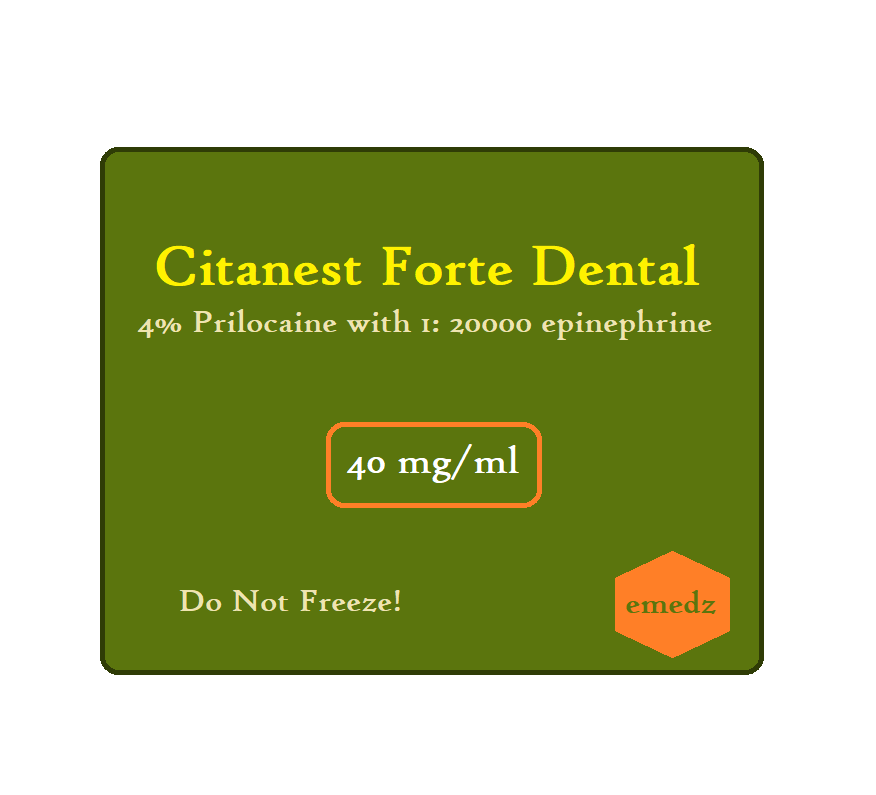
Prilocaine with epinephrine (Citanest Forte Dental) is a combination of a local anesthetic and a local vasoconstrictor drug that is used for nerve block in dental procedures such as dental extraction.
Prilocaine with epinephrine Uses:
-
Dental anesthesia:
- It is used as a local anesthetic and for nerve block in dental procedures.
Prilocaine with epinephrine (Citanest Forte Dental) Dose in Adults
Note: The effective anesthetic dose varies with the procedure, the intensity of anesthesia required, the duration of anesthesia that is needed for the procedure, and the physical condition of the patient. The lowest effective dose should be used.
Prilocaine with epinephrine (Citanest Forte Dental) Dose in the Dental anesthesia:
- Initial: 40 to 80 mg (1 to 2 mL) of prilocaine hydrochloride as a 4% solution with epinephrine 1:200,000
-
The maximum weight-based dose within a 2-hour period: Prilocaine hydrochloride:
- <70 kg: 6 mg/kg (400 mg)
- ≥70 kg: 400 mg or 5 to 6 cartridges
Prilocaine with epinephrine (Citanest Forte Dental) Dose in Childrens
Prilocaine with epinephrine (Citanest Forte Dental) Dose in the Dental anesthesia:
-
Children younger than 10 years of age:
- Doses exceeding 40 mg (1 mL) of prilocaine hydrochloride as a 4% solution with epinephrine 1:200,000 are rarely required for procedures involving a single tooth, in a maxillary infiltration for 2 to 3 teeth, or for an entire quadrant with a mandibular block.
-
Children older than 10 years of age:
- Refer to adult dosing.
Pregnancy Risk Factor B
- Animal reproduction studies have not shown any adverse events.
Breastfeeding: Prilocaine and epinephrine
- It can be used if administered in the recommended dosages for local dental procedures.
Dose in Kidney disease:
There are no dosage adjustments provided in the manufacturer’s labeling. However, use with caution as it is metabolized in the kidneys.
Dose in Liver disease:
There are no dosage adjustments provided in the manufacturer’s labeling as the drug is metabolized by the kidneys.
Side effects of Prilocaine with epinephrine (Citanest Forte Dental):
-
Cardiovascular:
- Bradycardia
- Circulatory Shock
- Edema
- Hypotension
- Vasodepressor Syncope
-
Central Nervous System:
- Apprehension
- Confusion
- Dizziness
- Drowsiness
- Euphoria
- Flushing Sensation
- Loss Of Consciousness
- Nervousness
- Numbness
- Seizure
- Sensation Of Cold
- Twitching
-
Dermatologic:
- Skin Lesion
- Urticaria
-
Gastrointestinal:
- Vomiting
-
Hypersensitivity:
- Anaphylactoid Shock
- Hypersensitivity Reaction (Rare)
-
Ophthalmic:
- Blurred Vision
- Diplopia
-
Otic:
- Tinnitus
-
Neuromuscular & Skeletal:
- Tremor
-
Respiratory:
- Respiratory Depression
- Hypoxia
Contraindications to Prilocaine with epinephrine:
- Allergy to any component or amide-type local anesthetic;
- Congenital and idiopathic methemoglobinemia
Warnings and precautions
-
CNS toxicity:
- Local anesthetic drugs can cause central nervous system toxicities. CNS toxicity can be symptomatic in the early stages.
- These include dizziness, restlessness, anxiety, tremors blurred vision, depression and drowsiness. It is important to receive supportive and symptomatic treatment.
-
Methemoglobinemia:
- Local anesthetic drugs have been linked to methemoglobinemia. Treatment should be stopped if methemoglobinemia is diagnosed as clinically serious.
- Sometimes, methemoglobinemia can be delayed for hours after drug exposure.
- Patients with these conditions should be closely monitored, as they could develop methemoglobinemia.
- Glucose-6-phosphate dehydrogenase deficiency,
- Congenital and idiopathic methemoglobinemia
- Cardiac and pulmonary compromise
- Exposition to oxidizing agents and their metabolites
- Infants under 6 months old
- Patients with methemoglobinemia should be closely monitored for symptoms such as fatigue, cyanosis and rapid pulse.
- Patients with congenital or irreversible methemoglobinemia should avoid it.
-
Respiratory arrest
- Local anesthetics are rarely used to treat sudden respiratory arrest.
-
Seizures:
- It has been linked to systemic and seizures. Unintentional intravascular injections may have caused seizures.
-
Cardiovascular disease
- Patients with heart disease or other conditions should not take more than the recommended dose.
-
Familial malignant hyperthermia
- Malignant hyperthermia could be caused by Prilocaine. Patients who have a history of hyperthermia in the family should avoid using it.
- Patients without a history of hyperthermia should be screened according to standard protocols.
-
Hepatic impairment
- The liver is responsible for the metabolism of anesthetics of amide type. Patients with liver disease should not use them.
-
Hyperthyroidism:
- Hyperthyroidism patients should be cautious. Hyperthyroidism can be symptomatic and may lead to a thyroid crisis.
-
Vascular disease
- Patients with peripheral vascular disease or hypertensive disorders should not use local anesthetics containing epinephrine and other vasoconstrictor drugs.
- They may experience ischemia, necrosis and other hypertensive emergencies.
- You should use it with caution.
Prilocaine with epinephrine (dental): Drug Interaction
|
Alpha1-Blockers |
May diminish the vasoconstricting effect of Alpha-/Beta-Agonists. Similarly, Alpha-/Beta-Agonists may antagonize Alpha1-Blocker vasodilation. |
|
Antidiabetic Agents |
Hyperglycemia-Associated Agents may diminish the therapeutic effect of Antidiabetic Agents. |
|
AtoMOXetine |
May enhance the hypertensive effect of Sympathomimetics. AtoMOXetine may enhance the tachycardic effect of Sympathomimetics. |
|
Benperidol |
May diminish the therapeutic effect of EPINEPHrine (Systemic). |
|
Beta-Blockers (Beta1 Selective) |
May diminish the therapeutic effect of EPINEPHrine (Systemic). |
|
Beta-Blockers (Nonselective) |
May enhance the hypertensive effect of EPINEPHrine (Systemic). Exceptions: Arotinolol; Carvedilol; Labetalol. |
|
Beta-Blockers (with Alpha-Blocking Properties) |
May diminish the therapeutic effect of EPINEPHrine (Systemic). |
|
Cannabinoid-Containing Products |
May enhance the tachycardic effect of Sympathomimetics. Exceptions: Cannabidiol. |
|
Chloroprocaine |
May enhance the hypertensive effect of Alpha-/Beta-Agonists. |
|
CloZAPine |
May diminish the therapeutic effect of Alpha-/Beta-Agonists. |
|
COMT Inhibitors |
May decrease the metabolism of COMT Substrates. |
|
Dapsone (Topical) |
May enhance the adverse/toxic effect of Methemoglobinemia Associated Agents. |
|
Doxofylline |
Sympathomimetics may enhance the adverse/toxic effect of Doxofylline. |
|
Guanethidine |
May enhance the arrhythmogenic effect of Sympathomimetics. Guanethidine may enhance the hypertensive effect of Sympathomimetics. |
|
Local Anesthetics |
Methemoglobinemia Associated Agents may enhance the adverse/toxic effect of Local Anesthetics. Specifically, the risk for methemoglobinemia may be increased. |
|
Methemoglobinemia Associated Agents |
May enhance the adverse/toxic effect of Prilocaine. Combinations of these agents may increase the likelihood of significant methemoglobinemia. Management: Monitor patients for signs of methemoglobinemia (e.g., hypoxia, cyanosis) when prilocaine is used in combination with other agents associated with development of methemoglobinemia. Avoid lidocaine/prilocaine in infants receiving such agents. |
|
Monoamine Oxidase Inhibitors |
May enhance the hypertensive effect of EPINEPHrine (Systemic). |
|
Neuromuscular-Blocking Agents |
Local Anesthetics may enhance the neuromuscular-blocking effect of Neuromuscular-Blocking Agents. |
|
Nitric Oxide |
May enhance the adverse/toxic effect of Methemoglobinemia Associated Agents. Combinations of these agents may increase the likelihood of significant methemoglobinemia. Management: Monitor patients for signs of methemoglobinemia (e.g., hypoxia, cyanosis) when nitric oxide is used in combination with other agents associated with development of methemoglobinemia. Avoid lidocaine/prilocaine. |
|
Sodium Nitrite |
Methemoglobinemia Associated Agents may enhance the adverse/toxic effect of Sodium Nitrite. Combinations of these agents may increase the likelihood of significant methemoglobinemia. |
|
Solriamfetol |
Sympathomimetics may enhance the hypertensive effect of Solriamfetol. |
|
Spironolactone |
May diminish the vasoconstricting effect of Alpha-/Beta-Agonists. |
|
Sympathomimetics |
May enhance the adverse/toxic effect of other Sympathomimetics. |
|
Technetium Tc 99m Tilmanocept |
Local Anesthetics may diminish the diagnostic effect of Technetium Tc 99m Tilmanocept. Management: Avoid mixing and simultaneously co-injecting technetium Tc 99m tilmanocept with local anesthetics. This interaction does not appear to apply to other uses of these agents in combination. |
|
Tedizolid |
May enhance the hypertensive effect of Sympathomimetics. Tedizolid may enhance the tachycardic effect of Sympathomimetics. |
|
Benzylpenicilloyl Polylysine |
Alpha-/Beta-Agonists may diminish the diagnostic effect of Benzylpenicilloyl Polylysine. Management: Consider use of a histamine skin test as a positive control to assess a patient's ability to mount a wheal and flare response. |
|
Cocaine (Topical) |
May enhance the hypertensive effect of Sympathomimetics. Management: Consider alternatives to use of this combination when possible. Monitor closely for substantially increased blood pressure or heart rate and for any evidence of myocardial ischemia with concurrent use. |
|
Hyaluronidase |
May enhance the vasoconstricting effect of Alpha-/Beta-Agonists. Management: Avoid the use of hyaluronidase to enhance dispersion or absorption of alpha-/beta-agonists. Use of hyaluronidase for other purposes in patients receiving alpha-/beta-agonists may be considered as clinically indicated. |
|
Inhalational Anesthetics |
May enhance the arrhythmogenic effect of EPINEPHrine (Systemic). Management: Administer epinephrine with added caution in patients receiving, or who have recently received, inhalational anesthetics. Use lower than normal doses of epinephrine and monitor for the development of cardiac arrhythmias. |
|
Linezolid |
May enhance the hypertensive effect of Sympathomimetics. Management: Reduce initial doses of sympathomimetic agents, and closely monitor for enhanced pressor response, in patients receiving linezolid. Specific dose adjustment recommendations are not presently available. |
|
Promethazine |
May diminish the vasoconstricting effect of EPINEPHrine (Systemic). Management: When vasoconstrictive effects are desired in patients receiving promethazine, consider alternatives to epinephrine. Consider use of norepinephrine or phenylephrine, and avoid epinephrine, when treating hypotension associated with promethazine overdose. |
|
Serotonin/Norepinephrine Reuptake Inhibitors |
May enhance the tachycardic effect of Alpha-/Beta-Agonists. Serotonin/Norepinephrine Reuptake Inhibitors may enhance the vasopressor effect of Alpha-/Beta-Agonists. |
|
Tricyclic Antidepressants |
May enhance the vasopressor effect of Alpha-/Beta-Agonists (DirectActing). Management: Avoid, if possible, the use of direct-acting alpha-/beta-agonists in patients receiving tricyclic antidepressants. If combined, monitor for evidence of increased pressor effects and consider reductions in initial dosages of the alpha-/beta-agonist. |
|
Blonanserin |
May diminish the therapeutic effect of EPINEPHrine (Systemic). |
|
Bromperidol |
May diminish the therapeutic effect of EPINEPHrine (Systemic). |
|
Bupivacaine (Liposomal) |
Local Anesthetics may enhance the adverse/toxic effect of Bupivacaine (Liposomal). Management: Liposomal bupivacaine should not be administered with local anesthetics. Liposomal bupivacaine may be administered 20 minutes or more after the administration of lidocaine, but the optimal duration of dose separation for other local anesthetics is unknown |
|
Ergot Derivatives |
May enhance the hypertensive effect of Alpha-/Beta-Agonists. Ergot Derivatives may enhance the vasoconstricting effect of Alpha-/Beta-Agonists. Exceptions: Ergoloid Mesylates; Nicergoline. |
|
Lurasidone |
EPINEPHrine (Systemic) may enhance the hypotensive effect of Lurasidone. |
Monitoring parameters:
- Cardiovascular and respiratory vital signs;
- Monitor conscious level after each injection;
- CNS toxicity
How to administer Prilocaine with epinephrine (Citanest Forte Dental)?
It is administered using a 25 gauge needle around the nerve (locally infiltrated). before injecting the drug, pull the plunger of the syringe. If blood is drawn while pulling the plunger, the injection should not be injected.
Mechanism of action of Prilocaine with epinephrine (Citanest Forte Dental):
- It acts as a local anesthetic and blocks sodium influx into the axons.
- It prevents depolarization and subsequent action potential.
- When the neuronal inhibition is restored depolarization and subsequent neuronal function are restored.
- Epinephrine, a powerful vasoconstrictor, prevents drug diffusion from the area where it is administered.
- By causing neuronal vasoconstriction, Epinephrine does this. This causes prilocaine to prolong its action.
The beginning of action:
- Infiltration takes less than 2 minutes
- Inferior Alveolar Nerve Block: Less Than 3 Minutes
Duration:
- Infiltration: About 2.25 hours;
- Inferior alveolar nerve block: about 3 hours
International Brand Names of Prilocaine with epinephrine:
- Citanest Forte Dental
- Citanest Adrenalin
- Citanest Forte
Prilocaine with epinephrine Brand Names in Pakistan:
No Brands Available in Pakistan.
.png)


