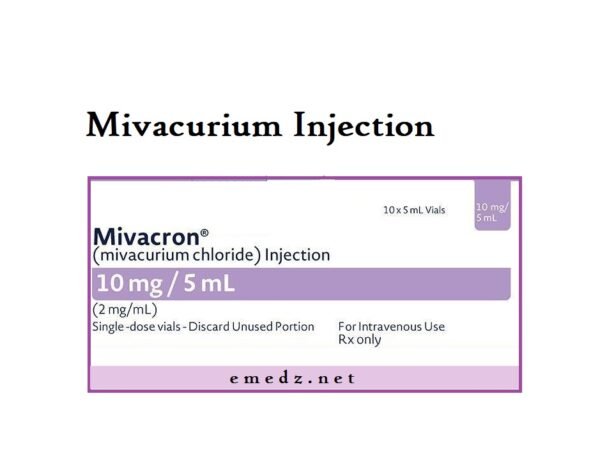
A neuromuscular blocking medication called mivacurium (Mivacron) is given to patients who are undergoing surgery or receiving mechanical ventilation.
Mivacurium (Mivacron) Uses:
-
Neuromuscular inhibition for surgery, mechanical ventilation, or endotracheal intubation:
- For tracheal intubation and skeletal muscle relaxation during surgery or mechanical breathing inappropriately sedated ICU patients, it is prescribed as a supplement to general anesthesia (GA).
Note:
- Neuromuscular blockade provides only skeletal muscle relaxation, It does not provide analgesia, sedation, or amnestic effects.
- Analgesic and sedatives should be given before and during the use of neuromuscular blockade to achieve deep sedation.
-
Off Label Use of Mivacurium in Adults:
- Acute respiratory distress syndrome (ARDS);
- Shivering due to therapeutic hypothermia after cardiac arrest
Mivacurium Dose in Adults:
Note: Dose to effect; There is inter-patient variability individualized dose. Make sure adequate analgesia and sedation before and during the use of neuromuscular blockade to achieve deep sedation.
Mivacurium (Mivacron) Dose in the treatment of Neuromuscular blockade for endotracheal intubation, surgery, or mechanical ventilation ( as an adjunct to general anesthesia ): IV:
-
Intermittent bolus:
-
Initial: 0.15 mg/kg over 5–15 seconds, 0.2 mg/kg over 30 seconds, or 0.25 mg/kg split into two doses of 0.15 mg/kg and 0.1 mg/kg, respectively.
-
Maintenance: 0.1 mg/kg given every 15 minutes or such.
- Patients with burns should first get a test dosage of 0.015 to 0.02 mg/kg, followed by the proper administration and monitoring.
-
Mivacurium (Mivacron) Dose in patients with clinically significant cardiovascular disease or increased sensitivity to the release of histamine (eg, asthma):
- Initial: ≤0.15 mg/kg over 1 minute.
-
Continuous infusion:
- Usual infusion rate: 5 - 7 mcg/kg/minute under balanced anesthesia.
- Start with signs of spontaneous recovery from the initial bolus dosage and proceed at a rate of 9 to 10 mcg/kg/minute (0.54 to 0.6 mg/kg/hour).
Note: A lower first infusion rate, such as 4 mcg/kg/minute, should be utilized if a continuous infusion is started at the same time as the initial dosage.
Adjusting the dosage of mivacurium (Mivacron) in a steady state while concurrently using inhalational anesthetics
- Reduce the continuous infusion rate by ≤35% - 40% and bolus dose ≤25% when used in combination with isoflurane and enflurane.
- With the use of higher concentrations of isoflurane and enflurane, greater reduction may be required
- when used with halothane, a smaller reduction of mivacurium may be required
Mivacurium (Mivacron) Dose in the Intensive care unit paralysis (eg, use for up to 48 hours in patients with early ARDS with PaO /FiO <150, to facilitate mechanical ventilation, or for shivering from therapeutic hypothermia) (off-label dosing):
- Intravenous: Initial bolus of 0.25 mg/kg, then 5 to 6 mcg/kg/minute (0.3 - 0.36 mg/kg/hour)
Mivacurium Dose in Children:
Note: The dose should be titrated to the effect; there is an interpatient variability dose that must be individualized. Obese patients (weighing ≥30% IBW) should be dosed on IBW.
Mivacurium (Mivacron) Dose for neuromuscular blockade as an adjunct to surgical anesthesia:
Note: There are pharmacodynamics differences in pediatric patients as compared to adults, children 2 - 12 years require a higher mg/kg initial dose as well as frequent maintaining doses or higher continuous infusion rates.
-
Children 2 to 12 years:
- Intermittent IV bolus: 2 mg/kg over 5 - 15 seconds
- Continuous IV infusion: Usual dose is 14 mcg/kg/minute (0.84 mg/kg/hour), with a range of 5 to 31 mcg/kg/minute (0.3 to 1.86 mg/kg/hour). The dose should be started with signs of spontaneous recovery from the initial dose.
-
Adolescents:
- Intermittent IV bolus: Initial: 0.15 mg/kg administered over 5 to 15 seconds; 0.2 mg/kg administered over 30 seconds; or a total bolus of 0.25 mg/kg divided into 2 doses (0.15 mg/kg followed by 0.1 mg/kg in 30 seconds).
- Maintenance: 1 mg/kg at ~15-minute intervals; start with evidence of spontaneous recovery from initial bolus
- Burn patients: Administer test dose of 0.015 - 0.02 mg/kg, then follow with appropriate dosing and monitoring
Patients with severe cardiovascular disease or elevated histamine sensitivity (such as those with asthma) should get a higher dose of mivacurium (Mivacron):
- Initial: ≤0.15 mg/kg over 1 minute
- Ongoing IV injection: When there is evidence of spontaneous recovery from the initial bolus dosage, the infusion is started at a rate of 9 to 10 mcg/kg/minute (0.54 to 0.6 mg/kg/hour).
- Usual infusion rate: 5 -7 mcg/kg/minute (0.3 - 0.42 mg/kg/hour) under balanced anesthesia; range: 1 - 15 mcg/kg/minute (0.06 - 0.9 mg/kg/hour).
Note: If the infusion is begun concurrently with the first bolus, a lower initial infusion rate should be utilized (for example, 4 mcg/kg/minute [0.24 mg/kg/hour]).
To facilitate mechanical breathing in some patients who are sufficiently sedated in the intensive care unit, mivacurium (Mivacron) is dosed as follows:
-
Infants:
- Intravenous: Initial bolus: 0.2 mg/kg, then a 0.6 mg/kg/hour continuous IV infusion at 10 mcg/kg/min
-
Children:
- Intravenous: Initial bolus: 0.2 mg/kg, then a 0.96 mg/kg/hour continuous IV infusion at 16 mcg/kg/min
-
Adolescents:
- Intravenous: Initial bolus: 0.2 mg/kg, followed by a 0.42 mg/kg/hour continuous IV infusion at a rate of 7 mcg/kg/min.
Mivacurium (Mivacron) Dosing adjustment for concomitant inhalational anesthetics at a steady state:
-
Children ≥2 years and Adolescents:
- Reduce the continuous infusion rate by ≤35% - 40% and bolus dose ≤25% when used in combination with isoflurane and enflurane. If higher concentrations of isoflurane and enflurane, greater reduction may be required
- when used with halothane, and a smaller reduction in the dose may be required.
Pregnancy Risk Category: C
- Studies on animal reproduction have not shown any adverse effects.
- Neuromuscular blockade can be extended if concentrations of Cholinesterase are reduced immediately after delivery.
- It was used by patients who had to have a cesarean section.
- Sometimes, dose adjustment is necessary.
Use while breastfeeding
- It is not known if it is present in breast milk.
- Neuromuscular blockade can be prolonged if concentrations of Cholinesterase are reduced immediately after delivery.
- It is recommended that it be used with caution by lactating mothers
Dose in Kidney Disease:
-
Mild to severe impairment:
- IV: Initial bolus: 0.15 mg/kg;
- Further doses may be administered according to the clinical response.
Dose in Liver disease:
-
Mild to severe impairment:
- IV: Initial bolus: 0.15 mg/kg;
- Further doses may be administered according to the clinical response.
- Up to 50% of the infusion rate should be cut back (dependent on the degree of hepatic impairment).
Common Side Effects of Mivacurium (Mivacron):
-
Cardiovascular:
- Flushing
- Hypotension
Contraindications to Mivacurium (Mivacron):
- Hypersensitivity to any ingredient of the formulation
- Neuromuscular blockers have been shown to show limited cross-reactivity.
- It is possible that it could cross-react with neuromuscular blockers, but this cannot be ruled out.
Warnings and precautions
-
Anaphylaxis
- Anaphylactic reactions can be severe and potentially life-threatening.
- Before using epinephrine at 1 mg/mL, ensure that you have access to appropriate emergency treatment.
- If the patient has had anaphylactic reactions to neuromuscular-blocking drugs in the past, extreme caution is advised.
-
Bradycardia
- It does not cause bradycardia or vagal stimulation.
-
Cross-sensitivity of neuromuscular neurons:
- Cross-reactivity is possible with other neuromuscular blocking drugs
- Patients with anaphylactic reactions are advised to exercise extreme caution.
-
Burn injury
- Patients with burns may develop mivacurium resistance, particularly if they have a body surface area of more than 20%. (TBSA).
- This can persist for several days or even months.
- You may need to increase or decrease the dose to combat resistance.
-
Cardiovascular disease
- If the patient has clinically significant heart disease, be cautious.
- Inject slowly and reduce the initial dose (over 60 seconds).
- These patients should be closely monitored for hemodynamics and maintained adequate hydration.
-
Conditions that could lead to neuromuscular blockade (decreased parity)
- These conditions could interfere with the effects of the drug or neuromuscular blockade.
- Muscle trauma
- Hypercalcemia
- Denervation
- Demyelinating lesion
- Respiratory alkalosis
- Peripheral neuropathies
- These conditions could interfere with the effects of the drug or neuromuscular blockade.
-
There are some conditions that could reduce plasma cholinesterase activity.
- Due to a decreased plasma cholinesterase activity, the following patients are at high risk of developing a neuromuscular blockade.
- Malignant tumors
- Genetic abnormalities in plasma cholinesterase
- Peptic ulcer
- Infections
- Decompensated Heart Disease
- Myxedema
- Anemia
- Due to a decreased plasma cholinesterase activity, the following patients are at high risk of developing a neuromuscular blockade.
-
Conditions that can cause neuromuscular blockade (increased parity):
- Patients at high risk for neuromuscular blockade should not use it. Patients at high risk include:
- Neuromuscular diseases
- Respiratory acidosis
- Myasthenia gravis
- Metabolic acidosis
- An abnormality in electrolyte levels, e.g. Hypermagnesemia, severe hypocalcemia, severe hyperkalemia
- Eaton-Lambert syndrome
- Patients at high risk for neuromuscular blockade should not use it. Patients at high risk include:
-
Renal impairment
- Patients with impaired renal function should be cautious.
- It's possible for these people to have a protracted neuromuscular blockade.
- Patients with renal disease may have reduced plasma cholinesterase activity.
-
Hepatic impairment
- If the patient is suffering from a severe hepatic impairment, be cautious.
- This patient may develop a long-lasting neuromuscular blockade.
- The plasma cholinesterase activity of patients with chronic liver disease may be decreased.
Mivacurium: Drug Interaction
Note: Drug Interaction Categories:
- Risk Factor C: Monitor When Using Combination
- Risk Factor D: Consider Treatment Modification
- Risk Factor X: Avoid Concomitant Use
Risk Factor C (Monitor therapy) |
|
| Acetylcholinesterase Inhibitors | May diminish the neuromuscular-blocking effect of Neuromuscular-Blocking Agents (Nondepolarizing). |
| Aminoglycosides | May enhance the respiratory depressant effect of Neuromuscular-Blocking Agents. |
| Bacitracin (Systemic) | May enhance the neuromuscular-blocking effect of NeuromuscularBlocking Agents. |
| Botulinum Toxin-Containing Products | May enhance the neuromuscular-blocking effect of Neuromuscular-Blocking Agents. |
| Bromperidol | May enhance the neuromuscular-blocking effect of Neuromuscular-Blocking Agents. |
| Calcium Channel Blockers | May enhance the neuromuscular-blocking effect of NeuromuscularBlocking Agents (Nondepolarizing). |
| Capreomycin | May enhance the neuromuscular-blocking effect of Neuromuscular-Blocking Agents. |
| CarBAMazepine | May decrease the serum concentration of Neuromuscular-Blocking Agents (Nondepolarizing). |
| Cardiac Glycosides | Neuromuscular-Blocking Agents may enhance the arrhythmogenic effect of Cardiac Glycosides. |
| Clindamycin (Topical) | May enhance the neuromuscular-blocking effect of NeuromuscularBlocking Agents. |
| Cyclophosphamide | May increase the serum concentration of Mivacurium. |
| CycloSPORINE (Systemic) | May enhance the neuromuscular-blocking effect of NeuromuscularBlocking Agents. |
| Echothiophate Iodide | May increase the serum concentration of Mivacurium. |
| Estrogen Derivatives | May increase the serum concentration of Mivacurium. |
| Fosphenytoin-Phenytoin | May diminish the neuromuscular-blocking effect of NeuromuscularBlocking Agents (Nondepolarizing). The neuromuscular-blocking action of neuromuscular-blocking agents may be enhanced by fosphenytoin-phenytoin (Nondepolarizing). Fosphenytoin-Phenytoin may lower the level of neuromuscular-blocking medications in the serum (Nondepolarizing). |
| Inhalational Anesthetics | Might increase the effectiveness of neuromuscular blocking agents (Nondepolarizing). |
| Ketorolac (Nasal) | It May make neuromuscular-blocking agents more harmful or poisonous (Nondepolarizing). Patients utilizing this combination have reportedly experienced bouts of apnea. |
| Ketorolac (Systemic) | May intensify the negative or harmful effects of neuromuscular-blocking agents (Nondepolarizing). Patients utilizing this combination have experienced instances of apnea, specifically. |
| Lincosamide Antibiotics | Might make neuromuscular-blocking agents more effective in blocking neuromuscular activity. |
| Lithium | Might make neuromuscular-blocking agents more effective in blocking neuromuscular activity. |
| Local Anesthetics | Might make neuromuscular-blocking agents more effective in blocking neuromuscular activity. Benzocaine, Benzydamine, Cocaine (Topical), Dibucaine, Dyclonine, Ethyl Chloride, Hexylresorcinol, Lidocaine (Topical), Pramoxine, Proparacaine, Tetracaine (Ophthalmic), and Tetracaine are some exceptions (Topical). |
| Loop Diuretics | May lessen the neuromuscular-blocking effects of drugs that inhibit muscles. The neuromuscular-blocking effects of neuromuscular-blocking agents may be enhanced by loop diuretics. |
| Magnesium Salts | Might make neuromuscular-blocking agents more effective in blocking neuromuscular activity. |
| Minocycline (Systemic) | Might make neuromuscular-blocking agents more effective in blocking neuromuscular activity. |
| Phenelzine | May raise the serum concentration of Mivacurium. |
| Pholcodine | May enhance the adverse/toxic effect of Neuromuscular-Blocking Agents. Specifically, anaphylaxis has been reported. |
| Procainamide | May enhance the neuromuscular-blocking effect of Neuromuscular-Blocking Agents. |
| QuiNIDine | May enhance the neuromuscular-blocking effect of Neuromuscular-Blocking Agents. |
| Sertraline | May increase the serum concentration of Mivacurium. |
| Spironolactone | May enhance the neuromuscular-blocking effect of Neuromuscular-Blocking Agents (Nondepolarizing). |
| Tetracyclines | May enhance the neuromuscular-blocking effect of Neuromuscular-Blocking Agents. |
| Thiazide and Thiazide-Like Diuretics | May enhance the neuromuscular-blocking effect of Neuromuscular-Blocking Agents (Nondepolarizing). |
| Trimebutine | May enhance the neuromuscular-blocking effect of Neuromuscular-Blocking Agents (Nondepolarizing). |
| Vancomycin | May enhance the neuromuscular-blocking effect of Neuromuscular-Blocking Agents. |
Risk Factor D (Consider therapy modification) |
|
| Colistimethate | May enhance the neuromuscular-blocking effect of Neuromuscular-Blocking Agents. |
| Corticosteroids (Systemic) | Neuromuscular-Blocking Agents (Nondepolarizing) may enhance the adverse neuromuscular effect of Corticosteroids (Systemic). Increased muscle weakness, possibly progressing to polyneuropathies and myopathies, may occur. |
| Polymyxin B | May enhance the neuromuscular-blocking effect of Neuromuscular-Blocking Agents. |
Risk Factor X (Avoid combination) |
|
| QuiNINE | May enhance the neuromuscular-blocking effect of Neuromuscular-Blocking Agents. |
Monitoring parameters:
- Vital signs: heart rate, blood pressure, respiratory rate
- Degree of muscle paralysis: the presence of spontaneous movement, ventilator asynchrony, and shivering
- Think about using a peripheral nerve stimulator with four-way monitoring combined with clinical evaluations.
How to administer Mivacurium (Mivacron)?
IV: Only to be used intravenously. can be administered as a continuous infusion or an IV bolus.
Mechanism of action of Mivacurium (Mivacron):
- It is an acetylcholine antagonist by binding competitively to cholinergic motor endplates of skeletal muscle.
- After cholinergic site blockade, there is no contraction in skeletal muscles and this causes muscle paralysis
The onset of action:
- Neuromuscular blockade (dose-dependent): IV:
- Elderly: 1.5 minutes slower
- Adults: 1.5 - 3 minutes
- Children 2 to 12 years of age: Faster than adults
Peak: Neuromuscular blockade (dose-dependent): IV:
- Children 2 - 12 years of age: Median range: 1.6 t- 2.8 minutes
- Adults: Median range: 2.3 - 4.9 minutes
Duration of action:
- Usually shorter duration because of rapid hydrolysis by plasma cholinesterases;
- There may be a shorter duration may be slightly longer in the elderly, hepatic or renal impairment, and patients with reduced plasma cholinesterase (pseudocholinesterase) activity
- A longer duration of hypothermia can occur.
- Children:
- A clinically effective block may last 10 minutes (6 - 15 minutes) with 95% spontaneous recovery in 14 - 26 minutes
- Adult:
- A clinically effective block may last for 15 - 20 minutes; spontaneous recovery maybe 95% complete in 21 - 34 minutes (dose-dependent).
Metabolism:
- Enzymatic hydrolysis via plasma cholinesterase, inactive metabolites.
Half-life elimination:
- About 2 minutes.
Excretion:
- Urine (~7% as unchanged drug) and bile
International Brand Names of Mivacurium:
- Mivacron
Mivacurium Brand Names in Pakistan:
No Brands Available in Pakistan.
.png)


