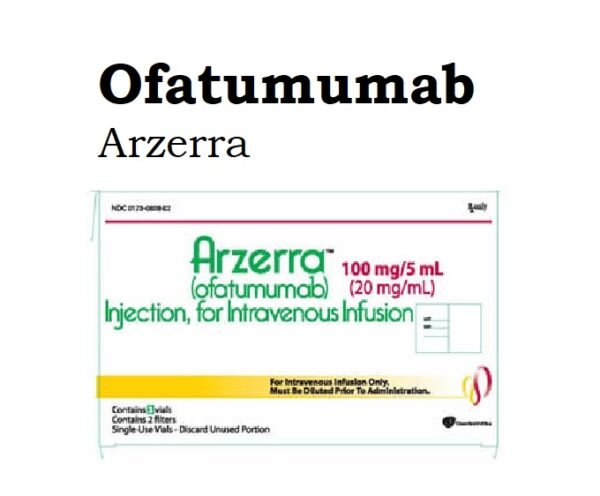
Ofatumumab (Arzerra) is a human monoclonal antibody that targets CD-20 positive B lymphocytes and inhibits its activation.
Ofatumumab (Arzerra) Uses:
-
Chronic lymphocytic leukemia, previously untreated:
- When fludarabine-based therapy is considered inappropriate, treatment of previously untreated chronic lymphocytic leukemia (CLL) (in combination with chlorambucil)
-
Chronic lymphocytic leukemia, relapsed:
- Relapsed CLL treatment (in combination with fludarabine and cyclophosphamide).
-
Chronic lymphocytic leukemia, refractory:
- CLL Treatment refractory to fludarabine & alemtuzumab
-
Chronic lymphocytic leukemia, extended treatment:
- After at least two lines of therapy for recurrent or progressive CLL, extended treatment of patients who are in complete or partial response
Ofatumumab (Arzerra) Dose in Adults
Note:
- Prior to treatment, Premedicate with acetaminophen, an antihistamine & a corticosteroid 30-120 mins (see Premedication below).
Ofatumumab (Arzerra) Dose in the treatment of Chronic lymphocytic leukemia (CLL), previously untreated:
- Cycle 1 (cycle is 28 days):
- 300 mg IV on 1st day, followed by 1,000 mg on the 8th day.
-
Subsequent cycles:
- 1,000 mg on day 1 every 28 days.
- Until best response or a max of 12 cycles, continue for at least 3 cycles (in combination with chlorambucil)
-
Premedication:
- Premedicate with oral acetaminophen (1,000 mg) or equivalent, an oral or IV antihistamine (eg, diphenhydramine 50 mg or cetirizine 10 mg orally or equivalent), and an IV corticosteroid (prednisolone 50 mg or equivalent).
- For the first 2 infusions, full dose corticosteroid is recommended.
- For subsequent infusions, in the absence of infusion reaction ≥ grade 3, may reduce or omit corticosteroid dose.
Ofatumumab (Arzerra) Dose in the treatment of relapsed CLL:
-
Cycle 1 (cycle is 28 days):
- 300 mg IV on 1st day, followed by 1,000 mg on the 8th day.
-
Subsequent cycles:
- 1,000 mg on 1st day every 28 days.
- Continue for a max of six cycles (in combination with fludarabine and cyclophosphamide) (Robak 2017)
-
Premedication:
- Premedicate with oral acetaminophen (1,000 mg) or equivalent, an oral or IV antihistamine (eg, diphenhydramine 50 mg or cetirizine 10 mg orally or equivalent), and an IV corticosteroid (prednisolone 50 mg or equivalent).
- Full dose corticosteroid is recommended for the first 2 infusions; in the absence of infusion reaction ≥ grade 3, may reduce or omit corticosteroid dose for subsequent infusions.
Ofatumumab (Arzerra) Dose in the treatment of refractory CLL:
- Initial dose:
- 300 mg IV on 1st day,
- followed 1 week later by 2,000 mg once weekly for 7 doses (doses 2 to 8),
- followed 4 weeks later by 2,000 mg once every 4 weeks for 4 doses (doses 9 to 12; for a total of 12 doses).
-
Premedication:
- Premedicate with oral acetaminophen (1,000 mg) or equivalent, an oral or IV antihistamine (eg, diphenhydramine 50 mg or cetirizine 10 mg orally or equivalent), and an IV corticosteroid (prednisolone 100 mg or equivalent).
- For doses 1, 2 & 9, full dose corticosteroid is recommended.
- May reduce or omit corticosteroid dose for doses 3-8, in the absence of infusion reaction ≥ grade 3.
- With doses 10 to 12 if ≥ grade 3 reaction did not occur with dose 9, may administer reduced corticosteroid dose (ranging from half to full dose).
Ofatumumab (Arzerra) Dose in the treatment of CLL, extended:
-
IV:
- 300 mg on 1st day, followed by 1,000 mg on day 8, followed by 1,000 mg 7 weeks later and then every 8 weeks for up to a max of 2 years (van Oers 2015)
-
Premedication:
- Premedicate with oral acetaminophen (1,000 mg) or equivalent, an oral or IV antihistamine (eg, diphenhydramine 50 mg or cetirizine 10 mg orally or equivalent), & an IV corticosteroid (prednisolone 50 mg or equivalent).
- For the first 2 infusions, full dose corticosteroid is recommended.
- May reduce or omit corticosteroid dose for subsequent infusions in the absence of infusion reaction ≥ grade 3, .
Ofatumumab use in children:
The safety and efficacy of the drug in children have not been established.
Ofatumumab Pregnancy Risk category: C
- Ofatumumab (humanized monoclonal antibody) is an IgG.
- The potential for placental transfer to human IgG increases with pregnancy. This is dependent on the IgG subclass and gestational age.
- The lowest possible exposure is expected during the period of organogenesis.
- Based on animal data, prolonged depletion may occur in circulating B cells.
- Avoid giving live vaccines to newborns who have been exposed to ofatumumab intrauterinely until B cell recovery is complete.
Use of Ofatumumab while breastfeeding
- It is unknown if ofatumumab can be found in human milk.
- Human IgG is secreted by breast milk. Therefore, milk may contain ofatumumab.
- The data suggests that antibodies found in breast milk don't significantly enter infant and neonatal circulation.
- According to the manufacturer, the decision to breastfeed during therapy must consider the risks to the infant as well as the benefits to the mother.
Ofatumumab Dose in Kidney Disease:
CrCl ≥30 mL/minute:
- In the US manufacturer's labeling, there are no dosage adjustments provided.
- however, in patients with baseline CrCl ≥30 mL/minute, there were no clinically relevant pharmacokinetic effects observed.
CrCl <30 mL/minute:
- In the manufacturer's labeling, there are no dosage adjustments provided (has not been studied).
Ofatumumab Dose in Liver Disease:
- In the manufacturer's labeling, there are no dosage adjustments provided (has not been studied).
Common Side Effects of Ofatumumab (Arzerra):
-
Central Nervous System:
- Fatigue
-
Dermatologic:
- Skin Rash
-
Gastrointestinal:
- Diarrhea
- Nausea
-
Hematologic & Oncologic:
- Neutropenia
- Anemia
-
Infection:
- Infection
- Serious Infection
-
Respiratory:
- Pneumonia
- Cough
- Upper Respiratory Tract Infection
- Dyspnea
- Bronchitis
-
Miscellaneous:
- Infusion Related Reaction
- Fever
Less Common Side Effects Of Ofatumumab (Arzerra):
-
Cardiovascular:
- Peripheral Edema
- Hypertension
- Hypotension
- Tachycardia
-
Central Nervous System:
- Chills
- Insomnia
- Headache
-
Dermatologic:
- Urticaria
- Hyperhidrosis
-
Hematologic & Oncologic:
- Hypogammaglobulinemia
-
Infection:
- Sepsis
- Influenza
- Herpes Zoster
-
Neuromuscular & Skeletal:
- Back Pain
- Muscle Spasm
-
Respiratory:
- Nasopharyngitis
- Sinusitis
Contraindications to Ofatumumab (Arzerra):
- There are no contraindications in the US manufacturer's labeling.
Canadian labeling
- Hypersensitivity to any component of the formulation or ofatumumab.
- History or presence of progressive multifocal encephalopathy
Warnings and precautions
-
Hematologic toxicities:
- Anemia, thrombocytopenia and neutropenia may be severe and last for more than a week.
- There have been reports of grade 3 or 4 late-onset neutropenia, which occurs >=42 days after the last treatment dose. Likewise, prolonged neutropenia has not resolved for at least 24 to 42 days.
- Combining chlorambucil with Pancytopenia, Agranulocytosis and Fatal Neutropenia have been reported.
- Regular blood counts should be checked during and after treatment.
- Grade 3 and 4 cytopenias are more common.
-
Hepatitis B virus infection: [US Boxed Warn]
- Patients may experience reactivation after receiving CD20-directed antibody treatment. This includes ofatumumab and Hepatitis A virus (HBV).
- Could cause fulminant liver disease, hepatic failure and death.
- Even in patients who were not previously infected, HBV can also cause fatalities.
- Before initiating treatment, measure the hepatitis B antigen (HBsAg), and the hepatitis B core antibodies (anti-HBc), in all patients.
- After treatment, check for signs and symptoms of hepatitis and HBV in the laboratory and during the following months.
- Reactivation of therapy after discontinuation has been reported up to 12 month.
- If viral hepatitis is suspected, discontinue use ofatumumab and concomitant medication.
- Patients who have HBsAg positivity as well as those with HBsAg negativity but are anti-HBc are reactivated.
- Reactivation of HBV infection in patients with a history of treatment has been seen.
- Patients with evidence of HBV infection, such as HBsAg positivity, should be treated cautiously (regardless of anti-HBc status or HBsAg negativity).
- Consult with the appropriate clinicians before and during treatment with atumumab to discuss monitoring and antiviral therapy.
- The safety of atumumab resuming treatment after HBV reactivation is not known.
- Talk to HBV specialists about the possibility of resuming therapy for patients who have had their HBV reactivation resolved.
- American Society of Clinical Oncology's provisional clinical opinion update regarding hepatitis B virus testing [Hwang 2015]) recommendations
- Patients with anti-CD20 antibodies are more at risk of hepatitis B virus reactivation.
- Before starting treatment, test for HBV infection using hepatitis B antigen (HBsAg), and hepatitis B core antibodies (anti-HBc).
- To screen for chronic or recurrent HBV infection, either a total anti HBc test (with both IgG/IgM) or an anti-HBc IgG (do not use anti HBc IgM because it may only confirm acute HBV infections).
- Patients with risk factors for HBV infection should be screened before starting therapy. This includes HBV-infected individuals who were born in countries with >=2% HBV prevalence, sexual contact with infected persons in the household, and high-risk behavior [eg intravenous drug abuse, HIV infection].
- Start prophylactic antiviral treatment (using antivirals that have low viral resistance rates) for HBsAg-positive/anti-HBc-positive patients. Do not delay cancer treatment. Continue the antivirals for 6-12 months.
- Patients with HBsAg/anti-HBc negative status should be tested for HBV reactivation by HBV DNA and ALT testing every 3 months.
- Antiviral therapy can be started immediately or prophylactically at the first sign of HBV activation.
-
Infection
- Following therapy, bacterial, fungal and new or reactivated viruses infections can occur.
- Pay attention to signs and symptoms of infection.
-
Infusion reaction
- Some infusion reactions can be fatal.
- Some reactions include bronchospasm and dyspnea.
- Infusion reactions may occur more often with the first two infusions and may not be treated.
- Before infusion with acetaminophen or an antihistamine, it is important to premedicate.
- For severe reactions, interrupt infusion and institute the appropriate treatment.
- You may need to modify the rate later.
- Stop using the medication immediately and discontinue if you experience an anaphylactic reaction.
-
Progressive multifocal Leukoencephalopathy: [US-Bound Warning]
- With CD-20 directed antibody therapy, ofatumumab may cause progressive multifocal encephalopathy (PML), which can lead to death..
- If you notice any new or worsening symptoms, PML should be considered. Stop taking Atumumab immediately and have your doctor evaluate.
-
Tumor lysis syndrome
- Tumor lysis syndrome (TLS), has been reported in patients who have received ofatumumab.
- TLS is more common in patients with high tumor burdens 7 and high circulating lymphocyte count (>25,000/mm3).
- Before you start ofatumumab therapy, it is important to administer aggressive hydration and prophylactic antihyperuricemic treatment.
- Correct electrolyte anomalies
- Assess your renal function and hydration status.
Ofatumumab: Drug Interaction
|
Risk Factor C (Monitor therapy) |
|
|
Coccidioides immitis Skin Test |
Immunosuppressants may diminish the diagnostic effect of Coccidioides immitis Skin Test. |
|
Denosumab |
May enhance the adverse/toxic effect of Immunosuppressants. Specifically, the risk for serious infections may be increased. |
|
Ocrelizumab |
May enhance the immunosuppressive effect of Immunosuppressants. |
|
Pidotimod |
Immunosuppressants may diminish the therapeutic effect of Pidotimod. |
|
Siponimod |
Immunosuppressants may enhance the immunosuppressive effect of Siponimod. |
|
Tertomotide |
Immunosuppressants may diminish the therapeutic effect of Tertomotide. |
|
Trastuzumab |
May enhance the neutropenic effect of Immunosuppressants. |
|
Risk Factor D (Consider therapy modification) |
|
|
Baricitinib |
Immunosuppressants may enhance the immunosuppressive effect of Baricitinib. Management: Use of baricitinib in combination with potent immunosuppressants such as azathioprine or cyclosporine is not recommended. Concurrent use with antirheumatic doses of methotrexate or nonbiologic disease modifying antirheumatic drugs (DMARDs) is permitted. |
|
Echinacea |
May diminish the therapeutic effect of Immunosuppressants. |
|
Fingolimod |
Immunosuppressants may enhance the immunosuppressive effect of Fingolimod. Management: Avoid the concomitant use of fingolimod and other immunosuppressants when possible. If combined, monitor patients closely for additive immunosuppressant effects (eg, infections). |
|
Leflunomide |
Immunosuppressants may enhance the adverse/toxic effect of Leflunomide. Specifically, the risk for hematologic toxicity such as pancytopenia, agranulocytosis, and/or thrombocytopenia may be increased. Management: Consider not using a leflunomide loading dose in patients receiving other immunosuppressants. Patients receiving both leflunomide and another immunosuppressant should be monitored for bone marrow suppression at least monthly. |
|
Nivolumab |
Immunosuppressants may diminish the therapeutic effect of Nivolumab. |
|
Roflumilast |
May enhance the immunosuppressive effect of Immunosuppressants. |
|
Sipuleucel-T |
Immunosuppressants may diminish the therapeutic effect of Sipuleucel-T. Management: Evaluate patients to see if it is medically appropriate to reduce or discontinue therapy with immunosuppressants prior to initiating sipuleucel-T therapy. |
|
Tofacitinib |
Immunosuppressants may enhance the immunosuppressive effect of Tofacitinib. Management: Concurrent use with antirheumatic doses of methotrexate or nonbiologic disease modifying antirheumatic drugs (DMARDs) is permitted, and this warning seems particularly focused on more potent immunosuppressants. |
|
Vaccines (Inactivated) |
Immunosuppressants may diminish the therapeutic effect of Vaccines (Inactivated). Management: Vaccine efficacy may be reduced. Complete all age-appropriate vaccinations at least 2 weeks prior to starting an immunosuppressant. If vaccinated during immunosuppressant therapy, revaccinate at least 3 months after immunosuppressant discontinuation. |
|
Risk Factor X (Avoid combination) |
|
|
BCG (Intravesical) |
Immunosuppressants may diminish the therapeutic effect of BCG (Intravesical). |
|
Cladribine |
May enhance the immunosuppressive effect of Immunosuppressants. |
|
Natalizumab |
Immunosuppressants may enhance the adverse/toxic effect of Natalizumab. Specifically, the risk of concurrent infection may be increased. |
|
Pimecrolimus |
May enhance the adverse/toxic effect of Immunosuppressants. |
|
Tacrolimus (Topical) |
May enhance the adverse/toxic effect of Immunosuppressants. |
|
Vaccines (Live) |
Immunosuppressants may enhance the adverse/toxic effect of Vaccines (Live). Immunosuppressants may diminish the therapeutic effect of Vaccines (Live). Management: Avoid use of live organism vaccines with immunosuppressants; live-attenuated vaccines should not be given for at least 3 months after immunosuppressants. |
Monitoring Parameters:
- CBC with differential (at regular intervals throughout and after therapy; more often if grades 3 or 4, cytopenias, develop)
- Renal function
- Serum electrolytes
- Hepatitis B screening recommendations (ASCO provisional Clinical Opinion Update [Hwang 2015]).
- Before starting treatment, test for hepatitis B virus infection (HBV).
- To screen for chronic or recurrent HBV infection, either a total anti HBc test (with both IgG/IgM) or an anti-HBc IgG (do not use anti HBc IgM because it may only confirm acute HBV infections).
- Patients with HBsAg/anti-HBc negative status should be tested for HBV reactivation by HBV DNA and AL testing approximately every 3 months.
- Signs of active Hepatitis B infection (during therapy and up to 12 months afterwards).
- Hepatitis symptoms and signs
- An infusion reaction is a series of symptoms or signs.
- Infection signs
- Status fluid
- Signs and symptoms of intestinal obstruction (eg abdominal pain, repeated vomit).
- The signs and symptoms of progressive multifocal encephalopathy (focal neurological deficits) may include hemiparesis or visual field deficits, cognitive impairment, cognitive impairment, aphasia, cranial nerve deficiencies, and hemiparesis.
How to administer Ofatumumab (Arzerra)?
Infusion:
- You should not give IV push, IV Bolus, or subcutaneous injections.
- Premedicate with acetaminophen or an antihistamine and a corticosteroid for 30-120 minutes before administering (see Dosing).
- Infuse in an environment that can monitor and manage infusion reactions.
- Use infusion pump and administration set to administer.
- Infusion rates should not be exceeded below.
- Do not mix or infuse other medications.
- Before and after infusions with NS, flush the line.
- Infusion should be started within 12 hours after preparation.
- For any serious infusion reaction, interrupt infusion.
- You may continue infusion if the reaction is resolved or remains at = Grade 2.
CLL (chronic lymphocytic Leukemia) previously untreated, relapsed CLL and extended treatment for CLL:
Initial 300 mg dose
- Start infusion at 12 mg/hour. If tolerated (no Infusion Reaction), increase to 25 mg/hour. For half an anhour, increase by 50 mg/hour. If tolerated, go up to 100 mL/hour. For half an anhour, go up to 200 mL/hour. If tolerated, go up to 300 mL/hour. Continue infusion for 400 mL/hour.
-
The median infusion time:
- Between 4.8 and 5.2 hours
-
If there is no reaction to the previous infusion, you can continue with 1,000 mg infusions.
- For half an hour, start infusion at 25mL/hour
- If tolerated (no Infusion Reaction), increase to 50mL/hour for 50 minutes
- If tolerated, increase to 100mL/hour for 30 minutes.
- If tolerated, increase to 200mL/hour for half an hours
- If tolerated, increase the dose to 400 mL/hour during the remaining infusion.
-
The median duration of infusion:
- 4.2-4.4 hours.
Refractory CLL:
Doses 1 and 2:
-
- Initiate infusion at 12 mL/hour for 30 mins,
- if tolerated (no infusion reaction) increase to 25 mL/hour for 30 mins,
- if tolerated, increase to 50 mL/hour for 30 mins,
- if tolerated, increase to 100 mL/hour for 30 mins,
- if tolerated, increase to 200 mL/hour for the remainder of infusion.
- The median duration of infusion:
- 6.8 hours.
Doses 3 to 12:
-
- Initiate infusion at 25 mL/hour for 30 mins,
- if tolerated (no infusion reaction) increase to 50 mL/hour for 30 mins,
- if tolerated, increase to 100 mL/hour for 30 mins,
- if tolerated, increase to 200 mL/hour for 30 mins,
- if tolerated, increase to 400 mL/hour for the remainder of infusion.
-
The median duration of infusion:
- 4.2-4.4 hours.
Mechanism of action of Ofatumumab (Arzerra):
- Ofatumumab, a monoclonal anti-body that binds only the extracellular loops (large and small), of CD20 (which is expressed in normal B lymphocytes) results in powerful complement-dependent cell lysis as well as antibody-dependent cell-mediated toxicity in cells that are overexpressed CD20.
Half-life elimination:
- 17.6 days (following repeated infusions)
International Brands of Ofatumumab:
- Arzerra
Ofatumumab Brand Names in Pakistan:
No Brands Available in Pakistan.
.png)


