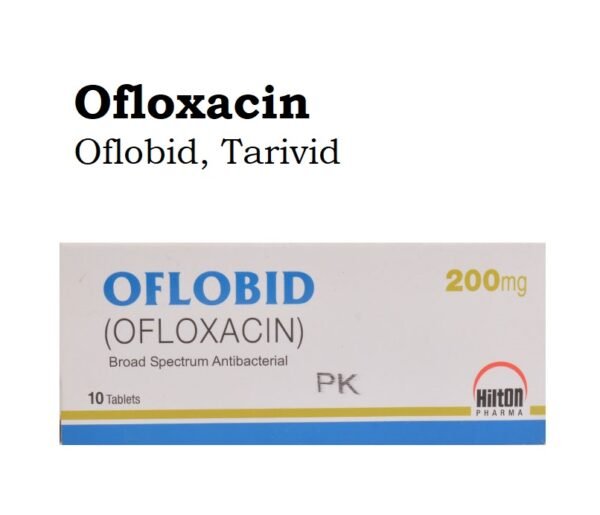
Ofloxacin (Tarivid, Floxin) is a broad-spectrum antibiotic that is used to treat a variety of bacterial infections including pneumonia, enteric infections, eye, and ear infections.
Ofloxacin Uses:
- Acute exacerbations of chronic bronchitis
- Community-acquired pneumonia
- Uncomplicated Skin & skin structure infections
- nongonococcal urethritis & cervicitis due to Chlamydia trachomatis infection
- Mixed infections of the urethra and cervix
- Acute pelvic inflammatory disease
- Acute uncomplicated Urethral & cervical gonorrhea.
- Uncomplicated Cystitis
- Complicated Urinary tract infections
- Prostatitis
Note:
- As of April 2007, for the treatment of gonococcal disease, the CDC no longer recommends the use of fluoroquinolones.
-
Off Label Use of Ofloxacin in Adults:
- Epididymitis.
- Leprosy (multibacillary).
- Leprosy (paucibacillary).
- Treatment of spontaneous bacterial peritonitis.
- Traveler's diarrhea.
Ofloxacin Dose in Adults
Ofloxacin Dose in the treatment of Cervicitis and urethritis:
P/O:
-
Nongonococcal (due to Chlamydia trachomatis):
- For 7 days, 300 mg every 12 hours
-
Gonococcal (acute, uncomplicated):
- 400 mg as a single dose.
Note:
-
- As of April 2007, for the treatment of uncomplicated gonococcal disease, the CDC no longer recommends the use of fluoroquinolones.
Ofloxacin Dose in the treatment of acute exacerbation Chronic bronchitis, community-acquired pneumonia, skin, and uncomplicated skin structure infections:
P/O:
- For 10 days, 400 mg every 12 hours
Ofloxacin Dose in the treatment of acute Pelvic inflammatory disease:
-
Manufacturer's labeling:
- For 10-14 days, 400 mg every 12 hours.
Note:
-
- The CDC recommends use only if standard cephalosporin therapy is not feasible (patients with severe cephalosporin allergy) & community prevalence of quinolone-resistant gonococcal organisms is low.
- With metronidazole, CDC recommends use in combination.
- Followup & culture and sensitivity must be confirmed (CDC [Workowski 2015]).
Ofloxacin Dose in the treatment of Prostatitis:
P/O:
- For 6 weeks, 300 mg every 12 hours
Ofloxacin Dose in the treatment of UTI:
P/O:
-
Uncomplicated:
- For 3 to 7 days, 200 mg every 12 hours
-
Complicated:
- For 10 days, 200 mg every 12 hours
Ofloxacin Dose in the treatment of Epididymitis (off-label):
P/O
-
Likely caused by enteric organisms:
- For 10 days, 300 mg twice daily or
- for 14 days, 200 mg twice daily (Canadian STI Guidelines 2008 [Update 2014])
-
Likely caused by sexually transmitted chlamydia and gonorrhea and enteric organisms in men who practice insertive anal sex:
- 300 mg twice daily for 10 days in combination with ceftriaxone (CDC [Workowski 2015])
Ofloxacin Dose in the treatment of Leprosy (multibacillary) (off-label):
P/O:
- 400 mg once in 24 hours (in combination with dapsone and rifampin) for 12 months (WHO 2012) or alternatively,
- 400 mg once 30 days (in combination with monthly rifampin and minocycline) for 24 months.
Ofloxacin Dose in the treatment of Leprosy (paucibacillary) (off-label):
Multiple-dose regimen:
-
- For 4 weeks, 400 mg orally once 24 hours (in combination with rifampin).
Single-dose regimen:
-
- 400 mg as a single dose (in combination with single doses of rifampin & minocycline).
Note:
-
- Found to be less effective than standard WHO multiple drug therapy (WHO-MDT) for paucibacillary leprosy.
- Should be used only if close follow-up of relapse is possible
Ofloxacin Dose in the treatment of Spontaneous bacterial peritonitis (off-label):
P/O:
- 400 mg twice every 24 hours.
Ofloxacin Dose in the treatment of Traveler's diarrhea (off-label):
P/O:
- 200 mg twice every 24 hours for 1-3 days or 400 mg once every 24 hours as a single dose or for 3 days, with or without loperamide.
- Continue with a 3-day therapy course, if symptoms not resolved after 24 hours.
- In patients with fever or dysentery, a 3-day course of therapy is recommended.
- Enteric infection due to Shigella dysenteriae is an exception & a 5-day treatment duration is superior to single-dose or 3-day regimens.
Note:
- Fluoroquinolone resistance is increasing.
- Azithromycin may be preferred, particularly in regions such as southeast Asia or India with a high prevalence of Campylobacter (ACG [Riddle 2016]).
Ofloxacin Dose in Childrens
Ofloxacin Dose in the treatment of Susceptible infections in children:
P/O:
-
- 15 mg/kg/day divided every 12 hours.
Pregnancy Risk Factor C
- Some adverse events were observed in animal reproduction studies.
- Ofloxacin crosses into the placenta and is found in the amniotic fluid.
- The serum concentrations of ofloxacin in pregnant women may be lower than those of nonpregnant women.
- According to available data, there is no evidence that ofloxacin can cause an increase in teratogenic effects during pregnancy.
Ofloxacin use during breastfeeding:
- Ofloxacin is produced in breast milk.
- Manufacturer recommends that a decision is made regarding whether to stop nursing or discontinue using the drug.
- This consideration should be taken in light of the possibility of serious adverse reactions in the infant while nursing.
Ofloxacin Dose in Kidney Disease:
P/O:
-
After a normal initial dose, adjust as follows:
-
CrCl >50 mL/min:
- No dosage adjustment is necessary.
-
CrCl 20-50 mL/min:
- Every 24 hours, administer the usual recommended dose.
-
CrCl <20 mL/minute:
- Every 24 hours, administer half the usual recommended dose.
-
Intermittent hemodialysis (IHD):
- After dialysis, 100-200 mg.
-
Peritoneal dialysis:
- Every 24 hours, 200 mg.
-
Continuous renal replacement therapy (CRRT):
- Every 24 hours, 300 mg.
-
Ofloxacin Dose in Liver Disease:
-
Mild to moderate impairment:
- In the manufacturer’s labeling, there are no dosage adjustments provided.
- use cautiously.
-
Severe impairment (eg, cirrhosis with or without ascites):
- Max dose:
- 400 mg per day
Side Effects of Ofloxacin:
-
Cardiovascular:
- Chest Pain
-
Central Nervous System:
- Headache
- Insomnia
- Dizziness
- Fatigue
- Drowsiness
- Sleep Disorder
- Nervousness
- Pain
-
Dermatologic:
- Pruritus
- Skin Rash
- Genital Pruritus
-
Gastrointestinal:
- Nausea
- Diarrhea
- Vomiting
- Abdominal Cramps
- Constipation
- Decreased Appetite
- Dysgeusia
- Flatulence
- Gastrointestinal Distress
- Xerostomia
-
Genitourinary:
- Vaginitis
-
Ophthalmic:
- Visual Disturbance
-
Respiratory:
- Pharyngitis
-
Miscellaneous:
- Fever
Contraindications to Ofloxacin:
- Hypersensitivity to ofloxacin or other quinolones or any component in the formulation
Warnings and precautions
-
Modified cardiac conduction
- Fluoroquinolones may prolong the QTc interval.
- In patients with a history of QTc prolongation, uncorrected hypokalemia, hypomagnesemia, or concurrent administration of other medications known to prolong the QT interval, avoid use (including Class Ia and Class III antiarrhythmics, cisapride, erythromycin, antipsychotics, and tricyclic antidepressants).
-
Aneurysm of the aorta and dissection
- Fluoroquinolones have been linked to ruptures of aortic aneurysms in elderly patients.
- Fluoroquinolones should be avoided in patients who have a history of aneurysm, or are at higher risk, such as patients with hypertension, peripheral atherosclerotic diseases, hypertension, and patients with genetic disorders involving blood vessels (eg, Marfan, Ehlers Danlos syndrome) unless there is no alternative treatment.
- Extended treatment (eg, >14 Days) can increase the risk (Lee 2018,
-
CNS effects
- Fluoroquinolones have been linked to an increased risk for CNS effects such as seizures, elevated intracranial pressure (including pseudotumor Cerebri), dizziness and lightheadedness, and tremors.
- Patients with CNS disorders, such as epilepsy, severe cerebral arteriosclerosis or epilepsy, or any other risk factors, should be cautious.
-
Regulation of Glucose
- Fluoroquinolones have been linked to disturbances in glucose regulation including hypoglycemia and hyperglycemia.
- Patients who are also taking insulin or oral hypoglycemic drugs have been most affected by these events.
- There have been several cases of severe hypoglycemia including death and coma.
- Diabetic patients should be closely examined for signs and symptoms of impaired glucose regulation.
- Stop taking the medication if you experience hypoglycemia.
-
Hypersensitivity reactions
- Anaphylaxis and severe hypersensitivity reactions can occur with quinolone therapy.
- These reactions may have a wide spectrum.
- Itching, urticaria and rash may be the most common reactions after one dose. However, severe idiosyncratic dermatologic symptoms may also occur after multiple doses.
- You should immediately stop taking any drugs if you experience a skin rash, or other symptoms.
-
Peripheral neuropathy:
- Rarely, peripheral neuropathy has been reported.
- The effects of therapy can be immediate and irreversible.
- Stop taking medication if you experience symptoms of sensorimotor or sensory neuropathy.
-
Phototoxicity:
- Avoid too much sun and take safety precautions (e.g., wearing loose-fitting clothes, using sunscreen).
- Phototoxicity reactions may range from mild to severe.
- If you experience photosensitivity, stop using the product.
-
Psychiatric reactions
- Fluoroquinolones are associated with an increased risk for psychiatric reactions. This includes toxic psychosis and hallucinations.
- It can also cause anxiety, agitation and confusion, disorientation, delirium, attention disorders & memory impairment.
- Patients with depression history or other risk factors should be cautious.
- Stop using the medication if you experience a reaction.
-
Superinfection
- Use of the product for prolonged periods can lead to fungal and bacterial superinfections, such as C. difficile-associated diarrhea(CDAD), pseudomembranous collitis.
- CDAD was observed for >2 months after antibiotic treatment.
-
Tendon rupture/ inflammation: [US Boxed Warn]
- Reports of tendon inflammation and rupture have been reported after using quinolone antibiotics.
- Concurrent corticosteroids may increase the risk for organ transplant recipients and patients over 60 years old.
- Most often, Achilles tendon ruptures require surgical repair. However, other tendon sites such as rotator cuff and biceps have been reported.
- Tendonitis can be caused by strenuous exercise.
- Stop using the medication immediately if there is any tendon inflammation.
- This may occur even after therapy is stopped.
-
Hepatic impairment
- Patients with hepatic impairment should be cautious.
-
Myasthenia gravis: [US Boxed Warning]:
- Might exacerbate muscle weakness due to myasthenia Gravis.
- There have been cases of death and severe exacerbations.
- Avoid use in patients with myasthenia Gravis.
-
Renal impairment
- Patients with impaired renal function should be cautious.
- Adjustment of dosage is required.
- Increased risk of tendon rupture.
-
Rheumatoid arthritis:
- Patients with rheumatoid arthritis should be cautious.
- Increased risk of tendon rupture.
-
Seizures:
- Be cautious when administering medication to patients at high risk for seizures (CNS disorders, or concurrent therapy with medications that may lower the seizure threshold).
- Although seizures are rare, they can be increased by concomitant NSAID therapy.
-
Syphilis:
- Syphilis should be checked on all patients at the time they are diagnosed with gonorrhea and three months later. Ofloxacin is not effective in treating syphilis, and can mask symptoms.
Note:
- As of April 2007, the CDC no longer recommends the use of fluoroquinolones for the treatment of uncomplicated gonococcal disease.
Ofloxacin (systemic): Drug Interaction
|
Risk Factor C (Monitor therapy) |
|
|
Aminolevulinic Acid (Topical) |
Photosensitizing Agents may enhance the photosensitizing effect of Aminolevulinic Acid (Topical). |
|
BCG Vaccine (Immunization) |
Antibiotics may diminish the therapeutic effect of BCG Vaccine (Immunization). |
|
Blood Glucose Lowering Agents |
Quinolones may enhance the hypoglycemic effect of Blood Glucose Lowering Agents. Quinolones may diminish the therapeutic effect of Blood Glucose Lowering Agents. Specifically, if an agent is being used to treat diabetes, loss of blood sugar control may occur with quinolone use. |
|
Corticosteroids (Systemic) |
May enhance the adverse/toxic effect of Quinolones. Specifically, the risk of tendonitis and tendon rupture may be increased. |
|
Haloperidol |
QT-prolonging Agents (Indeterminate Risk - Avoid) may enhance the QTcprolonging effect of Haloperidol. |
|
Heroin |
Quinolones may enhance the adverse/toxic effect of Heroin. |
|
Lactobacillus and Estriol |
Antibiotics may diminish the therapeutic effect of Lactobacillus and Estriol. |
|
Mycophenolate |
Quinolones may decrease the serum concentration of Mycophenolate. Specifically, quinolones may decrease concentrations of the active metabolite of mycophenolate. |
|
Nonsteroidal Anti-Inflammatory Agents |
May enhance the neuroexcitatory and/or seizurepotentiating effect of Quinolones. Nonsteroidal Anti-Inflammatory Agents may increase the serum concentration of Quinolones. |
|
Porfimer |
Photosensitizing Agents may enhance the photosensitizing effect of Porfimer. |
|
Probenecid |
May decrease the excretion of Quinolones. Specifically, probenecid may decreased the renal excretion of quinolone antibiotics. Probenecid may increase the serum concentration of Quinolones. |
|
QT-prolonging Agents (Highest Risk) |
QT-prolonging Agents (Indeterminate Risk - Avoid) may enhance the QTc-prolonging effect of QT-prolonging Agents (Highest Risk). Management: Monitor for QTc interval prolongation and ventricular arrhythmias when these agents are combined. Patients with additional risk factors for QTc prolongation may be at even higher risk. |
|
Varenicline |
Quinolones may increase the serum concentration of Varenicline. Management: Monitor for increased varenicline adverse effects with concurrent use of levofloxacin or other quinolone antibiotics, particularly in patients with severe renal impairment. International product labeling recommendations vary. Consult appropriate labeling. |
|
Verteporfin |
Photosensitizing Agents may enhance the photosensitizing effect of Verteporfin. |
|
Vitamin K Antagonists (eg, warfarin) |
Quinolones may enhance the anticoagulant effect of Vitamin K Antagonists. |
|
Risk Factor D (Consider therapy modification) |
|
|
Antacids |
May decrease the absorption of Quinolones. Of concern only with oral administration of quinolones. Management: Avoid concurrent administration of quinolones and antacids to minimize the impact of this interaction. Recommendations for optimal dose separation vary by specific quinolone. Exceptions: Sodium Bicarbonate. |
|
Calcium Salts |
May decrease the absorption of Quinolones. Of concern only with oral administration of both agents. Exceptions: Calcium Chloride. |
|
Delamanid |
Quinolones may enhance the QTc-prolonging effect of Delamanid. Management: Avoid concomitant use if possible. If coadministration is unavoidable, frequent monitoring of electrocardiograms (ECGs) throughout the full delamanid treatment period should occur. Exceptions are discussed in separate monographs. |
|
Didanosine |
Quinolones may decrease the serum concentration of Didanosine. Didanosine may decrease the serum concentration of Quinolones. Management: Administer oral quinolones at least 2 hours before or 6 hours after didanosine. Monitor for decreased therapeutic effects of quinolones, particularly if doses cannot be separated as recommended. This does not apply to unbuffered enteric coated didanosine. |
|
Iron Salts |
May decrease the serum concentration of Quinolones. Management: Give oral quinolones at least several hours before (4 h for moxi- and sparfloxacin, 2 h for others) or after (8 h for moxi-, 6 h for cipro/dela-, 4 h for lome-, 3 h for gemi-, and 2 h for levo-, nor-, oflox-, pefloxacin, or nalidixic acid) oral iron salts Exceptions: Ferric Carboxymaltose; Ferric Gluconate; Ferric Hydroxide Polymaltose Complex; Ferric Pyrophosphate Citrate; Ferumoxytol; Iron Dextran Complex; Iron Isomaltoside; Iron Sucrose. |
|
Lanthanum |
May decrease the serum concentration of Quinolones. Management: Administer oral quinolone antibiotics at least one hour before or four hours after lanthanum. |
|
Magnesium Salts |
May decrease the serum concentration of Quinolones. Management: Administer oral quinolones several hours before (4 h for moxi/pe/spar-, 2 h for others) or after (8 h for moxi-, 6 h for cipro/dela-, 4 h for lome/pe-, 3 h for gemi-, and 2 h for levo-, nor-, or ofloxacin or nalidixic acid) oral magnesium salts. |
|
Multivitamins/Minerals (with ADEK, Folate, Iron) |
May decrease the serum concentration of Quinolones. Specifically, polyvalent cations in multivitamin products may decrease the absorption of orally administered quinolone antibiotics. Management: Interactions can be minimized by administering the oral quinolone at least 2 hours before, or 6 hours after, the dose of a multivitamin that contains polyvalent cations (i.e., calcium, iron, magnesium, selenium, zinc). |
|
Multivitamins/Minerals (with AE, No Iron) |
May decrease the serum concentration of Quinolones. Specifically, minerals in the multivitamin/mineral product may impair absorption of quinolone antibiotics. Management: Interactions can be minimized by administering the oral quinolone at least 2 hours before, or 6 hours after, the dose of a multivitamin that contains polyvalent cations (i.e., calcium, iron, magnesium, selenium, zinc). |
|
Quinapril |
May decrease the serum concentration of Quinolones. Management: Separate doses of quinapril and oral quinolones by at least 2 hours in order to reduce the risk of interaction. Monitor for reduced efficacy of the quinolone if these products are used concomitantly. |
|
Sevelamer |
May decrease the absorption of Quinolones. Management: Administer oral quinolones at least 2 hours before or 6 hours after sevelamer. |
|
Sodium Picosulfate |
Antibiotics may diminish the therapeutic effect of Sodium Picosulfate. Management: Consider using an alternative product for bowel cleansing prior to a colonoscopy in patients who have recently used or are concurrently using an antibiotic. |
|
Sucralfate |
May decrease the serum concentration of Quinolones. Management: Administer oral quinolones at least 2 hours before or 6 hours after the sucralfate dose. Greater separation of doses may further lessen the risk for a significant interaction. |
|
Theophylline Derivatives |
Quinolones may decrease the metabolism of Theophylline Derivatives. Ciprofloxacin and enoxacin are of greatest concern. Theophylline/quinolone therapy might augment the seizure-producing potential of each of the individual agents. Exceptions: Dyphylline. |
|
Typhoid Vaccine |
Antibiotics may diminish the therapeutic effect of Typhoid Vaccine. Only the live attenuated Ty21a strain is affected. Management: Vaccination with live attenuated typhoid vaccine (Ty21a) should be avoided in patients being treated with systemic antibacterial agents. Use of this vaccine should be postponed until at least 3 days after cessation of antibacterial agents. |
|
Zinc Salts |
May decrease the serum concentration of Quinolones. Management: Give oral quinolones at least several hours before (4 h for moxi- and sparfloxacin, 2 h for others) or after (8 h for moxi-, 6 h for cipro/dela-, 4 h for lome-, 3 h for gemi-, and 2 h for levo-, nor-, pe- or ofloxacin or nalidixic acid) oral zinc salts. Exceptions: Zinc Chloride. |
|
Risk Factor X (Avoid combination) |
|
|
Aminolevulinic Acid (Systemic) |
Photosensitizing Agents may enhance the photosensitizing effect of Aminolevulinic Acid (Systemic). |
|
BCG (Intravesical) |
Antibiotics may diminish the therapeutic effect of BCG (Intravesical). |
|
Cholera Vaccine |
Antibiotics may diminish the therapeutic effect of Cholera Vaccine. Management: Avoid cholera vaccine in patients receiving systemic antibiotics, and within 14 days following the use of oral or parenteral antibiotics. |
|
Nadifloxacin |
May enhance the adverse/toxic effect of Quinolones. |
|
Strontium Ranelate |
May decrease the serum concentration of Quinolones. Management: In order to minimize any potential impact of strontium ranelate on quinolone antibiotic concentrations, it is recommended that strontium ranelate treatment be interrupted during quinolone therapy. |
Monitoring Parameters:
- If therapy is prolonged, examine CBC, renal, and hepatic function periodically.
- Signs and symptoms of disordered glucose regulation.
How to administer Ofloxacin?
- Administer with or without food.
- Do not take within 2 hours of sucralfate, didanosine, iron, zinc, or antacids containing magnesium, calcium, or aluminum.
Mechanism of action of Ofloxacin:
- Ofloxacin is a DNA-gyrase inhibitor.
- DNA gyrase, a vital bacterial enzyme, is responsible for maintaining the DNA's superhelical structure.
- DNA gyrase is required for DNA repair and transcription, DNA replication, and DNA transposition.
- Bactericidal.
Absorption:
- Well absorbed
Distribution:
- Widely distributed into body tissues and fluids, including blister fluid, cervix, lung, ovary, prostatic tissue, skin, and sputum.
Protein binding:
- 20%-32 %
Bioavailability:
- 98 %
Half-life elimination:
- ~9 hours (biphasic: 4 to 5 hours [6.4 to 7.4 hours in elderly patients] and 20 to 25 hours [accounts for <5%]).
- Extended with renal impairment
Time to peak serum concentration:
- 1-2 hours
Excretion:
- Urine:
- 65 %-80 % (as unchanged drug).
- Feces:
- 4 %-8 %.
- <10 % is metabolized.
International Brands of Ofloxacin:
- Akilen
- Avaflox
- Biloxcin
- Cilox 200
- Cinaflox
- Danoflox
- Evaflox
- Flobacin
- Flogirax
- Floksan
- Flotavid
- Flovid
- Floxil
- Floxitop
- Floxstat
- Fugacin
- Hyflox
- Kinflocin
- Kinoxacin
- Loxinter
- Loxwin
- Medofloxine
- Mefoxa
- Menazin
- Microbac
- Novecin
- Nufafloqo
- Ofcin
- Ofla
- Oflacin
- Oflamed
- Oflin
- Oflobid
- Oflocee
- Oflocet
- Oflocin
- Oflodal
- Oflodex
- Oflodura
- Oflovir
- Ofloxin
- Ofloxol
- Oltrex
- Onexacin
- Orivid
- Orocin
- Oxacid
- Oxacin
- Pharflox
- Quotavil
- Rilox
- Sinflo
- Tabrin
- Tafloc
- Taravid
- Tariflox
- Tarivid
- Taroflex
- Telbit
- Uro Tarivid
- Vioflox
- Vioson
- Viotisone
- Zanocin
Ofloxacin Brand Names in Pakistan:
Ofloxacin Injection 500 mg/10ml |
|
| Ketalin | Saturn Pharmaceuticals (Pvt) Ltd |
Ofloxacin Injection 500 Mg/10ml |
|
| Ketalin | Saturn Pharmaceuticals (Pvt) Ltd |
Ofloxacin Inf 200 Mg |
|
| Albacat | Nabiqasim Industries (Pvt) Ltd. |
| Infuxac | Elko Organization (Pvt) Ltd. |
| Oranex | Isis Pharmaceutical |
| Sterioflox | Frontier Dextrose Ltd |
| Technoflox | Hygeia Pharmaceuticals |
Ofloxacin Infusion 200 mg/100ml |
|
| Tranxcin | Treat Pharmaceuticals |
Ofloxacin Infusion 200 mg/100ml |
|
| Adios | Wilshire Laboratories (Pvt) Ltd. |
| Bactivid | Dr. Raza Pharma (Private) Limited |
| Bidflox | Ahad International Pharmaceuticals |
| Curitol | Standpharm Pakistan (Pvt) Ltd. |
| Epoflox | Epoch Pharmaceutical |
| Exact | Saydon Pharmaceutical Industries (Pvt) Ltd. |
| Florains | Mac & Rans Pharmaceuticals (Pvt) Ltd |
| Floxy | Glaxosmithkline |
| G-Vid | Akson Pharmaceuticals (Pvt) Ltd. |
| Geoflox | Geofman Pharmaceuticals |
| Lebx | Raazee Theraputics (Pvt) Ltd. |
| Loxat | Siza International (Pvt) Ltd. |
| Ofcil | Mediceena Pharma (Pvt) Ltd. |
| Ofcil | Mediceena Pharma (Pvt) Ltd. |
| Oflobid | Hilton Pharma (Pvt) Limited |
| Oflocin | Helix Pharma (Private) Limited |
| Ofloquin | Global Pharmaceuticals |
| Oflosave | Medisave Pharmaceuticals |
| Oflosol I.V | Marions Laboratories Pakistan |
| Ofloxa-Z | Z-Jans Pharmaceutical (Pvt) Ltd. |
| Oftin | Mass Pharma (Private) Limited |
| Oloxin | Eg Pharmaceuticals |
| Quinox | Brookes Pharmaceutical Laboratories (Pak.) Ltd. |
| Tariflox | Bosch Pharmaceuticals (Pvt) Ltd. |
| Tarivid | Sanofi Aventis (Pakistan) Ltd. |
Ofloxacin Eye Drops 3 mg/ml |
|
| Taripharm | Epharm Laboratories |
Ofloxacin Eye Drops 0.3 % W/V |
|
| Ciof | Remington Pharmaceutical Industries (Pvt) Ltd. |
| Exocin | Barrett Hodgson Pakistan (Pvt) Ltd. |
| Eyeforex | Atco Laboratories Limited |
| Floxy | Glaxosmithkline |
| Gw Floxy | Glaxosmithkline |
| Ofcil | Mediceena Pharma (Pvt) Ltd. |
| Oflexer | The Schazoo Laboratories Ltd. |
| Oflo-V | Remington Pharmaceutical Industries (Pvt) Ltd. |
| Oflobiotic | Zafa Pharmaceutical Laboratories (Pvt) Ltd. |
| Oflocin | Helix Pharma (Private) Limited |
| Oflocin-D | Helix Pharma (Private) Limited |
| Oflonim | Nimrall Laboratories |
| Ofloquin | Global Pharmaceuticals |
| Op Lox | Epoch Pharmaceutical |
| Ophth-Flox | Ophth-Pharma (Pvt) Ltd. |
| Optiquin | Azron Pharmaceuticals (Pvt) Ltd |
| Optoflox | Sante (Pvt) Limited |
| Ponoflox | Zinta Pharmaceuticals Industries |
| Tariflox | Bosch Pharmaceuticals (Pvt) Ltd. |
| Veflox | Vega Pharmaceuticals Ltd. |
Ofloxacin Ear Drops 0.3 % W/V |
|
| Earocin | Vega Pharmaceuticals Ltd. |
| Kunoxy | Remington Pharmaceutical Industries (Pvt) Ltd. |
| Oflocin | Helix Pharma (Private) Limited |
| Otoflox | Sante (Pvt) Limited |
Ofloxacin Ear Drops 0.6 %W/V |
|
| Earocin | Vega Pharmaceuticals Ltd. |
| Kunoxy | Remington Pharmaceutical Industries (Pvt) Ltd. |
| Oflocin | Helix Pharma (Private) Limited |
| Otoflox | Sante (Pvt) Limited |
Ofloxacin Eye Ointment 0.3 % W/W |
|
| Exocin | Barrett Hodgson Pakistan (Pvt) Ltd. |
| Oflo | Remington Pharmaceutical Industries (Pvt) Ltd. |
| Ophth-Oflox | Ophth-Pharma (Pvt) Ltd. |
| Optoflox | Sante (Pvt) Limited |
Ofloxacin Ointment 0.3 %W/W |
|
| Tifcin | Valor Pharmaceuticals |
Ofloxacin Tablets 200 Mg |
|
| A-Vid | Alliance Pharmaceuticals (Pvt) Ltd. |
| Adiflox | Davis Pharmaceutical Laboratories |
| Adios | Wilshire Laboratories (Pvt) Ltd. |
| Alcin | Alina Combine Pharmaceuticals (Pvt) Ltd. |
| Ankavid | Ankaz Pharmex (Pvt) Ltd. |
| Arixtra Tablet | Meditech Pharmaceuticals |
| Arloxin | Pakistan Pharmaceutical Products (Pvt) Ltd. |
| Avocin | Harmann Pharmaceutical Laboratories (Pvt) Ltd. |
| Azoflox | Delta Pharma (Pvt) Ltd. |
| Bacivid | Umersons |
| Bacrid | Neutro Pharma (Pvt) Ltd. |
| Bactacin | Pharmacare Laboratories (Pvt) Ltd. |
| Bacteflox | Drugs Inn Pakistan |
| Bactivid | Dr. Raza Pharma (Private) Limited |
| Bacus | Elko Organization (Pvt) Ltd. |
| Beflo | Basel Pharmaceuticals |
| Capflo | Zesion Pharmaceutical (Pvt) Ltd |
| Cinax | Aptcure Private Limited |
| Cinvolox | Everest Pharmaceuticals |
| Ciof | Remington Pharmaceutical Industries (Pvt) Ltd. |
| Citivid | City Pharma |
| Civra | Gaba Pharmaceuticals Labs |
| Clamocid | Rock Pharmaceuticals |
| Curitol | Standpharm Pakistan (Pvt) Ltd. |
| Danvid | Danas Pharmaceuticals (Pvt) Ltd |
| Delvid | Delta Pharma (Pvt) Ltd. |
| Dintoflox | Combat Pharma |
| Divirat | Polyfine Chempharma (Pvt) Ltd. |
| Dyramid | Don Valley Pharmaceuticals (Pvt) Ltd. |
| E-Flox | English Pharmaceuticals Industries |
| Ecoflox | Candid Pharmaceuticals |
| Ecolox | Stalwart Pharmaceuticals (Pvt) Ltd |
| Edox | Zephyr Pharmatec (Pvt) Ltd. |
| Eflox | Eros Pharmaceuticals |
| Eracin | Consolidated Chemical Laboratories (Pvt) Ltd. |
| Euvid | Unexo Labs (Pvt) Ltd. |
| Exact | Saydon Pharmaceutical Industries (Pvt) Ltd. |
| Fasbact | Fassgen Pharmaceuticals |
| Flostad | Standard Drug Co. |
| Flovix | Bryon Pharmaceuticals (Pvt) Ltd. |
| Floxicare | Wise Pharmaceuticals (Pvt) Ltd |
| Floxicon | Cibex (Private) Limited |
| Floxiwin | Wns Field Pharmaceuticals |
| Floxol | P.D.H. Pharmaceuticals (Pvt) Ltd. |
| Floxtat | Welmark Pharmaceuticals |
| Floxyan | Roryan Pharmaceutical Industries (Pvt) Ltd |
| Fugacin | High - Q International |
| G-Vid | Akson Pharmaceuticals (Pvt) Ltd. |
| Geoflox | Geofman Pharmaceuticals |
| Grexcin | Gray`S Pharmaceuticals |
| Gw Floxy | Glaxosmithkline |
| Gyrasid | Ferozsons Laboratoies Ltd. |
| Gyrex | Platinum Pharmaceuticals (Pvt.) Ltd. |
| Haloxin | Lowitt Pharmaceuticals (Pvt) Ltd |
| Hocin | Honig Pharmaceuticals Laboratories |
| Hoxidal | Ambrosia Pharmaceuticals |
| Idevid | Ideal Pharmaceutical Industries |
| Irzaflox | Irza Pharma (Pvt) Ltd. |
| Joxacin | Jawa Pharmaceuticals(Pvt) Ltd. |
| Jp-Flox | Jinnah Pharmaceuticals |
| Kapcin | Cirin Pharmaceuticals (Pvt) Ltd. |
| Kemyvid | Alkemy Pharmaceutical Laboratories (Private) Ltd. |
| Kenvid | Shrooq Pharmaceuticals |
| Korvid | Venture Chemical & Pharmaceuticals (Pvt) Ltd. |
| Lebx | Raazee Theraputics (Pvt) Ltd. |
| Loxacin | Shazals Pharmaceuticals |
| Loxat | Siza International (Pvt) Ltd. |
| Loxin | Dosaco Laboratories |
| Loxpro | Adamjee Pharmaceuticals (Pvt) Ltd. |
| Medi-Xin | Medicon Pharmaceuticals Industries (Pvt) Ltd |
| Mediox | Medera Pharmaceuticals (Pvt) Ltd. |
| Megavid | Mega Pharmaceuticals (Pvt) Ltd |
| Miroxin | Miracle Pharmaceuticals(Pvt) Ltd |
| Mykuin | Envoy Pharma |
| Negabact | Adfa San Pharmaceuticals. |
| O Oxacin | Bio Labs (Pvt) Ltd. |
| O-Max | Ferroza International Pharmaceuticals (Pvt) Ltd. |
| O-Quine | Nova Med Pharmaceuticals |
| Oblx | Batala Pharmaceuticals. |
| Ofacin | Heal Pharmaceuticals Pvt Ltd |
| Ofaxin | Fynk Pharmaceuticals |
| Ofcil | Mediceena Pharma (Pvt) Ltd. |
| Oflaban | Friends Pharma (Pvt) Ltd |
| Oflamac | Macter International (Pvt) Ltd. |
| Oflan | Lisko Pakistan (Pvt) Ltd |
| Oflaxa-Z | Z-Jans Pharmaceutical (Pvt) Ltd. |
| Oflazat | Hizat Pharmaceutical Industries (Pvt) Ltd. |
| Ofloban | Saffron Pharmaceutical Company |
| Oflobid | Hilton Pharma (Pvt) Limited |
| Oflobid | Hilton Pharma (Pvt) Limited |
| Oflobiotic | Zafa Pharmaceutical Laboratories (Pvt) Ltd. |
| Oflobro | Albro Pharma |
| Oflofine | Medifine Laboratories |
| Oflogen | Genera Pharmaceuticals |
| Oflogood | Goodman Laboratories |
| Ofloheim | Pakheim Internanational Pharma |
| Oflom | Well & Well Pharma (Pvt) Ltd |
| Oflomax | Dyson Research Laboratories |
| Oflomed | Medicraft Pharmaceuticals (Pvt) Ltd. |
| Oflonim | Nimrall Laboratories |
| Oflonim | Nimrall Laboratories |
| Ofloquin | Global Pharmaceuticals |
| Oflosave | Medisave Pharmaceuticals |
| Ofloscot | Scotmann Pharmaceuticals |
| Oflowan | Swan Pharmaceuticals(Pvt) Ltd |
| Oflowin | Medicraft Pharmaceuticals (Pvt) Ltd. |
| Oflox | Indus Pharma (Pvt) Ltd. |
| Ofloxadvan | Advanced Pharmaceuticals |
| Ofloxin | Werrick Pharmaceuticals |
| Ofloxy | Safina Pharma (Pvt) Ltd |
| Ofspan | Genome Pharmaceuticals (Pvt) Ltd |
| Oftab | Akhai Pharmaceuticals. |
| Oftag | Obsons Pharmaceuticals |
| Oftin | Mass Pharma (Private) Limited |
| Ofus | Rehman Medicine Co. |
| Okcin-200 | Evergreen Pharmaceuticals Pvt Limited |
| Olaxcin | Paramount Pharmaceuticals |
| Oliflox | Olive Laboratories |
| Olox | Shaheen Pharmaceuticals |
| Onid | Silver Oak Corporation. |
| Oracin | Orta Labs. (Pvt) Ltd. |
| Oraflox | Sante (Pvt) Limited |
| Otacin | Glaxosmithkline |
| Otaking | Biogen Pharma |
| Oxacin | Nenza Pharmaceuticals (Pvt) Limited |
| Oxil | Himont Pharmaceuticals (Pvt) Ltd. |
| Oxinof | Zanctok Pharmaceuticals |
| Oxopulse | Pulse Pharmaceuticals |
| Ponolox | Zinta Pharmaceuticals Industries |
| Q-Span | Spencer Pharma |
| Quinox | Brookes Pharmaceutical Laboratories (Pak.) Ltd. |
| Quinzi | Noa Hemis Pharmaceuticals |
| Qulavid | Helicon Pharmaceutek Pakistan (Pvt) Ltd. |
| Rakavid | Rakaposhi Pharmaceutical (Pvt) Ltd. |
| Rakavid | Rakaposhi Pharmaceutical (Pvt) Ltd. |
| Re-Ved | Rasco Pharma |
| Rekoflox | Reko Pharmacal (Pvt) Ltd. |
| Rewell | Fozan Pharmaceuticals Industriers (Pvt) Ltd |
| Rivid | Regent Laboratories Ltd. |
| Rovid | Roryan Pharmaceutical Industries (Pvt) Ltd |
| Royflox | Royal Consumer Manufacturing Company |
| Salmocine | Rasco Pharma |
| Shaflo | Shawan Pharmaceuticals |
| Sydacin | Sayyed Pharmaceuticals |
| Synoflox | Syntex Pharmaceuticals |
| T-Vid | Tagma Pharma (Pvt) Ltd. |
| Tabroxacin | Tabros Pharma |
| Tafy | Pliva Pakistan (Pvt) Limited |
| Taricin | Hansel Pharmacueutical Pvt (Ltd) |
| Taridix | Neo Medix |
| Tariflox | Bosch Pharmaceuticals (Pvt) Ltd. |
| Taripharm | Epharm Laboratories |
| Tarivid | Sanofi Aventis (Pakistan) Ltd. |
| Tasoflox | F.M. Pharmaceuticals International |
| Teknoflox | Hygeia Pharmaceuticals |
| Telbit | Hamaz Pharmaceutical (Pvt) Ltd. |
| Tifcin | Valor Pharmaceuticals |
| Tissot | Macquins International |
| Tyfox | Rakaposhi Pharmaceutical (Pvt) Ltd. |
| Utixan | Leama Chemi Pharma (Pvt.) Ltd. |
| Visoflox | Vision Pharmacueticals |
| Wefloxacin | Webros Pharmaceuticals |
| Wiloxin | Wilsons Pharmaceuticals |
| Xarivid | Axis Pharmaceuticals |
| Zarevid | Zumars Pharma (Pvt) Ltd. |
| Zippy | Everest Pharmaceuticals |
| Zoflox | Pharmatec Pakistan (Pvt) Ltd. |
| Zoxam | Medisure Laboratories Pakistan (Pvt.) Ltd. |
Ofloxacin 400 Mg Tablets |
|
| Adiflox | Davis Pharmaceutical Laboratories |
| Adiflox | Davis Pharmaceutical Laboratories |
| Adios | Wilshire Laboratories (Pvt) Ltd. |
| Ankavid | Ankaz Pharmex (Pvt) Ltd. |
| Ankavid | Ankaz Pharmex (Pvt) Ltd. |
| Clamocid | Rock Pharmaceuticals |
| Curitol | Standpharm Pakistan (Pvt) Ltd. |
| Ecolox | Stalwart Pharmaceuticals (Pvt) Ltd |
| Edox | Zephyr Pharmatec (Pvt) Ltd. |
| Fasbact | Fassgen Pharmaceuticals |
| Floxicon | Cibex (Private) Limited |
| Floxtat | Welmark Pharmaceuticals |
| Jp-Flox | Jinnah Pharmaceuticals |
| Kapcin | Cirin Pharmaceuticals (Pvt) Ltd. |
| Loxacin | Shazals Pharmaceuticals |
| Myobid | Panacea Pharmaceuticals |
| Oflobid | Hilton Pharma (Pvt) Limited |
| Oflomed | Medicraft Pharmaceuticals (Pvt) Ltd. |
| Ofloquin | Global Pharmaceuticals |
| Ofloscot | Scotmann Pharmaceuticals |
| Oflowin | Medicraft Pharmaceuticals (Pvt) Ltd. |
| Oflox | Indus Pharma (Pvt) Ltd. |
| Olax | Linear Pharma |
| Olaxcin | Paramount Pharmaceuticals |
| Olaxcin | Paramount Pharmaceuticals |
| Oxacin | Nenza Pharmaceuticals (Pvt) Limited |
| Oxopulse | Pulse Pharmaceuticals |
| Ponolox | Zinta Pharmaceuticals Industries |
| Quinof | Hisun Pharmaceuticals |
| Rovid | Roryan Pharmaceutical Industries (Pvt) Ltd |
| Tafy | Pliva Pakistan (Pvt) Limited |
| Tafy | Pliva Pakistan (Pvt) Limited |
| Taridix | Neo Medix |
| Tariflox Forte | Bosch Pharmaceuticals (Pvt) Ltd. |
| Taripharm | Epharm Laboratories |
| Unox | Unison Chemical Works |
| Unox | Unison Chemical Works |
| Visoflox | Vision Pharmacueticals |
Ofloxacin 200 mg Capsules |
|
| Biovid | Biorex Pharmaceuticals |
| Joxacin | Jawa Pharmaceuticals (Pvt) Ltd. |
| Orvacin | Bloom Pharmaceuticals (Pvt) Ltd. |
.png)


