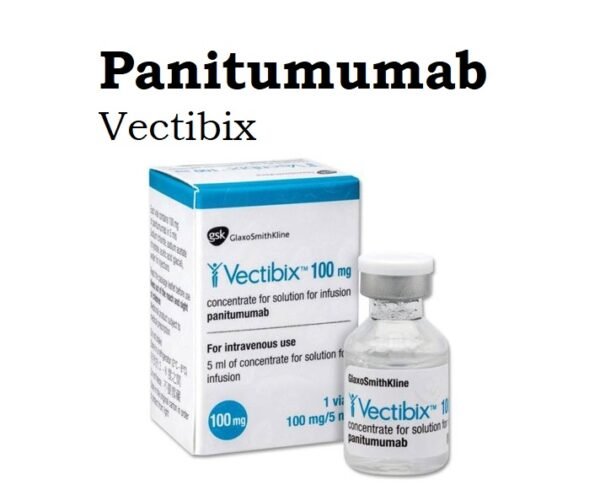
Panitumumab (Vectibix) is a fully human IgG2 monoclonal antibody that targets the EGFR (epidermal growth factor receptors).
Panitumumab Uses:
-
Metastatic Colorectal Cancer:
- Treatment of wild-type RAS (defined as wild-type in both KRAS and NRAS as determined by an approved test) metastatic colorectal carcinoma (mCRC), either as first-line therapy in combination with FOLFOX (fluorouracil, leucovorin, and oxaliplatin) or as a single agent therapy following disease progression after earlier treatment with fluoropyrimidine-, oxaliplatin-, and irinotecan-containing chemotherapy
-
Limitations of use:
- Panitumumab is not indicated for the treatment of patients with RAS-mutant metastatic colorectal carcinoma (mCRC) or for whom RAS mutation status is unknown.
-
Off Label Use of Panitumumab in Adults:
- metastatic colorectal cancer, KRAS wild-type (in combination with other chemotherapy agents)
Panitumumab Dose in Adults
- Note: Establish RAS mutation status (to confirm RAS wild-type) before treatment initiation.
Panitumumab Dose in the treatment of metastatic colorectal cancer, RAS wild-type:
- 6 mg/kg IV every 2 weeks as a single agent or in combination with FOLFOX (fluorouracil, leucovorin, and oxaliplatin);
- continue until disease progression or unacceptable toxicity.
Panitumumab Dose in the treatment of metastatic colorectal cancer, RAS wild-type in combination with FOLFIRI (fluorouracil, leucovorin, and irinotecan; off-label combination):
- IV: 6 mg/kg every 2 weeks;
- continue until disease progression or unacceptable toxicity.
Use in children:
The safety and efficacy of the drug in children have not been established.
Panitumumab Pregnancy Risk Category: C
- Based on animal reproduction studies and the mechanism of action, panitumumab can cause harm to fetal health if administered during pregnancy.
- Panitumumab (humanized monoclonal antibody, IgG) is a panitumumab.
- The IgG subclass and gestational year are important factors in placental transfer. It generally increases with pregnancy progression.
- During the organogenesis period, you would expect to be exposed at a minimum.
- Panitumumab causes inhibition of epidermal Growth Factor (EGF), which is a component in fetal development. Therefore, it would be reasonable to expect adverse effects on pregnancy.
- Effective contraception should be used by females with reproductive potential during treatment, and at least for 2 months after the last dose.
Use panitumumab while breastfeeding
- It is unknown if panitumumab can be found in breast milk.
- Panitumumab, an IgG monoclonal antibody, and maternal IgG immunoglobulins can be excreted from breast milk.
- However, it is not likely that breast milk antibodies will enter infant and neonatal circulation in large quantities.
- The manufacturer suggests that women refrain from breastfeeding during therapy or for at least 2 months after receiving the last panitumumab dose.
Panitumumab Dose in Kidney Disease:
- There are no dosage adjustments provided in the drug manufacturer's labeling (has not been studied).
Panitumumab Dose in Liver Disease:
- There are no dosage adjustments provided in the drug manufacturer's labeling (has not been studied).
Monotherapy:
Common Side Effects of Panitumumab (Vectibix):
-
Central Nervous System:
- Fatigue
-
Dermatologic:
- Skin Toxicity
- Erythema
- Pruritus
- Acneiform Eruption
- Paronychia
- Rash
- Skin Fissure
- Exfoliative Dermatitis
- Acne Vulgaris
-
Endocrine & Metabolic:
- Hypomagnesemia
-
Gastrointestinal:
- Nausea
- Diarrhea
- Vomiting
-
Ophthalmic:
- Ocular Toxicity
-
Respiratory:
- Dyspnea
- Cough
-
Miscellaneous:
- Fever
Less Common Side Effects Of Panitumumab (Vectibix):
-
Cardiovascular:
- Pulmonary Embolism
-
Central Nervous System:
- Chills
-
Dermatologic:
- Nail Toxicity
- Xeroderma
- Desquamation
- Dermal Ulcer
- Pustular Rash
- Papular Rash
-
Endocrine & Metabolic:
- Dehydration
-
Gastrointestinal:
- Mucositis
- Stomatitis
- Xerostomia
-
Immunologic:
- Antibody Formation
-
Ophthalmic:
- Abnormal Eyelash Growth
- Conjunctivitis
-
Respiratory:
- Epistaxis
- Interstitial Pulmonary Disease
-
Miscellaneous:
- Infusion Related Reaction
Combination Therapy With FOLFOX:
Common Side Effects Of Panitumumab (Vectibix):
-
Dermatologic:
- Skin Rash
- Acneiform Eruption
- Pruritus
- Paronychia
- Xeroderma
- Erythema
- Skin Fissure
- Alopecia
- Acne Vulgaris
-
Endocrine & Metabolic:
- Hypomagnesemia
- Hypokalemia
- Weight Loss
-
Gastrointestinal:
- Diarrhea
- Anorexia
- Abdominal Pain
- Stomatitis
- Mucosal Inflammation
-
Neuromuscular & Skeletal:
- Weakness
-
Ophthalmic:
- Conjunctivitis
-
Respiratory:
- Epistaxis
Less Common Side Effects Of Panitumumab (Vectibix):
-
Cardiovascular:
- Deep Vein Thrombosis
-
Central Nervous System:
- Fatigue
- Paresthesia
-
Dermatologic:
- Nail Disorder
- Palmar-Plantar Erythrodysesthesia
- Cellulitis
-
Endocrine & Metabolic:
- Dehydration
- Hypocalcemia
-
Hypersensitivity:
- Hypersensitivity
-
Local:
- Localized Infection
Contraindications to Panitumumab (Vectibix):
- The US labeling of the manufacturer does not list any contraindications.
- Canadian labeling
- Previous history of life-threatening or severe hypersensitivity reactions to panitumumab and any component of the formulation
Warnings and precautions
-
Dermatologic toxicities: [US Boxed Warning]
- Patients who received single drug panitumumab have had skin toxicities reported in 90%. Severe skin reactions (grade 3 or greater) were also observed in 15% of patients. These included dermatitis, erythema and pruritus.
- Infection, sepsis and necrotizing fasciitis can all lead to severe skin toxicities.
- The median time for skin (or ocular toxicities) was 14 days. There was resolution within 12 weeks.
- A response is predetermined based on the severity of toxic effects.
- Toxicities in grades 2 through 4 are associated with better survival rates and overall survival than those in grade 1.
- For the prevention of infection or inflammation, monitor all dermatologic toxicities.
- Rare cases of Stevens Johnson syndrome (SJS), and toxic epidermal necrolysis have been reported. Bullous mucocutaneous diseases (life-threatening/fatal) have also been reported.
- You should not receive treatment for severe or life-threatening skin or soft tissue toxicities that are associated with serious/life-threatening inflammatory and infectious complications.
- Dermatological toxicity can require dose reductions or discontinuation.
- Sunlight exposure should be avoided. Wear sunscreen and protective clothing/hats.
- It has also been reported that nails can be toxic.
-
Diarrhea
- Combination chemotherapy can cause diarrhea.
- Combination chemotherapy with panitumumab has been associated with severe diarrhea and dehydration.
- It has also been reported that gastric mucosal toxicities have occurred.
-
Depletion of electrolytes:
- Treatment may cause magnesium and/or calcium depletion (may be delayed; hypomagnesemia occurred more than 2 months after the completion of panitumumab). After treatment has ended, electrolyte replacement may be necessary.
- Monitor for hypomagnesemia or hypocalcemia throughout treatment, and at least for 2 months after it is completed.
- It has also been reported that hypokalemia is a possibility.
-
Infusion reactions
- Infusion reactions that are severe (bronchospasm and dyspnea, fevers, chills, hypotension, or fever) have been reported in less than 1% of patients. Postmarketing surveillance has been used to monitor fatal infusion reactions.
- Stop infusions for severe reactions. If patients have persistent severe reactions, discontinue infusions permanently.
- It is important to have immediate access to appropriate medical assistance for infusion reactions.
- You can manage mild to moderate infusion reactions by slowing down the infusion rate.
-
Ocular toxicities:
- Keratitis, ulcerative keratitis, and other risk factors have been reported.
- You should monitor for ocular toxicities and stop or suspend treatment for severe or more severe keratitis.
-
Toxicity in the lungs:
- Clinical trials have not shown a lot of evidence for pulmonary fibrosis or interstitial lung disease. There have been fatalities.
- If symptoms worsen or become acutely severe, discontinue treatment immediately. Interrupt treatment if interstitial lung disease has been confirmed.
- Most clinical trials were canceled for patients with interstitial pneumonia or pulmonary Fibrosis.
- Take into account the risks and benefits of treatment for patients with pulmonary complications.
-
Status of RAS mutation and colorectal cancer:
- Before you start treatment, confirm that there is no RAS mutation.
- Patients with codons 12-13 (exon 2), codons 59-61 (exon 3) or codons 117-146 (exon 4) RAS or NRAS mutations are less likely to receive EGFR inhibitor therapy.
- Patients with RAS mutation-positive metastatic cancer and patients with unknown RAS mutation status are not recommended.
- Patients with RAS mutations were treated with an anti-EGFR directed antibody. This increased toxicity was not clinically significant.
- Patients with KRAS mutations who received panitumumab with FOLFOX4 had a significantly lower chance of surviving.
- A subset of KRAS patients with wild-type KRAS also showed additional RAS (KRAS [exons 3, 4,] or NRAS[exons 2, 3, 4,]) mutations.
- Patients with RAS mutations were significantly less likely to survive if they received FOLFOX4 and panitumumab together.
- According to the American Society of Clinical Oncology's provisional clinical opinion update, all patients with metastatic colorectal carcinoma should be tested in a certified laboratory for mutations or changes in KRAS and NRAS exons 2 and 3 (codons 59-61), exon 3 and exon 3, respectively, and exon 4 (codons 117-146). Anti-EGFR monoclonal anti-EGFR therapy should only be recommended for patients whose tumors have not been confirmed by extended RAS testing.
- Information about tests that can detect RAS mutations is available at www.fda.gov/CompanionDiagnostics.
- Panitumumab has also been shown to not be effective in patients with the BRAF V600E mutation.
Panitumumab: Drug Interaction
Note: Drug Interaction Categories:
- Risk Factor C: Monitor When Using Combination
- Risk Factor D: Consider Treatment Modification
- Risk Factor X: Avoid Concomitant Use
Risk Factor C (Monitor therapy) |
|
| Aminolevulinic Acid (Topical) | Photosensitizing Agents may enhance the photosensitizing effect of Aminolevulinic Acid (Topical). |
| Porfimer | Photosensitizing Agents may enhance the photosensitizing effect of Porfimer. |
| Verteporfin | Photosensitizing Agents may enhance the photosensitizing effect of Verteporfin. |
Risk Factor X (Avoid combination) |
|
| Aminolevulinic Acid (Systemic) | Photosensitizing Agents may enhance the photosensitizing effect of Aminolevulinic Acid (Systemic). |
Monitoring Parameters:
- Before treatment can begin, it is important to perform RAS genotyping on tumor tissue in order to determine RAS mutation status.
- Monitor serum electrolytes including magnesium, calcium, and potassium (periodically during therapy and for at most 8 weeks thereafter).
- Monitor your vital signs and temperature prior to, during, or after infusion.
- For signs of ocular toxicities, skin toxicity and acute onset/worsening of pulmonary symptoms, monitor closely.
How to administer Panitumumab (Vectibix)?
- Only for IV infusion; don't administer as an IV push, or as a Bolus.
- Use an infusion pump to infuse through a low-protein-binding, 0.22-micrometer inline filter.
- Doses below 1,000 mg should be infused for at least one hour. If the first dose is well tolerated, additional doses can be given over half an hour.
- Doses >1,000mg, infuse for more than 90 minutes
- Infusion: Flush line with NS before and after infusion
- Do not combine or give other medications.
- Reduce infusion rate by half if you have mild to moderate reactions, i.e. grades 1 and 2. Stop infusion if you experience severe infusion reactions (i.e. grades 3 and 4.) and consider discontinuing the drug permanently.
- It is important to have access to the appropriate medical assistance for infusion reactions.
Mechanism of action of Panitumumab (Vectibix):
- It is a recombinant human IgG2 monoclonal anti-mouse antibody. It binds specifically to the epidermal Growth Factor receptor (EGFR, HER1, c–ErbB-1) and causes competitive inhibition in the binding of epidermal Growth Factor (EGF).
- The EGFR binding blocks phosphorylation/activation of intracellular tyrosine kinases. This results in cell death, growth, proliferation and transformation.
- EGFR signal transduction could result in KRAS or NRAS wild type activation. Cells with RAS mutations seem to not be affected by EGFR inhibition.
Half-life elimination:
- ~7.5 days (range: 4 to 11 days)
International Brands of Panitumumab:
- Vectibix
Panitumumab Brand Names in Pakistan:
No Brands Available in Pakistan.
.png)


