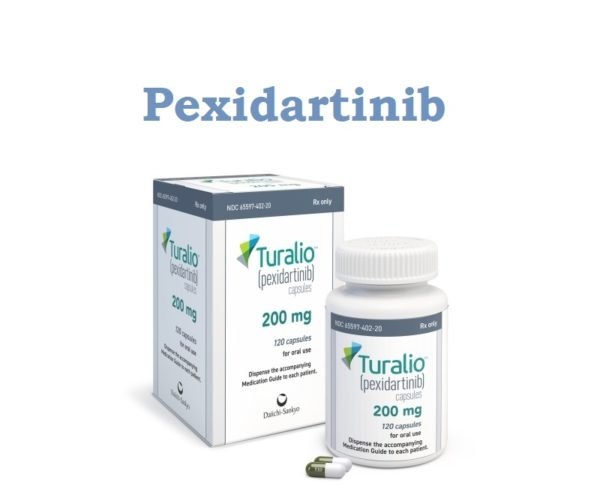
Turalio is the brand name of Pexidartinib. It is a Tyrosine kinase inhibitor and the first drug that has been approved for the treatment of tenosynovial giant cell tumor
Indications of Pexidartinib:
-
Tenosynovial giant cell tumor:
- It is indicated for treatment of symptomatic tenosynovial giant cell tumor (TGCT) associated with severe morbidity or functional limitations and not amenable to improvement with surgery in adults.
Turalio (Pexidartinib) dose in adults:
Turalio (Pexidartinib) dose in the treatment of Tenosynovial giant cell tumor:
- 400 mg per oral b.i.d daily until disease progression or unacceptable toxicity.
-
Dosage adjustment for concomitant CYP3A inhibitors or UGT inhibitors:
- Avoid concomitant use of pexidartinib with strong CYP3A inhibitors or UGT inhibitors.
- If concomitant use with a strong CYP3A inhibitor or UGT inhibitor cannot be avoided, reduce the pexidartinib dose from 400 mg twice daily to 200 mg twice daily, or from 600 mg/day (200 mg in the morning and 400 mg in the evening) to 200 mg twice daily, or from 200 mg twice daily to 200 mg once daily.
- If concomitant use of a strong CYP3A inhibitor or UGT inhibitor is discontinued, increase the pexidartinib dose to the dose that was used prior to initiating the inhibitor after 3 plasma half-lives of the strong CYP3A inhibitor or UGT inhibitor have elapsed.
-
Missed dose:
- If a dose is missed or vomited, administer the next dose at its scheduled time.
Pexidartinib (Turalio) use in Children:
It has not been studied in children.
Turalio (Pexidartinib) Pregnancy Risk Category: U (Undefined)
- Pexidartinib could cause harm to fetal health, according to animal reproduction studies.
- Before starting therapy, it is important to get rid of any pregnancy.
- Effective contraception should be used by females during treatment as well as for one month following the last dose of pexidartinib.
- Effective contraception should be used by males who have a female partner with reproductive potential during treatment and for one week after the last dose of pexidartinib.
Use of Pexidartinib while breastfeeding
- Excessivb excretion is not known in breast milk.
- The manufacturer does not recommend breastfeeding during treatment or for more than one week after the last dose of pexidartinib. This is because of the fatal side effects.
Turalio (Pexidartinib) Dose adjustment in renal disease:
Note: Kidney function estimated by using actual body weight.
-
Creatinine clearance 15 to 89 mL/minute:
- Reduce dose to 200 mg in the morning and 400 mg in the evening (total of 600 mg/day).
- Pexidartinib is not expected to be dialyzable (due to high plasma protein binding).
Turalio (Pexidartinib) Dose adjustment in liver disease:
-
Hepatic impairment prior to treatment initiation:
-
Mild impairment (total bilirubin ≤ ULN with AST > ULN or total bilirubin >1 to 1.5 times ULN and any AST):
- No dosage adjustment necessary.
-
Moderate (total bilirubin >1.5 to 3 times ULN and any AST) or severe (total bilirubin >3 to 10 times ULN and any AST) impairment:
- There are no dosage adjustments provided in the manufacturer's labeling.
-
Active liver or biliary tract disease (including increased alkaline phosphatase):
- Avoid pexidartinib use.
-
-
Hepatotoxicity during treatment:
-
Recommended pexidartinib dosage reduction levels:
- Initial (usual dose): 400 mg twice daily (total of 800 mg/day).
- First dose reduction level: 200 mg in the morning and 400 mg in the evening (total of 600 mg/day).
- Second dose reduction level: 200 mg twice daily (total of 400 mg/day); if unable to tolerate 200 mg twice daily, permanently discontinue.
-
ALT and/or AST increase:
-
>3 to 5 times ULN:
- Withhold pexidartinib and monitor liver function tests weekly. If AST and ALT are ≤3 times ULN within 4 weeks, resume pexidartinib at a reduced dose. If
- Pexidartinib should be permanently stopped if AST or ALT is not ≤3 times ULN within 4 weeks.
-
>5 to 10 times ULN:
- Withhold pexidartinib and monitor liver function tests twice weekly.
- If AST and ALT are ≤3 times ULN within 4 weeks, resume pexidartinib at a reduced dose. It should be permanently stopped if AST or ALT is not ≤3 times ULN within 4 weeks.
-
>10 times ULN:
- Permanently discontinue pexidartinib.
- Monitor liver function tests twice weekly until AST or ALT is ≤5 times ULN, then monitor weekly until ≤3 times ULN.
-
-
Alkaline phosphatase and gamma-glutamyl transferase increase:
-
Alkaline phosphatase >2 times ULN with GGT >2 times ULN:
- Permanently discontinue pexidartinib.
- Monitor liver function tests twice weekly until alkaline phosphatase is ≤5 times ULN, then monitor weekly until ≤2 times ULN.
-
-
Bilirubin increase:
-
Total bilirubin > ULN to <2 times ULN or direct bilirubin > ULN and <1.5 times ULN:
- Withhold pexidartinib and monitor liver function tests twice weekly.
- If an alternate cause for increased bilirubin is confirmed and bilirubin is < ULN within 4 weeks, resume pexidartinib at a reduced dose.
- It should be permanently stopped if bilirubin is not < ULN within 4 weeks.
-
Total bilirubin ≥2 times ULN or direct bilirubin >1.5 times ULN:
- Permanently discontinue pexidartinib. Monitor liver function tests twice weekly until bilirubin is ≤ ULN.
-
-
Common Side Effects of Pexidartinib:
-
Cardiovascular:
- Peripheral Edema
- Hypertension
-
Central Nervous System:
- Fatigue
-
Dermatologic:
- Hair Discoloration
- Skin Rash
- Pruritus
-
Endocrine & Metabolic:
- Increased Lactate Dehydrogenase
- Increased Serum Cholesterol
- Decreased Serum Phosphate
-
Gastrointestinal:
- Dysgeusia
- Vomiting
- Decreased Appetite
- Constipation
-
Hematologic & Oncologic:
- Decreased Neutrophils
- Lymphocytopenia
- Decreased Hemoglobin
- Thrombocytopenia
-
Hepatic:
- Increased Serum Aspartate Aminotransferase
- Increased Serum Alanine Aminotransferase
- Increased Serum Alkaline Phosphatase
-
Ophthalmic:
- Swelling Of Eye
Uncommon Side Effects Of Turalio (Pexidartinib):
-
Central Nervous System:
- Neuropathy
- Cognitive Dysfunction
-
Dermatologic:
- Alopecia
- Dyschromia
-
Gastrointestinal:
- Cholangitis
- Oral Mucosa Ulcer
- Stomatitis
- Xerostomia
-
Hepatic:
- Hepatotoxicity
- Increased Serum Bilirubin
- Hepatic Disease
-
Ophthalmic:
- Blurred Vision
- Decreased Visual Acuity
- Diplopia
- Photophobia
-
Miscellaneous:
- Fever
Rare side effects of Turalio:
-
Central Nervous System:
- Dizziness
-
Endocrine & Metabolic:
- Increased Gamma-Glutamyl Transferase
-
Gastrointestinal:
- Abdominal Pain
- Nausea
Contraindications to Turalio (Pexidartinib):
The manufacturer's labeling does not list any contraindications.
Warnings and precautions
-
Hepatotoxicity: [US Boxed Warning]
- Pexidartinib may cause severe and possibly fatal liver toxicities.
- This can be treated with withholding, dose reduction, permanent discontinuation or permanent discontinuation. Regular monitoring of liver function tests is also required.
- Before pexidartinib is initiated, hepatic function tests, including alkalinephosphatase and gamma–glutamyl transase, should be performed weekly for the first 8 week, then every 2 weeks thereafter.
- Then, each 3 months thereafter.
- Therapy should be avoided in patients suffering from transaminitis.
- Clinical studies revealed that fatal liver injury was possible (ALT or AS >=3x ULN with total Bilirubin >=2x ULN). Peak ALT was between 6 and 9 x ULL, peak total bilirubin was 2.5 to 15x ULLN, alkalinephosphatase >=2x ULN.
- After a period of 1-7 months, the ALT, AAST and total bilirubin levels improved to 2x ULN.
- Re-initiating pexidartinib may cause transaminitis, an increase in bilirubin or alkalinephosphatase. Therefore, hepatic function tests should always be performed every week for the first month.
- You should take Pexidartinib on an empty stomach. This is because it increases the exposure by 100% and can increase the risk for hepatotoxicity.
- Patients with elevated transaminases, elevated total or direct Bilirubin (>ULN), active liver disease or biliary tract diseases should not be given hepatotoxic medication.
- Hepatotoxicity has been associated with ductopenia, cholestasis, and rare cases of irreversible cholestatic liver injury that required a liver transplant.
-
Renal impairment
- Patients with impaired renal function should be advised to reduce their doses.
Pexidartinib: Drug Interaction
|
Aprepitant |
May increase the serum concentration of CYP3A4 Substrates (High risk with Inhibitors). |
|
Bosentan |
May decrease the serum concentration of CYP3A4 Substrates (High risk with Inducers). |
|
Clofazimine |
May increase the serum concentration of CYP3A4 Substrates (High risk with Inhibitors). |
|
CYP3A4 Inducers (Moderate) |
May decrease the serum concentration of Pexidartinib. Exceptions: St John's Wort. |
|
CYP3A4 Inhibitors (Moderate) |
May increase the serum concentration of Pexidartinib. Exceptions: Grapefruit Juice. |
|
Deferasirox |
May decrease the serum concentration of CYP3A4 Substrates (High risk with Inducers). |
|
Duvelisib |
May increase the serum concentration of CYP3A4 Substrates (High risk with Inhibitors). |
|
Erdafitinib |
May decrease the serum concentration of CYP3A4 Substrates (High risk with Inducers). |
|
Erdafitinib |
May increase the serum concentration of CYP3A4 Substrates (High risk with Inhibitors). |
|
Fosaprepitant |
May increase the serum concentration of CYP3A4 Substrates (High risk with Inhibitors). |
|
Fosnetupitant |
May increase the serum concentration of CYP3A4 Substrates (High risk with Inhibitors). |
|
Ivosidenib |
May decrease the serum concentration of CYP3A4 Substrates (High risk with Inducers). |
|
Larotrectinib |
May increase the serum concentration of CYP3A4 Substrates (High risk with Inhibitors). |
|
Netupitant |
May increase the serum concentration of CYP3A4 Substrates (High risk with Inhibitors). |
|
Palbociclib |
May increase the serum concentration of CYP3A4 Substrates (High risk with Inhibitors). |
|
Sarilumab |
May decrease the serum concentration of CYP3A4 Substrates (High risk with Inducers). |
|
Siltuximab |
May decrease the serum concentration of CYP3A4 Substrates (High risk with Inducers). |
|
Simeprevir |
May increase the serum concentration of CYP3A4 Substrates (High risk with Inhibitors). |
|
Tocilizumab |
May decrease the serum concentration of CYP3A4 Substrates (High risk with Inducers). |
|
Risk Factor D (Consider therapy modification) |
|
|
Antacids |
May decrease the serum concentration of Pexidartinib. Management: Administer pexidartinib 2 hours before or after antacids. |
|
CYP3A4 Inhibitors (Strong) |
|
|
Dabrafenib |
May decrease the serum concentration of CYP3A4 Substrates (High risk with Inducers). Management: Seek alternatives to the CYP3A4 substrate when possible. If concomitant therapy cannot be avoided, monitor clinical effects of the substrate closely (particularly therapeutic effects). |
|
Histamine H2 Receptor Antagonists |
May decrease the serum concentration of Pexidartinib. Management: Administer pexidartinib 2 hours before or 10 hours after histamine H2 receptor antagonists. |
|
Lorlatinib |
May decrease the serum concentration of CYP3A4 Substrates (High risk with Inducers). Management: Avoid concurrent use of lorlatinib with any CYP3A4 substrates for which a minimal decrease in serum concentrations of the CYP3A4 substrate could lead to therapeutic failure and serious clinical consequences. |
|
MiFEPRIStone |
May increase the serum concentration of CYP3A4 Substrates (High risk with Inhibitors). Management: Minimize doses of CYP3A4 substrates, and monitor for increased concentrations/toxicity, during and 2 weeks following treatment with mifepristone. Avoid cyclosporine, dihydroergotamine, ergotamine, fentanyl, pimozide, quinidine, sirolimus, and tacrolimus. |
|
Stiripentol |
May increase the serum concentration of CYP3A4 Substrates (High risk with Inhibitors). Management: Use of stiripentol with CYP3A4 substrates that are considered to have a narrow therapeutic index should be avoided due to the increased risk for adverse effects and toxicity. Any CYP3A4 substrate used with stiripentol requires closer monitoring. |
|
UGT1A6 Inhibitors |
May increase the serum concentration of Pexidartinib. Management: Avoid use of UGT1A6 inhibitors and pexidartinib. If combined use is required, reduce the pexidartinib dose. If receving pexidartinib 800 mg or 600 mg daily, reduce to 200 mg twice daily. If receiving 400 mg/day, reduce to 200 mg/day. |
|
Risk Factor X (Avoid combination) |
|
|
Conivaptan |
May increase the serum concentration of CYP3A4 Substrates (High risk with Inhibitors). |
|
CYP3A4 Inducers (Strong) |
May decrease the serum concentration of Pexidartinib. |
|
Fusidic Acid (Systemic) |
May increase the serum concentration of CYP3A4 Substrates (High risk with Inhibitors). |
|
Grapefruit Juice |
May increase the serum concentration of Pexidartinib. |
|
Idelalisib |
May increase the serum concentration of CYP3A4 Substrates (High risk with Inhibitors). |
|
Proton Pump Inhibitors |
May decrease the serum concentration of Pexidartinib. Management: If acid-reduction is needed, consider administering an antacid 2 hours before or after pexidartinib, or administer pexidartinib 2 hours before or 10 hours after an H2 receptor antagonist. |
|
St John's Wort |
May decrease the serum concentration of Pexidartinib. |
Monitoring parameters:
- Pregnancy status before starting therapy
- Liver function tests before pexidartinib therapy, weekly for the first 8 weeks, every 2 weeks for the next month and then every 3 months thereafter. After re-challenge, liver function tests should be monitored weekly for the first month.
- Renal function tests.
- Signs/symptoms of liver injury.
- Monitor adherence.
How to administer Turalio (Pexidartinib)?
- It should be given orally on an empty stomach, ≥1 hour before or 2 hours after a meal or snack. Capsules should be swallowed as a whole without breaking, chewing, or opening.
Acid-reducing agents:
- Pexidartinib should be given 2 hours before or 2 hours after locally-acting antacids;
- Administer pexidartinib ≥2 hours before or 10 hours after a H2 -receptor antagonist.
- Combination therapy with proton pump inhibitors is not recommended.
Mechanism of action of Pexidartinib (Turalio):
- Pexidartinib acts as a tyrosine-kinase inhibitor.
- It works by inhibiting the colony-stimulating factors 1 receptor (CSF1R), KIT and FMS-like Tyrosine Kinase 3(FLT3)-internal duplication.
- Overexpression of the CSF1R-ligand can increase cell proliferation and synovial accumulation.
- Pexidartinib can also inhibit the proliferation of CSF1R-dependent cell lines.
Protein binding:
- >99%; to albumin and alpha-1 acid glycoprotein
Metabolism:
- Oxidation via CYP3A4 and glucuronidation via UGT1A4 (glucuronidation forms inactive N-glucuronide metabolite)
Half-life elimination:
- 26.6 hours
Time to peak:
- 2.5 hours
Excretion:
- Feces (65%; 44% as unchanged drug); Urine (27% as metabolites); Clearance: 5.1 L/hour
International Brands of Pexidartinib:
- Turalio
Pexidartinib Brand Names in Pakistan:
No Brands Available in Pakistan.
.png)


