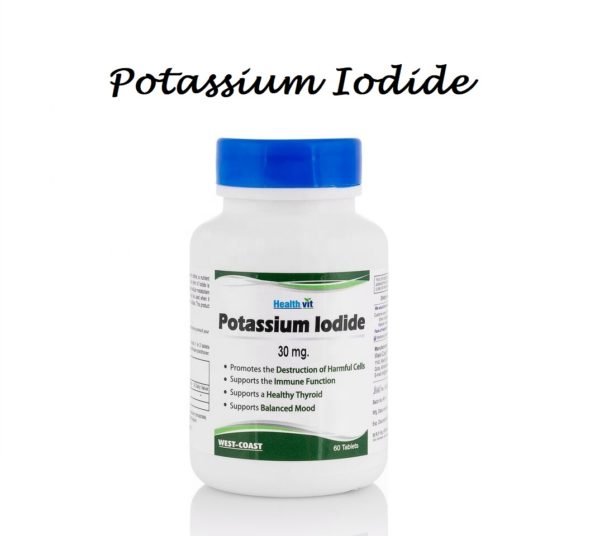
Potassium iodide is non-radioactive iodine-containing salt that prevents the absorption of radioactive iodine in the thyroid gland preventing it from radiation injury.
Potassium iodide Uses:
-
Antidote:
- It leads to blockage of radioactive isotopes of iodine in thyroid in a nuclear radiation emergency.
-
Expectorant:
- It is also advised as an expectorant for the symptomatic treatment of chronic lung diseases complicated by mucous.
-
Off Label Use of Potassium iodide in Adults:
- Graves hyperthyroidism (following radioactive iodine therapy);
- Sporotrichosis (cutaneous and lymphocutaneous);
- Thyroidectomy preparation in patients with Graves disease;
- Thyroid gland protection during radiopharmaceutical use;
- Thyrotoxic crisis and thyroid storm
Potassium iodide dosage in adults:
Expectorant (SSKI):
- 300 to 600 mg (0.3 to 0.6 mL) per oral t.i.d. or q.i.d daily
Potassium iodide Dose as Antidote [thyroid block following nuclear radiation emergency (iOSAT, ThyroSafe, ThyroShield)]:
- Includes pregnant/lactating women: 130 mg per oral once a day, continue for 10 to 14 days or as directed by public officials (until the risk of exposure has passed or other measures are implemented).
Potassium iodide Treatment dosage of Thyroidectomy preparation in patients with Graves disease (off-label):
- 50 to 100 mg (1 to 2 drops or 0.05 to 0.1 mL SSKI) per oral thrice a day. It is recommended for 10 days prior to surgery.
- Concurrent beta-blocker (eg, propranolol) in the immediate preoperative period to decrease the risk of thyroid storm is advised if thyroid levels are not normal before surgery.
Potassium iodide treatment dose of cutaneous and lympho-cutaneous Sporotrichosis:
- An initial dose of 5 drops per oral thrice daily.
- The dose is increased to 40 to 50 drops thrice daily as tolerated until 2 to 4 weeks after lesions have resolved (usual duration 3 to 6 months).
Potassium iodide Treatment dose of Thyroid gland protection during radiopharmaceutical use (off-label):
- Tablets or SSKI solution:
- 130 to 300 mg (3 to 6 drops SSKI) per oral per day.
Note:
Begin at 1 to 48 hours before exposure. Potassium iodide should be continued after radiopharmaceutical administration until the risk of exposure has decreased (treatment duration and time of starting is based on the radiopharmaceutical, consult specific protocol).
Potassium Iodide for the treatment of Thyrotoxic crisis and thyroid storm (off-label):
Note: Administer oral dose at least 60 minutes after antithyroid drug therapy such as propylthiouracil and methimazole
- SSKI 250 mg (5 drops or 0.25 mL) per oral every 6 hours.
Potassium iodide dosage in children:
Potassium Iodide for the treatment of cutaneous Sporotrichosis:
-
Children and Adolescents:
-
SSKI:
- An initial dose of 50 mg (1 drop or 0.05 mL) per oral 3 thrice daily.
- Increase the dose as tolerated to ≤50 mg/kg/dose (≤1 drop/kg/dose or ≤0.05 mL/kg/dose) thrice daily.
- The maximum dose is 2500 mg/dose (50 drops/dose or 2.5 mL/dose).
- It should be continued at the maximum tolerated dosage for several weeks after lesions have resolved.
-
Potassium Iodide for the treatment of Thyroid block following nuclear radiation emergency: Iosat, ThyroSafe, ThyroShield
Note: Oral treatment should be continued until the risk of exposure has passed and/or until other measures such as evacuation/sheltering/control of the food and milk supply are taken.
-
Infants and Children ≤3 years:
- 5 mg per oral every 24 hours
-
Children >3 to 12 years:
- 65 mg per oral once a day
-
Adolescents:
- Weight <68 kg: 65 mg once daily
- Weight ≥68 kg: 130 mg once daily
Potassium Iodide for the treatment of Thyroid gland protection during radiopharmaceutical use:
-
Age-directed dosing:
-
Infants and Children <3 years:
- 32 mg once daily
-
Children and Adolescents 3 to 13 years:
- 65 mg once daily
-
Adolescents >13 years:
- 130 mg once daily
-
-
Weight-directed dosing:
-
<5 kg:
- 16 mg once daily
-
5 to <15 kg:
- 32 mg once daily
-
15 to <50 kg:
- 65 mg once daily
-
≥50 kg:
- 130 mg once daily
-
Potassium Iodide for the preoperative preparation of Thyroidectomy:
-
Children and Adolescents:
-
SSKI:
- 150 to 350 mg (3 to 7 drops or 0.15 to 0.35 mL) per oral thrice daily;
- Administer for 10 days prior to surgery
- concurrent beta-blocker (eg, propranolol) in the immediate preoperative period to reduce the incidence of thyroid storm should be given if normal thyroid status is not achieved before surgery.
-
Potassium Iodide for the treatment of Thyrotoxic crisis and thyroid storm:
Note: Administer at least 60 minutes after antithyroid drug administration:
-
Infants:
- SSKI: 100 mg (2 drops or 0.1 mL) per oral 4 times daily
-
Children and Adolescents:
- SSKI: 250 mg (5 drops or 0.25 mL) per oral2 to 4 times daily
Pregnancy Risk Factor D
- Iodide Can cross the placenta (may cause hypothyroidism or goiter in the fetus/newborn).
- The AAP has declared that expectorant use is not permitted during pregnancy.
- Radioactive iodine can cause thyroid cancer. Protective therapy is possible, but it must be considered as risk-benefit.
- Antidotes must be considered in the context of the health and prognosis for the mother.
- They should be administered during pregnancy if there are clear indications and should not be stopped because of teratogenicity risk.
- Pregnant women need to follow the instructions of public officials and consult their doctor.
- If possible, avoid repetition of the dose.
- For more information, refer to the Iodine monograph
Potassium iodide use during breastfeeding:
- Breast milk contains potassium iodide.
- It can cause skin rash or thyroid suppression in the nursing baby.
- Nursing mothers should follow the instructions of public officials and contact their doctor.
- For more information, refer to the Iodine monograph
Potassium iodide dose adjustment in renal disease:
There are no dosage adjustments provided in the manufacturer's labeling. Use with caution.
Potassium iodide dose adjustment in liver disease:
There are no dosage adjustments provided in the manufacturer's labeling.
Side effects of potassium iodide:
-
Cardiovascular:
- Cardiac Arrhythmias
- Numbness
- Vasculitis
-
Central Nervous System:
- Confusion
- Fatigue
- Fever
- Numbness
- Tingling Sensation
-
Dermatologic:
- Acne Vulgaris
- Dermatitis
- Urticaria
-
Endocrine & Metabolic:
- Goiter
- Hyperthyroidism (Prolonged Use)
- Hypothyroidism (Prolonged Use)
- Myxedema
-
Gastrointestinal:
- Diarrhea
- Enlargement Of Salivary Glands
- Gastric Distress
- Gastrointestinal Hemorrhage
- Gingival Pain
- Metallic Taste
- Nausea
- Stomach Pain
- Toothache
- Vomiting
-
Hematologic & Oncologic:
- Eosinophilia
- Lymphedema
- Thyroid Adenoma
-
Hypersensitivity:
- Hypersensitivity Reaction (Angioedema
- Cutaneous And Mucosal Hemorrhage
- Serum Sickness-Like Symptoms)
-
Neuromuscular & Skeletal:
- Arthralgia
- Weakness
-
Respiratory:
- Dyspnea
- Rhinitis
- Wheezing
-
Miscellaneous:
- Iodine Poisoning (With Prolonged Treatment/High Doses)
Contraindication to Potassium iodide:
- Contraindications include hypersensitivity or iodine intolerance, or any component in the formulation.
- Dermatitis herpetiformis
- Hypocomplementemic vasculitis
- Heart disease and nodular thyroid condition
Warnings and precautions
-
Hypersensitivity
- Angioedema, cutaneous or mucosal hemorhage and serum sickness-like symptoms can all be seen as angioedema and eosinophilia.
-
Reactions to skin:
- This can lead to acne flare-ups or dermatitis.
-
Thyroid adverse effects:
- Hypothyroidism may develop from long-term therapy.
- Iodide may result in underactive/overactive thyroid;
- Thyroid enlargement can also be a possibility.
- Patients with a goiter (nodular thyroid condition) or heart disease are not advised to take it.
- Long-term iodide poisoning or iodism may develop from long-term use. This can manifest as severe headaches, burning in the mouth/throat and sore gums.
- In such cases, it is important to stop potassium iodide treatments and instead seek supportive care.
-
Insufficiency of the adrenal glands:
- Patients with Addison disease should be cautious.
-
Bronchitis
- Patients with acute bronchitis should be cautious.
-
Cardiac disease
- Patients with heart disease should be cautious.
-
Myotonia congenita:
- Patients with myotonia congenita should be cautious.
-
Renal impairment
- Patients with impaired renal function should be cautious
-
Tuberculosis
- Patients with tuberculosis should be cautious.
Potassium iodide (SSKI, Thyroshield): Drug Interaction
|
Aliskiren |
Potassium Salts may enhance the hyperkalemic effect of Aliskiren. |
|
Angiotensin II Receptor Blockers: |
Potassium Salts may enhance the hyperkalemic effect of Angiotensin II Receptor Blockers. |
|
Angiotensin-Converting Enzyme Inhibitors |
Potassium Salts may enhance the hyperkalemic effect of Angiotensin-Converting Enzyme Inhibitors. |
|
Cardiac Glycosides |
Antithyroid Agents may increase the serum concentration of Cardiac Glycosides. |
|
Drospirenone |
Potassium Salts may enhance the hyperkalemic effect of Drospirenone. |
|
Heparin |
May enhance the hyperkalemic effect of Potassium Salts. |
|
Heparins (Low Molecular Weight) |
May enhance the hyperkalemic effect of Potassium Salts. |
|
Lithium |
Potassium Iodide may enhance the hypothyroid effect of Lithium. Risk C: Monitor therapy |
|
Nicorandil |
May enhance the hyperkalemic effect of Potassium Salts. |
|
Theophylline Derivatives |
Antithyroid Agents may increase the serum concentration of Theophylline Derivatives. Exceptions: Dyphylline. |
|
Eplerenone |
May enhance the hyperkalemic effect of Potassium Salts. Management: This combination is contraindicated in patients receiving eplerenone for treatment of hypertension. |
|
Potassium-Sparing Diuretics |
Potassium Salts may enhance the hyperkalemic effect of Potassium-Sparing Diuretics. |
|
Vitamin K Antagonists (eg, warfarin) |
Antithyroid Agents may diminish the anticoagulant effect of Vitamin K Antagonists. |
|
Sodium Iodide I131 |
Antithyroid Agents may diminish the therapeutic effect of Sodium Iodide I131. Management: Discontinue antithyroid therapy 3-4 days prior to sodium iodide I-131 administration. |
Monitoring parameters:
- Thyroid function tests should be observed in pregnancy, breastfeeding, neonates, and young infants if repeat dose is needed following exposure to radioactive iodine.
- Signs and symptoms of hypothyroidism and hyperthyroidism should be considered.
How to administer Potassium iodide?
SSKI:
- It is diluted to administer orally in a glassful of water, fruit juice, or milk. Administer with food or milk to avoid gastric irritation.
iOSAT, ThyroSafe, ThyroShield:
- Administer as soon as possible after instructed to do so by public officials. No more than 1 dose should be taken in 24 hours.
- Tablets may be used as whole or crushed and then mixed with water, low-fat milk (white or chocolate), orange juice, soda (flat), raspberry syrup, or infant formula.
- Raspberry syrup disguises the taste best; low-fat white milk or water do not hide the salty taste well).
Mechanism of action of Potassium iodide:
- It increases the respiratory tract secretions and decreases mucous viscosit
- It inhibits thyroid hormone secretion and causes colloid accumulation in the thyroid follicles.
- Potassium Iodide reduces radioactive iodine metabolism in the thyroid. This lowers the risk of developing thyroid cancer.
The beginning of actionHyperthyroidism can be diagnosed within 24 to 48 hours.
Peak effect:Hyperthyroidism can be treated with continuous therapy for approximately 2 weeks.
TimeRadioactive iodine exposure - Each dose lasts approximately 24 hours
International Brands of Potassium iodide:
- iOSAT
- SSKI
- ThyroSafe
- Cato-Bell
- Iodid
- Iodure de Potassium
- Ioduro Potasico Rovi
- Jodam
- Jodetten Henning
- Jodgamma
- Jodid
- Jodid Merck
- Jodid Verla
- Jodid-ratiopharm
- Jodix
- Jodostin
- Jodox
- Kalium jodatum
- Kaliumiodid
- Kaliumiodid BC
- Kaliumjodid Lannacher
- Kaliumjodid Recip
- Kaliumjodid ”Dak”
- Kaliumjodide G. L.
- Mono-Jod
- Tarjod
- Thyroprotect
Potassium iodide brand names in Pakistan:
Brands will be updated later. Important brand names include Lugols iodine solution and tincture iodine.
.png)


