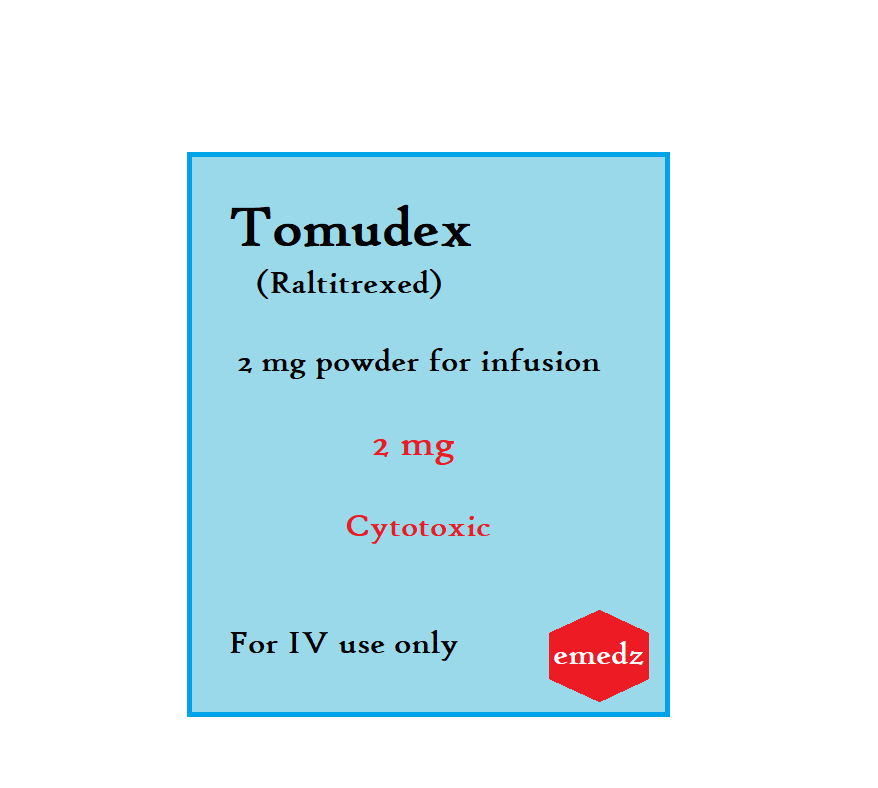
Raltitrexed (Tomudex) manufactured by AstraZeneca is an antimetabolite (a thymidylate synthase inhibitor) that is used as a chemotherapeutic drug for the treatment of advanced colorectal cancer.
Raltitrexed Uses:
-
Advanced Colorectal Cancer:
- It is indicated for the treatment of advanced colorectal cancer
-
Off Label Use of Raltitrexed in Adults:
- It is also used in the treatment of malignant pleural mesothelioma.
Raltitrexed (Tomudex) Dose in Adults
Note: Treatment initiation is only indicated if the baseline WBC is greater than 4,000/mm³, ANC is greater than 2,000/mm³, and platelet counts is greater than 100,000/mm³
Raltitrexed (Tomudex) Dose in the treatment of advanced colorectal cancer:
- IV: 3 mg/m² once every 3 weeks in the absence of toxicity
Raltitrexed (Tomudex) Dose in the treatment of malignant pleural mesothelioma (off-label):
- IV: 3 mg/m² once every 3 weeks combined with cisplatin until toxicity is observed or the disease progresses despite the treatment.
Use in Children:
It is contraindicated in children.
Pregnancy Risk Category: X
- It is not recommended for women who are pregnant, or might become pregnant.
- Negative pregnancy outcomes were seen in animal reproduction studies.
- It is best to avoid pregnancy prior to treatment initiation.
- It is also recommended that women with male partners who are on treatment avoid becoming pregnant. Pregnant women should not take the drug.
Breastfeeding:
- It is not recommended for use in lactating mothers.
Dose in Kidney Disease:
- CrCl >65 mL/minute:
- Dosage adjustment is not necessary.
- CrCl 55 to 65 mL/minute:
- Reduce the dose to 75% of the usual dose once monthly.
- CrCl 25 to 54 mL/minute:
- Reduce the dose to the percentage of a dose equivalent to CrCl once monthly (eg, reduce dose to 25% of usual dose for CrCl of 25 mL/minute)
- CrCl <25 mL/minute:
- Do not administer the drug. It is contraindicated in severe renal impairment.
Dose in Liver disease:
- Adults with preexisting hepatic impairment:
- It should be avoided in patients with decompensated liver disease or clinical jaundice.
- Mild to moderate impairment:
- Dosage adjustment is not necessary, however, use it with caution.
- Severe impairment:
- Use is contraindicated.
- Hepatotoxicity during treatment:
- The treatment should be interrupted until improvement or toxicity returns to grade 2 or lower.
Common Side Effects of Raltitrexed (Tomudex):
-
Dermatologic:
- Skin Rash
-
Gastrointestinal:
- Nausea
- Diarrhea
- Vomiting
- Anorexia
- Abdominal Pain
- Constipation
- Mucositis
- Stomatitis
-
Hematologic & Oncologic:
- Leukopenia
- Anemia
-
Hepatic:
- Increased Serum AST
- Increased Serum ALT
-
Neuromuscular & Skeletal:
- Weakness
-
Miscellaneous:
- Fever
Less Common Side Effects Of Raltitrexed (Tomudex):
-
Cardiovascular:
- Peripheral Edema
- Cardiac Arrhythmia
- Cardiac Abnormality
-
Central Nervous System:
- Headache
- Dizziness
- Chills
- Malaise
- Pain
- Insomnia
- Depression
- Paresthesia
- Hypertonia
-
Dermatologic:
- Alopecia
- Diaphoresis
- Cellulitis
- Pruritus
-
Endocrine & Metabolic:
- Dehydration
- Weight Loss
- Hypokalemia
-
Gastrointestinal:
- Dysgeusia
- Dyspepsia
- Flatulence
- Xerostomia
-
Genitourinary:
- Urinary Tract Infection
-
Hematologic & Oncologic:
- Thrombocytopenia
-
Hepatic:
- Hyperbilirubinemia
- Increased Serum Alkaline Phosphatase
-
Infection:
- Infection
- Sepsis
-
Neuromuscular & Skeletal:
- Myalgia
- Arthralgia
-
Ophthalmic:
- Conjunctivitis
-
Renal:
- Increased Serum Creatinine
-
Respiratory:
- Flu-Like Symptoms
- Cough
- Dyspnea
- Pharyngitis
Contraindications to Raltitrexed (Tomudex):
- Allergy to raltitrexed, or any component of this formulation
- Grave liver or kidney disease
- Patients who are pregnant or may become pregnant
- Breast-feeding women
- Use with children.
Warnings and precautions
-
Suppression of bone marrow
- Cytopenias can be severe, mainly anemia, neutropenia and leukopenia.
- Sometimes, thrombocytopenia and neutropenia can be severe enough to require treatment interruption.
- Most often, bone marrow suppression occurs between 7 and 14 days after treatment. Most patients recover by the 21st day.
- Patients who have marrow suppression or preexisting conditions should be cautious about taking the drug.
-
Gastrointestinal toxicities:
- Gastrointestinal toxicities are common and can manifest as nausea, vomiting, or diarrhea.
- Mucositis can manifest as oral ulcers, stomatitis, or diarrhea.
- Diarrhea can be serious, especially if there is concomitant hematologic toxicities like neutropenia.
- This could be life-threatening. It is possible to interrupt or stop treatment. Following treatment interruption or discontinuation, dose reduction might be recommended.
- Other gastrointestinal-related toxicities like nausea or vomiting are usually treated with common antiemetics, and may not require treatment interruption.
-
Malaise and weakness
- It can cause weakness and malaise. Patients who drive or perform heavy tasks should be cautious.
-
Hepatic impairment
- Patients with mild to moderate liver impairment should use it with caution.
- It should not be used in severe hepatic impairment, patients with clinical jaundice, or those suffering from decompensated liver disease.
- Treatment-related liver toxicities should be treated immediately.
- The treatment can be restarted if the liver enzymes are back to normal, or at the very least, to grade 2 or lower.
- Transaminitis, which may be self-limiting but reversible, may occur.
-
Renal impairment
- It should be used with caution in patients with mild or moderate renal impairment. It should not be used in the case of severe renal impairment.
Raltitrexed (United States: Not available): Drug Interaction
|
Chloramphenicol (Ophthalmic) |
May enhance the adverse/toxic effect of Myelosuppressive Agents. |
|
CloZAPine |
Myelosuppressive Agents may enhance the adverse/toxic effect of CloZAPine. Specifically, the risk for neutropenia may be increased. |
|
Mesalamine |
May enhance the myelosuppressive effect of Myelosuppressive Agents. |
|
Promazine |
May enhance the myelosuppressive effect of Myelosuppressive Agents. |
|
Pyrimethamine |
May enhance the adverse/toxic effect of Raltitrexed. |
|
Risk Factor D (Consider therapy modification) |
|
|
Deferiprone |
Myelosuppressive Agents may enhance the neutropenic effect of Deferiprone. Management: Avoid the concomitant use of deferiprone and myelosuppressive agents whenever possible. If this combination cannot be avoided, monitor the absolute neutrophil count more closely. |
|
Lenograstim |
|
|
Lipegfilgrastim |
Antineoplastic Agents may diminish the therapeutic effect of Lipegfilgrastim. Management: Avoid concomitant use of lipegfilgrastim and myelosuppressive cytotoxic chemotherapy. Lipegfilgrastim should be administered at least 24 hours after the completion of myelosuppressive cytotoxic chemotherapy. |
|
Palifermin |
May enhance the adverse/toxic effect of Antineoplastic Agents. Specifically, the duration and severity of oral mucositis may be increased. Management: Do not administer palifermin within 24 hours before, during infusion of, or within 24 hours after administration of myelotoxic chemotherapy. |
|
Risk Factor X (Avoid combination) |
|
|
BCG (Intravesical) |
Myelosuppressive Agents may diminish the therapeutic effect of BCG (Intravesical). |
|
Cladribine |
May enhance the myelosuppressive effect of Myelosuppressive Agents. |
|
Dipyrone |
May enhance the adverse/toxic effect of Myelosuppressive Agents. Specifically, the risk for agranulocytosis and pancytopenia may be increased |
|
Folic Acid |
May diminish the therapeutic effect of Raltitrexed. |
|
Leucovorin Calcium-Levoleucovorin |
May diminish the therapeutic effect of Raltitrexed. |
|
Levomefolate |
May diminish the therapeutic effect of Raltitrexed. |
|
Methylfolate |
May diminish the therapeutic effect of Raltitrexed. |
|
Multivitamins/Minerals (with ADEK, Folate, Iron) |
May diminish the therapeutic effect of Raltitrexed. Specifically, the folic acid contained in multivitamins is responsible for this potential interaction. |
Monitoring parameters:
- Monitor CBC with differential at baseline, before each treatment, and weekly if gastrointestinal toxicity is observed
- Liver function tests and serum creatinine at baseline and before each treatment
- Signs of GI toxicity.
How to administer Raltitrexed (Tomudex)?
- It is administered as a slow intravenous infusion over 15 minutes.
- When used to treat malignant pleural mesothelioma, in combination with cisplatin, administer raltitrexed first, followed by cisplatin.
Mechanism of action of Raltitrexed (Tomudex):
Raltitrexed, an analog folate, inhibits DNA synthesis by inhibiting selectively thymidylate synthase and blocking purine synthesis.
Protein binding:
- 93%
Metabolism:
- It undergoes extensive intracellular metabolism to active polyglutamate forms; appears to be little or no systemic metabolism of the drug
Half-life elimination:
- Triphasic;
- Beta: about 2 hours;
- Terminal: 198 hours
Excretion:
- Urine (about 50% as unchanged drug);
- feces (~15%)
International Brand Names of Raltitrexed:
- Tomudex
Raltitrexed Brand Names in Pakistan:
No Brands Available in Pakistan.
.png)