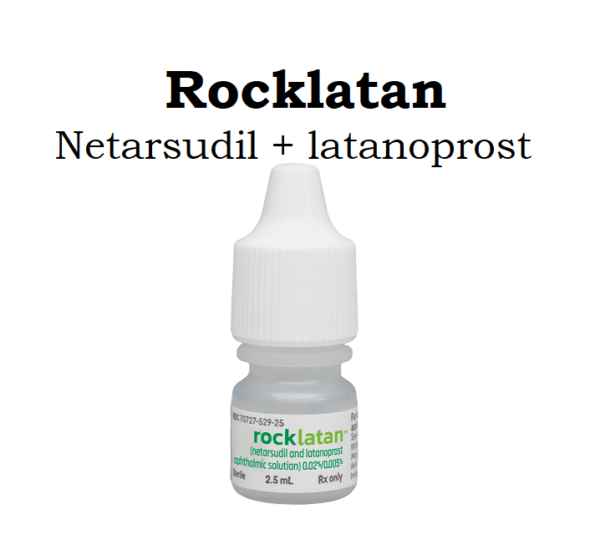
Rocklatan is a combination of two drugs, Netarsudil and latanoprost, a Rho-kinase inhibitor and a prostaglandin analog.
Rocklatan (Netarsudil and latanoprost) Uses:
-
Elevated intraocular pressure:
- In patients with open-angle glaucoma or ocular hypertension, reduction of elevated intraocular pressure (IOP)
Rocklatan Dose in Adults
Rocklatan Dose in the treatment of Elevated intraocular pressure:
- Ophthalmic:
- In the evening, one drop in the affected eye(s) once everyday
- maximum dose: 1 drop in affected eye(s) once everyday.
Rocklatan Dose in Childrens
Not indicated in children.
Pregnancy Risk Category: N (Not assigned)
- Systemic absorption is very limited after the ophthalmic application.
- To reduce potential exposure to the foetus, it is recommended that the minimum effective dose be used in conjunction with punctal obstruction.
- Refer to individual monographs.
Use of netarsudil or latanoprost during breastfeeding
- It is unknown if netarsudil and latanoprost may be present in breast milk.
- Systemic absorption can be limited after ophthalmic applications.
- According to the manufacturer, when deciding whether to breastfeed during therapy, you should consider the risks to infants, the benefits to breastfeeding for the mother, and the benefits to the mother.
- Refer to also individual monographs.
Rocklatan Dose in Kidney Disease:
- In the manufacturer's labeling, there are no dosage adjustments provided.
- However, dosage adjustment is unlikely due to low systemic absorption.
Rocklatan Dose in Liver disease:
- In the manufacturer's labeling, there are no dosage adjustments provided.
- However, dosage adjustment unlikely due to low systemic absorption.
Common Side Effects of Rocklatan (Netarsudil and latanoprost):
-
Local:
- Application site pain
-
Ophthalmic:
- Conjunctival hyperemia
- Epithelial keratopathy
- Conjunctival hemorrhage
Less Common Side Effects of Rocklatan (Netarsudil and latanoprost):
-
Ophthalmic:
- Blurred vision
- decreased visual acuity
- eye discomfort
- eye pruritus
- increased lacrimation
Contraindications to Rocklatan (Netarsudil and latanoprost):
- There are no contraindications in the manufacturer's labeling.
Warnings and precautions
-
Bacterial Keratitis
- Inadvertent contamination with multiple-dose ophthalmic solution has led to bacterial keratitis.
-
Ocular effects
- The eyelid skin and iris pigmentation may be altered or increased.
- You may be able to increase the length and number of your eyelashes.
- While iris color changes may not be visible for many months or years, pigmentation of the eyes is likely to last a lifetime.
- After discontinuation of therapy, pigmentation and eyelash changes can be reversed.
- It is not yet known what long-term effects and potential injury the eye may have.
-
Ocular inflammation:
- Intraocular inflammation and exacerbation may occur.
- Patients with an history of intraocular inflammation (e.g., iritis/uveitis), should be cautious about using this product. Avoid use in patients with active intraocular swelling.
-
Herpetic keratitis
- Patients with a history or herpes simplex keratitis should be cautious.
- Reactivation is possible.
- Patients with active herpes simplex should be avoided.
-
Ocular disease:
- Avoid use in patients who are aphakic, pseudophakic, have a damaged posterior lens capsule or have risk factors for macular degeneration.
- Safety and efficacy of the product have not yet been established for patients with angle-closure, inflammation, or neovascular.
Netarsudil and latanoprost: Drug Interaction
Note: Drug Interaction Categories:
- Risk Factor C: Monitor When Using Combination
- Risk Factor D: Consider Treatment Modification
- Risk Factor X: Avoid Concomitant Use
Risk Factor C (Monitor therapy) |
|
| Bimatoprost | The concomitant use of Latanoprost and Bimatoprost may result in increased intraocular pressure. |
| Nonsteroidal Anti-Inflammatory Agents | May diminish the therapeutic effect of Prostaglandins (Ophthalmic). Nonsteroidal Anti-Inflammatory Agents may also enhance the therapeutic effects of Prostaglandins (Ophthalmic). |
| Nonsteroidal Anti-Inflammatory Agents (Ophthalmic) | May diminish the therapeutic effect of Prostaglandins (Ophthalmic). Nonsteroidal Anti-Inflammatory Agents (Ophthalmic) may enhance the therapeutic effect of Prostaglandins (Ophthalmic). |
Monitoring parameters:
- Examine IOP.
- Regularly examine patients who develop increased iris pigmentation
How to administer Rocklatan (Netarsudil and latanoprost)?
Ophthalmic:
- May be used with other eye drops to lower IOP.
- Administer the drugs at least 5 minutes apart, if more than one topical ophthalmic drug is being used.
- Prior to administration, remove contact lenses and wait 15 mins before reinserting.
- To minimize contamination of the dropper tip, avoid touching the dropper tip with fingers, eyes, eyelids, or surrounding areas.
Mechanism of action of Rocklatan (Netarsudil and latanoprost):
- Netarsudil acts as a Rho kinase inhibitor and latanoprost works as a prostaglandin F-2 analog.
- Both may decrease intraocular pressure by increasing outflow of aqueous matter, though the exact mechanism remains elusive.
Absorption:
- Limited
- Latanoprost absorbs through the cornea, and is hydrolyzed to the biologically activated acid (measurable in plasma and aqueous humor for the first four hours).
Metabolism:
- Latanoprost:
- Hydrolysis of Isopropyl Ester Prodrug in the cornea produces the biologically active chemical.
- Via fatty acids beta-oxidation, biologically activated acid is primarily metabolized in the liver.
Netarsudil:
- Metabolized by ophthalmic esterases to the active metabolite, AR-13503.
Half-life elimination:
- Latanoprost:
- 17 mins
Excretion:
- Latanoprost:
- Urine: ~88 percent (as metabolites)
International Brands of Netarsudil and latanoprost:
- Rocklatan
Netarsudil and latanoprost Brand Names in Pakistan:
No Brands Available in Pakistan.
.png)


