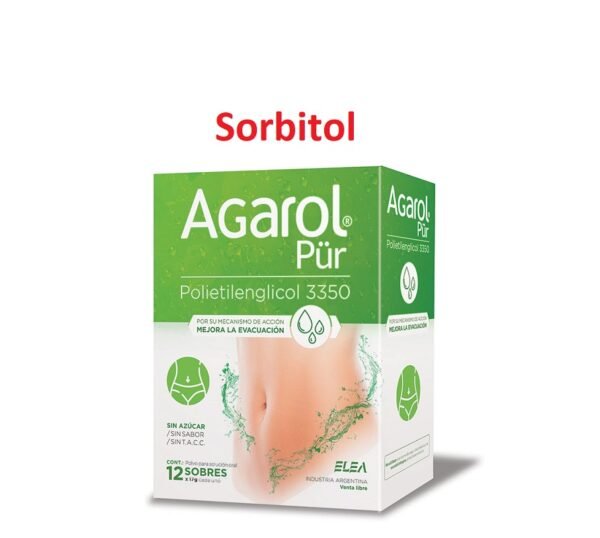
Sorbitol (Agarol) is a type of sugar that has got cathartic properties and is also used as an artificial sweetener. It is used for bladder irrigation during urethral procedures.
Sorbitol Uses:
- It is used as a bladder irrigant in patients undergoing transurethral resection of the prostate, or other transurethral surgical procedures.
- It is also used as a laxative (as an osmotic laxative) and to facilitate the passage of kayexalate (sodium polystyrene sulfonate) through the intestinal tract.
- It may be used for the following purposes as well
- used as a diuretic.
- Humectant
- Sweetening agent;
Sorbitol (Agarol) Dose in Adults
Sorbitol (Agarol) Dose in the treatment of Hyperosmotic laxative (single dose, at infrequent intervals):
- Oral: 30 to 45 mL (as 70% solution)
- Rectal enema: 120 mL as 25% to 30% solution
-
Adjunct to sodium polystyrene sulfonate:
- 15 mL as 70% solution orally until diarrhea occurs (10 to 20 mL/2 hours) or
- 20 to 100 mL as an oral vehicle for the sodium polystyrene sulfonate resin
-
Transurethral surgical procedures:
- Irrigation: Topical: 3% to 3.3% as transurethral surgical procedure irrigation
Sorbitol (Agarol) Dose in Childrens
Sorbitol (Agarol) Dose in the treatment of Constipation:
-
Oral: 70% solution:
- Manufacturer's labeling:
- Children ≥12 years and Adolescents:
- Usual dose: 30 to 45 mL once a day as needed;
- The maximum dose: 60 mL/dose;
- Higher daily doses (60 to 90 mL in divided doses) may be required in some patients.
- Children ≥12 years and Adolescents:
- Alternate dosing: Limited data available:
- Infants, Children, and Adolescents:
- 1 to 3 mL/kg/day in divided doses, once or two times a day
- The usual dosage range in adolescents is: 30 to 90 mL/day
- Infants, Children, and Adolescents:
Rectal enema: 25% to 30% solution:
-
Children 2 to <12 years:
- 30 to 60 mL once a day as needed
-
Children ≥12 years and Adolescents:
- 120 mL once a day as needed
Sorbitol (Agarol) Dose in the treatment of slow fecal disimpaction: Oral: 70% solution:
-
Infants, Children, and Adolescents:
- 2 mL/kg two times a day for 7 days.
Sorbitol (Agarol) Dose in the treatment of Toxic ingestion as an adjunct with charcoal:
-
Children and Adolescents:
- Oral: 35% solution: 4.3 mL/kg;
- Note: Current guidelines recommend limiting use to a single dose administered with the initial charcoal dose of 1 g/kg.
Pregnancy Risk Factor C
- Studies on animal reproduction have not been done.
Use during breastfeeding:
- Manufacturers recommend that lactating mothers use the drug with caution.
Dose in Kidney Disease:
There are no dosage adjustments provided in the manufacturer's labeling.
Dose in Liver disease:
There are no dosage adjustments provided in the manufacturer's labeling.
Side effects of Sorbitol (Agarol):
-
Cardiovascular:
- Edema
-
Endocrine & Metabolic:
- Electrolyte Depletion
- Hyperglycemia
- Hypovolemia
- Lactic Acidosis
-
Gastrointestinal:
- Abdominal Distress
- Diarrhea
- Nausea
- Vomiting
- Xerostomia
Contraindications to Sorbitol (Agarol):
- Anuria (for irrigation).
OTC labeling
- Self-medication should not be used for longer than seven days. Avoid using the medication if you have abdominal pain, nausea or vomiting.
Warnings and precautions
-
Fluid and electrolyte imbalances:
- Fluid overload or electrolyte changes can occur if you use a large amount of the drug.
-
Cardiopulmonary disease
- Patients suffering from severe cardiopulmonary disease must be cautious.
-
Renal impairment
- It should be used with caution by patients with impaired renal function.
-
Incapable to metabolizesorbitol
- Patients who are unable to metabolize sorbitol must be advised not to use it.
Sorbitol: Drug Interaction
Note: Drug Interaction Categories:
- Risk Factor C: Monitor When Using Combination
- Risk Factor D: Consider Treatment Modification
- Risk Factor X: Avoid Concomitant Use
Risk Factor D (Think about therapy modification) |
|
| LamiVUDine | The serum level of LamiVUDine may be decreased by using sorbitol. Management: Avoid prolonged coadministration of lamivudine-containing sorbitol-containing products with lamivudine. However, if it is not possible to avoid this combination, be more vigilant for potential therapeutic failures due to decreased lamivudine. |
Risk Factor X (Avoid Combination) |
|
| Calcium Polystyrene Sulfonate | Calcium Polystyrene Sulfonate may have a more toxic/adverse effect than Sorbitol. Concomitant use with these agents could increase the risk of intestinal necrosis. |
| Sodium Polystyrene Sulfonate | Sorbitol can increase the toxic/adverse effects of Sodium Polystyrene Sulfonate. Concomitant use with these agents could increase the risk of intestinal necrosis. |
Monitoring parameters:
- Monitor for fluid overload and/or electrolyte disturbances following large volumes;
- Monitor for gastrointestinal distress such as bloating and flatulence.
How to administer Sorbitol (Agarol)?
Sorbitol Syrup:
- It is administered after meals with a glass of water or mixed with a beverage.
Sorbitol for Rectal administration:
- The 70% sorbitol solution is mixed with water in a ratio of 1:2.3 to make a solution of 25% - 30% concentration.
- The final mixture is then administered rectally gently with the tubings provided by the manufacturer.
Urethral administration:
- A 3.3% urethral solution is used for bladder irrigation. Follow the manufacturer's drug prescribing information manual.
Mechanism of action of Sorbitol (Agarol):
It is a sugary polyalcoholic that can be used for osmotic cathartic purposes.
The beginning of action:
- Rectal: 0.25 to 1 hour
Absorption:
- Oral, rectal: Poor
Metabolism:
- Primarily metabolized in the liver to fructose.
International Brand Names of Sorbitol:
- Agarol
- Ardeanutrisol SO
- Cystosol
- klysma Sorbit
- Medevac
- Progras
- Resulax
- Sladial
- Sorbilande
- Sorbilax
- Sorbit Fresenius
- Sorbit Leopold
- Sorbit Mayrhofer
- Sorbitol Aguettant
- Sorbitol Baxter
- Sorbitol Delalande
- Sorbitol-Infusionslosung
- Syn M.D.
Sorbitol Brand Names in Pakistan:
No Brands Available in Pakistan.
.png)


