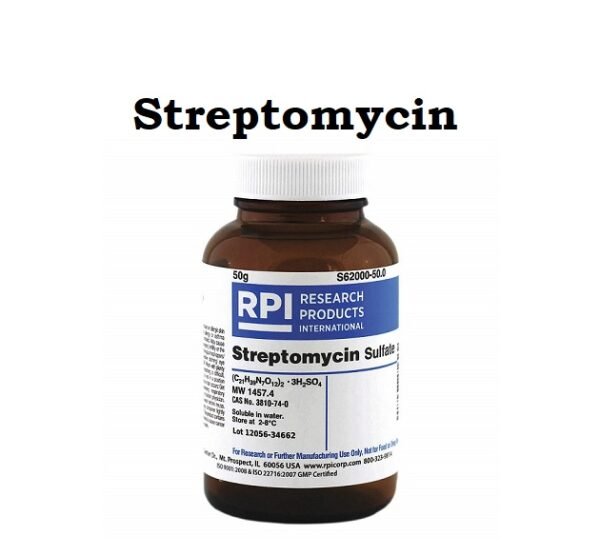
Streptomycin is a bactericidal antibiotic that belongs to the aminoglycoside class. Like other drugs in the same class, it has poor absorption when taken orally and is administered either via the intramuscular or the intravenous route.
Streptomycin Uses:
-
Tuberculosis:
- Treatment of tuberculosis, in combination with other appropriate antitubercular drugs, when the primary agents (eg, isoniazid, rifampin, ethambutol, pyrazinamide) are contraindicated or not be administered because of toxicity or intolerance.
-
Non-tuberculosis infections:
- Treatment of infections caused by susceptible bacteria that are not amenable to therapy with less potentially toxic agents,including:
- sensitive Yersinia pestis (plague);
- Francisella tularensis (tularemia);
- Brucella;
- Klebsiella granulomatis (donovanosis, granuloma inguinale);
- Haemophilus influenzae (in respiratory, endocardial, and meningeal infections,
- Haemophilus ducreyi (chancroid);
- concomitantly with another antibacterial agent);
- Escherichia coli,
- Proteus spp.,
- Klebsiella pneumoniae pneumonia (concomitantly with another antibacterial agent);
- Enterobacter aerogenes, K. pneumoniae, and Streptococcus viridans;
- E. faecalis (in endocardial infections, concomitant with penicillin);
- Enterococcus faecalis in urinary tract infections; and
- gram-negative bacillary bacteremia (concomitant with another antibacterial agent).
- Treatment of infections caused by susceptible bacteria that are not amenable to therapy with less potentially toxic agents,including:
-
Off Label Use of Streptomycin in Adults:
- Buruli ulcer (Mycobacterium ulcerans);
- Ménière’s disease;
- Mycobacterium avium complex (MAC);
- Mycobacterium avium complex (MAC) disease, disseminated in HIV persons;
- Mycobacterium kansasii
Streptomycin Dose in Adults
- Note: drug Manufacturer’s labeling suggest for IM administration only, however, IV administration (off-label route) has also been described.
Usual dosage range: IM: at 15 to 30 mg/kg/day or 1 to 2 g daily
Indication-specific dosing:
Streptomycin Dose in the treatment of Brucellosis:
- IM: at dose of 1 g daily in 2 to 4 divided doses for 14 to 21 days (with doxycycline).
Streptomycin Dose in the treatment of Enterococcal Endocarditis:
- Susceptible to penicillin and streptomycin/resistant to gentamicin:
-
Native or prosthetic valve:
- IM, IV: at 15 mg/kg/day in divided doses every 12 hours in combination with ampicillin or penicillin;
- Duration of therapy: 4 weeks (native valve and symptoms present <3 months); ≥6 weeks (native valve and symptoms present ≥3 months or prosthetic valve).
-
Manufacturer’s labeling:
- Dosing in the prescribing information may not reflect the current clinical practice.
- IM: 1 g every 12 hours for 2 weeks, followed by 500 mg every 12 hours
Dose in the treatment of Streptococcal infections:
- IM: at 1 g every 12 hours for 1 week, followed by 500 mg every 12 hours for 1 week in combination with penicillin.
Streptomycin Dose in the treatment of Mycobacterium avium complex (MAC) (off-label):
- IM: Adjunct therapy (with macrolide, rifamycin, and ethambutol): 8 to 25 mg/kg 2 to 3 times weekly for first 2 to 3 months for severe disease (maximum single dose for age >50 years: 500 mg).
Streptomycin Dose in the treatment of disseminated Mycobacterium avium complex (MAC) infection in HIV-infected patients (off label):
- IM, IV: by 1 g daily as optional adjunct therapy with ethambutol (plus clarithromycin or azithromycin).
Streptomycin Dose in the treatment of Mycobacterium kansasii disease (rifampin-resistant) (off-label):
- IM: 750 mg to 1 g daily (as part of a three-drug regimen based on susceptibilities).
Dose in the treatment of Mycobacterium ulcerans (Buruli ulcers) (off-label):
- IM: 15 mg/kg once daily (maximum dose: 1 g) in combination with rifampin for 8 weeks or in combination with rifampin for 4 weeks, followed by 4 weeks of rifampin and clarithromycin.
Streptomycin Dose in the treatment of Plague:
- 30 mg/kg/day (maximum dose: 2 g) divided every 12 hours until the patient is afebrile for at least 2 to 3 days.
- Note: Full course is considered for 10 days (CDC 2014; WHO 2009).
-
Manufacturer’s labeling:
- Dosing in the prescribing information may not reflect the current clinical practice. 1 g twice daily
Streptomycin Dose in the treatment of Tuberculosis:
- IM, IV: at 15 mg/kg (maximum dose: 1 g) once daily for 5 to 7 days per week for 2 to 4 months, followed by 15 mg/kg (maximum dose: 1 g) 2 to 3 times weekly.
-
Manufacturer’s labeling:
- Dosing in the prescribing information may not reflect the current clinical practice.
- Daily therapy: 15 mg/kg/day (maximum: 1 g)
- Directly observed therapy (DOT) twice weekly: 25 to 30 mg/kg (maximum: 1.5 g)
- Directly observed therapy (DOT), 3 times weekly: 25 to 30 mg/kg (maximum: 1.5 g)
Streptomycin Dose in the treatment of Tularemia:
- IM 2 g daily in 2 divided doses for ≥10 days.
-
Manufacturer’s labeling:
- Dosing in the prescribing information may not reflect the current clinical practice. 1 to 2 g daily in divided doses every 12 hours
Streptomycin Dose in Childrens
- Note: IM route preferred; consider use of IV route in case where IM therapy not tolerated.
- Monitor serum drug concentrations.
Streptomycin General dosing, combination therapy for susceptible infection:
-
Manufacturer's labeling:
- IM: at 20 to 40 mg/kg/day in divided doses every 6 to 12 hours;
- The maximum dose: 1,000 mg/dose;
- The maximum daily dose: 2,000 mg/day
-
Alternate dosing:
- IM, IV: at 20 to 30 mg/kg/day divided every 12 hours;
- The maximum daily dose: 1,000 mg/day.
Streptomycin Dose in the treatment of enterococcal Endocarditis, resistant to gentamicin:
- IM, IV: at 20 to 30 mg/kg/day divided every 12 hours; maximum daily dose: 2,000 mg/day;
- used in combination with other antibiotics, adjustment of the dose to target concentrations.
Streptomycin Dose in the treatment of Mycobacterium avium complex:
-
Adolescents:
- IM, IV: a dose of 1,000 mg once daily as part of combination therapy.
Streptomycin dose in the treatment of Mycobacterium ulcerans (Buruli ulcers):
- IM: at 15 mg/kg once daily;
- The maximum daily dose: 1,000 mg/day;
- used in combination with rifampin for 2 months, or may use this combination for 4 weeks, followed by 4 weeks of rifampin and clarithromycin combination therapy.
Streptomycin Dose in the treatment of Plague:
- IM, IV: at 30 mg/kg/day divided every 12 hours for 10 days;
- The maximum daily dose: 2,000 mg/day.
Streptomycin Dose in the treatment of active Tuberculosis as a second-line therapy, multidrug-resistant (MDR) Tuberculosis or TB-meningitis:
- Note:
- Always use it as part of a multidrug regimen.
- Any drug regimens using less than once-daily dosing should administer dosing as directly observed therapy (DOT).
- Treatment regimens for MDR TB are different depending upon sensitivity and clinical response.
- Streptomycin frequency and dosing changes depending upon the treatment regimen opted; consult current drug-sensitive TB guidelines for detailed and extensive information.
Primary pulmonary disease:
-
Once-daily therapy:
-
Infants, Children, and Adolescents <15 years weighing ≤40 kg:
- Note: Suggested expert dosing range is large and variable.
- IM, IV: 15 to 40 mg/kg/dose once daily;
- some experts recommend an initial dose range of 15 to 20 mg/kg/dose once daily;
- The maximum daily dose: 1,000 mg/day;
- monitor serum concentrations.
- Note: Some clinicians suggest every 12-hour dosing may be utilized.
-
Children and Adolescents <15 years weighing >40 kg or Adolescents ≥15 years:
- IM, IV: 15 mg/kg/dose once daily; maximum daily dose: 1,000 mg/day; monitor serum concentrations (ATS/CDC/IDSA [Nahid 2016]; Pérez Tanoira 2014)
-
-
Three-times-weekly DOT:
-
Children and Adolescents <15 years weighing >40 kg or Adolescents ≥15 years:
- IM, IV: 25 mg/kg/dose three times weekly; maximum dose: 1,000 mg/dose.
-
-
Twice weekly DOT:
-
Infants, Children, and Adolescents <15 years weighing ≤40 kg:
- IM, IV: 25 to 30 mg/kg/dose twice weekly; maximum dose: 1,000 mg/dose (ATS/CDC/IDSA [Nahid 2016])
-
Dose in the treatment of Meningitis (independent of HIV-status):
Note: Suggested expert dosing range is large and variable (Schaaf 2015):
- IM, IV: 15 to 40 mg/kg/dose once daily;
- some experts recommend an initial dose range of 15 to 20 mg/kg/dose once daily;
- maximum daily dose: 1,000 mg/day;
- monitor serum concentrations.
Dose in the treatment of Tularemia:
- IM: at 15 mg/kg/dose twice daily for 10 days;
- The maximum daily dose: 2,000 mg/day.
Pregnancy Risk Factor D
- Streptomycin crosses over to the placenta.
- If Streptomycin is administered during pregnancy, it can cause harm to the fetus.
- Multiple reports have been made of children who received streptomycin from their mothers during pregnancy.
- Streptomycin should not be used as a substitute for it in the treatment of tuberculosis during pregnancy.
Streptomycin use during breastfeeding:
- Breast milk contains streptomycin.
- The potential for severe side effects in nursing infants is why the drug manufacturer suggests that you decide whether to stop nursing or discontinue using the drug.
- This decision should be made taking into consideration the importance of the mother's treatment.
- Aminoglycosides as a class are likely to be poorly distributed in breast milk, limiting the systemic exposure of a nursing infant.
- Any antibiotic may cause a modification in the bowel flora.
Streptomycin Dose in Kidney Disease:
- There are no dosage adjustments provided in the drug manufacturer’s labeling; however, the following adjustments have been recommended:
-
Aronoff 2007:
Note: Recommendations are based on doses of 1 to 2 g every 6 to 12 hours (1 g once daily for tuberculosis):
-
CrCl >50 mL/minute:
- No dosage adjustment is necessary.
-
CrCl 10 to 50 mL/minute:
- Administer every 24 to 72 hours.
-
CrCl <10 mL/minute:
- Administer every 72 to 96 hours.
-
End-stage renal disease (ESRD):
-
Intermittent hemodialysis (IHD):
- One-half of the recommended dose administered after hemodialysis on dialysis days.
- Note: Dosing dependent on the assumption of 3 times weekly complete IHD sessions.
-
Peritoneal dialysis (PD):
- Administration via PD fluid: 20 to 40 mg/L (20 to 40 mcg/mL) of PD fluid
-
Continuous renal replacement therapy (CRRT):
- Administer every 24 to72 hours; monitor levels.
- Note:
- Drug clearance is highly dependent on the method of renal replacement, filter type, and flow rate.
- Appropriate dosing requires close monitoring of pharmacologic response, signs of adverse reactions due to drug accumulation, as well as drug concentrations in relation to target trough (if appropriate).
-
-
ATS 2003 Guidelines:
-
Tuberculosis:
-
CrCl ≥30 mL/minute:
- No dosage adjustment is necessary.
-
CrCl <30 mL/minute:
- 12 to 15 mg/kg/dose (maximum dose: 1 g) 2 to 3 times weekly
-
End-stage renal disease (ESRD) on intermittent hemodialysis (IHD):
- 12 to 15 mg/kg/dose (maximum dose: 1 g) 2 to 3 times weekly.
-
-
Streptomycin Dose in Liver disease:
- There are no dosage adjustments provided in the drug manufacturer’s labeling.
Streptomycin Side effects:
-
Cardiovascular:
- Hypotension
-
Central Nervous System:
- Drug Fever
- Facial Paresthesia
- Headache
- Neurotoxicity
-
Dermatologic:
- Exfoliative Dermatitis
- Skin Rash
- Urticaria
-
Gastrointestinal:
- Nausea
- Vomiting
-
Genitourinary:
- Azotemia
- Nephrotoxicity
-
Hematologic & Oncologic:
- Eosinophilia
- Hemolytic Anemia
- Leukopenia
- Pancytopenia
- Thrombocytopenia
-
Hypersensitivity:
- Anaphylaxis
- Angioedema
-
Neuromuscular & Skeletal:
- Arthralgia
- Tremor
- Weakness
-
Ophthalmic:
- Amblyopia
-
Otic:
- Auditory Ototoxicity
- Vestibular Ototoxicity
-
Respiratory:
- Dyspnea
Contraindications to Streptomycin:
- Hypersensitivity/hyperresponsiveness to streptomycin, other aminoglycosides, or any component of the formulation
Warnings and precautions
-
The US Boxed Warning: Neuromuscular Blockade and Respiratory Paralysis
- This may cause neuromuscular blockage and paralysis of the respiratory muscles, especially if given immediately after anesthesia or muscle relaxants.
-
Neurotoxicity: [US Boxed Warn]
- Neurotoxicity may occur, which is a condition that causes disturbances in vestibular or cochlear function, peripheral neuritis and encephalopathy.Common risk factors include concomitant neurotoxic and/or neuro-/nephrotoxic medication, pre-existing renal impairment.
- The amount of drug taken and the length of treatment are both factors that contribute to ototoxicity.
- Vertigo and tinnitus could indicate vestibular injury or impending bilateral irreversible damages.
- Long-term therapy is recommended for those who are able to tolerate periodic and baseline caloric stimulation as well as audiometric testing.
- If you notice signs of ototoxicity, discontinue treatment.
-
Superinfection
- Prolonged use may develop fungal or bacterial superinfection, including C.difficile-associated diarrhea (CDAD) and pseudomembranous colitis; CDAD has been observed >2 months post-antibiotic treatment.
-
Hearing impairment:
- Patients with hearing loss, vertigo, or tinnitus should be cautious.
-
Neuromuscular disorders:
- Patients with neuromuscular disorders such as myasthenia gravis should be treated with caution.
-
Renal impairment: [US-Boxed Warning]
- Could cause nephrotoxicity.
- Patients with impaired renal function should be cautious.
- Patients with a renal impairment or nitrogen retention may need to adjust their dose.
- Pay attention to your renal function
- Patients with severe renal impairment should not exceed 20-25 mcg/mL for peak serum concentrations.
Streptomycin: Drug Interaction
|
Amphotericin B |
May enhance the nephrotoxic effect of Aminoglycosides. |
|
Arbekacin |
May enhance the nephrotoxic effect of Aminoglycosides. Arbekacin may enhance the ototoxic effect of Aminoglycosides. |
|
BCG Vaccine (Immunization) |
Antibiotics may diminish the therapeutic effect of BCG Vaccine (Immunization). |
|
Bisphosphonate Derivatives |
Aminoglycosides may enhance the hypocalcemic effect of Bisphosphonate Derivatives. |
|
Botulinum Toxin-Containing Products |
Aminoglycosides may enhance the neuromuscularblocking effect of Botulinum Toxin-Containing Products. |
|
Capreomycin |
May enhance the neuromuscular-blocking effect of Aminoglycosides. |
|
CARBOplatin |
Aminoglycosides may enhance the ototoxic effect of CARBOplatin. Especially with higher doses of carboplatin. |
|
Cefazedone |
May enhance the nephrotoxic effect of Aminoglycosides. |
|
Cephalosporins (2nd Generation) |
May enhance the nephrotoxic effect of Aminoglycosides. |
|
Cephalosporins (3rd Generation) |
May enhance the nephrotoxic effect of Aminoglycosides. |
|
Cephalosporins (4th Generation) |
May enhance the nephrotoxic effect of Aminoglycosides. |
|
Cephalothin |
May enhance the nephrotoxic effect of Aminoglycosides. |
|
Cephradine |
May enhance the nephrotoxic effect of Aminoglycosides. |
|
CISplatin |
May enhance the nephrotoxic effect of Aminoglycosides. |
|
CycloSPORINE (Systemic) |
Aminoglycosides may enhance the nephrotoxic effect of CycloSPORINE (Systemic). |
|
Distigmine |
Aminoglycosides may diminish the therapeutic effect of Distigmine. |
|
Lactobacillus and Estriol |
Antibiotics may diminish the therapeutic effect of Lactobacillus and Estriol. |
|
Loop Diuretics |
May enhance the adverse/toxic effect of Aminoglycosides. Specifically, nephrotoxicity and ototoxicity. |
|
Neuromuscular-Blocking Agents |
Aminoglycosides may enhance the respiratory depressant effect of Neuromuscular-Blocking Agents. |
|
Nonsteroidal Anti-Inflammatory Agents |
May decrease the excretion of Aminoglycosides. Data only in premature infants. |
|
Oxatomide |
May enhance the ototoxic effect of Aminoglycosides. |
|
Tenofovir Products |
Aminoglycosides may increase the serum concentration of Tenofovir Products. Tenofovir Products may increase the serum concentration of Aminoglycosides. |
|
Vancomycin |
May enhance the nephrotoxic effect of Aminoglycosides. |
|
Risk Factor D (Consider therapy modification) |
|
|
Colistimethate |
Aminoglycosides may enhance the nephrotoxic effect of Colistimethate. Aminoglycosides may enhance the neuromuscular-blocking effect of Colistimethate. |
|
Penicillins |
|
|
Sodium Picosulfate |
Antibiotics may diminish the therapeutic effect of Sodium Picosulfate. Management: Consider using an alternative product for bowel cleansing prior to a colonoscopy in patients who have recently used or are concurrently using an antibiotic. |
|
Typhoid Vaccine |
Antibiotics may diminish the therapeutic effect of Typhoid Vaccine. Only the live attenuated Ty21a strain is affected. Management: Vaccination with live attenuated typhoid vaccine (Ty21a) should be avoided in patients being treated with systemic antibacterial agents. Use of this vaccine should be postponed until at least 3 days after cessation of antibacterial agents. |
|
Risk Factor X (Avoid combination) |
|
|
Ataluren |
May enhance the adverse/toxic effect of Aminoglycosides. Specifically, an increased risk of nephrotoxicity may occur with the concomitant use of ataluren and aminoglycosides. |
|
Bacitracin (Systemic) |
Streptomycin may enhance the nephrotoxic effect of Bacitracin (Systemic). |
|
BCG (Intravesical) |
Antibiotics may diminish the therapeutic effect of BCG (Intravesical). |
|
Cholera Vaccine |
Antibiotics may diminish the therapeutic effect of Cholera Vaccine. Management: Avoid cholera vaccine in patients receiving systemic antibiotics, and within 14 days following the use of oral or parenteral antibiotics. |
|
Foscarnet |
May enhance the nephrotoxic effect of Aminoglycosides. |
|
Mannitol (Systemic) |
May enhance the nephrotoxic effect of Aminoglycosides. |
|
Mecamylamine |
Aminoglycosides may enhance the neuromuscular-blocking effect of Mecamylamine. |
|
Methoxyflurane |
Aminoglycosides may enhance the nephrotoxic effect of Methoxyflurane. |
Monitoring parameters:
- Baseline and periodic hearing tests (audiograms),
- BUN, creatinine;
- serum drug concentrations should be monitored in all patients recieving this.,
How to administer Streptomycin?
- IM: Inject deeply IM into large muscle mass; mid-lateral thigh muscle or upper outer quadrant of the buttocks; rotate injection sites.
- IV (off-label route): After dilution in admixture, infuse over time period of 30 to 60 minutes.
Mechanism of action of Streptomycin:
- By binding to the 30S subunits of the ribosomal 30S ribosomal ribosomal sulfate, inhibits bacterial protein synthesis.
- This in turn causes a faulty peptide sequence in the protein chain.
Absorption:
- Oral: Poorly absorbed;
- IM: Well absorbed
Distribution:
- Distributes into most body tissues and fluids except the brain; small amounts enter the CSF only with inflamed meninges
Protein binding: 34% Half-life elimination:
- Newborns: 4 to 10 hours; Adults: ~2 to 4.7 hours; prolonged with renal impairment
Time to peak:
- IM: Within 1 to 2 hours
Excretion:
- Urine (29% to 89% excreted as unchanged drug); a small amount (1%) excreted in bile, saliva, sweat, and tears
International Brands of Streptomycin:
- Streptomycin
- Ambistryn-S
- Estrepto-Monaxin
- Estreptomicina
- Strepiovit
- Strepto
- StreptoHefa
- Streptocin
- Streptomycinum
- Streptosol
- Streptoz
- Stretopen
Streptomycin Brand Names in Pakistan:
Streptomycin Injection 1 gm |
|
| Streptomycin | P.D.H. Pharmaceuticals (Pvt) Ltd. |
.png)


