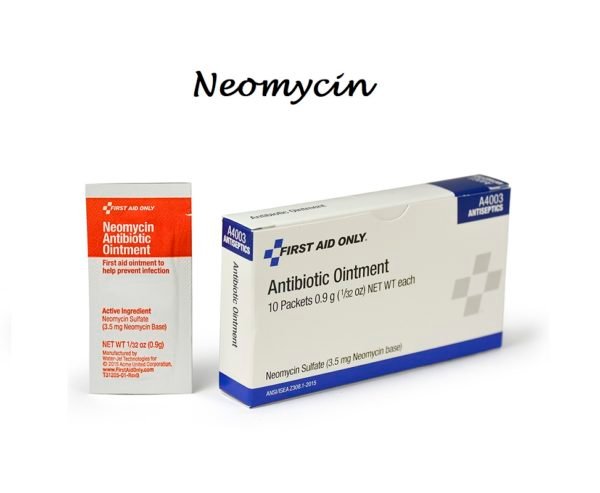
Neomycin is a non-absorbable antibiotic of the aminoglycoside group. It is mostly used as a topical preparation, however, it is also used orally for bacterial overgrowth and bacterial eradication.
Indications of Neomycin:
-
Hepatic coma (portal-systemic encephalopathy):
- It is used as a combination therapy in hepatic coma.
-
Perioperative prophylaxis:
- It is given as combination therapy with enteric-coated erythromycin for the suppression of the normal bacterial bowel flora.
Neomycin dose in adults:
Neomycin dose in the perioperative prophylaxis:
- 1g per oral at 1 PM, 2 PM, and 11 PM on the day preceding 8 AM surgery in addition to oral erythromycin for cleansing (manufacturer’s labeling) or in alternatively in combination with erythromycin/metronidazole and intravenous antibiotics on the day of surgery.
Neomycin dose in the treatment of Hepatic encephalopathy:
- 4 to 12 g per oral daily divided every 4 to 6 hours for 5 to 6 days
Neomycin dose in the treatment of Chronic hepatic insufficiency:
- 4 g per oral daily for an indefinite period
Neomycin dose in children:
Note: Dosage is expressed in terms of neomycin sulfate.
Neomycin dose for the prophylactic treatment of recurrent cholangitis after Kasai porto-enterostomy:
- 25 to 50 mg/kg per oral per day in 4 divided doses 4 days per week continued until 2 to 3 years of age.
Treatment dose in the Enteric bacteria eradication (including gut flora)/ infection:
- 50 to 100 mg/kg per oral per day divided every 6 to 8 hours
- The maximum daily dose: 12 g/day
- Treatment duration should not be more than 2 weeks due to systemic toxicity.
Neomycin dose for the treatment of Hepatic encephalopathy:
- 50 to 100 mg/kg per oral per day divided every 6 hours for one week with or without lactulose
- The maximum daily dose: 12 g/day
Treatment dose in the Preoperative intestinal antisepsis:
- 15 mg/kg per oral for 3 doses administered over 10 hours (eg, at 1 PM, 2 PM, and 11 PM) prior to surgery used concurrently with erythromycin or metronidazole with or without mechanical intestinal cleansing.
- The maximum dose is 1,000 mg/dose
Pregnancy Risk Factor D
- It can cross placenta.
- Use of aminoglycosides during pregnancy can lead to irreversible bilateral congenital hearing loss in children.
- Higher doses of oral therapy may result in malabsorption of nutrients.
Neomycin use during breastfeeding:
- It is not known if the drug was absorbed into breast milk.
- Manufacturer recommends that you stop feeding/ Drug therapy is stopped depending on how important it is for the mother.
- The infant's bowel flora may be altered by antibiotic exposure.
Dose adjustment in renal disease:
- There are no dosage adjustments provided in manufacturer’s labeling.
- The risk of nephrotoxicity or ototoxicity is increased in patients with renal impairment, therefore, dose reduction or discontinuation is necessary.
Dose adjustment in liver disease:
There are no dosage adjustments provided in manufacturer’s labeling.
Side Effects of Neomycin:
-
Central nervous system:
- Sore mouth
-
Gastrointestinal:
- Anorectal Pain
- Diarrhea
- Mouth Irritation
- Nausea
- Rectal Irritation
- Vomiting
Contraindication to Neomycin:
They include hypersensitivity to the Neomycin or any component in the formulation Inflammatory bowel disease Intestinal obstruction
Warnings and precautions
-
Malabsorption
- In larger amounts, malabsorption of fats, Sodium and Iron, Vitamin B12, Vitamin B12, Vitamin B12, Vitamin B12, Nitrogen, Cholesterol, Carotene, Vitamin B12 and glucose can occur.
-
Nephrotoxicity: [US Boxed Warning]
- Dehydration, pre-existing kidney impairment, and a combination nephrotoxic medication are all risk factors for renal toxicities.
-
The US Boxed Warning: Neuromuscular Blockade and Respiratory Paralysis
- Dosing immediately after anesthesia or using other muscle relaxants could cause neuromuscular blockade or respiratory paralysis.
-
Neurotoxicity: [US Boxed Warn]
- You may experience symptoms such as numbness or skin tingling, muscle spasms, seizures, or other signs.
-
Superinfection
- Fungal or bacterial superinfection(C. difficile-associated diarrhea/pseudomembranous colitis) can be seen with long term therapy.
-
Hearing impairment:
- Patients with hearing loss, vertigo, or tinnitus should be cautious.
-
Neuromuscular disorders:
- Patients with neuromuscular disorders like myasthenia gravis or Parkinson's disease should be cautious.
-
Renal impairment
- Patients with pre-existing renal impairment need to be reduced in dosage
Neomycin: Drug Interaction
|
Risk Factor C (Monitor therapy) |
|
|
Acarbose |
Neomycin may enhance the adverse/toxic effect of Acarbose. Neomycin may decrease the metabolism of Acarbose. |
|
Amphotericin B |
May enhance the nephrotoxic effect of Aminoglycosides. |
|
Arbekacin |
May enhance the nephrotoxic effect of Aminoglycosides. Arbekacin may enhance the ototoxic effect of Aminoglycosides. |
|
BCG Vaccine (Immunization) |
Antibiotics may diminish the therapeutic effect of BCG Vaccine (Immunization). |
|
Bisphosphonate Derivatives |
Aminoglycosides may enhance the hypocalcemic effect of Bisphosphonate Derivatives. |
|
Botulinum Toxin-Containing Products |
Aminoglycosides may enhance the neuromuscularblocking effect of Botulinum Toxin-Containing Products. |
|
Capreomycin |
May enhance the neuromuscular-blocking effect of Aminoglycosides. |
|
CARBOplatin |
Aminoglycosides may enhance the ototoxic effect of CARBOplatin. Especially with higher doses of carboplatin. |
|
Cardiac Glycosides |
Aminoglycosides may decrease the serum concentration of Cardiac Glycosides. This effect has only been demonstrated with oral aminoglycoside administration. |
|
Cefazedone |
May enhance the nephrotoxic effect of Aminoglycosides. |
|
Cephalosporins (2nd Generation) |
May enhance the nephrotoxic effect of Aminoglycosides. |
|
Cephalosporins (3rd Generation) |
May enhance the nephrotoxic effect of Aminoglycosides. |
|
Cephalosporins (4th Generation) |
May enhance the nephrotoxic effect of Aminoglycosides. |
|
Cephalothin |
May enhance the nephrotoxic effect of Aminoglycosides. |
|
Cephradine |
May enhance the nephrotoxic effect of Aminoglycosides. |
|
CISplatin |
May enhance the nephrotoxic effect of Aminoglycosides. |
|
CycloSPORINE (Systemic) |
Aminoglycosides may enhance the nephrotoxic effect of CycloSPORINE (Systemic). |
|
Distigmine |
Aminoglycosides may diminish the therapeutic effect of Distigmine. |
|
Lactobacillus and Estriol |
Antibiotics may diminish the therapeutic effect of Lactobacillus and Estriol. |
|
Loop Diuretics |
May enhance the adverse/toxic effect of Aminoglycosides. Specifically, nephrotoxicity and ototoxicity. |
|
Neuromuscular-Blocking Agents |
Aminoglycosides may enhance the respiratory depressant effect of Neuromuscular-Blocking Agents. |
|
Nonsteroidal Anti-Inflammatory Agents |
May decrease the excretion of Aminoglycosides. Data only in premature infants. |
|
Oxatomide |
May enhance the ototoxic effect of Aminoglycosides. |
|
Regorafenib |
Neomycin may decrease serum concentrations of the active metabolite(s) of Regorafenib. |
|
SORAfenib |
Neomycin may decrease the serum concentration of SORAfenib. |
|
Tenofovir Products |
Aminoglycosides may increase the serum concentration of Tenofovir Products. Tenofovir Products may increase the serum concentration of Aminoglycosides. |
|
Vancomycin |
May enhance the nephrotoxic effect of Aminoglycosides. |
|
Vitamin K Antagonists (eg, warfarin) |
Neomycin may enhance the anticoagulant effect of Vitamin K Antagonists. |
|
Risk Factor D (Consider therapy modification) |
|
|
Colistimethate |
Aminoglycosides may enhance the nephrotoxic effect of Colistimethate. Aminoglycosides may enhance the neuromuscular-blocking effect of Colistimethate. |
|
Penicillins |
May decrease the serum concentration of Aminoglycosides. Primarily associated with extended spectrum penicillins, and patients with renal dysfunction. Exceptions: Amoxicillin; Ampicillin; Bacampicillin; Cloxacillin; Dicloxacillin; Nafcillin; Oxacillin; Penicillin G (Parenteral/Aqueous); Penicillin G Benzathine; Penicillin G Procaine; Penicillin V Benzathine; Penicillin V Potassium. |
|
Sodium Picosulfate |
Antibiotics may diminish the therapeutic effect of Sodium Picosulfate. Management: Consider using an alternative product for bowel cleansing prior to a colonoscopy in patients who have recently used or are concurrently using an antibiotic. |
|
Risk Factor X (Avoid combination) |
|
|
Ataluren |
May enhance the adverse/toxic effect of Aminoglycosides. Specifically, an increased risk of nephrotoxicity may occur with the concomitant use of ataluren and aminoglycosides. |
|
Bacitracin (Systemic) |
Neomycin may enhance the nephrotoxic effect of Bacitracin (Systemic). |
|
BCG (Intravesical) |
Antibiotics may diminish the therapeutic effect of BCG (Intravesical). |
|
Foscarnet |
May enhance the nephrotoxic effect of Aminoglycosides. |
|
Mannitol (Systemic) |
May enhance the nephrotoxic effect of Aminoglycosides. |
|
Mecamylamine |
Aminoglycosides may enhance the neuromuscular-blocking effect of Mecamylamine. |
|
Methoxyflurane |
Aminoglycosides may enhance the nephrotoxic effect of Methoxyflurane. |
Monitoring parameters:
Monitoring is required for :
- Renal function tests (BUN and Creatinine)
- audiometry in symptomatic patients
How to administer Neomycin?
It should be given orally irrespective of food, Administration at prescribed dosing times is necessary in preoperative intestinal antisepsis.
Mechanism of action of Neomycin:
It acts by binding with 30S ribosomal Subunits, causing an interruption in bacterial protein synthesis
Absorptionis not recommended for subQ or oral administration.
Distribution97% of the orally administered dose is still in the gastrointestinal tract. Neomycin is absorbed into tissues and concentrated in the renal cortex. The inner ear can also accumulate if you take repeated doses.
Protein binding0% to 30%
Time required to reach peak serum concentration: 1 to 4 Hours
Excretion: Feces (97% oral dose as unchanged drugs); urine (30% to 50%) of absorbed drug is unchanged drugs
Neomycin Brand Names (International):
- Apokalin
- Bykomycin
- Concatag
- Cysto-Myacyne N
- Endomixin
- Enteromicina
- Fradyl
- Glubacida
- Minims Neomycin
- Myacyne
- Nebacetin N Spruhverband
- Nebapol B
- Neo-Mix
- Neomas
- Neomicina
- Neomycin
- Neomycin Drossapharm
- Neomycine
- Neomycine Diamant
- Neomycine Minims
- Neomycinsulfat Chevita
- Neomycinum
- Nivemycin
- Ofodex
- Rovicine
- Sulfate de Neomycine-Chauvin
- Trioftín
- Unguentum Neomycini
- Uro-Beniktol N
- Uro-Nebacetin N
- Vagicillin
- Vinacil
- Vitacilina
- Xyloderm
Neomycin Brand Names in Pakistan:
Neomycin Ointment 5 Mg |
|
| Ismycin Skin | Isis Pharmaceutical |
| Nemozin | Zanctok Pharmaceuticals |
Neomycin Ointment 0.5 % W/W |
|
| Biozon | Biogen Pharma |
| Elimycin | Elite Pharma |
| Neocin | Semos Pharmaceuticals (Pvt) Ltd. |
| NeomycinOintment | Krka-Pak Pharmaceutical & Chemical Works |
| NeomycinOintment | Geofman Pharmaceuticals |
| NeomycinOirntment | Eros Pharmaceuticals |
| NeomycinOintment | Amros Pharmaceuticals. |
| NeomycinOintment | Swiss Pharmaceuticals (Pvt) Ltd. |
| Neopharm | Epharm Laboratories |
| Neosul | Epoch Pharmaceutical |
| Newcin | Euro Pharma International |
| Tasomycin | Tas Pharmaceutical |
| Webnate -N | Webros Pharmaceuticals |
Neomycin Cream 0.5 % W/W |
|
| Beone Plus | Reliance Pharma |
| Neogray | Gray`S Pharmaceuticals |
| Neoskin | Trigon Pharmaceuticals Pakistan (Pvt) Ltd. |
| Webnate -N , | Webros Pharmaceuticals |
Neomycin Tablets 500 Mg |
|
| Lavenda | Hamaz Pharmaceutical (Pvt) Ltd. |
.png)


