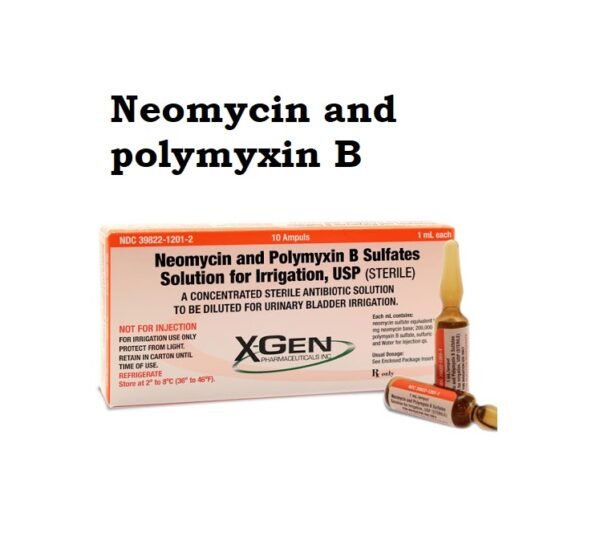
Neomycin and polymyxin B (Maxitrol) is a combination of non-absorbable antibiotics that are used for bladder irrigation in patients who develop bacteriuria due to prolonged bladder catheterization.
Neomycin and polymyxin B (Maxitrol) Uses:
-
Urinary bladder irrigant:
- It is used as a bladder irrigant (for short-term use of up to 10 days) in patients who have bacteriuria due to the use of long-term indwelling catheters to prevent bacteria and septicemia.
Neomycin and polymyxin B (Maxitrol) Dose in Adults
Neomycin and polymyxin B Dose in the treatment of Urinary bladder irrigant:
- Intravesical:
- Add 1 mL irrigant to 1,000 ml isotonic saline solution per day as continuous irrigation for up to 10 days.
Neomycin and polymyxin B (Maxitrol) Dose in Childrens
Neomycin and polymyxin B Dose in the treatment of Urinary bladder irrigant:
Note: The data is limited and the effectiveness of the drug varies. Most of the experience with the drug has been in patients with spinal cord injury or neurogenic bladder.
-
Children and Adolescents:
- Irrigant solution (neomycin 40 mg/polymyxin B 200,000 units/L):
- Intravesical: 10 mL instilled at the end of each catheterization and retained until next catheterization.
- In older adolescents, 30 mL 2 to 3 times daily has been used for asymptomatic bacteriuria.
- Note: Use has generally been replaced with other agents (eg, saline, gentamicin).
- Irrigant solution (neomycin 40 mg/polymyxin B 200,000 units/L):
Pregnancy Category: C
- Animal reproduction studies have not been conducted with this combination
- There are reports of total irreversible bilateral congenital deafness in children whose mothers received streptomycin during pregnancy.
- Talk to individual agents.
Use during breastfeeding:
- It is unknown if the drug will be excreted into breastmilk.
Dose in Kidney Disease:
The manufacturer has not recommended any adjustments in the dose in patients with kidney disease.
Dose in Liver disease:
The manufacturer has not recommended any adjustments in the dose in liver disease.
Side effects of Neomycin and polymyxin B (Maxitrol):
-
Central Nervous System:
- Localized Burning
-
Dermatologic:
- Contact Dermatitis
- Erythema
- Skin Rash
- Urticaria
-
Genitourinary:
- Bladder Mucosa Irritation
- Nephrotoxicity
-
Neuromuscular & Skeletal:
- Neuromuscular Blockade
-
Otic:
- Ototoxicity
Contraindications to Neomycin and polymyxin B (Maxitrol):
- Allergy reactions to neomycin, neomycin B or any other component of the formulation
- Patients who have had severe allergic reactions to aminoglycosides in the past.
Warnings and precautions
-
Superinfection
- Long-term use of the drug can lead to fungal and bacterial superinfections, such as C. difficile-associated diarrhea or pseudomembranous collitis.
- CDAD can occur even after two months of last antibiotic use.
-
Systemic toxicities:
- Systemic absorption may lead to nephrotoxicity, ototoxicity, or neuromuscular blockade.
- Systemic absorption can be more common in patients who have bladder defects or who have had surgery that has caused injury to the bladder wall.
-
Renal impairment
- It can increase the risk of kidney toxicity. You should use it with caution.
Neomycin and polymyxin B: Drug Interaction
|
Risk Factor C (Monitor therapy) |
|
|
Acarbose |
Neomycin may enhance the adverse/toxic effect of Acarbose. Neomycin may decrease the metabolism of Acarbose. |
|
Amphotericin B |
May enhance the nephrotoxic effect of Aminoglycosides. |
|
Arbekacin |
May enhance the nephrotoxic effect of Aminoglycosides. Arbekacin may enhance the ototoxic effect of Aminoglycosides. |
|
BCG Vaccine (Immunization) |
Antibiotics may diminish the therapeutic effect of BCG Vaccine (Immunization). |
|
Bisphosphonate Derivatives |
Aminoglycosides may enhance the hypocalcemic effect of Bisphosphonate Derivatives. |
|
Botulinum Toxin-Containing Products |
Aminoglycosides may enhance the neuromuscularblocking effect of Botulinum Toxin-Containing Products. |
|
Capreomycin |
May enhance the neuromuscular-blocking effect of Polymyxin B. |
|
CARBOplatin |
Aminoglycosides may enhance the ototoxic effect of CARBOplatin. Especially with higher doses of carboplatin. |
|
Cardiac Glycosides |
Aminoglycosides may decrease the serum concentration of Cardiac Glycosides. This effect has only been demonstrated with oral aminoglycoside administration. |
|
Cefazedone |
May enhance the nephrotoxic effect of Polymyxin B. |
|
Cephalosporins (2nd Generation) |
May enhance the nephrotoxic effect of Aminoglycosides. |
|
Cephalosporins (3rd Generation) |
May enhance the nephrotoxic effect of Aminoglycosides. |
|
Cephalosporins (4th Generation) |
May enhance the nephrotoxic effect of Aminoglycosides. |
|
Cephalothin |
May enhance the nephrotoxic effect of Aminoglycosides. |
|
Cephradine |
May enhance the nephrotoxic effect of Aminoglycosides. |
|
CISplatin |
May enhance the nephrotoxic effect of Aminoglycosides. |
|
CycloSPORINE (Systemic) |
Aminoglycosides may enhance the nephrotoxic effect of CycloSPORINE (Systemic). |
|
Distigmine |
Aminoglycosides may diminish the therapeutic effect of Distigmine. |
|
Lactobacillus and Estriol |
Antibiotics may diminish the therapeutic effect of Lactobacillus and Estriol. |
|
Loop Diuretics |
May enhance the adverse/toxic effect of Aminoglycosides. Specifically, nephrotoxicity and ototoxicity. |
|
Nonsteroidal Anti-Inflammatory Agents |
May decrease the excretion of Aminoglycosides. Data only in premature infants. |
|
Oxatomide |
May enhance the ototoxic effect of Aminoglycosides. |
|
Regorafenib |
Neomycin may decrease serum concentrations of the active metabolite(s) of Regorafenib. |
|
SORAfenib |
Neomycin may decrease the serum concentration of SORAfenib. |
|
Tenofovir Products |
Aminoglycosides may increase the serum concentration of Tenofovir Products. Tenofovir Products may increase the serum concentration of Aminoglycosides. |
|
Vancomycin |
May enhance the nephrotoxic effect of Aminoglycosides. |
|
Vitamin K Antagonists (eg, warfarin) |
Neomycin may enhance the anticoagulant effect of Vitamin K Antagonists. |
|
Risk Factor D (Consider therapy modification) |
|
|
Colistimethate |
Aminoglycosides may enhance the nephrotoxic effect of Colistimethate. Aminoglycosides may enhance the neuromuscular-blocking effect of Colistimethate. |
|
Neuromuscular-Blocking Agents |
Polymyxin B may enhance the neuromuscular-blocking effect of Neuromuscular-Blocking Agents. |
|
Penicillins |
May decrease the serum concentration of Aminoglycosides. Primarily associated with extended spectrum penicillins, and patients with renal dysfunction. Exceptions: Amoxicillin; Ampicillin; Bacampicillin; Cloxacillin; Dicloxacillin; Nafcillin; Oxacillin; Penicillin G (Parenteral/Aqueous); Penicillin G Benzathine; Penicillin G Procaine; Penicillin V Benzathine; Penicillin V Potassium. |
|
Sodium Picosulfate |
Antibiotics may diminish the therapeutic effect of Sodium Picosulfate. Management: Consider using an alternative product for bowel cleansing prior to a colonoscopy in patients who have recently used or are concurrently using an antibiotic. |
|
Risk Factor X (Avoid combination) |
|
|
Ataluren |
May enhance the adverse/toxic effect of Aminoglycosides. Specifically, an increased risk of nephrotoxicity may occur with the concomitant use of ataluren and aminoglycosides. |
|
Bacitracin (Systemic) |
Polymyxin B may enhance the nephrotoxic effect of Bacitracin (Systemic). |
|
Bacitracin (Systemic) |
Neomycin may enhance the nephrotoxic effect of Bacitracin (Systemic). |
|
BCG (Intravesical) |
Antibiotics may diminish the therapeutic effect of BCG (Intravesical). |
|
Cholera Vaccine |
Antibiotics may diminish the therapeutic effect of Cholera Vaccine. Management: Avoid cholera vaccine in patients receiving systemic antibiotics, and within 14 days following the use of oral or parenteral antibiotics. |
|
Foscarnet |
May enhance the nephrotoxic effect of Aminoglycosides. |
|
Mannitol (Systemic) |
May enhance the nephrotoxic effect of Aminoglycosides. |
|
Mecamylamine |
Polymyxin B may enhance the neuromuscular-blocking effect of Mecamylamine. |
|
Methoxyflurane |
May enhance the nephrotoxic effect of Polymyxin B |
Monitoring parameters:
- Urinalysis,
- renal function.
How to administer Neomycin and polymyxin B?
- It is indicated only for the irrigation of the bladder and not for parenteral administration.
- The inflow lumen of the 3-way catheter should be connected to the irrigation container to allow the continuous irrigation of the urinary bladder.
- The bladder rinse should be continuous and the irrigation should not be interrupted for more than a few minutes.
- The flow rate of the irrigation should be adjusted to 1 liter per 24 hours.
- However, if the patients' urine output exceeds 2 liters per 24 hours, the flow rate should be set at a rate of 2 liters per 24 hours.
Mechanism of action of Neomycin and polymyxin B:
Neomycin:
- It binds with the 30S subunit of the ribosomal ribosomal subunit, inhibits bacterial protein synthesis, and indirectly inhibits bacterial replication.
Polymyxin B
- By binding to phospholipids, it damages the bacterial cell membrane. It causes a decrease in bacterial cellular permeability, which allows for the leakage intracellular content.
Talk to individual agents.
Absorption:
- It is only minimally absorbed when used topically. Systemic absorption can occur if the bladder is inflamed or denuded.
International Brands of Neomycin and polymyxin B:
- Neosporin G.U. Irrigant
- Neosporin Irrigating Solution
- Alosol
- Isopto Statrol
- Maxitrol
- Statrol
Neomycin and polymyxin B Brands Names in Pakistan:
- Maxitrol
.png)


