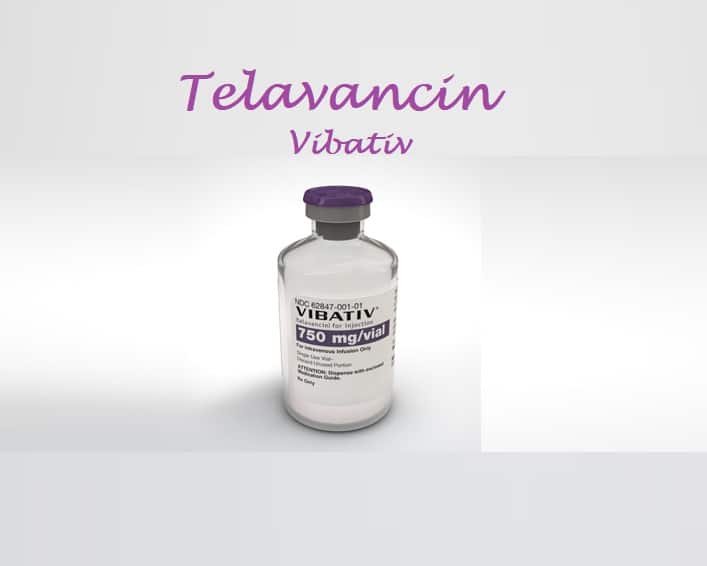
Telavancin (Vibativ) is a semisynthetic derivative of vancomycin that has concentration-dependent bactericidal activity.
It is used to treat the following conditions:
-
Complicated skin and skin structure infections:
-
it is used in the treatment of complicated skin and skin structure infections caused by:
-
susceptible gram-positive organisms e.g methicillin-susceptible or resistant Staphylococcus aureus,
-
vancomycin-susceptible Enterococcus faecalis, and
-
Streptococcus pyogenes, Streptococcus agalactiae, or Streptococcus anginosus group
-
-
-
Hospital-acquired and ventilator-associated bacterial pneumonia (HABP/VABP):
-
it is used in the treatment of HABP/VABP caused by susceptible isolates of Staphylococcus aureus when alternative treatments are not appropriate
-
-
Off Label Use of Telavancin in Adults:
-
it is used in the treatment of Bacteremia due to S. aureus
-
Other drugs used to treat resistant infections caused by staphylococci include:
- Linezolid
- Ceftaroline (Teflaro)
- Quinopristine-daptomycin
Telavancin (Vibativ) Dose in Adults
Telavancin (Vibativ) Dose in the treatment of Bacteremia due to S. aureus (off-label):
- 10 mg/kg intravenous given every 24 hours
Telavancin (Vibativ) Dose in the treatment of complicated skin and skin structure infection:
- 10 mg/kg intravenous given every 24 hours for 1 to 2 weeks
Telavancin (Vibativ) Dose in the treatment of Hospital-acquired and ventilator-associated bacterial pneumonia (HABP/VABP) due to S. aureus:
- 10 mg/kg intravenous given every 24 hours for 1 to 3 weeks
Use in Children:
Safety and efficacy in children not established.
Telavancin (Vibativ) Pregnancy Risk Factor C
- [US Boxed Warning]According to animal data, there have been adverse developmental outcomes.
- A serum pregnancy test should be done before use for women with childbearing potential.
- Telavancin should not be used during pregnancy unless there is a clear benefit for the mother and the risk to the baby.
- Telavancin crosses the placenta
- Effective contraception should be used in therapy for women with childbearing potential.
Telavancin (Vibativ) use during breastfeeding:
- It is recommended that you stop breastfeeding during treatment.
- It is unknown if telavancin is excreted into breastmilk.
- According to the US labeling, it is important to exercise caution when giving telavancin as a nursing drug.
Telavancin (Vibativ) dose in kidney disease:
-
US labeling:
-
CrCl >50 mL/minute:
- No dosage adjustment required
-
CrCl 30 to 50 mL/minute:
- 5 mg/kg given every 24 hours
-
CrCl 10 to <30 mL/minute:
- 10 mg/kg given every 48 hours
-
CrCl <10 mL/minute:
- No dosage adjustment given in manufacturer’s labeling (has not been studied).
-
ESRD and hemodialysis patients:
- No dosage adjustment is given in the manufacturer’s labeling (has not been studied).
-
-
Canadian labeling:
-
CrCl >50 mL/minute:
- No dosage adjustment required
-
CrCl 30 to 50 mL/minute:
- 5 mg/kg given every 24 hours
-
CrCl <30 mL/minute:
- Not recommended.
-
ESRD and hemodialysis patients:
- Not recommended.
-
Telavancin (Vibativ) dose in liver disease:
-
Mild-to-moderate hepatic impairment (Child-Pugh class A or B):
- No dosage adjustment required.
-
Severe hepatic impairment (Child-Pugh class C):
- No dosage adjustment is given in the manufacturer's labeling (has not been studied).
Common Side Effects of Vibativ (Telavancin):
-
Central Nervous System:
- Metallic Taste
-
Gastrointestinal:
- Nausea
- Vomiting
-
Renal:
- Increased Serum Creatinine
- Foamy Urine
Less Common Side Effects of Telavancin (Vibativ):
-
Central Nervous System:
- Dizziness
- Infusion Site Pain
- Rigors
-
Dermatologic:
- Pruritus
- Skin Rash
- Localized Erythema
-
Gastrointestinal:
- Diarrhea
- Decreased Appetite
- Abdominal Pain
-
Local:
- Infusion Site Reaction
-
Renal:
- Renal Insufficiency
- Acute Renal Failure
Contraindications to Telavancin (Vibativ):
- Hypersensitivity to telavancin and any component of the formulation
- Concomitant intravenous unfractionated Heparin use
Warnings and precautions
-
Anaphylaxis/hypersensitivity reactions:
- After the first or subsequent doses, severe hypersensitivity reactions including anaphylaxis have been observed. Some have even been fatal.
- If hypersensitivity or rash occurs, discontinue use.
- Patients with known hypersensitivity to vancomycin should be cautious.
-
Modification of cardiac conduction:
- It could prolong the QTc interval
- Patients with congenital QT syndrome, known QTc lengthenation, severe left ventricular hypertrophy, and uncompensated cardiac failure should be avoided.
- Patients who are taking concurrently other drugs that prolong the QT interval should be cautious.
-
Infusion reactions
- Rapid intravenous administration may cause flushing, rash and/or pruritus.
- These symptoms can be relieved by slowing down or stopping infusions.
-
Nephrotoxicity: [US Boxed Warning]
- There have been cases of new or worsening renal impairment.
- Monitor renal function before, during, and after treatment (at minimum every 48 to 72 hour; more often if indicated) in all patients.
- Concomitant nephrotoxic drugs or baseline comorbidities that are associated with decreased renal function (eg, baseline renal dysfunction, hypertension or heart failure) are common risk factors.
- Contains solubilizer cyclodextrin (hydroxypropyl-beta-cyclodextrin) that may accumulate in patients with kidney disease, although the clinical significance of this finding is uncertain
-
Superinfection
- Prolonged use can result in fungal or bacterial superinfection, including C.difficile-associated diarrhea (CDAD) and pseudomembranous colitis;
- After 2 months of antibiotic treatment, CDAD infection was still present.
-
Renal impairment: [US-Boxed Warning]
- Patients with pre-existing moderate-to-severe kidney disease with a CrCl <=50 mL/minute, treated for hospital-acquired or ventilator-associated bacterial pneumonia (HABP/VABP) had increased (all-cause) mortality compared to those treated with vancomycin.
- Use of HABP/VABP is only recommended when the benefit outweighs any risk.
- Patients with skin structure and complicated skin conditions can have their efficacy reduced if they have a baseline CrCl of =50mL/minute.
Telavancin: Drug Interaction
|
Anticoagulants |
Telavancin may diminish the therapeutic effect of Anticoagulants. Specifically, telavancin may artificially increase the results of laboratory tests commonly used to monitor anticoagulant effectiveness, which could lead to incorrect decisions to decrease anticoagulant doses. Exceptions: Antithrombin; Bemiparin; Dalteparin; Enoxaparin; Fondaparinux; Nadroparin; Protein C Concentrate (Human); Tinzaparin. |
|
BCG Vaccine (Immunization) |
Antibiotics may diminish the therapeutic effect of BCG Vaccine (Immunization). |
|
Haloperidol |
QT-prolonging Agents (Indeterminate Risk - Caution) may enhance the QTcprolonging effect of Haloperidol. |
|
Lactobacillus and Estriol |
Antibiotics may diminish the therapeutic effect of Lactobacillus and Estriol. |
|
QT-prolonging Agents (Highest Risk) |
QT-prolonging Agents (Indeterminate Risk - Caution) may enhance the QTc-prolonging effect of QT-prolonging Agents (Highest Risk). Management: Monitor for QTc interval prolongation and ventricular arrhythmias when these agents are combined. Patients with additional risk factors for QTc prolongation may be at even higher risk. |
|
Sodium Picosulfate |
Antibiotics may diminish the therapeutic effect of Sodium Picosulfate. Management: Consider using an alternative product for bowel cleansing prior to a colonoscopy in patients who have recently used or are concurrently using an antibiotic. |
|
Typhoid Vaccine |
Antibiotics may diminish the therapeutic effect of Typhoid Vaccine. Only the live attenuated Ty21a strain is affected. Management: Vaccination with live attenuated typhoid vaccine (Ty21a) should be avoided in patients being treated with systemic antibacterial agents. Use of this vaccine should be postponed until at least 3 days after cessation of antibacterial agents. |
|
BCG (Intravesical) |
Antibiotics may diminish the therapeutic effect of BCG (Intravesical). |
|
Cholera Vaccine |
Antibiotics may diminish the therapeutic effect of Cholera Vaccine. Management: Avoid cholera vaccine in patients receiving systemic antibiotics, and within 14 days following the use of oral or parenteral antibiotics. |
|
Heparin |
Telavancin may diminish the therapeutic effect of Heparin. Specifically, telavancin may artificially increase the results of laboratory tests commonly used to monitor IV heparin effectiveness, which could lead to incorrect decisions to decrease heparin doses. |
Monitor:
- Renal function (prior to the start, every 48 to 72 hours; more frequently if indicated and following therapy)
- Pregnancy test
How to administer Telavancin (Vibativ)?
- Administer intravenously over one hour.
- Other medications should not be given simultaneously through the same IV line.
- When the same intravenous line is used for sequential infusion of other medications, flush line with D W, LR, or NS before and after infusing telavancin.
- Red-man syndrome can occur if the infusion is too rapid.
- It may be characterized by low blood pressure and/or a maculopapular rash appearing on the face, trunk, neck, and/or upper extremities, however, this is not an allergic reaction.
- If a rash appears or hypotension occurs, discontinue or slow the infusion rate.
Mechanism of action of Telavancin (Vibativ):
- It is a semisynthetic derivative of Vancomycin that has concentration-dependent bactericidal activity.
- It blocks the polymerization and cross-linking peptidoglycans in bacterial cell walls by binding to the D–Ala-D–Ala portion.
- The additional mechanism, which is different from vancomycin's, involves the disruption of membrane potential and alteration of cell permeability by the presence of lipophilic side chains moiety.
Protein binding:
- ~90%; primarily to albumin
Half-life elimination:
- 6.6 to 9.6 hours
Excretion:
- Via Urine (~76%); feces (<1%)
International Brand Names of Telavancin:
- Vibativ
Telavancin Brand Names in Pakistan:
No brands available in Pakistan
.png)


