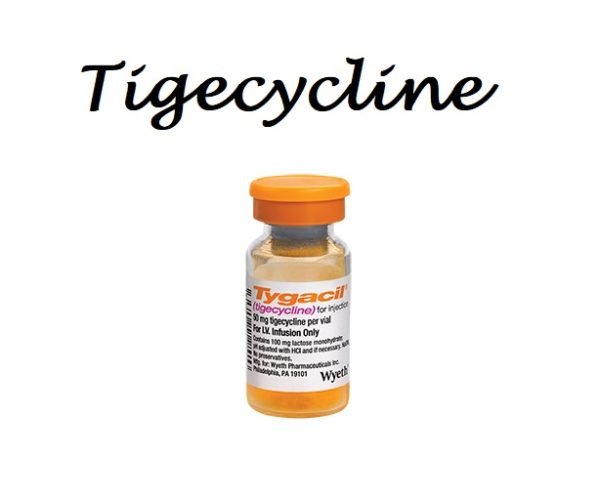
Tigecycline (Tygacil) is a bacteriostatic antibiotic that binds to the 30S ribosomal subunit of susceptible bacteria, thereby, inhibiting protein synthesis.
In 2019, it was removed from the WHO's list of essential medicine
It is used to treat the following infections:
- Community-acquired bacterial Pneumonia in patients 18 years and older caused by:
- Penicillin-susceptible isolates of Streptococcus pneumoniae including cases with concurrent bacteremia,
- Haemophilus influenzae,
- Legionella pneumophila &
- Chlamydia pneumoniae
- Intra-abdominal complicated infections in patients 18 years of age and older caused by:
- Methicillin-susceptible and methicillin-resistant isolates of Staphylococcus aureus,
- Citrobacter freundii,
- Enterobacter cloacae,
- Escherichia coli,
- Klebsiella oxytoca,
- Klebsiella pneumoniae,
- Vancomycin-susceptible isolates of Enterococcus faecalis,
- Streptococcus anginosus group including S. anginosus, Streptococcus intermedius, and Streptococcus constellatus,
- Bacteroides fragilis,
- Bacteroides thetaiotaomicron,
- Bacteroides uniformis,
- Bacteroides vulgatus,
- Clostridium perfringens, and
- Peptostreptococcus micros.
-
Complicated Skin and soft tissue infections in patients 18 years of age and older caused by:
- E. coli,
- Vancomycin susceptible isolates of E. faecalis,
- Streptococcus agalactiae,
- S. anginosus group including S. anginosus, S. intermedius, and S. constellatus,
- S. anginosus ,
- Streptococcus pyogenes,
- E. cloacae,
- K. pneumoniae,
- B. fragilis &
- Methicillin-susceptible and methicillin-resistant isolates of Staphylococcus aureus.
Tigecycline (Tygacil) Dose in Adults
Tigecycline (Tygacil) dosage in the treatment of community-acquired Pneumonia:
- Initially, 100 mg intravenously given as a single dose;
- The maintenance dose is 50 mg every 12 hours for 7 to 14 days
Tigecycline (Tygacil) dosage in the treatment of complicated Intra-abdominal infections:
- Initially 100 mg intravenously as a single dose
- The maintenance dose is 50 mg every 12 hours for 5 to 14 days
Tigecycline (Tygacil) dosage in the treatment of complicated skin/skin structure infections:
- Initially, 100 mg intravenously as a single dose;
- The maintenance dose is 50 mg every 12 hours for 5 to 14 days
Tigecycline (Tygacil) Dose in Childrens
Tigecycline (Tygacil) dosing in susceptible infection:
Its use should be reserved for situations when no effective alternative therapy is available. It should not be used in pediatric patients younger than 8 years due to adverse effects on tooth development unless no alternatives are available
-
Infants and Children <8 years:
-
Loading dose (optional):
- 1.5 to 3 mg/kg intravenously once
-
Maintenance dose:
- 1 to 2 mg/kg/dose every 12 hours is given
- The maximum dose is 50 mg/dose
- if no loading dose is given then a maintenance dose of 2 mg/kg every 12 hours has been used
-
-
Children ≥8 years and Adolescents
-
8 to 11 years:
- 1.2 to 2 mg/kg/dose intravenously every 12 hours is given
- The maximum dose is 50 mg/dose
-
≥12 years:
- 50 mg IV every 12 hours is given
-
Tigecycline (Tygacil) Pregnancy Risk Factor D
- Tigecycline is classified in pregnancy category D because of its potential to cause permanent tooth discoloration and adverse effects on animals.
- Tigecycline can cause nausea and vomiting, so it is not recommended for pregnant women.
Tigecycline (Tygacil) use during breastfeeding:
- It is unknown if tigecycline is present in breast milk.
- Tigecycline should not be given to a woman who is nursing.
- Modification of the bowel flora is an example of non-dose-related effects.
Tigecycline (Tygacil) Dose in Renal disease:
- No dosage adjustment is required
End-stage renal disease (ESRD) on dialysis:
- It is poorly dialyzed
- no supplemental dose or dosage adjustment essential, including patients on intermittent hemodialysis, peritoneal dialysis, or continuous renal replacement therapy (eg, CVVHD).
Tigecycline (Tygacil) Dose in Liver disease:
-
Mild-to-moderate hepatic impairment (Child-Pugh class A or B):
- No dosage adjustment required.
-
Severe hepatic impairment (Child-Pugh class C):
- 100 mg single dose is given initially;
- The maintenance dose is 25 mg every 12 hours.
Common Side Effects of Tigecycline (Tygacil):
-
Gastrointestinal:
- Nausea
- Vomiting
- Diarrhea
Less Common Side Effects of Tigecycline (Tygacil):
-
Cardiovascular:
- Localized Phlebitis
- Septic Shock
- Thrombophlebitis
-
Central Nervous System:
- Headache
- Dizziness
- Chills
-
Dermatologic:
- Skin Rash
- Pruritus
-
Endocrine & Metabolic:
- Increased Amylase
- Hyponatremia
- Hypocalcemia
- Hypoglycemia
-
Gastrointestinal:
- Abdominal Pain
- Dyspepsia
- Abnormal Stools
- Anorexia
- Dysgeusia
-
Genitourinary:
- Leukorrhea
- Vaginitis
- Vulvovaginal Candidiasis
-
Hematologic & Oncologic:
- Anemia
- Hypoproteinemia
- Eosinophilia
- Increased INR
- Prolonged Partial Thromboplastin Time
- Prolonged Prothrombin Time
- Thrombocytopenia
-
Hepatic:
- Increased Serum ALT
- Increased Serum AST
- Increased Serum Alkaline Phosphatase
- Hyperbilirubinemia
- Jaundice
-
Hypersensitivity:
- Hypersensitivity Reaction
-
Infection:
- Infection
- Abscess
-
Local:
- Inflammation At Injection Site
- Injection Site Reaction
- Pain At Injection Site
- Swelling At Injection Site
-
Neuromuscular & Skeletal:
- Weakness
-
Renal:
- Increased Blood Urea Nitrogen
- Increased Serum Creatinine
-
Respiratory:
- Pneumonia
Contraindications to Tigecycline (Tygacil):
- Allergy to tigcycline or any component of the formulation
- Very few studies have documented allergenic cross-reactivity with tetracyclines.
- Hypersensitivity to the tetracycline antibiotic class.
Warnings and precautions
- Anaphylactic and hypersensitivity reactions
- Can lead to life-threatening anaphylaxis.
- Patients with hypersensitivity to tetracyclines-class antibiotics should not be given this medication due to their structural similarities.
- Antianabolic effects
- It may be associated with the antianabolic effects of the tetracycline tetracycline classes (e.g., increased BUN, azotemia and acidosis and hyperphosphatemia).
- Hepatotoxicity:
- A few abnormal liver function tests have been observed (increased total and prothrombin times, transaminases, etc.
- There have been reports of liver dysfunction and liver failure.
- Patients who have abnormal liver function tests should be closely monitored for any signs of hepatic derangement.
- After discontinuation of a drug, adverse hepatic effects may occur.
- Pancreatitis
- Patients without known risk factors have been diagnosed with acute pancreatitis, which can lead to fatalities.
- If you suspect that your treatment is not working, discontinue it.
- Photosensitivity
- Photosensitivity can be linked to tetracyclines' structural similarities.
- Pseudotumor cerebri:
- Due to structural similarities with Tetracyclines, can be mistaken for pseudotumor cerebri.
- Superinfection
- Prolonged use can result in fungal or bacterial superinfection, including C.difficile-associated diarrhea (CDAD) and pseudomembranous colitis
- Treatment-related Mortality: [US Boxed Warning]
- A meta-analysis of Phase 3, 4 and 5 clinical trials showed an increase in all-cause death in patients treated with tigecycline compared to patients who were not.
- You should not use it if other treatments are unavailable.
- Deaths were generally the result of a worsening infection, complications, or an underlying condition.
- Hepatic impairment
- Patients with hepatic impairment should be cautious.
- In severe hepatic impairment, dosage adjustment is recommended.
- Intestinal infections
- It is best to avoid its monotherapy in patients with intestinal perforation.
- In a small number of cases, sepsis/septichock occurred more often than patients who were treated with imipenem/cilastatin comparator.
Tigecycline: Drug Interaction
|
Warfarin |
Tigecycline may increase the serum concentration of Warfarin. |
Monitor:
- Monitor hepatic function periodically.
- Signs and symptoms of anaphylaxis during administration should be observed
How to administer Tigecycline (Tygacil)?
- It should be administered intravenously over 30 to 60 minutes through a dedicated line or via Y-site.
- If the same intravenous line is used for sequential infusion of several drugs, then flush the line with NS, D5W, or LR before and after tigecycline administration.
Mechanism of action of Tigecycline (Tygacil):
- It is a glycylcycline antibacterial that binds with the 30S subunit of susceptible bacteria and inhibits its protein synthesis.
- They are generally considered to be bacteriostatic.
- However, the bactericidal properties of L. pneumophila and S. pneumoniae have been shown to be effective.
- Tigecycline, although not classified as a tetracycline, it is a derivative of minocycline (9-t-butylglycylamido minocycline) and shares some class-associated adverse effects.
- It has demonstrated activity against a variety of gram-positive and -negative bacterial pathogens including methicillin-resistant staphylococci.
Distribution:
- It has extensive tissue distribution including the gallbladder, lungs, and colon.
Protein binding: 71% - 89%
Metabolism:
- Mainly hepatic, via glucuronidation, N-acetylation, and epimerization to several metabolites, each <10% of the dose
Half-life elimination:
- Single dose is 27 hours & following multiple doses is 42 hours; It is increased by 23% in moderate hepatic impairment and 43% in severe hepatic impairment
Excretion:
- Via feces (59%, primarily as unchanged drug); urine (33%, with 22% of the total dose as unchanged drug)
- Clearance: Reduced by 25% in patients with moderate hepatic impairment and 55% in severe hepatic impairment.
International Brands of Tigecycline:
- Bacticil
- Capessa
- Linicetil
- Standiga
- Tagix
- Treprex
- Tygacil
- Tylin
- Widebac IV
Tigecycline brands in Pakistan:
- B Tig (Inj. 50 mg - 2940 per vial) - Bosch
- Tagagy (Inj. 50 mg - 2940 per vial) - MTI
- TigaBio (Inj. 50 mg - 2940 per vial) - Bio-Labs
- Tigatec (Inj. 50 mg - 2940 per vial) - Laderly
- Tigelin (Inj. 50 mg - 2500 per vial) - Global/ Vision
- Tilane (Inj. 50 mg - 2500 per vial) - Continental Pharma
- Tygacil (Inj. 50 mg - 4200 per vial) - Pfizer [/bg_collapse]
.png)


