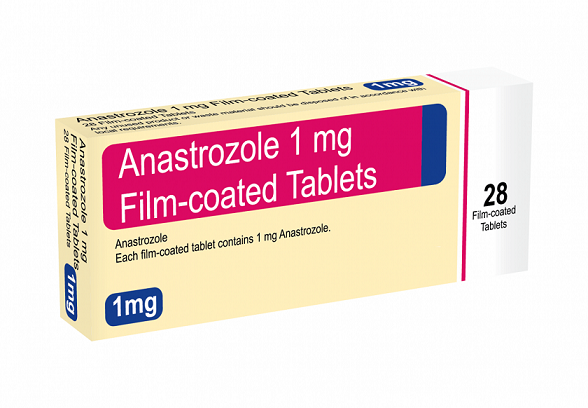
Anastrozole is a selective and potent nonsteroidal aromatase inhibitor that inhibits the conversion of androstenedione to estrone and testosterone to estradiol by inhibiting the enzyme aromatase.
It is used to treat the following conditions:
-
As a first-line treatment of locally-advanced or metastatic hormone receptor-positive (or unknown) breast cancer in postmenopausal women.
-
As adjuvant treatment of early hormone receptor-positive breast cancer in postmenopausal women.
-
Advanced breast cancer with disease progression following tamoxifen therapy in postmenopausal women.
-
Recurrent or metastatic endometrial or uterine cancers
-
Recurrent ovarian cancer
-
Risk reduction for breast cancer in postmenopausal women
It is one of the WHO's List Of Essential Medicine
Anastrozole Dose in Adults
Dose in the treatment of advanced Breast cancer:
- Postmenopausal females:
- 1 mg orally once a day.
- Continue until the progression of the tumor is observed.
Dose in estrogen-receptor-positive and HER2-negative advanced Breast cancer (off-label use):
- Postmenopausal females:
- 1 mg orally once a day until disease progression and unacceptable toxicity (in combination with abemaciclib).
- Premenopausal or perimenopausal females:
- 1 mg orally once a day until disease progression or unacceptable toxicity (in combination with ribociclib and goserelin).
Dose in the treatment as adjuvant therapy of early Breast cancer:
- Postmenopausal females:
- 1 mg orally once a day
- Duration of therapy:
- The American Society of Clinical Oncology (ASCO) guidelines for Adjuvant Endocrine Therapy of Hormone-Receptor Positive Breast Cancer recommend a maximum duration of five years of aromatase inhibitor therapy for postmenopausal women.
- Aromatase inhibitor therapy may be combined with tamoxifen for a total duration of up to ten years.
- The decision to extend aromatase inhibitor therapy for an additional 5 years should include assessment of the risk of recurrence and initial adjuvant therapy (tamoxifen versus an aromatase inhibitor).
Dose in the treatment of risk reduction of Breast cancer as off-label use:
- Postmenopausal females older than 40 years of age:
- 1 mg orally once a day for 5 years.
Dose in the treatment of recurrent or metastatic Endometrial or uterine cancer as off-label use:
- 1 mg orally once a day.
Dose in the treatment of recurrent Ovarian cancer as off-label use:
- 1 mg orally once daily (until disease progression or unacceptable toxicity).
Pregnancy Risk Factor: X
- Anastrozole can have serious adverse effects on the fetal health.
- Before starting therapy, a pregnancy test must be done.
- Effective contraception should be used by women in their reproductive years.
Use of anastrozole while breastfeeding
- It is unknown if the drug can be absorbed into breastmilk.
- Because of possible serious side effects, the manufacturer suggests that breastfeeding be stopped for no less than two weeks.
Anastrozole Dose in Renal Disease:
- Adjustment in the dose is not necessary in patients with renal disease.
Anastrozole Dose in Liver Disease:
- Mild to moderate and stable hepatic impairment:
- Adjustment in the dose is not necessary.
- Severe hepatic impairment:
- The manufacturer has not recommended any adjustment in the dose in patients with severe hepatic impairment.
Common Side Effects of Anastrozole Include:
- Cardiovascular:
- Vasodilatation
- Ischemic Heart Disease
- Hypertension
- Angina Pectoris
- Edema
- Central Nervous System:
- Fatigue
- Mood Disorder
- Headache
- Pain
- Depression
- Dermatologic:
- Skin Rash
- Endocrine & Metabolic:
- Hot Flash
- Gastrointestinal:
- Gastrointestinal Distress
- Nausea
- Vomiting
- Neuromuscular & Skeletal:
- Weakness
- Arthritis
- Arthralgia
- Back Pain
- Ostealgia
- Osteoporosis
- Respiratory:
- Pharyngitis
- Dyspnea
- Increased Cough
Less Common Side Effects Of Anastrozole Include:
- Cardiovascular:
- Peripheral Edema
- Chest Pain
- Venous Thrombosis
- Myocardial Infarction
- Central Nervous System:
- Insomnia
- Dizziness
- Paresthesia
- Anxiety
- Confusion
- Drowsiness
- Malaise
- Nervousness
- Carpal Tunnel Syndrome
- Hypertonia
- Cerebrovascular Insufficiency
- Lethargy
- Dermatologic:
- Alopecia
- Pruritus
- Diaphoresis
- Endocrine & Metabolic:
- Hypercholesterolemia
- Increased Serum Cholesterol
- Weight Gain
- Increased Gamma-Glutamyl Transferase
- Weight Loss
- Gastrointestinal:
- Constipation
- Diarrhea
- Abdominal Pain
- Anorexia
- Dyspepsia
- Gastrointestinal Disease
- Xerostomia
- Genitourinary:
- Mastalgia
- Urinary Tract Infection
- Pelvic Pain
- Vulvovaginitis
- Vaginal Dryness
- Vaginal Hemorrhage
- Vaginal Discharge
- Vaginitis
- Leukorrhea
- Hematologic & Oncologic:
- Lymphedema
- Breast Neoplasm
- Neoplasm
- Anemia
- Leukopenia
- Tumor Flare
- Hepatic:
- Increased Serum Alkaline Phosphatase
- Increased Serum ALT
- Increased Serum AST
- Infection:
- Infection
- Neuromuscular & Skeletal:
- Bone Fracture
- Arthrosis
- Myalgia
- Neck Pain
- Pathological Fracture
- Ophthalmic:
- Cataract
- Respiratory:
- Flu-Like Symptoms
- Sinusitis
- Bronchitis
- Rhinitis
- Miscellaneous:
- Accidental Injury
- Cyst
- Fever
Contraindication to Anastrozole Include:
- Allergy to anastrozole and any component of the formulation
- Pregnancy
- Breastfeeding
Warnings and Precautions
- Reduced bone mineral density
- It inhibits estrogen and causes bone mineral density to decrease.
- Patients who have osteopenia before starting therapy are more likely to develop osteoporosis.
- To reduce fracture risk, patients should be checked for osteoporosis. Bisphosphonates can be recommended.
- Hypercholesterolemia
- Anastrozole can raise LDL cholesterol.
- Patients with dyslipidemias should not use it.
- Patients must be monitored and treated according to the guidelines for statin use.
- Hypersensitivity
- Allergy reactions can occur in patients, ranging from anaphylaxis to angioedema, itching, and urticaria.
- Hepatic impairment
- Patients with severe hepatic impairment have not had it studied and should be cautious.
- Ischemic Disease:
- Therapy may increase the risk of developing ischemic heart disease.
- Patients with preexisting ischemic cardiac disease should be cautious about taking the drug.
Anastrozole: Drug Interaction
Note: Drug Interaction Categories:
- Risk Factor C: Monitor When Using Combination
- Risk Factor D: Consider Treatment Modification
- Risk Factor X: Avoid Concomitant Use
Risk Factor C (Monitor therapy). |
|
| Levomethadone | Aromatase inhibitors may increase serum Levomethadone concentrations. |
| Methadone | The serum Methadone concentration may be increased by aromatase inhibitors |
Risk Factor D (Consider therapy modifications) |
|
| Tamoxifen | Anastrozole may cause a decrease in serum concentration. |
Risk Factor X (Avoid Combination) |
|
| Estrogen Derivatives | Anastrozole may cause an increase in the side effects. |
Monitoring Parameters:
- Bone mineral density
- Lipid profile including total cholesterol and LDL
- Pregnancy test in females of reproductive age groups before the start of therapy.
- Monitor drug adherence
- Mammogram and breast examination at baseline and every 2 years when prescribed for breast cancer risk reduction.
How to take the drug?
- It may be administered orally with or without food.
Mechanism of action of Anastrozole:
- It is a potent and selective nonsteroidal aromatase inhibitor.
- It prevents androstenedione from being converted to estrogen and testosterone from estradiol.
- This inhibits aromatase and slows down the progression of patients with hormone-responsive tumors. It decreases the estrone sulfate level by 85%.
It takes approximately 24 hours to reduce estrogen by 70%, and about 2 weeks to reduce it to 80%.
It is known to have aDurationAction for 6 Days It works wellIntakeIt is not affected by foods.
40% of the drug isProteins boundIt is. It is widely used.MetabolizedBy the liver to inactivemetabolites.
It has been aEliminating half-lifeapproximately 50 hours, and the time it takes to reachPeak plasma concentrationIt takes approximately 2 hours to administer without food, and 5 hours to administer with food.
It isExcretedIn the feces.
International Brands of Anastrozole:
- ACH-Anastrozole
- ACT Anastrozole
- APO-Anastrozole
- Arimidex
- Auro-Anastrozole
- BIO-Anastrozole
- CCP-Anastrozole
- JAMP-Anastrozole
- Mar-Anastrozole
- MED-Anastrozole
- MINT-Anastrozole
- MYLAN-Anastrozole
- NAT-Anastrozole
- PMS-Anastrozole
- RAN-Anastrozole
- RIVA-Anastrozole
- SANDOZ Anastrozole
- TARO-Anastrozole
- TEVA-Anastrozole
- VAN-Anastrozole
- Zinda-Anastrozole
- A-Dex
- Agerdex
- Alozex
- Altraz
- Amidex
- Anaccord
- Anaglob
- Anamidex
- Anarix
- Anarom
- Anaromat
- Anastralex
- Anastrodex
- Anastrol
- Anatero
- Anatrole
- Anazo
- Anazole
- Anzonat
- Anzucia
- Aremed
- Aremed 1
- Arimidex
- Ariniq
- Armida
- Armotraz
- Aromatt-1
- Axastrol
- Azonet
- Egistrozol
- Femistra
- Gondonar
- Leprofen
- Madelen
- Ozolan
- Sananas
- Trozolite
- Vexal-A
- Victeve
- Zanazole
- Zolasatin
- Zortex
Anastrozole Brands in Pakistan:
|
Anastrozole [Inj 1 mg] |
|
| Pantestone | Atco Laboratories Limited |
|
Anastrazole [Tabs 1 mg] |
|
| Anastrozole | Novartis Pharma (Pak) Ltd |
| Arimidex | Ici Pakistan Ltd. |
| Armotraz | A. J. Mirza Pharma (Pvt) Ltd |
.png)


