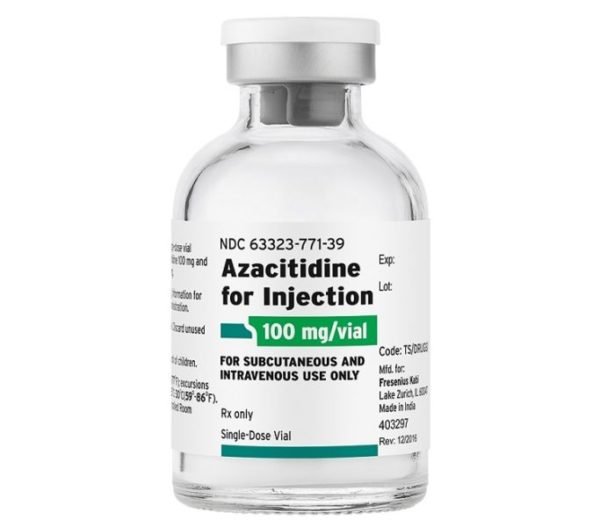
Vidaza (Azacitidine) promotes hypomethylation of the DNA, resulting in the restoration of normal DNA and gene differentiation.
It is used to treat the following conditions:
-
It is used in the treatment of myelodysplastic syndromes (MDS) in patients with French-American-British (FAB) classification subtypes as follows:
-
Refractory anemia
-
Refractory anemia with ringed sideroblasts (if coexisting with neutropenia or thrombocytopenia or requiring transfusions)
-
Refractory anemia with excess blasts,
-
Refractory anemia with excess blasts in transformation
-
Chronic myelomonocytic leukemia.
-
Off Label Usage of Azacitidine (vidaza) in Adults:
-
Acute myeloid leukemia (AML) in patients requiring low-intensity traetment
Azacitidine Dose in Adults
Vidaza dosage in the treatment of Myelodysplastic syndromes (MDS):
- In initial cycle , 75 mg/m² /day IV or subQis given for 7 days.
- Then in subsequent cycles, 75 mg/m²/day for 7 days every 4 weeks
- The dose can be increased to 100 mg/m /day if no favorable results after 2 cycles and no toxicity other than nausea and vomiting have occurred.
- Patients should be given treatment for a minimum of 4 to 6 cycles then it may be continued as long as the patient continues to benefit.
Off-label schedules :
- Subcutaneous: 75 mg/m² /day for 5 days (Mon-Fri),
- Followed by 2 days rest (Sat, Sun),
- Then 75 mg/m² /day for 2 days (Mon, Tues);
- Repeat cycle every 28 days
- or
- 50 mg/m /day for 5 days (Mon-Fri),
- Then 2 days rest (Sat, Sun),
- Then 50 mg/m² /day for 5 days (Mon-Fri)
- Repeat cycle every 28 days
- or
- 75 mg/m² /day for 5 days (Mon-Fri),
- Then repeat cycle every 28 days
Off label Dosage used in the treatment of Acute myeloid leukemia:
-
- 75 mg/m² /day subQ for 7 days every 4 weeks for at least 6 cycles
- Then treatment may be continued as long as the patient continues to improve or until disease progression or unwanted toxicity
- Dose reductions and/or interruptions in therapy may be required for hematologic toxicity.
-
Dosage adjustment according to serum electrolytes:
- If serum bicarbonate becomes less than <20 mEq/L then reduce dose by 50% for next treatment course.
Azacitidine Dose in Childrens
Vidaza dose in the treatment of Acute myeloid leukemia (AML):
-
Children ≥2 years and Adolescents:
- 75 mg/m² /dose subQ once daily for 1 week
-
Dosing Choices variable:
- Children and Adolescents:
- 300 mg/m² /dose I/V OD daily for 2 consecutive days is widely used for induction and intensive consolidation therapy in various combinations in newly diagnosed patients.
- Children and Adolescents:
-
Dosing adjustment for toxicity:
- The presented dosing adjustments are based on practice in adult patients.
-
Hematologic toxicity:
- Adult:
-
For baseline WBC ≥3,000/mm , ANC ≥1,500/mm , and platelets ≥75,000/mm³:
-
If ANC is less than 500/mm³ or platelets less than 25,000/mm³:
- Administer half dose during the next treatment course
-
If ANC is 500/mm³- 1,500/mm³ or platelets 25,000 - 50,000/mm³:
- Administer 2/3 rd of dose during the next treatment course
-
If ANC is greater than 1,500/mm³ or platelets more than 50,000/mm³:
- Administer full dose during next treatment course
-
For baseline WBC <3,000/mm³ , ANC <1,500/mm³ , or platelets <75,000/mm³:
- Adjust dose according to nadir counts and bone marrow biopsy cellularity at the time of nadir, unless a significant improvement in differentiation at the time of the next treatment cycle
- WBC or platelet nadir decreased 50% to 75% from standard and bone marrow biopsy cellularity at time of nadir 30% to 60%:
- Administer full dose during the next treatment course
- WBC or platelet nadir decreased 50% to 75% from standard and bone marrow biopsy cellularity at time of nadir 15% to 30%:
- Administer half dose during the next treatment course
- WBC or platelet nadir decreased more than 75% from baseline and bone marrow biopsy cellularity at time of nadir 30% to 60%:
- Administer 2/3rd of dose during the next treatment course
- WBC or platelet nadir decreased more than 75% from baseline and bone marrow biopsy cellularity at time of nadir 15% to 30%:
- Administer half dose during the next treatment
-
WBC or platelet nadir decreased more than 75% from baseline and bone marrow biopsy cellularity at time of nadir less than 15%:
- Administer 1/3rd of dose during the next treatment course
-
- If a nadir defined above happens, give the next course of therapy 4 weeks after the beginning of the previous course as long as the number of WBCs and platelets is greater than 25% above the nadir and increasing.
- If day 28 does not see a rise of more than 25 percent above the nadir, reassess counts every 1 week.
- If day 42 does not see an increase of 25 percent, give half a scheduled dose.
Electrolyte disturbances:
-
- If serum bicarbonate decreases to less than 20 mEq/L then reduce dose by 50% for next scheduled course.
Dose in pregnancy and lectation :
Azacitidine (Vidaza) pregnancy Risk factor: D
- In animal reproduction studies, adverse events were observed.
- Azacitidine's mechanism of action can cause fetal harm when administered during pregnancy.
- Women with childbearing potential need to be advised to not get pregnant during treatment and to verify their pregnancy status before starting therapy.
- A male should also be warned not to father a child while receiving azacitidine therapy.
- Effective contraception should be used by males during therapy.
Use of Azacitidine (Vidaza), during breastfeeding
- It is not known if azacitidine can be found in breast milk.
- The manufacturer does not recommend breastfeeding due to the potential for serious adverse reactions in breastfed infants.
Azacitidine (Vidaza) dose in Renal disease:
Renal impairment at baseline:
-
Mild to moderate impairment (CrCl ≥30 mL/minute):
- No dosage adjustment required.
-
Severe impairment (CrCl <30 mL/minute):
- No dosage adjustment required for cycle 1
- azacitidine and its metabolites are excreted renally
- Look closely for toxicity.
Renal toxicity during treatment:
-
Unexplained increases in BUN or serum creatinine:
- Postpone next cycle until values reach baseline or normal, then reduce dose by half for next treatment course.
Vidaza (Azacitidine) dose in Liver disease:
- No dosage adjustment is given in the manufacturer’s labeling.
- Its use is contraindicated in patients with advanced malignant hepatic tumors.
Common Side Effects of Vidaza (Azacitidine) Include:
-
Cardiovascular:
- Peripheral Edema
- Chest Pain
-
Central Nervous System:
- Fatigue
- Rigors
- Headache
- Dizziness
- Anxiety
- Depression
- Malaise
- Pain
- Insomnia
-
Dermatologic:
- Erythema
- Pallor
- Skin Lesion
- Skin Rash
- Pruritus
- Diaphoresis
-
Endocrine & Metabolic:
- Weight Loss
- Pitting Edema
- Hypokalemia
-
Gastrointestinal:
- Nausea
- Vomiting
- Constipation
- Diarrhea
- Anorexia
- Abdominal Pain
- Abdominal Tenderness
-
Hematologic & Oncologic:
- Thrombocytopenia
- Anemia
- Neutropenia
- Leukopenia
- Bruise
- Petechia
- Febrile Neutropenia
- Bone Marrow Depression
-
Local:
- Injection Site Reactions :
- Erythema
- Pain
- Bruising
-
Neuromuscular & Skeletal:
- Weakness
- Arthralgia
- Limb Pain
- Back Pain
- Myalgia
-
Respiratory:
- Cough
- Dyspnea
- Pharyngitis
- Epistaxis
- Nasopharyngitis
- Upper Respiratory Infection
- Pneumonia
- Rales
-
Miscellaneous:
- Fever
Less Common Side Effects of Vidaza (Azacitidine) Include:
-
Cardiovascular:
- Heart Murmur
- Tachycardia
- Hypertension
- Hypotension
- Syncope
- Chest Wall Pain
-
Central Nervous System:
- Lethargy
- Hypoesthesia
- Postoperative Pain
-
Dermatologic:
- Night Sweats
- Cellulitis
- Rash At Injection Site
- Urticaria
- Skin Nodules
- Xeroderma
-
Gastrointestinal:
- Gingival Hemorrhage
- Stomatitis
- Hemorrhoids
- Dyspepsia
- Abdominal Distention
- Loose Stools
- Dysphagia
- Tongue Ulcer
-
Genitourinary:
- Urinary Tract Infection
- Dysuria
- Hematuria
-
Hematologic & Oncologic:
- Lymphadenopathy
- Hematoma
- Oral Mucosal Petechiae
- Postprocedural Hemorrhage
- Oral Hemorrhage
-
Hypersensitivity:
- Transfusion Reaction
-
Infection:
- Herpes Simplex Infection
-
Local:
- Itching At Injection Site
- Hematoma At Injection Site
- Induration At Injection Site
- Injection Site Granuloma
- Skin Discoloration At Injection Site
- Swelling At Injection Site
-
Neuromuscular & Skeletal:
- Muscle Cramps
-
Respiratory:
- Rhinorrhea
- Wheezing
- Abnormal Breath Sounds
- Nasal Congestion
- Pharyngolaryngeal Pain
- Pleural Effusion
- Post-Nasal Drip
- Rhinitis
- Rhonchi
- Atelectasis
- Sinusitis
-
Miscellaneous:
- Lymphadenopathy
- Herpes Simplex
- Night Sweats
- Transfusion Reaction
- Mouth Hemorrhage
Contraindication to Vidaza (Azacitidine) Include:
- Hypersensitivity to azacitidine or mannitol, and any component of the formulation.
- Advanced malignant hepatic cancers
Warnings and precautions
- Suppression of bone marrow
- Anemia, thrombocytopenia and neutropenia are all very common
- It can cause treatment delays or dosage reductions.
- At a minimum, monitor blood counts prior to each cycle and when clinically indicated.
- Based on the hematologic response and nadir counts, adjust dose for the next cycle.
- Hepatotoxicity
- Patients with preexisting hepatic impairments can be exposed to it.
- Patients with metastatic disease and extensive tumor burden have been known to experience coma.
- Patients with advanced malignant liver tumors are not advised to use this medication.
- Before each cycle begins, monitor liver function.
- Gastrointestinal toxicities:
- Azacitidine has moderate emetic properties.
- Antiemetics can be used to prevent nausea or vomiting.
- Reactions at the injection site:
- Subcutaneous administration can often cause injection site reactions.
- Nephrotoxicity
- When intravenous Azacitidine is used with other chemotherapy agents, it has been associated with renal toxicities such as serum creatinine and renal tubular acidosis.
- Before each cycle, and prior to therapy initiation, test serum creatinine.
- Reduce or withhold the dose if there are unexplained drops in serum bicarbonate 20 mg/L, or if there are elevations in serum creatinine or BUN.
- Patients with kidney impairment are more at risk of renal toxicity.
- Patients with severe renal dysfunction should be monitored for toxicities (azacitidine or metabolites excreted renally).
- Tumor lysis syndrome
- It can lead to serious or fatal tumor lysis syndrome (TLS).
- TLS has been reported in patients who have received anti-hyperuricemic therapy (eg allopurinol).
- TLS risk assessment at baseline. Monitor for symptoms of TLS and treat accordingly.
Azacitidine: Drug Interaction
Note: Drug Interaction Categories:
- Risk Factor C: Monitor When Using Combination
- Risk Factor D: Consider Treatment Modification
- Risk Factor X: Avoid Concomitant Use
Risk Factor C (Monitor therapy). |
|
| Chloramphenicol Ophthalmic | May increase the toxic/adverse effects of Myelosuppressive Agents. |
| CloZAPine | CloZAPine's toxic/adverse effects may be exacerbated by myelosuppressive agents. Particularly, there may be an increase in the risk of neutropenia. |
| Coccidioides immitis skin test | Coccidioides immitis Skin Test may be affected by immunosuppressants. |
| Denosumab | Might increase the toxic/adverse effects of Immunosuppressants. In particular, there may be an increase in the risk of serious infections. |
| Ocrelizumab | May increase the immunosuppressive effects of Immunosuppressants. |
| Pidotimod | Pidotimod's therapeutic effects may be diminished by immunosuppressants. |
| Promazine | May increase the myelosuppressive effects of Myelosuppressive Drugs. |
| Siponimod | Siponimod's immunosuppressive effects may be enhanced by taking immunosuppressants. |
| Sipuleucel - T | Sipuleucel T's therapeutic effects may be diminished by immunosuppressants |
| Tertomotide | Tertomotide's therapeutic effects may be diminished by immunosuppressants. |
| Trastuzumab | May increase the neutropenic effects of Immunosuppressants. |
Risk Factor D (Regard therapy modification) |
|
| Baricitinib | Baricitinib's immunosuppressive effects may be enhanced by immunosuppressants. Baricitinib should not be used in combination with immunosuppressants like azathioprine and cyclosporine. It is permissible to use methotrexate antirheumatically or nonbiologic disease-modifying antirheumatic drug (DMARDs), concurrently. |
| Echinacea | Might decrease the therapeutic effects of Immunosuppressants. |
| Fingolimod | Fingolimod may be immunosuppressed by immunosuppressants. When possible, avoid the use of fingolimod with other immunosuppressants. Patients should be closely monitored for any additive immunosuppressant effects, such as infections, if they are used together. |
| Leflunomide | Leflunomide's toxic/adverse effects may be exacerbated by immunosuppressants. The risk of hematologic toxicities such as pancytopenia and thrombocytopenia (agranulocytosis) may increase. Patients on immunosuppressants should not be given a leflunomide loading dosage. Patients who are receiving leflunomide or another immunosuppressant must be checked for bone marrow suppression at minimum monthly. |
| Lenograstim | Antineoplastic Agents can reduce the therapeutic effects of Lenograstim. Management: Lenograstim should be avoided 24 hours prior to and 24 hours following the completion of myelosuppressive, cytotoxic chemotherapy. |
| Lipegfilgrastim | Antineoplastic agents may reduce the therapeutic effects of Lipegfilgrastim. Management: It is important to avoid the simultaneous use of lipegfilgrastim with myelosuppressive, cytotoxic chemotherapy. After myelosuppressive chemotherapy has been completed, lipegfilgrastim must be given at least 24 hours. |
| Nivolumab | Nivolumab's therapeutic effects may be diminished by immunosuppressants. |
| Palifermin | Can increase the toxic/adverse effects of Antineoplastic Agents. In particular, oral mucositis can be more severe and prolonged. Management: Avoid palifermin administration within the first 24 hours of infusion or 24 hours following myelotoxic chemotherapy. |
| Roflumilast | May increase the immunosuppressive effects of Immunosuppressants. |
| Tofacitinib | Tofacitinib's immunosuppressive effects may be enhanced by immunosuppressants. Management: It is permissible to use methotrexate (or nonbiologic disease-modifying antirheumatic drug (DMARDs), concurrently with antirheumatic doses. This warning appears to be particularly targeted at more potent immunosuppressants. |
| Vaccines (Inactivated). | Immunosuppressants can reduce the therapeutic effects of Vaccines (Inactivated). Management: The effectiveness of vaccines may be decreased. All age-appropriate vaccines must be completed at least two weeks before you start an immunosuppressant. Re-vaccinate anyone who was vaccinated while on immunosuppressant therapy. |
Risk Factor X (Avoid Combination) |
|
| BCG (Intravesical). | The therapeutic effects of BCG (Intravesical) may be diminished by immunosuppressants |
| BCG (Intravesical). | Myelosuppressive agents may reduce the therapeutic effects of BCG (Intravesical). |
| Cladribine | May increase the immunosuppressive effects of Immunosuppressants. |
| Cladribine | May increase the myelosuppressive effects of Myelosuppressive Drugs. |
| Deferiprone | Deferiprone may have a neutropenic effect that myelosuppressive agents can increase. |
| Dipyrone | May increase the toxic/adverse effects of Myelosuppressive Agents. In particular, there may be an increase in the risk of pancytopenia and agranulocytosis. |
| Natalizumab | Natalizumab's toxic/adverse effects may be exacerbated by immunosuppressants. Particularly, concurrent infections may increase. |
| Pimecrolimus | May increase the toxic/adverse effects of Immunosuppressants |
| Tacrolimus - Topical | May increase the toxic/adverse effects of Immunosuppressants |
| Vaccines (Live). | Immunosuppressants can increase the toxic/adverse effects of Vaccines (Live). Immunosuppressants can decrease the therapeutic effects of Vaccines. Management: Live-attenuated vaccines should be avoided for at least three months following immunosuppressants. |
Monitor:
- liver function tests
- electrolytes
- CBC with differential and platelets
- renal function (BUN and serum creatinine) at baseline, before each cycle, and more frequently if indicated.
- hematologic response
- nausea/vomiting
- injection site reactions.
How to administer Azacitidine (Vidaza)?
- Azacitidine has a moderate emetic potency.
- To prevent nausea and vomiting, antiemetics should be used.
Intravenous:
- Allow to infuse for between 10 and 40 minutes
- Infusion must be completed within 60 mins of (vial), reconstitution.
Administration of SubQ:
- According to the manufacturer, it is recommended that you divide doses that require more than one vial into two syringes so that they can be injected into two different sites.
- Rotate injection sites (thighs, abdomen, and upper arms)
- Next injections should be at least 1 inch away from the previous injection sites
- Do not inject into areas that are tender, bruised or red.
- Before administering, allow refrigerated suspensions (up to 30 min) to reach room temperature.
- Continue to roll the syringe between your palms, until it becomes cloudy.
- Wash your skin immediately if azacitidine suspension comes into contact with it.
- Flush it with water if it comes in contact with mucous membranes
Mechanism of action of Azacitidine (Vidaza):
- Azacitidine's ability promote hypomethylation of DNA can lead to antineoplastic effects.
- This allows normal gene differentiation and proliferation to be restored.
- Azacitidine can also cause direct toxicity to abnormal hematopoietic bone marrow cells.
Absorption: SubQ:
- It is rapid and complete
Distribution: V :
- IV: 76 ± 26 L
- It does not cross the blood-brain barrier
Metabolism:
- Hepatic; hydrolysis to several metabolites
Bioavailability: SubQ:
- Almost 89%
Half-life elimination: Intravenous, SubQ:
- almost 4 hours
Time to peak plasma concentration after SubQ administration:
- 30 minutes
Excretion: By Urine (50% to 85%) & feces (<1%)
International Brands of Azacitidine:
- Azadine
- Celazadine
- NAT-AzaCITIDine
- REDDY-Azacitidine
- Vidaza
- Xpreza 100
Azacitidine Brands in Pakistan:
No Brands available in Pakistan
.png)