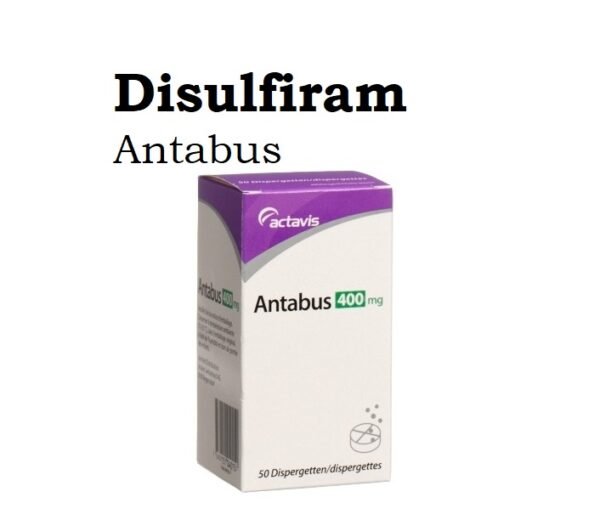
Antabus (Disulfiram) inhibits the enzyme acetaldehyde dehydrogenase, causing sensitivity to ethanol. Severe unpleasant effects are seen immediately after alcohol intake even in small amounts.
Antabus (Disulfiram) Uses:
-
Alcohol use disorder:
- It is used in the management of chronic alcohol use disorder.
Note:
- can be considered for use in patients with alcohol use disorder (moderate to severe) who want to refrain from alcohol and either prefer disulfiram or are unable to tolerate or are non-responsive to naltrexone and acamprosate.
Antabus (Disulfiram) dose in Adults
Antabus (Disulfiram) dose in the treatment of alcohol use disorder:
Note: Do not administer until the patient has abstained from alcohol for at least 12 hours.
- Initial: Up to 500 mg once a day for 1 to 2 weeks (maximum: 500 mg/day)
- Average maintenance dose: 250 mg once a day (range: 125 to 500 mg/day; maximum: 500 mg/day).
Antabus (Disulfiram) dose in Childrens
Not indicated in children.
Antabus (Disulfiram) Pregnancy Risk Category: C
- Safety during pregnancy is not known. There are limited data regarding maternal use during pregnancy.
- Pregnancy alcohol abuse disorder must be treated with pharmacological agents. If acute alcohol withdrawal is required, disulfiram should not be used.
Disulfiram use during breastfeeding:
- It is unknown if breast milk contains disulfiram.
- Manufacturers do not recommend breastfeeding.
- If you are treating alcohol abuse disorder in breastfeeding women, you should not use pharmacological agents. Instead, consider other options for acute alcohol withdrawal.
Antabus (Disulfiram) Dose in Kidney disease:
- There are no dosage adjustments provided in the drug manufacturer’s labeling.
- Use with extreme caution in chronic and acute nephritis.
Antabus (Disulfiram) Dose in Liver disease:
- There are no dosage adjustments provided in the drug manufacturer’s labeling.
- Use with extreme caution in hepatic cirrhosis or insufficiency.
Side effects of Antabus (Disulfiram):
-
Central Nervous System:
- Bitter Taste (Garlic)
- Drowsiness
- Fatigue
- Headache
- Metallic Taste
- Peripheral Neuritis
- Peripheral Neuropathy
- Polyneuropathy
- Psychosis
-
Dermatologic:
- Acneiform Eruption
- Allergic Dermatitis
- Skin Rash
-
Genitourinary:
- Impotence
-
Hepatic:
- Cholestatic Hepatitis
- Fulminant Hepatitis
- Hepatic Failure (Multiple Case Reports)
-
Ophthalmic:
- Optic Neuritis
Contraindications to Antabus (Disulfiram):
- Hypersensitivity or Allergy to disulfiram, any component of the formulation, or other thiuram derivatives that are used in pesticides or rubber vulcanization
- Patients who use alcohol, metronidazole or paraldehyde or alcohol-containing products (eg, cough syrups, tonics) should not be taken or used.
- psychosis;
- Grave myocardial disease and coronary occlusion.
Warnings and precautions
-
Antabus (Disulfiram), reaction:
- Even small amounts of alcohol can cause flushing, throbbing in the head and neck, nausea and copious vomiting, respiratory difficulties, diaphoresis and diaphoresis.
- Severe reactions can include respiratory depression, cardiac collapse, arrhythmias and myocardial ischemia.
- The amount of alcohol and disulfiram taken will determine the intensity of the reaction.
- In more severe cases, the reaction may last for several hours or even longer depending on how long it takes for the alcohol to be metabolized.
- Patients should not consume alcohol for more than 12 hours before taking the drug. Disulfiram reactions can occur up to 14 days later if alcohol is consumed.
-
Hepatotoxicity:
- Use has been linked to severe (sometimes fatal) liver disease and/or hepatic dysfunction that can lead to transplantation.
- This may happen in patients with or without a history of abnormal hepatic function.
- Monitor for hepatotoxicity, and educate patients on signs and symptoms.
-
Cerebral damage:
- Patients with cerebral damage should be used with extreme caution.
-
Contact dermatitis:
- Before administering disulfiram, observe patients who have had rubber contact dermatitis in the past.
-
Diabetes:
- Patients with diabetes mellitus should be cautious.
-
Hepatic impairment
- Patients with hepatic impairment or cirrhosis should be cautious.
-
Hypothyroidism:
- Hypothyroidism patients should be treated with caution.
-
Nephritis:
- Patients with chronic or acute nephritis should be cautious.
-
Seizures:
- Patients with seizure disorders should be cautious.
Disulfiram: Drug Interaction
Note: Drug Interaction Categories:
- Risk Factor C: Monitor When Using Combination
- Risk Factor D: Consider Treatment Modification
- Risk Factor X: Avoid Concomitant Use
Risk Factor C (Monitor therapy). |
|
| Atazanavir | Disulfiram may cause a decrease in therapeutic effects. |
| ChlordiazePOXIDE | ChlordiazePOXIDE may be increased by Disulfiram. |
| Chlorzoxazone | The serum concentration of Chlorzoxazone may be increased by Disulfiram. |
| CloZAPine | CloZAPine serum concentrations may be increased by CYP1A2 inhibitors (Weak). Management: The drug interactions monographs for drugs listed as an exception to this monograph will discuss the management of these drugs. |
| DiazePAM | DiazePAM serum concentrations may be increased by Disulfiram |
| Flunitrazepam | Flunitrazepam serum concentration may be increased by Disulfiram |
| Isoniazid | Isoniazid's toxic/adverse effects may be increased by Disulfiram. Isoniazid serum concentration may be increased by disulfiram |
| Theophylline Derivatives | The serum concentrations of Theophylline Derivatives may be increased by Disulfiram. Dyphylline is an exception. |
| Vitamin K Antagonists (eg, warfarin) | Vitamin K Antagonists may be increased by Disulfiram. |
Risk Factor D (Take into account therapy modification) |
|
| CYP2E1 Substrates. High risk with Inhibitors | Strong CYP2E1 inhibitors (Strong) can decrease metabolism of CYP2E1 substrates (High Risk with Inhibitors). |
| Dronabinol | Dronabinol's toxic/adverse effects may be increased by disulfiram. Disulfiram can cause severe intolerance to alcohol in the oral solution of Dronabinol. |
| Fosphenytoin | Fosphenytoin may be increased by taking disulfiram. Management: When possible, avoid concomitant disulfiram/phenytoin use. When starting or stopping concurrent disulfiram, it is likely that phenytoin dosage adjustments will be required. Pay attention to the phenytoin response. |
| MetroNIDAZOLE (Topical). | Disulfiram may have an adverse or toxic effect. CNS toxicities, such as psychosis, may increase in particular. If disulfiram is being used topically, it is important to warn patients and monitor them for signs of CNS toxicities. Manufacturers of vaginal metronidazole products may list disulfiram as a contraindication for use within two weeks. |
| Phenytoin | The serum level of Phenytoin may be increased by taking disulfiram. Management: When possible, avoid concomitant disulfiram/phenytoin use. When starting or stopping concurrent disulfiram, it is likely that phenytoin dosage adjustments will be required. Pay attention to the phenytoin response. |
| Tipranavir | The adverse/toxic effects of Tipranavir may be increased by Disulfiram. |
| TiZANidine | CYP1A2 Inhibitors, Weak, may increase serum TiZANidine concentrations. These combinations should be avoided whenever possible. Begin tizanidine in adults at 2 mg. Then, increase the dose according to patient response. Be aware of any adverse reactions and increased effects of tizanidine. |
Risk Factor X (Avoid Combination) |
|
| Alcohol (Ethyl) | The adverse/toxic effects of alcohol (Ethyl) may be increased by disulfiram. Disulfiram-like reactions may occur. |
| Bacampicillin | Might increase the toxic/adverse effects of Disulfiram. |
| Benznidazole | Disulfiram may have an adverse or toxic effect. Particularly, there may be an increase in the risk of CNS toxicities like psychosis. |
| Carbocisteine | Carbocisteine's toxic/adverse effects may be increased by disulfiram. Specifically, disulfiram may enhance adverse effects of alcohol that is present in liquid formulations of carbocisteine-containing products. |
| Lopinavir | Disulfiram may have an adverse/toxic effect. Combining lopinavir/ritonavir solutions, which contain 42% alcohol, can cause a disulfiram reaction. |
| MetroNIDAZOLE (Systemic) | MetroNIDAZOLE (Systemic) may have a greater adverse/toxic effect if taken with Disulfiram. Particularly, there may be an increase in the risk of CNS toxicities like psychosis. |
| Paraldehyde | The serum Paraldehyde concentration may be increased by Disulfiram |
| Ritonavir | Disulfiram may have an adverse/toxic effect. Combining ritonavir oral solutions (43% alcohol) and Disulfiram may cause a disulfiram/alcohol reaction. |
| Sertraline | Sertraline may be affected by Disulfiram. Due to the 12% alcohol content of sertraline oral concentration, this is a particular problem. Management: Sertraline oral concentrate contains 12% alcohol. It should not be used in conjunction with disulfiram. |
| Tinidazole | Might increase the toxic/adverse effects of Disulfiram. |
Monitoring parameters:
- Liver function tests (baseline and after 10 to 14 days of treatment),
- CBC,
- serum chemistries;
- cardiac function at baseline if clinically appropriate.
How to administer Antabus (Disulfiram)?
- Co-administration of any medications containing alcohol, including topicals, is contraindicated.
- Do not administer disulfiram if alcohol has been ingested within the last 12 hours.
- Morning administration is of choice but maybe given at bedtime if sedation is experienced.
- Tablets may be crushed and mixed with liquids.
Mechanism of action of Antabus (Disulfiram):
- It is a thiuram-derived thiuram that prevents alcohol from being oxidized at the acetaldehyde level.
- Serum acetaldehyde levels increase when taken with alcohol.
- Unwanted symptoms of high acetaldehyde include nausea, vomiting and flushing.
- This reaction is the basis of disulfiram's use in long-term post-withdrawal treatment for alcohol use disorder.
The onset of action:
- Full effect: 12 hours
Duration:
- ~1 to 2 weeks after the last dose
Absorption:
- Slow
Metabolism:
- Reduction of disulfide linkage to diethyldithiocarbamic acid, which then further metabolized via glucuronidation, non-enzymatic degradation, methylation and oxidation
Excretion:
- Feces (20% unchanged) and exhaled gases (as metabolites),
- urine (50% metabolites)
International Brands of Disulfiram:
- Antabuse
- Alcobuse
- Alcohol Stop
- Alcolbing
- Alfiram
- Antabus
- Antabuse
- Antaethyl
- Antalcol
- Anticol
- Antietanol
- Busetal
- Chronol
- Deadict
- Difiram
- Disulfix
- Esperal
- Etabus
- Refusal
- Sarcoton
- Tetidis
- Tetradin
- Zincfrin
Disulfiram Brand Names in Pakistan:
Disulfiram 200 mg Tablets |
|
| Zanti-Abuse | Mass Pharma (Private) Limited |
.png)


