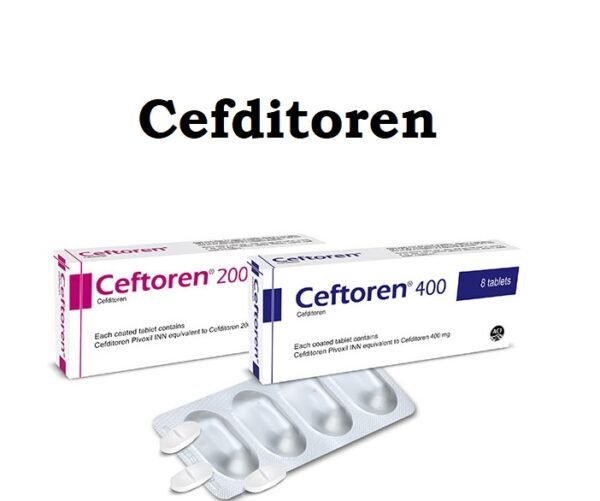
Cefditoren pivoxil (Meiact) is a third-generation cephalosporin that has a broad spectrum of activity against many gram-positive and gram-negative pathogens.
Cefditoren Uses:
- Treatment of:
- acute bacterial exacerbation of chronic bronchitis or
- communityacquired pneumonia (due to susceptible organisms including Haemophilus influenzae, Haemophilus parainfluenzae, Streptococcus pneumoniaepenicillin susceptible only, Moraxella catarrhalis);
- pharyngitis or tonsillitis (Streptococcus pyogenes);
- and uncomplicated skin and skinstructure infections (Staphylococcus aureus not MRSA, and Streptococcus pyogenes)
Other oral third-generation antibiotics include Cefixime and Cefpodoxime Proxetil. See IDSA Community-acquired Pneumonia Guidelines.
Adult dose:
Cefditoren dose in the treatment of acute bacterial exacerbation of chronic bronchitis:
- Oral: 400 mg twice a day for 10 days
Cefditoren Dose in the treatment of Community-acquired pneumonia:
- Oral: 400 mg twice a day for 14 days
Cefditoren Dose in the treatment of Pharyngitis, tonsillitis, and uncomplicated skin & skin structure infections:
- Oral: 200 mg twice a day for 10 days
Dose in children:
Cefditoren General dosing in mild to moderate infections susceptible infections:
-
Children ≥12 years and Adolescents:
- Oral: 200 to 400 mg twice a day.
Cefditoren Dose in the treatment of acute bacterial exacerbation of Chronic Bronchitis; :
-
Children ≥12 years and Adolescents:
- Oral: 400 mg twice a day for 10 days
Cefditoren Dose in the treatment of Community-acquired Pneumonia:
-
Children ≥12 years and Adolescents:
- Oral: 400 mg twice a day for 14 days
Cefditoren Dose in the treatment of Pharyngitis and Tonsillitis:
-
Manufacturer's labeling:
- Children ≥12 years and Adolescents:
- Oral: 200 mg twice a day for 10 days
- Children ≥12 years and Adolescents:
-
Alternate dosing:
- Infants ≥8 months and Children:
- Oral: 3 mg/kg/dose 3 times a day for 5 days;
- Infants ≥8 months and Children:
Cefditoren Dose in the treatment of Uncomplicated Skin and skin structure infections:
-
Children ≥12 years and Adolescents:
- Oral: 200 mg twice a day for 10 days
Pregnancy Risk Factor B
- Animal reproduction studies have not shown any adverse events.
- After the first-trimester cephalosporin exposure, most birth defects did not increase.
Use during breastfeeding:
- It is unknown if the drug is found in human milk.
- Cefditoren should be used with caution during breastfeeding, according to the manufacturer.
- Cefditoren may be absorbed into breast milk. However, this can reduce the impact on nursing infants.
Cefditoren Dose in Kidney disease:
-
CrCl >50 mL/minute/1.73 m²:
- No dosage adjustment necessary.
-
CrCl 30 to 49 mL/minute/1.73 m²:
- Maximum dose: 200 mg twice a day
-
CrCl <30 mL/minute/1.73 m²:
- Maximum dose: 200 mg once a day
-
End-stage renal disease (ESRD):
- There are no specific dosage adjustments provided in the manufacturer’s labeling;
- Safety and efficacy have not been established.
Cefditoren (Meiact) Dose in Liver disease:
-
Mild to moderate impairment (Child-Pugh class A or B):
- No dosage adjustment necessary.
-
Severe impairment (Child-Pugh class C):
- There are no dosage adjustments provided in the manufacturer’s labeling (has not been studied).
Common Side Effects of Cefditoren (Meiact):
-
Gastrointestinal:
- Diarrhea
Less Common Side Effects of Cefditoren (Meiact):
-
Central Nervous System:
- Headache
-
Endocrine & Metabolic:
- Increased Serum Glucose
-
Gastrointestinal:
- Nausea
- Abdominal Pain
- Dyspepsia
- Vomiting
-
Genitourinary:
- Vulvovaginal Candidiasis
- Hematuria
- Urine Abnormality
-
Hematologic & Oncologic:
- Decreased Hematocrit
Contraindications to Cefditoren (Meiact):
- Hypersensitivity to any drug component, other cephalosporins or milk protein
- Carnitine deficiency, or inborn errors in metabolism that could lead to clinically significant carnitine deficiencies.
Warnings and precautions
-
Elevated INR
- This may be due to an increase in INR, particularly in patients who are nutritionally deficient, prolonged treatment, or hepatic and renal disease.
-
Penicillin allergy
- Patients with penicillin allergy should be cautious, especially if they have had IgE-mediated reactions such as anaphylaxis, angioedema or urticaria.
-
Superinfection
- Extended use can cause fungal or bacterial overinfections, such as C. difficileassociated diarrhea (CDAD), and pseudomembranous collitis. This has been documented >2 months after antibiotic treatment.
-
Carnitine deficiency:
- Patients with a deficiency in carnitine should not be used.
- It results in renal excretion.
-
Hepatic impairment
- Patients with hepatic impairment should be cautious.
-
Renal impairment
- Patients with impaired renal function should be cautious.
- Modify the dosage for moderate or severe renal impairment.
-
Seizure disorders:
- Patients with a history of seizure disorder should be cautious. High levels of sepsis, especially in the presence renal impairment, can increase the risk.
Cefditoren: Drug Interaction
Note: Drug Interaction Categories:
- Risk Factor C: Monitor When Using Combination
- Risk Factor D: Consider Treatment Modification
- Risk Factor X: Avoid Concomitant Use
Risk Factor C (Monitor therapy). |
|
| Probenecid | May increase serum Cephalosporins. |
| Vitamin K antagonists (eg warfarin) | Cephalosporins can increase the anticoagulant effects of Vitamin K Antagonists. |
Risk Factor D (Regard therapy modification) |
|
| Antacids | The serum concentration of Cefditoren may be decreased. Management: Cefditoren is not advised to be taken with other antacids. Take into account Alternate methods of controlling acidreflux (eg diet modification) are also available Alternative antimicrobial therapy. Separate dosing may be necessary if antacid therapy cannot be avoided. |
| Histamine H2 Receptor Antagonists | The serum concentration of Cefditoren may be decreased. Management: Avoid using cefditoren in combination with H2antagonists or antacids. Other methods of controlling the disease are possible Acid reflux (eg diet modification) and alternative antimicrobial treatment If H2antagonists cannot be avoided, |
| Inhibitors of the proton pump | The serum concentration of Cefditoren may be decreased. Management: Avoid cefditoren and proton pump inhibitors (PPIs) if possible. Alternate methods of reducing/controlling acid reflux, such as diet Modification) or an alternative antimicrobial treatment if PPIs are not available Avoid. |
Monitoring parameters:
- Monitor renal function.
- Look for signs and symptoms of anaphylaxis during the first dose
How to administer the drug?
- Administer with meals.
Mechanism of action of Cefditoren (Meiact):
- By binding to one or more penicillin binding proteins (PBPs), it inhibits the final step of transpeptidation of synthesis peptidoglycan in bacterial cells walls. This inhibits cell wall biosynthesis.
- The cell wall assembly is then stopped and bacteria is broken down.
Protein binding:
- 88% (in vitro), primarily to albumin
Metabolism:
- Cefditoren pivoxil is metabolized by hydrolysis by esterases to cefditoren (active) and pivalate; cefditoren is not appreciably metabolized
Bioavailability:
- About 14% to 16%, increased by moderate to highfat meal (mean AUC by 70%; maximum plasma concentration by 50%)
Half life elimination:
- 1.6 ± 0.4 hours; increased with moderate (2.7 hours) and severe (4.7 hours) renal impairment
Time to peak:
- 1.5 to 3 hours
Excretion:
- Urine (as cefditoren and pivaloylcarnitine)
International Brands of Cefditoren:
- Spectracef
- Ceftor
- Ceftoren
- Geralcef
- Giasion
- Hidetron
- Meiact
- Meiacton
- Spacef
- Spektracef
- Telo
Cefditoren Brand Names in Pakistan:
No Brands Available in Pakistan.
.png)


