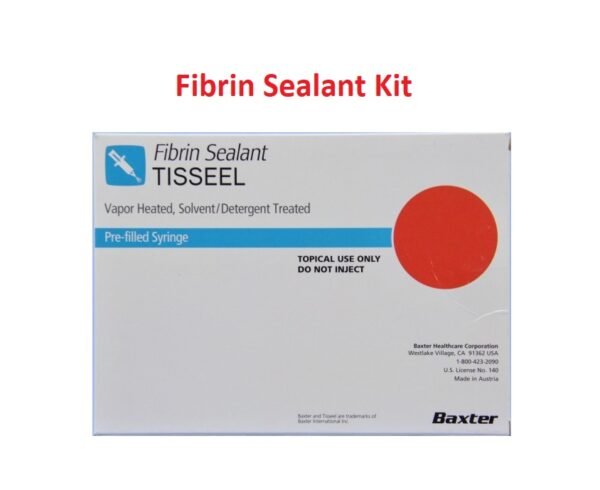
Fibrin Sealant Kit (Tisseel) is derived from human plasma that contains fibrinogen and thrombin, apart from other proteins. It is used during surgical procedures for sealing anastomosis and securing hemostasis.
Fibrin sealant kit Uses:
-
Colonic anastomosis sealing (Tisseel only):
- Adjunct to standard surgical techniques (such as suture and ligature) to prevent leakage from colonic anastomoses following the reversal of temporary colostomies
-
Facial rhytidectomy (Artiss only):
- Used to adhere to tissue flaps during facial rhytidectomy surgery (facelift)
-
Hemostasis, adjunct:
- Artiss:
- Adjunct to hemostasis is not indicated.
- Evarrest, Evicel:
- Adjunct to hemostasis for use in patients undergoing surgery when control of bleeding by conventional surgical techniques (such as ligature, suture, and cautery) is ineffective or impractical.
- Raplixa:
- Adjunct to hemostasis for mild to moderate bleeding in adults undergoing surgery when control of bleeding by standard surgical techniques (such as ligature, suture, and cautery) is ineffective or impractical.
- TachoSil:
- Adjunct to hemostasis for use with manual compression in adults and pediatric patients of 1 month and more than 1 month in cardiovascular and hepatic surgery when control of bleeding by standard surgical techniques (such as ligature, suture, or cautery) is ineffective or impractical
- Tisseel:
- As an adjunct to hemostasis in adult and pediatric patients ≥1-month undergoing surgery when control of bleeding by conventional surgical techniques, including ligature, suture, and cautery, is ineffective or impractical.
- Tisseel is effective in heparinized patients.
- Artiss:
-
Skin graft adhesion (Artiss only):
- To adhere autologous skin grafts to surgically prepared wound beds resulting from burns in adults and pediatric patients of 1 year and more than 1 year.
Fibrin Sealant Kit Dose in adults
Fibrin Sealant Kit Dose in adults for Colonic anastomosis:
- Tisseel:
- The package size to be used is determined by the size of the surface to be covered.
- Apply in a thin layer by dripping or spraying to completely cover the application area.
- Maximum area to be sealed: 8 cm² (cannula application) or 100 cm² (spray application)
- Required package size of Tisseel: 2 mL
- Maximum area to be sealed: 16 cm² (cannula application) or 200 cm² (spray application)
- Required package size of Tisseel: 4 mL
- Maximum area to be sealed: 40 cm² (cannula application) or 500 cm² (spray application)
- Required package size of Tisseel: 10 mL
Fibrin Sealant Kit as an adjunct for Hemostasis:
- Apply topically in an even, thin layer (do not inject intravascularly);
- The actual dose is dependent on the size of the surface to be covered:
- Evarrest:
- Apply an appropriate number of patches as determined by location and surface area; do not use more than four 10.2 cm x 10.2 cm (4-inch x 4-inch) patches or eight 5.1 cm x 10.2 cm (2-inch x 4-inch) patches.
- If the hemostatic effect is not complete due to insufficient area coverage, apply more patches with edges overlapping 1 to 2 cm (0.5 to 1 inch) with the existing patch. If the hemostatic effect is not complete due to incomplete adherence to the tissue, remove the patch and use a new one.
- Evicel:
- Spray or drop onto the surface of bleeding tissue in short bursts (0.1 to 0.2 mL); if the hemostatic effect is not complete, apply a second layer. See product labeling for additional administration details.
- To cover a layer of 1 mm thickness:
- Maximum area to be sealed: 20 cm²
- The required size of Evicel: 2 mL
- Maximum area to be sealed: 40 cm²
- The required size of Evicel: 4 mL
- Maximum area to be sealed: 100 cm²
- The required size of Evicel: 10 mL
- Raplixa:
- Adults: Maximum total dose per surgery: 3 g.
- Note: Used with concomitant absorbable gelatin sponge
- Direct application:
- Maximum surface area 25 cm²: Required package size of Raplixa: 0.5 g
- Maximum surface area 50 cm²: Required package size of Raplixa: 1 g
- Maximum surface area 100 cm²: Required package size of Raplixa: 2 g
- Raplixa Spray device application:
- Maximum surface area 50 cm²: Required package size of Raplixa: 0.5 g
- Maximum surface area 100 cm²: Required package size of Raplixa: 1 g
- Maximum surface area 200 cm²: Required package size of Raplixa: 2 g
- TachoSil:
- Apply the patch to the surface of cardiovascular or hepatic tissue only. The number of patches applied is determined by the size of the bleeding area. Do not exceed the following maximums:
- Patch size: 9.5 cm x 4.8 cm; maximum patches to be applied: 10
- Patch size: 4.8 cm x 4.8 cm; maximum patches to be applied: 14
- Patch size: 3 cm x 2.5 cm; maximum patches to be applied: 42
- Tisseel:
- The package size to be used is determined by the size of the surface to be covered. Apply in a thin layer by dripping or spraying to completely cover the application area.
- Maximum area to be sealed: 8 cm² (cannula application) or 100 cm² (spray application)
- Required package size of Tisseel: 2 ml
- Maximum area to be sealed: 16 cm² (cannula application) or 200 cm² (spray application)
- Required package size of Tisseel: 4 mL
- Maximum area to be sealed: 40 cm² (cannula application) or 500 cm² (spray application)
- Required package size of Tisseel: 10 mL
- Evarrest:
Fibrin Sealant Kit for Skin graft adherence:
- Artiss:
- Apply by spraying topically in an even, thin layer over the wound bed immediately prior to applying graft (do not inject intravascularly);
- The actual dose is based on the size of the surface to be covered:
- Approximate graft fixation area: 100 cm²
- The required size of Artiss: 2 mL
- Approximate graft fixation area: 200 cm²
- The required size of Artiss: 4 mL
- Approximate graft fixation area: 500 cm²
- The required size of Artiss: 10 mL
Fibrin Sealant Kit Facial rhytidectomy (facelift) surgery:
- Artiss:
- Adults: Apply by spraying topically in an even, thin layer over the wound bed immediately prior to attaching the skin flap (do not inject intravascularly);
- The actual dose is based on the size of the surface to be covered:
- Approximate graft fixation area: 100 cm²
- The required size of Artiss: 2 mL
- Approximate graft fixation area: 200 cm²
- The required size of Artiss: 4 mL
- Approximate graft fixation area: 500 cm²
- The required size of Artiss: 10 mL
Fibrin Sealant Kit Dose in Childrens
Fibrin Sealant Kit Dose in children for Hemostasis, adjunct:
- Topical: Apply topically in an even, thin layer (do not inject intravascularly;
- The actual dose is based on the size of the surface to be covered:
-
Evicel: Infants >6 months, Children, and Adolescents:
- Spray or drop onto the surface of bleeding tissue in short bursts (0.1 to 0.2 mL);
- If the hemostatic effect is not complete, apply a second layer.
- The amount required depends on the method of administration as well as the surface area to be covered.
- Area of coverage for specific Evicel package size:
| Evicel Package Size | BAC2 (fibrinogen) vial size | Thrombin vial size | Area of Coverage with 1 mm thickness |
| 2 mL | 1 mL | 1 mL | 20 cm2 |
| 4 mL | 2 mL | 2 mL | 40 cm2 |
| 10 mL | 5 mL | 5 mL | 100 cm2 |
-
TachoSil: Infants ≥1 month, Children, and Adolescents:
- Apply the patch to the surface of cardiovascular or hepatic bleeding tissue only.
- The number of patches applied is determined by the size of the bleeding area.
- Do not exceed the following maximums:
- Patch size: 9.5 cm x 4.8 cm; maximum patches to be applied: 10
- Patch size: 4.8 cm x 4.8 cm; maximum patches to be applied: 14
- Patch size: 3 cm x 2.5 cm; maximum patches to be applied: 42
-
Tisseel: Infants > 1 month, Children, and Adolescents:
- The package size to be used is determined by the size of the surface to be covered. Apply in a thin layer by dripping or spraying with an approved spray set to completely cover the application area.
|
Maximum Surface Area Coverage |
||
| Size of Tisseel Package | With Spray | With Cannula |
| 2 mL | 100 cm2 | 8 cm2 |
| 4 mL | 200 cm2 | 16 cm2 |
| 10 mL | 500 cm2 | 40 cm2 |
Fibrin Sealant Kit for Skin graft adherence: Topical:
- Artiss: Children ≥1 year and Adolescents:
- Apply by spraying topically in an even, thin layer over the wound bed immediately prior to applying graft (do not inject intravascularly);
- The actual dose is based on the size of the surface to be covered:
- Approximate graft fixation area: 100 cm²
- The required size of Artiss: 2 mL
- Approximate graft fixation area: 200 cm²
- The required size of Artiss: 4 mL
- Approximate graft fixation area: 500 cm²
- The required size of Artiss: 10 mL
Pregnancy Risk Factor C (manufacturer dependent)
- Studies on animal reproduction have not been done.
Fibrin sealant kit use during breastfeeding:
- It is unknown if breast milk contains fibrin sealant.
- According to the manufacturer of the product, when deciding whether to continue or stop breastfeeding during therapy, it should consider the risks to infant exposure, the benefits to the infant and the benefits to the mother.
Dose in Kidney Disease:
Manufacturer labeling doesn't provide any dose adjustments.
Dose in Liver disease:
No dosage adjustments provided in patients with liver disease.
The frequency may vary by product and patient age.
Common Side Effects of Tisseel (Fibrin Sealant Kit):
-
Cardiovascular:
- Hypertension
- Atrial Fibrillation
-
Gastrointestinal:
- Diarrhea
- Nausea
-
Hematologic & Oncologic:
- Anemia
-
Hepatic:
- Increased Serum Transaminases
-
Immunologic:
- Antibody Development
-
Respiratory:
- Pleural Effusion
Less Common Side Effects Of Fibrin Sealant Kit:
-
Cardiovascular:
- Thromboembolism
- Deep Vein Thrombosis
- Bradycardia
- Peripheral Edema
-
Dermatologic:
- Pruritus
-
Immunologic:
- Graft Complications
-
Infection:
- Localized Infection
-
Miscellaneous:
- Fever
- Procedural Complications
- Postoperative Complication
Uncommon Side effects of Tisseel (Fibrin Sealant Kit):
-
Hematologic & Oncologic:
- Hematoma
- Decreased Hemoglobin
-
Infection:
- Staphylococcal Infection
- Abscess (Abdomen)
-
Local:
- Incision Site Hemorrhage
Contraindications to Tisseel (Fibrin Sealant Kit):
Artissima:
- Hypersensitivity to aprotinin and any component of the formulation (including proteins like fibrinogen, human albumin, and thrombin)
- Injection directly into the circulatory or highly vascularized tissues;
- Use only where it is impossible to guarantee the minimum distance between the applicator tip and the target site.
Evarrest:
- Anaphylactic or severe systemic reaction due to human blood products
- intravascular application;
- Treatment of bleeding due to large defects in veins or arteries
Evicel
- Anaphylactic or severe systemic reaction due to blood products.
- severe or brisk arterial bleeding;
- direct intravascular injection;
- Spraying during laparoscopic or endoscopic procedures, where it is impossible to guarantee the minimum distance between the applicator tip and the target site.
Raplixa:
- Anaphylactic or severe systemic reaction due to human blood products
- intravascular application;
- Treatment of severe or brisk blood vessel bleeding
TachoSil
- Anaphylactic or severe systemic reaction due to blood products or horse protein.
- intravascular application
Tisseel
- Hypersensitivity to aprotinin and any component of the formulation
- direct intravascular injection;
- Venous or arterial bleeding that is severe or rapid;
- Application where the minimum distance between the applicator tip and the target site is not possible to be guaranteed
Warnings and precautions
-
Plasma from humans:
- Fibrin sealant products contain components made from human plasma. This theoretically could transmit disease.
- Potential risks include viral infections, Creutzfeldt-Jakob variant diseases (vCJD), or Creutzfeldt-Jakob Disease (CJD).
- Any product that may have transmitted infection should be reported immediately to the manufacturer.
-
Hypersensitivity
- Cases of hypersensitivity or allergic/anaphylactoid reactions that may progress to severe anaphylaxis have been reported (rarely) with use; the risk may increase with repetitive use or with prior systemic aprotinin administration.
- If you experience symptoms such as bradycardia or dyspnea and erythema (floozing, flushing), hypotension, nausea/paresthesia, brodycardia, dyspneasm, erythema or urticaria (wheezing), discontinue use.
Monitoring parameters:
Monitor changes in pulse, blood pressure, oxygen saturation, and end-tidal CO2 when spraying (due to the possibility of gas embolism); Monitor for hypersensitivity reactions.
How to administer Tisseel (Fibrin Sealant Kit)?
Artiss:
- Prior to use, dry application site using standard techniques (eg, intermittent application of compresses, use of suction devices, swabs);
- Do not use pressurized air for drying the site or gas also.
- Apply only to application sites that are visible using a painting motion from side to side in a thin layer to dry wound surface using Easy Spray and Spray set or an equivalent device cleared by FDA (areas covered with fibrin sealant will appear to “glisten”);
- Do not use Easy Spray and Spray set system in enclosed body cavities.
- Immediately after spraying fibrin sealant, attach flap or skin graft;
- The approximate time available for manipulation/positioning is 60 seconds.
- Hold graft in position with gentle compression for at least 3 minutes;
- full adherence is achieved in about 2 hours.
- To prevent the sealant from adhering to gloves, wet them with saline prior to contact.
- The cannulas included with the application system may be used for small wounds or for edges of a skin graft that did not adhere to the wound bed.
- Immediately before application, expel and discard the first several drops from the application cannula to ensure adequate mixing of the sealer protein and thrombin solutions.
- Cannulas may become clogged if the application is interrupted; replace cannula immediately prior to resuming application; if Y-connector is clogged, use provided spare piece.
Evarrest:
- For topical use only; apply to the surface of the bleeding site only.
- Prior to applying, remove excess blood or fluid from the site of application to improve visibility.
- The anatomic location and surface area of the bleeding should be used to determine how many patches should be applied.
- Patches can be cut to shape and size; ensure an overlap of about 0.5 to 1 inch.
- The active, powdery side of the patch should be applied to the tissue or prosthetic graft.
- Immediate, continuous manual compression using dry or moist laparotomy pads or surgical gauze should be applied evenly to the entire surface of the patch and continuous contact pressure should be held for 3 minutes.
Evicel:
- For topical use only; apply to the surface of bleeding tissue only; do not inject directly into the circulatory system or into tissues.
- Prior to applying, dry surface areas of the wound and remove excess blood from site of application by standard techniques (eg, intermittent application of compresses, swabs, use of suction devices).
- Application by 4 cm control tip by drip method:
- Bend tip to the desired position (the tip will retain shape);
- keep the tip of the applicator as close as possible to the tissue surface without touching it during application.
- Apply the solution to the surface area to be treated; as soon as the solution is applied, pull back tip from the treated area surface immediately.
- Control coverage area by varying applied force on the plunger and tip distance from tissue.
- Application by 6 cm, 35 cm, and 45 cm tips by spray or drip methods:
- The solution should be sprayed or dripped in short bursts (0.1 to 0.2 mL) on the tissue to produce an even, thin layer.
- Application with the provided device allows for the simultaneous application of both solutions.
- Apply spray with provided air tube; distance between nozzle and tissue surface should be 10 to 15 cm for open surgery or 4 to 10 cm for laparoscopic surgery.
- Apply drops keeping applicator close to, but not touching tissue surface.
- Application by airless spray accessory:
- Once the airless spray accessory (no connection to an external CO2 source) is firmly attached, do not press plungers to prime the device until intended use because the two biologic components will premix in the spray tip forming a fibrin clot that prevents dispensing.
- Position tip at least 2 cm away from the target tissue; increase distance accordingly to achieve desired coverage of the target area.
- Replace spray tip if any pause in expression;
- Do not try and clear fibrin clot within tip by depressing the plunger.
Raplixa: For topical use only.
- Direct application (refer to absorbable gelatin sponge labeling for detailed instructions):
- Remove vial stopper and sprinkle a thin layer of powder onto the bleeding site OR sprinkle a thin layer of powder onto a pre-wetted gelatin sponge and place onto the bleeding site; apply gentle pressure with gelatin sponge using sterile gauze.
- RaplixaSpray device (refer to absorbable gelatin sponge and RaplixaSpray device manufacturer's labeling for detailed instructions):
- To attach the vial to the RaplixaSpray device, invert the device and place the upright vial into the gray rubber ring on the device then turn the device upright.
- Activate air or gas flow.
- Do not push the spray device operating button until ready for administration.
- Pressure should be 1.5 bar (22 psi) and the vial should be kept within 45º of vertical.
- The spray nozzle should be a minimum of 5 cm (or 2 inches) from the bleeding site.
- Apply within 10 to 60 seconds; powder should cover the bleeding surface as a thin layer.
- Place a gelatin sponge (trimmed to the appropriate size) on top of the powder immediately after application; sponge may be dry or moistened with sterile saline (moistened sponge molds bet er to contoured bleeding areas);
- Apply manual pressure to gelatin sponge with sterile gauze.
- After application, remove the empty vial by holding the device upside down.
- No more than 2 vials may be used with a single RaplixaSpray device; to use the third vial, open a new Ralixa Spray delivery device.
TachoSil:
- The outer aluminum foil pouch may be opened in a nonsterile environment; the inner sterile blister must be opened in a sterile environment.
- Adequately cleanse tissue areas outside the desired application area to prevent tissue adhesions at undesired sites.
- Apply the yellow, active side directly to the bleeding tissue (extending 1 to 2 cm beyond margins of the wound) either wet or dry.
- If applied wet, premoisten patch in NS for ≤1 minute, then apply immediately.
- After applying, hold in place with gentle compression through moistened gloves or moistened pad for at least 3 minutes.
- To prevent the inactive side of the patch from adhering to the pads or gloves, place a clean surgical instrument at one end of the patch prior to relieving pressure; the area may also be moistened with saline solution.
- Once the patch adheres, leave it in place.
- Handle unattached patches with care and replace them with new patches.
- The application procedure may be repeated if bleeding continues during or after the compression per od, but do not remove applied patches. Document product batch number(s) in the patient's record.
Tisseel:
- Apply in thin layers (by dripping or spraying using a cannula or spray set) to avoid the excess formation of granulation tissue and slow absorption of the sealant.
- When using a spray device, use the ranges of gas, pressure, and distance from tissue recommended in the manufacturer's labeling.
- Following application, hold the sealed parts in the desired position for 3 to 5 minutes.
- If repeat application is necessary, dry the site as much as possible before reapplying.
- To prevent sealant from adhering to gloves or surgical instruments, wet them with saline prior to contact.
- In cases where very small volumes (1 to 2 drops) are required, expel and discard the first several drops from the application cannula to ensure adequate mixing of the sealer protein and thrombin solutions.
- Cannulas may become clogged if the application is interrupted; replace cannula immediately prior to resuming application; if Y connector is clogged, use provided spare piece.
Mechanism of action of Tisseel (Fibrin Sealant Kit):
- A biodegradable adhesive can be formed by replicating the last step in the coagulation cascade: the formation fibrinogen from fibrin.
- The main component of the sealant is fibrinogen.
- The sealant solution also contains thrombin which converts fibrinogen from a sealer protein solution to fibrin and fibrinolysis inhibitor (aprotinin), which stops the premature degradation fibrin.
- Mix the ingredients as directed to form a viscous mixture that sets into an elastic solution.
- The patches contain fibrinogen or thrombin which, when they come in contact with bleeding surfaces can hydrate and form active fibrin. This then forms a fibrin-clot.
The beginning of action:
-
- Artiss: Complete adherence achieved in 2 hours
Time to hemostasis:
- Evarrest: 4 minutes;
- Evicel: 4 to 10 minutes;
- Raplixa: 5 minutes;
- TachoSil: 3 to 6 minutes;
- Tisseel: 5 minutes
International Brand Names of Fibrin sealant kit:
- TachoSil
- Tisseel
- Tisseel Duo 500
- Tisseel VH S/D
- Artiss
- Evarrest
- Evicel
- Raplixa
Fibrin sealant kit Brand Names in Pakistan:
No Brands Available in Pakistan.
.png)