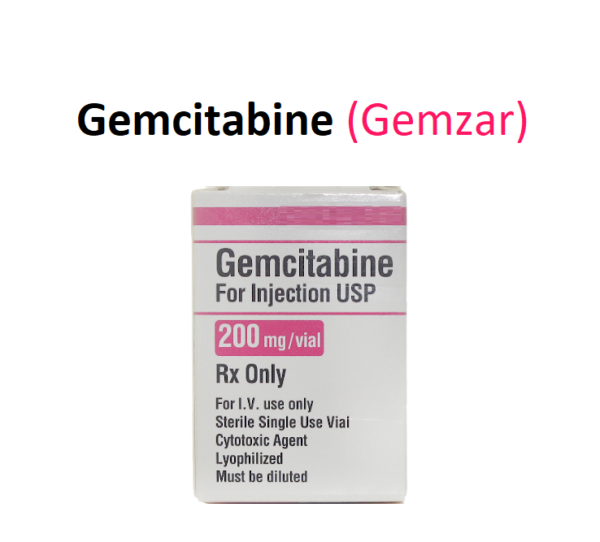
Gemcitabine (Gemzar) is a nucleoside analog that inhibits ribonucleotide reductase. It is classified as an antimetabolite. It is used in various chemotherapeutic regimens used to treat breast cancer, testicular, ovarian, bladder, pancreatic, and lung cancer.
Gemcitabine Uses:
-
Metastatic Breast cancer:
- It is indicated in the treatment of metastatic breast cancer as a first-line agent, combined with paclitaxel that is resistant to anthracycline-containing agents.
-
Locally advanced/ Inoperable, metastatic Non-small cell lung cancer:
- It is indicated in the treatment of inoperable locally advanced or metastatic (Stage IIIA, stage IIIB and stage IV) non-small cell lung carcinoma as a first-line agent, combined with cisplatin.
-
Advanced Ovarian cancer:
- Gemcitabine (combined with carboplatin) is used in the treatment of advanced ovarian cancer that has relapsed at least 6 months following completion of platinum-based chemotherapy
-
Metastatic or Locally advanced Pancreatic cancer:
- Gemcitabine is indicated in pancreatic adenocarcinoma which is locally advanced (stage II or III, non-resectable) or metastatic (stage IV) as a first-line agent in patients previously treated with fluorouracil.
-
Off Label Use of Gemcitabine in Adults:
- Advanced or metastatic Bladder cancer
- Refractory transitional cell Bladder cancer
- Recurrent or persistent Cervical cancer
- Refractory Ewing sarcoma
- Head and neck cancer: metastatic or advanced nasopharyngeal carcinoma
- Advanced Hepatobiliary cancer
- Relapsed Hodgkin lymphoma
- Malignant pleural mesothelioma
- Relapsed or refractory Non-Hodgkin lymphoma
- Refractory Osteosarcoma
- Pancreatic cancer as adjuvant therapy
- Metastatic Renal cell carcinoma
- Refractory or relapsed Small cell lung cancer
- Advanced Soft tissue sarcoma.
- Refractory Germ cell Testicular cancer
- Refractory Thymic malignancies
- Unknown-primary carcinoma
- Uterine cancer
Gemcitabine (Gemzar) Dose in Adults
Note: There is an increased risk of toxicity with an infusion duration of more than 60 minutes and if used more than once weekly. In case premixed infusion bags use, select the premixed bag that allows for a variance of ≤5% of the BSA-based calculated dose; If a patient requires a bag size of less than 1,200 mg/dose, do not use premix infusion bag in such a case.
Gemcitabine (Gemzar) Dose in the treatment of metastatic Breast cancer:
-
- IV: 1,250 mg/m² over 30 minutes days 1 and 8
- Repeat cycle every 21 days (combined with paclitaxel)
-
Off-label dosing (as a single-agent):
- 800 mg/m² over 30 minutes on days 1, 8, and 15 of a 28-day treatment cycle
Gemcitabine (Gemzar) Dose in the treatment of locally advanced, metastatic, or inoperable Non-small cell lung cancer: (IV over 30 minutes)
- 1,000 mg/m² on days 1, 8, and 15, repeat cycle every 28 days (combined with cisplatin) OR
- 1,250 mg/m² on days 1 and 8; repeat cycle every 21 days (combined with cisplatin)
-
Off-label dosing/ combinations: (IV over 30 minutes)
- 1,000 mg/m² on days 1 and 8; repeat cycle every 21 days (combined with carboplatin) for up to 4 cycles OR
- 1,000 mg/m² on days 1, 8, and 15; repeat cycle every 28 days (combined with carboplatin) for up to 4 cycles OR
- 1,000 mg/m² on days 1 and 8; repeat cycle every 21 days (combined with docetaxel) for 8 cycles OR
- 1,000 mg/m on days 1, 8, and 15; repeat cycle every 28 days (combined with vinorelbine) for 6 cycles.
Gemcitabine (Gemzar) Dose in the treatment of advanced or metastatic Ovarian cancer: (IV over 30 minutes)
- IV: 1,000 mg/m² on days 1 and 8; repeat cycle every 21 days (combined with carboplatin)
-
Off-label dosing (as a single agent): (IV over 30-60 minutes)
- 1,000 mg/m² on days 1 and 8; repeat cycle every 21 days.
Gemcitabine (Gemzar) Dose in the treatment of locally advanced or metastatic pancreatic cancer: (IV over 30 minutes)
- Initial: 1,000 mg/m² once a week for 7 weeks followed by 1-week rest; then once a week for 3 weeks out of every 4 weeks
-
Off-label dosing/ combinations: (IV over 30 minutes)
- 1,000 mg/m² (in combination with erlotinib) once a week for 7 weeks followed by 1-week rest; then once a week for 3 weeks out of every 4 weeks OR
- 1,000 mg/m² (in combination with capecitabine) on days 1, 8, and 15 every 28 days OR
- 1,000 mg/m² (in combination with cisplatin) on days 1 and 15 every 28 days OR
- 1,000 mg/m² (in combination with oxaliplatin) infused at 10 mg/m²/minute every 14 days OR
- 1,000 mg/m² (in combination with paclitaxel) days 1, 8, and 15 every 28 days.
Gemcitabine (Gemzar) Dose in the treatment of Pancreatic cancer (adjuvant therapy) (off-label):
- IV: 1,000 mg/m² (in combination with capecitabine) on days 1, 8 and 15 every 28 days for 6 cycles initiating within 12 weeks of resection ( and within 8 weeks according to American society of clinical oncology)
Gemcitabine (Gemzar Dose in the treatment of Bladder cancer (off-label):
-
Advanced or metastatic: (IV over 30-60 minutes)
- 1,000 mg/m² (in combination with cisplatin) on days 1, 8, and 15; repeat cycle every 28 days OR
- 1,000 mg/m (in combination with carboplatin) on days 1 and 8; repeat cycle every 21 days.
Gemcitabine (Gemzar) Dose in the treatment of Refractory Transitional cell carcinoma:
- Intravesicular instillation: 2,000 mg in 100 mL Normal saline twice weekly for 3 weeks; repeat cycle every 4 weeks for at least 2 cycles. It should be retained for 1 hour.
Gemcitabine (Gemzar) Dose in the treatment of recurrent or persistent Cervical cancer (off-label): (IV over 30 minutes)
- 1,000 mg/m² on days 1 and 8; repeat cycle every 21 days (in combination with cisplatin) OR
- 1,250 mg/m² on days 1 and 8; repeat cycle every 21 days (in combination with cisplatin) OR
- 800 mg/m² on days 1, 8, and 15; repeat cycle every 28 days (as a single-agent) OR
- 800 mg/m² days 1 and 8; repeat cycle every 28 days (in combination with cisplatin).
Gemcitabine (Gemzar) Dose in the treatment of advanced or metastatic head and neck cancer: nasopharyngeal, (off-label): (IV over 30 minutes)
- 1,000 mg/m² on days 1, 8, and 15 every 28 days OR
- 1,000 mg/m² on days 1 and 8 every 21 days (in combination with vinorelbine)
Gemcitabine (Gemzar) Dose in the treatment of advanced Hepatobiliary cancer, (off-label): (IV over 30 minutes)
- 1,000 mg/m² on days 1 and 8; repeat cycle every 21 days (in combination with cisplatin) OR
- 1,000 mg/m² on days 1 and 8; repeat cycle every 21 days (in combination with capecitabine) OR
- 1,000 mg/m² infused at 10 mg/m /minute every 2 weeks (in combination with oxaliplatin)
Gemcitabine (Gemzar) Dose in the treatment of relapsed Hodgkin lymphoma (off-label): (IV over 30 minutes)
- 1,000 mg/m² (800 mg/m² for post-transplant patients) on days 1 and 8; repeat cycle every 21 days (in combination with vinorelbine and doxorubicin liposomal) OR
- 800 mg/m² on days 1 and 4; repeat cycle every 21 days (in combination with ifosfamide, mesna, vinorelbine, and prednisolone).
Gemcitabine (Gemzar) Dose in the treatment of Malignant pleural mesothelioma (off-label use; in combination with cisplatin): (IV over 30 minutes)
- 1,000 mg/m² on days 1, 8, and 15 every 28 days for up to 6 cycles OR
- 1,250 mg/m² on days 1 and 8 every 21 days for up to 6 cycles
Gemcitabine (Gemzar) Dose in the treatment of refractory Non-Hodgkin lymphoma (off-label): (IV over 30 minutes)
- 1,000 mg/m² on days 1 and 8; repeat cycle every 21 days (in combination with cisplatin and dexamethasone) or
- 1,000 mg/m² every 15 to 21 days (in combination with oxaliplatin and rituximab)
Gemcitabine (Gemzar) Dose in the treatment of Sarcomas (off-label):(IV over 90 minutes):
-
Refractory Ewing sarcoma:
- 675 mg/m² on days 1 and 8; repeat cycle every 21 days (in combination with docetaxel)
-
Refractory Osteosarcoma:
- 675 mg/m² on days 1 and 8; repeat cycle every 21 days (in combination with docetaxel) OR
- 1,000 mg/m² once a week for 7 weeks followed by 1-week rest; then weekly for 3 weeks out of every 4 weeks.
-
Soft tissue sarcoma advanced:
- 800 mg/m² on days 1 and 8; repeat cycle every 21 days (in combination with vinorelbine) OR
- 675 mg/m² on days 1 and 8; repeat cycle every 21 days (in combination with docetaxel) OR
- 900 mg/m² on days 1 and 8; repeat cycle every 21 days (in combination with docetaxel)
Gemcitabine (Gemzar) Dose in the treatment of refractory or relapsed Small cell lung cancer (off-label): (IV over 30 minutes)
- 1,000 to 1,250 mg/m² on days 1, 8, and 15 every 28 days (as a single agent)
Gemcitabine (Gemzar) Dose in the treatment of Testicular cancer, refractory germ cell (off-label): (IV over 30 minutes)
- 1,000 to 1,250 mg/m² on days 1 and 8 every 21 days (in combination with oxaliplatin) OR
- 1,000 mg/m² on days 1, 8, and 15 every 28 days for up to 6 cycles (in combination with paclitaxel) OR
- 800 mg/m² on days 1 and 8 every 21 days (in combination with oxaliplatin and paclitaxel)
Gemcitabine (Gemzar) Dose in the treatment of Unknown-primary, adenocarcinoma (off-label): IV
- 1,250 mg/m² days 1 and 8 every 21 days (in combination with cisplatin) OR
- 1,000 mg/m² on days 1 and 8 every 21 days for up to 6 cycles (in combination with docetaxel)
Gemcitabine (Gemzar) Dose in the treatment of Uterine cancer (off-label): (IV over 90 minutes)
- 900 mg/m² on days 1 and 8 every 21 days (in combination with docetaxel) OR
- 1,000 mg/m² over 30 minutes days 1, 8, and 15 every 28 days
Dosing adjustment for toxicity: Dosing adjustment on basis of adult patients
-
Nonhematologic toxicity (all indications):
- Hold or dose reduction by 50% for the following:
- Severe (grade 3 or 4) non-hematologic toxicity until resolved (excludes nausea, vomiting, or alopecia [no dose modifications recommended])
- Permanently discontinue if any of the following:
- Unexplained dyspnea (or other evidence of severe pulmonary toxicity)
- Severe hepatotoxicity
- Hemolytic uremic syndrome (HUS)
- Capillary leak syndrome (CLS)
- Posterior reversible encephalopathy syndrome (PRES)
- Hold or dose reduction by 50% for the following:
-
Hematologic toxicity:
- Breast cancer:
- Day 1:
- Absolute granulocyte count (AGC) ≥1,500/mm³ and platelet count ≥100,000/mm³ : 100% of full dose
- AGC <1,500/mm³ or platelet count <100,000/mm³: Hold dose
- Day 8:
- AGC ≥1,200/mm³ and platelet count >75,000/mm³: 100% of full dose
- AGC 1,000 to 1,199/mm³ or platelet count 50,000 to 75,000/mm³: 75% of full dose
- AGC 700 to 999/mm³ and platelet count ≥50,000/mm³: 50% of full dose
- AGC <700/mm³ or platelet count <50,000/mm³: Hold dose
- Day 1:
- Non-small cell lung cancer (cisplatin dosage may also require adjustment):
- AGC ≥1,000/mm³ and platelet count ≥100,000/mm³: 100% of full dose
- AGC 500 to 999/mm³ or platelet count 50,000 to 99,999/mm³: 75% of full dose
- AGC <500/mm³ or platelet count <50,000/mm³: Hold dose
- Ovarian cancer:
- Day 1:
- AGC ≥1,500/mm³ and platelet count ≥100,000/mm³: 100% of full dose
- AGC <1,500/mm³ or platelet count <100,000/mm³: Delay treatment cycle
- Day 8:
- AGC ≥1,500/mm³ and platelet count ≥100,000/mm³: 100% of full dose
- AGC 1,000 to 1,499/mm³ or platelet count 75,000 to 99,999/mm³: 50% of full dose
- AGC <1,000/mm³ or platelet count <75,000/mm³: Hold dose
- Day 1:
- Breast cancer:
-
Hematologic toxicity in the previous cycle (dosing adjustment for subsequent cycles):
-
- Initial occurrence: Permanently reduce gemcitabine to 800 mg/m² on days 1 and 8 in the following conditions:
- AGC <500/mm³ for >5 days
- AGC <100/mm³ for >3 days
- Febrile neutropenia
- Platelet count <25,000/mm³ or
- Cycle delay >1 week due to toxicity
- Subsequent occurrence: Permanently reduce gemcitabine to 800 mg/m² and administer on day 1 only in the following conditions
- AGC <500/mm³ for >5 days
- AGC <100/mm³ for >3 days
- Neutropenic fever
- Platelet count <25,000/mm³ or
- Cycle delay >1 week due to toxicity
-
Pancreatic cancer:
- AGC ≥1,000/mm³ and platelet count ≥100,000/mm³: 100% of full dose
- AGC 500 to 999/mm³ or platelet count 50,000 to 99,999/mm³: 75% of full dose
- AGC <500/mm³ or platelet count <50,000/mm³: Hold dose
- Initial occurrence: Permanently reduce gemcitabine to 800 mg/m² on days 1 and 8 in the following conditions:
-
Gemcitabine (Gemzar) Dose in Childrens
Note:
- Details regarding dosing in combination regimens should also be consulted.
- There is an increased risk of toxicity with the infusion time of more than 60 minutes and if used more than once weekly.
- Gemcitabine is associated with a low emetic potential risk, antiemetics should be given to prevent nausea and vomiting.
Gemcitabine (Gemzar) Dose in the treatment of refractory or relapsed Hodgkin lymphoma:
-
Children ≥10 years and Adolescents: (IV over 100 minutes)
- 1,000 mg/m²/dose on days 1 and 8 (in combination with vinorelbine); repeat cycle every 21 days
-
Adolescents ≥17 years: (IV over 60minutes)
- 1,000 mg/m²/dose over 60 minutes on days 1, 8, and 15 (in combination with vinorelbine); repeat cycle every 28 days or
- 800 mg/m²/dose on days 1 and 4 (in combination with ifosfamide and vinorelbine); repeat cycle every 21 days.
Gemcitabine (Gemzar) Dose in the treatment of refractory or relapsed Sarcomas (including Ewing sarcoma, osteosarcoma): Limited data available:
-
Children ≥3 years and Adolescents: (IV over 90 minutes)
- 675 or 1,000 mg/m²/dose on days 1 and 8 (in combination with docetaxel); repeat cycle every 21 days OR
- 1,000 mg/m²/dose over 30 minutes on days 1 and 8 (in combination with oxaliplatin and irinotecan); repeat cycle every 28 days
Gemcitabine (Gemzar) Dose in the treatment of refractory or relapsed solid tumors: Limited data available:
-
Children ≥1 year and Adolescents: (IV over 30 minutes)
- 1,000 mg/m²/dose on days 1 and 8 (in combination with oxaliplatin and irinotecan); repeat cycle every 28 days OR
- 1,000 mg/m²/dose over 100 minutes on day 1 (in combination with oxaliplatin); repeat cycle every 14 days.
Note: Dosage reductions for toxicity: 800 mg/m²/dose over 80 minutes if
- Grade 3/4 non-hematological toxicity
- Grade 4 neutropenia with documented infection or lasting >7 days
- Grade 3/4 thrombocytopenia lasting >7 days or requiring platelets during >7 days, or
- Delay of next cycle ≥14 days
if necessary dose could be reduced a second time to 600 mg/m²/dose
Gemcitabine (Gemzar) Dose in the treatment of refractory Germ cell tumor: Limited data available:
-
Adolescents ≥16 years: (IV over 30 minutes)
- 1,200 mg/m²/dose on days 1, 8, and 15; repeat cycle every 28 days for up to 6 cycles.
Gemcitabine Pregnancy Category: D
- Based on animal reproduction studies and the mechanism of action, Gemcitabine may cause harm to fetal health.
- Before you start the therapy, it is a good idea to do a pregnancy check
- Effective contraception should be used during and 6 months following therapy. Use effective contraception for 3 months after therapy if a male patient is affected.
- It can impair male fertility.
Use of gemcitabine during lactation
- Breastmilk does not contain Gemcitabine.
- It is not advised to breastfeed during therapy or for more than one week after.
Gemcitabine (Gemzar) Dose in Kidney disease:
- Discontinue if severe renal toxicity or hemolytic uremic syndrome occurs during gemcitabine treatment.
- Mild-to-severe renal impairment:
- No dosage adjustment required
- ESRD (on hemodialysis):
- Hemodialysis should begin 6 - 12 hours after gemcitabine infusion.
- Mild-to-severe renal impairment:
Gemcitabine (Gemzar) Dose in Liver disease:
- Discontinue if severe hepatotoxicity occurs during gemcitabine use. Adjust the dose as follows:
- Transaminases elevated (with normal bilirubin):
- No dose adjustment required
- Serum bilirubin >1.6 mg/dL:
- Initial dose of 800 mg/m ; can be increased if patient tolerates initial dose
- Transaminases elevated (with normal bilirubin):
Frequency of adverse reactions reported for single-agent use of gemcitabine only.
Common Side Effects of Gemcitabine (Gemzar):
-
Cardiovascular:
- Peripheral Edema
- Edema
-
Central Nervous System:
- Drowsiness
-
Dermatologic:
- Skin Rash
- Alopecia
-
Gastrointestinal:
- Nausea And Vomiting
- Diarrhea
- Stomatitis
-
Genitourinary:
- Proteinuria
- Hematuria
-
Hematologic & Oncologic:
- Anemia
- Neutropenia
- Thrombocytopenia
- Hemorrhage
-
Hepatic:
- Increased Serum Alanine Aminotransferase
- Increased Serum Aspartate Aminotransferase
- Increased Serum Alkaline Phosphatase
- Hyperbilirubinemia
-
Infection:
- Infection
-
Renal:
- Increased Blood Urea Nitrogen
-
Respiratory:
- Dyspnea
- Flu-Like Symptoms
-
Miscellaneous:
- Fever
Less Common Side Effects Of Gemcitabine (Gemzar):
-
Central Nervous System:
- Paresthesia
-
Local:
- Injection Site Reaction
-
Renal:
- Increased Serum Creatinine
-
Respiratory:
- Bronchospasm
Contraindications to Gemcitabine (Gemzar):
Hypersensitivity reactions.
Warnings and precautions
-
Suppression of bone marrow
- Myelosuppression, which can include grade 3 or 4 hematological toxicities, is possible and dose-limiting
- Keep track of your blood pressure.
-
Capillary leak syndrome
- Both with gemcitabine or combination chemotherapy, there has been a case of capillary leak syndrome (CLS).
- If gemcitabine is diagnosed with CLS, permanent discontinuation is recommended.
-
Hemolytic uremic Syndrome:
- Reports of hemolytic uremic syndrome (HUS), have been made
- Monitoring for signs of anemia (microangiopathic hemolysis), raised bilirubin, LDH, severe thrombocytopenia and/or renal disease.
- After discontinuation of the drug, renal failure can be irreversible.
- Permanent discontinuation is recommended for any signs of HUS and renal failure.
-
Hepatotoxicity
- It can cause liver failure, death, or exacerbate hepatic impairment if there is a history of liver disease (hepatitis or cirrhosis), either alone or in combination.
- Monitor your liver function at baseline, and every so often during treatment.
- For elevated bilirubin, dosage adjustments may be necessary. However, if severe liver injury has occurred, the dose adjustment will need to be permanently discontinued.
-
Hypersensitivity
- There are many allergic reactions that can occur, including anaphylactoid, bronchospasm and life-threatening anaphylaxis.
-
The posterior reversible syndrome of encephalopathy:
- Reports of Posterior Reversible Encephalopathy Syndrome (PRES) have been made
- Signs and symptoms include confusion, blindness, headaches, hypertension, lethargy and seizure.
- If PRES is confirmed (By MRI), gemcitabine should be discontinued permanently
-
Toxicity in the lungs:
- There are many possible pulmonary toxicities, including interstitial pneumonitis and adult respiratory distress syndrome. May cause respiratory failure, some fatal, even after gemcitabine discontinuation.
- After 2 weeks after the last dose, pulmonary toxicity can occur.
- For any feature of pulmonary toxicology or unexplained dyspnea, discontinue use immediately
Gemcitabine: Drug Interaction
|
Risk Factor C (Monitor therapy) |
|
|
Chloramphenicol (Ophthalmic) |
May enhance the adverse/toxic effect of Myelosuppressive Agents. |
|
CloZAPine |
Myelosuppressive Agents may enhance the adverse/toxic effect of CloZAPine. Specifically, the risk for neutropenia may be increased. |
|
Coccidioides immitis Skin Test |
Immunosuppressants may diminish the diagnostic effect of Coccidioides immitis Skin Test. |
|
Denosumab |
May enhance the adverse/toxic effect of Immunosuppressants. Specifically, the risk for serious infections may be increased. |
|
Fluorouracil (Systemic) |
Gemcitabine may increase the serum concentration of Fluorouracil (Systemic). |
|
Fluorouracil (Topical) |
Gemcitabine may increase the serum concentration of Fluorouracil (Topical). |
|
Ocrelizumab |
May enhance the immunosuppressive effect of Immunosuppressants. |
|
Pidotimod |
Immunosuppressants may diminish the therapeutic effect of Pidotimod. |
|
Promazine |
May enhance the myelosuppressive effect of Myelosuppressive Agents. |
|
Siponimod |
Immunosuppressants may enhance the immunosuppressive effect of Siponimod. |
|
Trastuzumab |
May enhance the neutropenic effect of Immunosuppressants. |
|
Warfarin |
Gemcitabine may enhance the anticoagulant effect of Warfarin. |
|
Risk Factor D (Consider therapy modification) |
|
|
Baricitinib |
Immunosuppressants may enhance the immunosuppressive effect of Baricitinib. Management: Use of baricitinib in combination with potent immunosuppressants such as azathioprine or cyclosporine is not recommended. Concurrent use with antirheumatic doses of methotrexate or nonbiologic disease modifying antirheumatic drugs (DMARDs) is permitted. |
|
Bleomycin |
Gemcitabine may enhance the adverse/toxic effect of Bleomycin. The risk of pulmonary toxicity may be increased. |
|
Echinacea |
May diminish the therapeutic effect of Immunosuppressants. |
|
FingolimodI |
mmunosuppressants may enhance the immunosuppressive effect of Fingolimod. Management: Avoid the concomitant use of fingolimod and other immunosuppressants when possible. If combined, monitor patients closely for additive immunosuppressant effects (eg, infections). |
|
Leflunomide |
Immunosuppressants may enhance the adverse/toxic effect of Leflunomide. Specifically, the risk for hematologic toxicity such as pancytopenia, agranulocytosis, and/or thrombocytopenia may be increased. Management: Consider not using a leflunomide loading dose in patients receiving other immunosuppressants. Patients receiving both leflunomide and another immunosuppressant should be monitored for bone marrow suppression at least monthly. |
|
Lenograstim |
Antineoplastic Agents may diminish the therapeutic effect of Lenograstim. Management: Avoid the use of lenograstim 24 hours before until 24 hours after the completion of myelosuppressive cytotoxic chemotherapy. |
|
Lipegfilgrastim |
Antineoplastic Agents may diminish the therapeutic effect of Lipegfilgrastim. Management: Avoid concomitant use of lipegfilgrastim and myelosuppressive cytotoxic chemotherapy. Lipegfilgrastim should be administered at least 24 hours after the completion of myelosuppressive cytotoxic chemotherapy. |
|
Nivolumab |
Immunosuppressants may diminish the therapeutic effect of Nivolumab. |
|
Palifermin |
May enhance the adverse/toxic effect of Antineoplastic Agents. Specifically, the duration and severity of oral mucositis may be increased. Management: Do not administer palifermin within 24 hours before, during infusion of, or within 24 hours after administration of myelotoxic chemotherapy. |
|
Roflumilast |
May enhance the immunosuppressive effect of Immunosuppressants. |
|
Sipuleucel-T |
Immunosuppressants may diminish the therapeutic effect of Sipuleucel-T. Management: Evaluate patients to see if it is medically appropriate to reduce or discontinue therapy with immunosuppressants prior to initiating sipuleucel-T therapy. |
|
Tofacitinib |
Immunosuppressants may enhance the immunosuppressive effect of Tofacitinib. Management: Concurrent use with antirheumatic doses of methotrexate or nonbiologic disease modifying antirheumatic drugs (DMARDs) is permitted, and this warning seems particularly focused on more potent immunosuppressants. |
|
Vaccines (Inactivated) |
Immunosuppressants may diminish the therapeutic effect of Vaccines (Inactivated). Management: Vaccine efficacy may be reduced. Complete all age-appropriate vaccinations at least 2 weeks prior to starting an immunosuppressant. If vaccinated during immunosuppressant therapy, revaccinate at least 3 months after immunosuppressant discontinuation. |
|
Risk Factor X (Avoid combination) |
|
|
BCG (Intravesical) |
Immunosuppressants may diminish the therapeutic effect of BCG (Intravesical). |
|
BCG (Intravesical) |
Myelosuppressive Agents may diminish the therapeutic effect of BCG (Intravesical). |
|
Cladribine |
May enhance the immunosuppressive effect of Immunosuppressants. |
|
Cladribine |
May enhance the myelosuppressive effect of Myelosuppressive Agents. |
|
Cladribine |
Agents that Undergo Intracellular Phosphorylation may diminish the therapeutic effect of Cladribine. |
|
Deferiprone |
Myelosuppressive Agents may enhance the neutropenic effect of Deferiprone. |
|
Dipyrone |
May enhance the adverse/toxic effect of Myelosuppressive Agents. Specifically, the risk for agranulocytosis and pancytopenia may be increased |
|
Natalizumab |
Immunosuppressants may enhance the adverse/toxic effect of Natalizumab. Specifically, the risk of concurrent infection may be increased. |
|
Pimecrolimus |
May enhance the adverse/toxic effect of Immunosuppressants. |
|
Tacrolimus (Topical) |
May enhance the adverse/toxic effect of Immunosuppressants. |
|
Vaccines (Live) |
Immunosuppressants may enhance the adverse/toxic effect of Vaccines (Live). Immunosuppressants may diminish the therapeutic effect of Vaccines (Live). Management: Avoid use of live organism vaccines with immunosuppressants; live-attenuated vaccines should not be given for at least 3 months after immunosuppressants. |
Monitoring parameters:
- CBC with differential and platelet count
- Hepatic function
- Renal function
- Serum electrolytes, including magnesium, and calcium (when in combination with cisplatin)
- Pregnancy test before starting the therapy
- Pulmonary function tests
- Signs and symptoms of capillary leak syndrome and posterior reversible encephalopathy syndrome
How to administer Gemcitabine (Gemzar)?
- Refer to labeled indicationsOver 30 minutes
- Premixed infusion bags require 2 bags. Infuse both bags for 30 minutes.
- Uses that are not listed on the labelInfusion times can vary, so refer to specific references.
- Gemcitabine was administered at a fixed dose rate (FDR), of 10 mg/m2/minute, to maximize its pharmacokinetics
- A longer infusion time than 60 minutes can increase toxicity. Longer infusion times increase intracellular accumulations of the active metabolite
Bladder cancer
- Intravesicular Instillation (off-label): Mix 50 to 100mL normal solution in a glass of water. Keep in the bladder for at least 1 hour.
Mechanism of action of Gemcitabine (Gemzar):
- It is the pyrimidine antimetabolite.
- This causes inhibition of DNA synthesis by inhibiting mainly 2 enzymes, DNA Polymerase and Ribonucleotide Reductase.
- Cell cycle-specific for S-phase (also blocks cellular progress at G1/S phase).
- Gemcitabine is intracellularly phosphorylated (by deoxycytidinekinase), which initially produces gemcitabine monophosphate, and then phosphorylated to diphosphate or triphosphate.
- Gemcitabine diphosphate inhibits the ribonucleotide reducer and Gemcitabine triphosphate injures DNA polymerase.
Protein binding
- is negligible
Metabolism:
- intracellular by nucleoside kinases to the active diphosphate and triphosphate nucleoside.
Half-life elimination: Affected by infusion rate and age and gender
- Infusion time ≤70 minutes: 42 - 94 minutes
- Infusion time 3 - 4 hours: 4 - 10.5 hours
Time to peak:
- 30 minutes after infusion.
Excretion:
- Mainly by urine (92% - 98%) primarily as inactive uracil metabolite
International Brand Names of Gemcitabine:
- Gemzar
- Infugem
- ACT Gemcitabine
- Gemcitabine SUN
- Abine
- Abingem
- Bigemax
- Citabol
- Citafine
- Cytogem
- DBL
- Gembine
- Gembio
- Gemcetin
- Gemcibine
- Gemcikal
- Gemcit
- Gemcite
- Gemezar
- Gemflor
- Gemhope
- Gemita
- Gemmis
- Gemoxen
- Gemresec
- Gemtan
- Gemtavis
- Gemtero
- Gemtin
- Gemtra
- Gemtro
- Gemxit
- Gemzar
- Getanosan
- Gezt
- Gitrabin
- Oncogem
- Oncoril
- Pamigen
- Zarbin
- Zefei
Gemcitabine Brand Names in Pakistan:
Gemcitabine Injection 1 G in Pakistan |
|
| Gemcit | Al-Habib Pharmaceuticals. |
| Gemcitabine | Novartis Pharma (Pak) Ltd |
| Gemita | Atco Laboratories Limited |
| Gemzar | Eli Lilly Pakistan (Pvt) Ltd. |
Gemcitabine Injection 1 Gm in Pakistan |
|
| Oncogem | A. J. Mirza Pharma (Pvt) Ltd |
| Trugem | Pharmevo (Pvt) Ltd. |
Gemcitabine Injection 100 Mg in Pakistan |
|
| Pamigen | Ferozsons Laboratoies Ltd. |
Gemcitabine Injection 200 Mg in Pakistan |
|
| Gebina | Oncogene Pharmaceuticals Karachi |
| Gemcit | Al-Habib Pharmaceuticals. |
| Gemcitabine | Novartis Pharma (Pak) Ltd |
| Gemita | Atco Laboratories Limited |
| Gemzar | Eli Lilly Pakistan (Pvt) Ltd. |
| Oncogem | A. J. Mirza Pharma (Pvt) Ltd |
| Pamigen | Ferozsons Laboratoies Ltd. |
| Trugem | Pharmevo (Pvt) Ltd. |
Gemcitabine Injection 1000 Mg in Pakistan |
|
| Gebina | Oncogene Pharmaceuticals Karachi |
.png)


