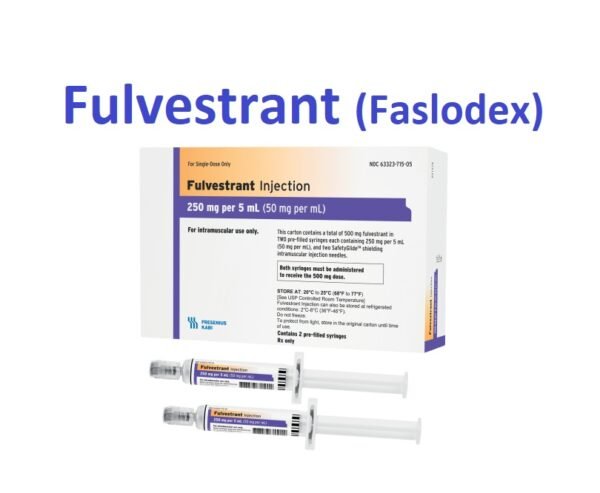
Fulvestrant (Faslodex) is an estrogen-receptor down-regulator. It binds to and inhibits the growth of estrogen-receptor-positive tumor cells. It is used in the treatment of patients with breast cancer.
Fulvestrant (Faslodex) Uses:
-
Breast cancer as monotherapy:
- Used in the treatment of hormone-receptor (HR)-positive advanced breast cancer in postmenopausal women with disease progression following endocrine therapy.
- Used in the treatment of HR-positive, human epidermal growth factor receptor 2 (HER2)-negative advanced breast cancer in postmenopausal women not previously treated with endocrine therapy
-
Breast cancer as combination therapy:
- Used in the treatment of HR-positive, HER2-negative advanced or metastatic breast cancer (in combination with ribociclib) in postmenopausal women as initial endocrine-based therapy or following disease progression on endocrine therapy
- Used in the treatment of HR-positive, HER2-negative advanced or metastatic breast cancer (in combination with palbociclib or abemaciclib) in women with disease progression following endocrine therapy.
Fulvestrant (Faslodex) Dose in Adults
Note: A luteinizing hormone-releasing hormone (LHRH) agonist should be considered for pre/ perimenopausal women receiving fulvestrant in combination with abemaciclib, palbociclib, or ribociclib.
Fulvestrant (Faslodex) Dose in the treatment of advanced Breast cancer in postmenopausal women who are HR-positive):
- IM: Initial: 500 mg on days 1, 15, and 29;
- Maintenance dose: 500 mg once every month.
Fulvestrant (Faslodex) Dose in the treatment of advanced Breast cancer in postmenopausal women (HR-positive, HER2 negative):
- IM: Initial: 500 mg on days 1, 15, and 29;
- Maintenance: 500 mg once monthly.
Fulvestrant (Faslodex) Dose in the treatment of advanced or metastatic Breast cancer in postmenopausal women (HR positive, HER2 negative):
- IM: Initial: 500 mg on days 1, 15, and 29;
- Maintenance dose: 500 mg once every 28 days.
- Administer in combination with ribociclib. The treatment may be continued until disease progression or unacceptable toxicity.
Fulvestrant (Faslodex) Dose in the treatment of advanced or metastatic Breast cancer, (second-line endocrine-based combination therapy):
-
Adult females (HR-positive, HER2-negative):
- IM: Initial: 500 mg on days 1, 15, and 29;
- Maintenance dose: 500 mg once every 28 days.
- Consider in combination with palbociclib or abemaciclib;
- The treatment may be continued until disease progression or unacceptable toxicity.
Fulvestrant (Faslodex) Dose in Childrens
Fulvestrant (Faslodex) Dose in the treatment of progressive precocious puberty in patients with McCune-Albright Syndrome (MAS):
-
Female children 1 to 10 years:
- IM: 4 mg/kg once monthly.
Fulvestrant Pregnancy Category: D
- Decitabine is hypomethylating agent. Decitabine, after phosphorylation is completed, is incorporated into DNA. It inhibits DNA methyltransferase ca
- Based on animal reproduction studies and the mechanism, fulvestrant can cause harm to fetuses if given during pregnancy.
- Animal data suggests that fulvestrant could affect male and female fertility, although it is not recommended for men.
- Pregnancy testing is highly recommended for females with reproductive potential.
- Effective contraception should also be used during treatment as well as for one year following the last dose of fulvestrant.
Use while breastfeeding
- Hypomethylation can cause cell death and result in cell death (within S-phase).
- It is unknown if breast milk contains fulvestrant.
- Due to the potential for serious adverse reactions in breastfed infants, breastfeeding mothers should discontinue breastfeeding during treatment and for at least one year after completion of the last fulvestrant dose.
Dose in Kidney Disease:
The manufacturer’s labeling doesn't provide any dosage adjustments (has not been studied). However, the renal elimination of fulvestrant is negligible.
Fulvestrant (Faslodex) Dose in Liver disease:
-
Mild impairment (Child-Pugh class A):
- No dosage adjustment is required.
-
Moderate impairment (Child-Pugh class B):
- Reduce initial and maintenance doses:
- Initial: 250 mg on days 1, 15, and 29;
- Maintenance: 250 mg once a month.
- Reduce initial and maintenance doses:
-
Severe impairment (Child-Pugh class C):
- There are no dosage adjustments provided in the manufacturer's labeling. The drug has not been studied in patients with severe liver disease.
Common Side Effects of Fulvestrant (Faslodex):
-
Central Nervous System:
- Fatigue
- Headache
-
Endocrine & Metabolic:
- Hot Flash
-
Gastrointestinal:
- Nausea
- Diarrhea
- Decreased Appetite
- Abdominal Pain
- Constipation
- Vomiting
- Stomatitis
-
Hematologic & Oncologic:
- Anemia
- Lymphocytopenia
-
Hepatic:
- Increased Serum Aspartate Aminotransferase
- Increased Serum Alanine Aminotransferase
- Increased Liver Enzymes
-
Infection:
- Infection
-
Local:
- Pain At Injection Site
-
Neuromuscular & Skeletal:
- Arthralgia
-
Renal:
- Increased Serum Creatinine
-
Respiratory:
- Cough
Less Common Side Effects Of Fulvestrant (Faslodex):
-
Cardiovascular:
- Peripheral Edema
-
Central Nervous System:
- Dizziness
-
Dermatologic:
- Pruritus
- Skin Rash
- Alopecia
-
Endocrine & Metabolic:
- Weight Loss
-
Gastrointestinal:
- Anorexia
- Dysgeusia
-
Hematologic & Oncologic:
- Leukopenia
- Neutropenia
- Thrombocytopenia
-
Neuromuscular & Skeletal:
- Ostealgia
- Back Painn
- Asthenia
- Myalgia
- Limb Pain
- Musculoskeletal Pai
-
Respiratory:
- Dyspnea
-
Miscellaneous:
- Fever
Contraindications to Fulvestrant (Faslodex):
Canadian labeling: Additional contraindications (not in the US labeling):
- Pregnant or lactating women
Warnings and Precautions
-
Hypersensitivity
- Hypersensitivity reactions can manifest as angioedema and urticaria.
-
Injection-site reactions
- The drug administration has received reports of events related to the injection site including neuropathy, sciatica and neuropathic pain.
- Because of the close proximity to the underlying sciatic nerve use caution when administering at the dorsogluteal location.
-
Bleeding disorders
- Patients with a history or bleeding disorder (including thrombocytopenia) should not use it. In fact, bleeding/hematoma could occur after intramuscular injections.
-
Hepatic impairment
- Patients with mild impairment may be exposed to more and require dosage adjustments.
- In severe hepatic impairment, safety and efficacy are not established.
Monitoring parameters:
- Liver function tests;
- pregnancy testing is adviced within a weak prior to fulvestrant initiation (for females of reproductive potential);
- Observe for signs and symptoms of bleeding.
How to administer Fulvestrant (Faslodex)?
- This medication is only administered intramuscularly.
- You should administer 500 mg of the drug as two 5-mL IM injections (one in each buttock [gluteal region]) over a period of 1 to 2 minutes.
- Because of the proximity to the sciatic nerve, be careful when injecting at the dorsogluteal location.
- Hold each syringe upright and gently tilt it back and forth until the cap is removed.
- To maintain sterility, pull the cap off without touching its tip.
- Attach safety needle to the tip of your syringe and twist to lock.
- To avoid damage to needlepoint, pull off the needle cap and remove the needle sheath.
- Before administering the medication, expel any excess air from the syringe.
Mechanism of action of Fulvestrant (Faslodex):
- Fulvestrant is an antagonist of estrogen receptors.
- It competely binds with estrogen receptors on tumors, and other targets in the tissue.
- This creates a nuclear complex that causes a dose dependent downregulation of estrogen receptors. This inhibits tumor growth.
Time:
- IM: Plasma levels attained for at least one month after administration of an additional dose 14 days after the initial dose.
Protein binding:
- 99 percent of the drug is protein-bound (to plasma proteins (VLDL, LDL, and HDL lipoprotein fractions)
Metabolism:
- It is metabolized in the liver through multiple biotransformation pathways (CYP3A4 substrate involved in oxidation pathway, although relative contribution to metabolism unknown).
- The metabolites formed are either less active or have similar activity to the parent compound.
Half-life elimination:
- Children 1.7 to 8.5 years: 70.4 ± 8.1 days.
- Adults: 250 mg: ~40 days
Excretion:
- Feces (~90 percent);
- urine (<1 percent )
International Brand Names of Fulvestran:
- Faslodex
- Nilgaban
- Olvestran
- TEVA-Fulvestrant
- Fulvetraz
- Fulvenat
Fulvestran Brand Names in Pakistan:
There is no brand available in Pakistan.
.png)


