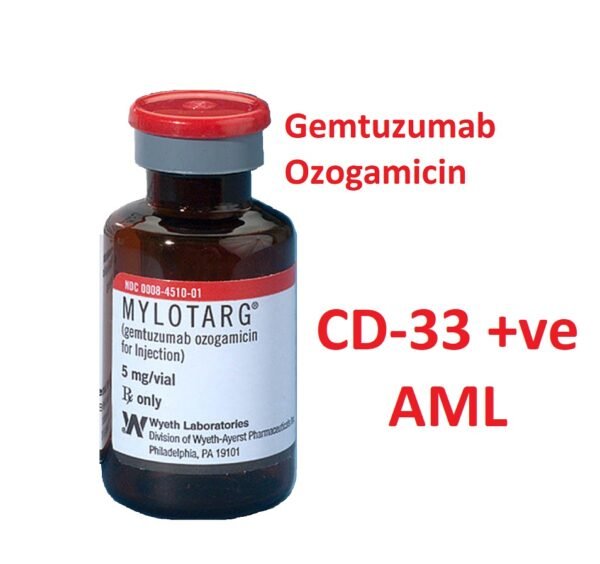
Gemtuzumab Ozogamicin (Mylotarg) is an antibody-drug conjugate that is indicated for the treatment of CD-33 +ve acute myeloid leukemia and is used as an off-label treatment in patients with acute promyelocytic leukemia.
Gemtuzumab ozogamicin Uses:
-
Acute myeloid leukemia (newly diagnosed):
- It is indicated in the treatment of newly diagnosed CD33-positive acute myeloid leukemia (AML) in adults.
-
Acute myeloid leukemia (relapsed/refractory):
- it is indicated in the treatment of relapsed/refractory CD33-positive acute myeloid leukemia (AML) in adults and pediatric patients ≥2 years.
-
Off Label Use of Gemtuzumab ozogamicin in Adults:
- Acute promyelocytic leukemia
Gemtuzumab Ozogamicin (Mylotarg) dose in Adults
Note: Premedication is needed as follows:
- Acetaminophen 650 mg orally and diphenhydramine 50 mg oral or intravenous 1 hour before infusion.
- Methylprednisolone 1 mg per kg (or equivalent) oral or intravenous within 30 minutes before infusion
- Acetaminophen and diphenhydramine can be repeated every 4 hours if required.
- If there is any sign of infusion-related reaction (eg, fever, chills, hypotension, dyspnea) during or within 4 hours' repeat methylprednisolone or equivalent dose of steroid
- Cytoreduction is recommended prior to gemtuzumab ozogamicin administration if hyperleukocytosis (leukocyte count >30,000/mm³) is present.
Dose in the treatment of newly diagnosed acute myeloid leukemia: IV:
-
Combination therapy:
Note: A treatment course consists of 1 induction cycle and 2 consolidation cycles (combined with chemotherapy).
-
- Induction:
- 3 mg/m² (maximum: 4.5 mg per dose) on days 1, 4, and 7 (combined with daunorubicin and cytarabine).
- If a second induction cycle required, do not administer gemtuzumab ozogamicin during that cycle.
- Consolidation (2 cycles):
- 3 mg/m² (maximum: 4.5 mg per dose) on day 1 (combined with daunorubicin and cytarabine).
- Induction:
-
Single-agent regimen:
Note: A treatment course consists of 1 induction cycle and up to 8 cycles of continuation therapy.
-
- Induction:
- 6 mg/m² on day 1 followed by 3 mg/m on day 8 (as monotherapy)
- Continuation:
- 2 mg/m² on day 1 every 4 weeks (as monotherapy) for up to 8 cycles
- Off-label dose:
- Favorable cytogenetics: Adults <60 years of age: 3 mg/m² on day 1 of course 1 (combined with induction chemotherapy) and on day 1 of course 3 ( combined with chemotherapy)
- Induction:
Gemtuzumab Ozogamicin (Mylotarg) dose in the treatment of relapsed/ refractory Acute myeloid leukemia:
- IV: 3 mg/m² (maximum: 4.5 mg/dose) on days 1, 4, and 7 (as monotherapy); treatment consists of a single course of therapy.
Gemtuzumab Ozogamicin (Mylotarg) Dose in Acute promyelocytic leukemia (off-label): IV:
-
Single-agent therapy (relapsed disease):
- 6 mg/m² on days 1 and 15; If PCR tests negative after 2 doses, a third dose was administered.
-
Combination therapy (high-risk patients with newly diagnosed disease):
- Induction: 9 mg/m² as a single dose on day 1 (combined with arsenic trioxide and tretinoin)
-
Post remission therapy (if arsenic trioxide or tretinoin discontinued due to toxicity):
- 9 mg/m² once every 4 to 5 weeks until 28 weeks after complete remission.
Gemtuzumab Ozogamicin (Mylotarg) dose in Childrens
Note: Premedication required as follows
- Oral acetaminophen 15 mg/kg (maximum dose: 650 mg/dose)
- Oral or intravenous diphenhydramine 1 mg/kg (maximum dose: 50 mg/dose) 1 hour before infusion
- Oral or intravenous methylprednisolone 1 mg/kg 30 minutes before infusion
- Additional acetaminophen and diphenhydramine doses can be given every 4 hours if required
- If there is any sign of infusion-related reaction (eg, fever, chills, hypotension, dyspnea) during or within 4 hours' repeat methylprednisolone or equivalent dose of steroid
- Cytoreduction is recommended prior to gemtuzumab ozogamicin administration if hyperleukocytosis (leukocyte count >30,000/mm³) is present.
Gemtuzumab Ozogamicin (Mylotarg) Dose in the treatment of CD33+ Acute myeloid leukemia, newly diagnosed (de novo) or refractory/relapse:
Limited data available in de novo diagnosis or as combination therapy:
-
Monotherapy:
- Children ≥2 years and Adolescents:
- IV: 3 mg/m²/dose,
- maximum dose: 4.5 mg per dose; administer on days 1, 4, and 7;
- treatment consists of a single course in the refractory/relapsed setting.
- Children ≥2 years and Adolescents:
-
Combination therapy:
- Infants, Children, and Adolescents:
- Induction:
- BSA <0.6 m²:
- IV: 0.1 mg/kg/dose once on day 6, over 2 hours combined with cytarabine, daunorubicin, and etoposide.
- BSA ≥0.6 m²:
- IV: 3 mg/m²/dose once on day 6, over 2 hours combined with cytarabine, daunorubicin, and etoposide.
- BSA <0.6 m²:
- Intensification course 2:
- BSA <0.6 m²:
- IV: 0.1 mg/kg/dose once on day 7, over 2 hours combined with cytarabine and mitoxantrone.
- BSA ≥0.6 m²:
- IV: 3 mg/m²/dose once on day 7, over 2 hours combined with cytarabine and mitoxantrone.
- BSA <0.6 m²:
- Induction:
- Infants, Children, and Adolescents:
-
Gemtuzumab Ozogamicin (Mylotarg) Dosing adjustment for toxicity:
-
Nonhematologic toxicity (when administering gemtuzumab ozogamicin either as monotherapy or in combination with chemotherapy):
-
Children ≥2 years and Adolescents:
- Infusion-related reactions:
- Discontinue infusion and give appropriate supportive treatment; Acetaminophen, diphenhydramine, and/or methylprednisolone can be given.
- Once symptoms resolve, resume the infusion at below half the rate at which the reaction occurred; In case of recurrence of symptoms or initial life-threatening symptoms Permanently discontinue gemtuzumab ozogamicin.
- Severe bleeding or hemorrhage:
- Treatment delay or permanent discontinuation may be required.
- Other severe or life-threatening toxicities:
- Delay gemtuzumab ozogamicin until recovery and can be given to mild symptoms, if symptoms more than mild it should not be given; if delayed for > 2 days between sequential infusions, omit scheduled dose
- Hematologic toxicity (when administering gemtuzumab ozogamicin in combination with chemotherapy):
- Current dosing adjustments are on the basis of studies in adult patients.
- Infusion-related reactions:
-
Adults:
- Persistent thrombocytopenia:
- Platelet counts of 100,000/mm³ or more are required to start a new cycle.
- If platelet count does not improve to ≥100,000/mm³ within 14 days following the previous cycle), discontinue gemtuzumab ozogamicin and do not administer during the consolidation of further cycles.
- Persistent neutropenia:
- Neutrophils of at least >500/mm³ are required to start a new cycle.
- If the neutrophil count does not improve to >500/mm³ within 14 days following the previous cycle, discontinue gemtuzumab ozogamicin and do not administer it during consolidation or further cycles.
- Persistent thrombocytopenia:
-
-
Gemtuzumab Ozogamicin Pregnancy Category: D
- Gemtuzumab and ozogamicin may be dangerous during pregnancy, according to animal reproduction studies.
- Before starting treatment, you should evaluate for pregnancy.
- Use effective contraceptive methods for treatment at least six months after your last dose.
- Effective contraceptive methods should be used by males and female partners in their reproductive years during treatment, and at least three months after the last dose.
- It can affect fertility in both males and women of reproductive potential.
Gemtuzumab ozogamicin is used during breastfeeding
- It is unknown if breast milk contains gemtuzumab or ozogamicin.
- Breastfeeding infants can experience serious adverse reactions. It is not recommended for use during therapy or for more than one month following the last dose.
Gemtuzumab Ozogamicin (Mylotarg) Dose in Kidney disease:
-
CrCl 30 to 89 mL/minute:
- No dose adjustments listed in the manufacturer's labeling;
- Patients with renal impairment and with CrCl 30 - 89 mL/minute had no clinically significant effects on the pharmacokinetics.
-
CrCl 15 to 29 mL/minute:
- No dose adjustments listed in the manufacturer's labeling.
- No studies done
Gemtuzumab Ozogamicin (Mylotarg) Dose in Liver disease:
-
Preexisting impairment:
- Mild impairment:
- No dose adjustments listed in the manufacturer's labeling. No clinically significant effect in mild hepatic impairment
- Moderate (total bilirubin >1.5 to 3 times ULN) and severe (total bilirubin >3 times ULN) impairment:
- No dose adjustments listed in the manufacturer's labeling. No studies done
- Mild impairment:
-
Hepatotoxicity during treatment: monitor bilirubin and transaminases
- Total bilirubin >2 times the upper limit of normal
- AST and/or ALT >2.5 times upper limit of normal
- If bilirubin and transaminases are raised to the above-mentioned level, delay gemtuzumab ozogamicin, but can be given once total bilirubin to ≤2 times ULN and AST and ALT to ≤2.5 times ULN before each dose
- Omit scheduled dose if delayed more than 2 days between sequential infusions.
-
Veno-occlusive disease (VOD):
- Discontinue gemtuzumab ozogamicin.
Common Side Effects of Gemtuzumab Ozogamicin (Mylotarg):
-
Cardiovascular:
- Cardiotoxicity
-
Central Nervous System:
- Fatigue
- Headache
-
Dermatologic:
- Skin Rash
-
Hematologic & Oncologic:
- Hemorrhage
- Febrile Neutropenia
-
Hepatic:
- Hepatotoxicity
- Increased Serum AST
- Increased Serum ALT
-
Infection:
- Infection
-
Miscellaneous:
- Fever
Less Common Side Effects of Gemtuzumab Ozogamicin (Mylotarg):
-
Genitourinary:
- Nephrotoxicity
-
Hepatic:
- Hyperbilirubinemia
Contraindications to Gemtuzumab Ozogamicin (Mylotarg):
- Hypersensitivity reactions
Warnings and precautions
-
Suppression of bone marrow
- It can cause myelosuppression and prolonged thrombocytopenia (>42-days post-dose).
- Monitor blood cell counts before each dose and again after therapy is completed until cytopenias resolves.
- If indicated, should be treated with supportive treatment.
-
Hemorrhage
- It can lead to hemorhage from prolonged thrombocytopenia, which can prove fatal.
- Clinical trials revealed that > 90% of patients experienced thrombocytopenia. 20% suffered from grade 3 or 4.
- These fatal bleeding events include intracranial, cerebral, and subdural hemorhages.
- Before each dose, monitor clinically for bleeding tendency or platelet counts. Keep monitoring until cytopenia resolves.
- If severe bleeding, hemorhage or persistent thrombocytopenia is present, treatment can be stopped or delayed.
-
Hepatotoxicity: [US Boxed Warning]
- Gemtuzumab-ozogamicin can cause liver damage, including severe and fatal venoocclusive disease (VOD), which is also known as Sinusoidal Obstruct Syndrome (SOS).
- This may happen if gemtuzumab-ozogamicin is used in combination with other chemotherapy agents.
- During treatment, be sure to monitor for any signs or symptoms of venoocclusive disease.
- One trial found that the median time it took for veno-occlusive diseases to develop was 9 days. (range: 2 to 298 days); some events happened within 28 days. And one case occurred more than 28 days after the last dose.
- VOD poses a higher risk to:
- Monotherapy: Higher gemtuzumab and ozogamicin doses
- Hepatic impairments ranging from mild to severe in the baseline
- Gemtuzumab ozogamicin is given to patients after hematopoietic stem cells transplant (HSCT) and for those who have received HSCT following treatment with gemtuzumab ozogamicin.
- The incidence of venoocclusive disease was not associated with the time taken for hematopoietic stem cells transplantation (HSCT).
- However, a clinical trial suggests that there is a 2 month interval between the last gemtuzumab dose and the transplant.
- Signs and symptoms include rapid weight gain, ascites (which may be painful), hepatomegaly (which may be painful), and transaminase or bilirubin elevations.
- Before each dose, monitor liver functions, including ALT, AST and total bilirubin. If the patient experiences abnormal liver function tests, more frequent monitoring is recommended.
- Patients undergoing HSCT following gemtuzumab ozogamicin treatment should be closely monitored and checked for any liver dysfunction.
- Hepatotoxicity can lead to therapy discontinuation or dose interruption.
-
Hypersensitivity and Infusion Reaction:
- Within 24 hours of receiving the infusion, an injection-related reaction and life-threatening anaphylaxis can occur.
- Infusion-related symptoms include fever, chills and hypotension.
- Before each dose, take acetaminophen or diphenhydramine and methylprednisolone.
- Vital monitoring is recommended. Monitor for signs or symptoms up to an hour after the infusion, or until they resolve completely.
- Stop infusion immediately if infusion-related reactions, such as dyspnea, hypotension, or bronchospasm develop.
- If the patient develops anaphylaxis, discontinue treatment.
-
Extendation of the QT interval:
- Patients who have been treated with calicheamicin-containing drugs have reported a prolongation in the QT interval.
- Before you start therapy, get electrolytes and ECGs
- Gemtuzumab-ozogamicin is recommended for monitoring QTc prolongation in patients who have a predisposition or combine use with medications known to prolong QT intervals and those with electrolyte disturbances.
-
Tumor lysis syndrome
- A tumor lysis syndrome, including renal failure, may develop.
- Before using, it is important to get adequate hydration.
- To reduce the risk of developing tumor lysis syndrome, you might also consider other methods to lower WBC (30,000 cells/mm3).
-
Acute myeloid Leukemia with adverse-risk Cytogenetics
- A subgroup analysis showed that in patients with adverse-risk Cytogenetics standard combination chemotherapy with gemtuzumab and ozogamicin did little to improve event-free survival.
- Gemtuzumab-ozogamicin should be used in combination with chemotherapy to evaluate the risk and benefit.
Gemtuzumab ozogamicin: Drug Interaction
|
Risk Factor C (Monitor therapy) |
|
|
Chloramphenicol (Ophthalmic) |
May enhance the adverse/toxic effect of Myelosuppressive Agents. |
|
CloZAPine |
Myelosuppressive Agents may enhance the adverse/toxic effect of CloZAPine. Specifically, the risk for neutropenia may be increased. |
|
Coccidioides immitis Skin Test |
Immunosuppressants may diminish the diagnostic effect of Coccidioides immitis Skin Test. |
|
Denosumab |
May enhance the adverse/toxic effect of Immunosuppressants. Specifically, the risk for serious infections may be increased. |
|
Ocrelizumab |
May enhance the immunosuppressive effect of Immunosuppressants. |
|
Pidotimod |
Immunosuppressants may diminish the therapeutic effect of Pidotimod. |
|
Promazine |
May enhance the myelosuppressive effect of Myelosuppressive Agents. |
|
Siponimod |
Immunosuppressants may enhance the immunosuppressive effect of Siponimod. |
|
Tertomotide |
Immunosuppressants may diminish the therapeutic effect of Tertomotide. |
|
Trastuzumab |
May enhance the neutropenic effect of Immunosuppressants. |
|
Risk Factor D (Consider therapy modification) |
|
|
Baricitinib |
Immunosuppressants may enhance the immunosuppressive effect of Baricitinib. Management: Use of baricitinib in combination with potent immunosuppressants such as azathioprine or cyclosporine is not recommended. Concurrent use with antirheumatic doses of methotrexate or nonbiologic disease modifying antirheumatic drugs (DMARDs) is permitted. |
|
Echinacea |
May diminish the therapeutic effect of Immunosuppressants. |
|
Fingolimod |
Immunosuppressants may enhance the immunosuppressive effect of Fingolimod. Management: Avoid the concomitant use of fingolimod and other immunosuppressants when possible. If combined, monitor patients closely for additive immunosuppressant effects (eg, infections). |
|
Leflunomide |
Immunosuppressants may enhance the adverse/toxic effect of Leflunomide. Specifically, the risk for hematologic toxicity such as pancytopenia, agranulocytosis, and/or thrombocytopenia may be increased. Management: Consider not using a leflunomide loading dose in patients receiving other immunosuppressants. Patients receiving both leflunomide and another immunosuppressant should be monitored for bone marrow suppression at least monthly. |
|
Nivolumab |
Immunosuppressants may diminish the therapeutic effect of Nivolumab. |
|
Roflumilast |
May enhance the immunosuppressive effect of Immunosuppressants. |
|
Sipuleucel-T |
Immunosuppressants may diminish the therapeutic effect of Sipuleucel-T. Management: Evaluate patients to see if it is medically appropriate to reduce or discontinue therapy with immunosuppressants prior to initiating sipuleucel-T therapy. |
|
Tofacitinib |
Immunosuppressants may enhance the immunosuppressive effect of Tofacitinib. Management: Concurrent use with antirheumatic doses of methotrexate or nonbiologic disease modifying antirheumatic drugs (DMARDs) is permitted, and this warning seems particularly focused on more potent immunosuppressants. |
|
Vaccines (Inactivated) |
Immunosuppressants may diminish the therapeutic effect of Vaccines (Inactivated). Management: Vaccine efficacy may be reduced. Complete all age-appropriate vaccinations at least 2 weeks prior to starting an immunosuppressant. If vaccinated during immunosuppressant therapy, revaccinate at least 3 months after immunosuppressant discontinuation. |
|
Risk Factor X (Avoid combination) |
|
|
BCG (Intravesical) |
Immunosuppressants may diminish the therapeutic effect of BCG (Intravesical). |
|
BCG (Intravesical) |
Myelosuppressive Agents may diminish the therapeutic effect of BCG (Intravesical). |
|
Belimumab |
Monoclonal Antibodies may enhance the adverse/toxic effect of Belimumab. |
|
Cladribine |
May enhance the immunosuppressive effect of Immunosuppressants. |
|
Cladribine |
May enhance the myelosuppressive effect of Myelosuppressive Agents. |
|
Deferiprone |
Myelosuppressive Agents may enhance the neutropenic effect of Deferiprone. |
|
Dipyrone |
May enhance the adverse/toxic effect of Myelosuppressive Agents. Specifically, the risk for agranulocytosis and pancytopenia may be increased |
|
Natalizumab |
Immunosuppressants may enhance the adverse/toxic effect of Natalizumab. Specifically, the risk of concurrent infection may be increased. |
|
Pimecrolimus |
May enhance the adverse/toxic effect of Immunosuppressants. |
|
Tacrolimus (Topical) |
May enhance the adverse/toxic effect of Immunosuppressants. |
|
Vaccines (Live) |
Immunosuppressants may enhance the adverse/toxic effect of Vaccines (Live). Immunosuppressants may diminish the therapeutic effect of Vaccines (Live). Management: Avoid use of live organism vaccines with immunosuppressants; live-attenuated vaccines should not be given for at least 3 months after immunosuppressants. |
Monitoring parameters:
- Liver function tests (ALT, AST, total bilirubin, alkaline phosphatase) before each dose, and more frequently with a suspected veno-occlusive disease (VOD)and/or in HSCT patients
- Blood counts before each dose and at least 3 times per week until recovery from treatment-related toxicities
- Serum chemistries including electrolytes at least 3 times per week through recovery from treatment-related toxicities
- Verify pregnancy status in women of reproductive age and potential before starting therapy.
- ECG and electrolytes before starting therapy in patient with a predisposition to QTc prolongation
- Vital monitoring for at least 1 hour after the end of infusion for infusion-related reactions
- Monitor for signs and symptoms of veno-occlusive disease (rapid weight gain, hepatomegaly, ascites), signs/symptoms of bleeding or hemorrhage, and tumor lysis syndrome.
How to administer Gemtuzumab Ozogamicin (Mylotarg)?
IV:
- Infuse over 2 hours through a 0.2-micron polyethersulfone (PES) in-line filter
- Do not administer as an IV push or bolus
- Premedicate with acetaminophen, diphenhydramine, and methylprednisolone
- Monitor for infusion-related reaction during and at least 1 hour after infusion.
- Do not mix or administer with other medications.
- Protect IV bag from light during infusion using a light-blocking cover (infusion line does not need to be protected from light). (see Dosing)
Mechanism of action of Gemtuzumab Ozogamicin (Mylotarg):
- It is a CD-33 humanized monoclonal directed monoclonal antibody-drug combination (ADC).
- It contains the IgG4-kappa antibody gemtuzumab and a cytotoxic calicheamicin derivative.
- CD33 expression is found on > 80% AML patients' leukemic cells.
- Gemtuzumab-ozogamicin binds with the CD33 antigen and results in internalization of the antibody/antigen complex.
- The calicheamicin derivative of calicheamicin is released into the myeloid cells after it has been internalized.
- The calicheamicin derivative binds DNA, causing double-strand breaks and cell cycle arrest.
Protein binding:
- Calicheamicin: ~97% (plasma proteins)
Metabolism:
- Extensive metabolization of Calicheamicin, mainly through the non-enzymatic reduction of the disulfide moiety.
Half-life elimination: Based on a 9 mg/m² dose: Antibody portion:
- 62 hours (after the first dose)
- 90 hours (after the second dose)
Excretion: Clearance: Based on a 9 mg/m² dose: Antibody portion
- 0.35 L/hour (after the first dose
- 0.15 L/hour (after the second dose)
International Brand Names of Gemtuzumab ozogamicin:
- Mylotarg
Gemtuzumab ozogamicin Brand Names in Pakistan:
No Brands Available in Pakistan.
.png)


