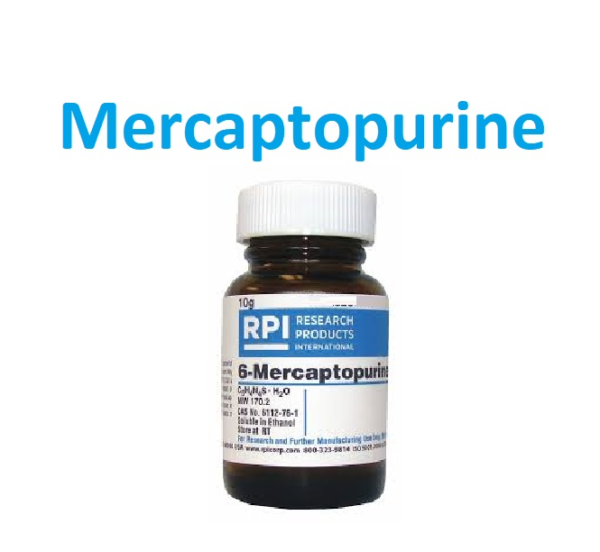
Mercaptopurine (6-MP) is a purine analog that interferes with DNA synthesis. It is used in the treatment of patients with ALL, APML, and inflammatory bowel diseases (ulcerative colitis and Crohn's disease).
Mercaptopurine Uses:
-
Acute lymphoblastic leukemia:
- It is used in the treatment of acute lymphoblastic leukemia (ALL), as part of a combination chemotherapy regimen.
-
Off Label Use of Mercaptopurine in Adults:
- In Acute promyelocytic leukemia as maintenance therapy.
- In Crohn disease for management after surgical resection.
- In Crohn's disease for remission maintenance or steroid-sparing therapy.
- Lymphoblastic lymphoma
- In Ulcerative colitis for remission induction.
- In Ulcerative colitis for remission maintenance.
Mercaptopurine Dose in Adults:
Consider testing for thiopurine S-methyltransferase (TPMT) and nudix hydrolase 15 (nucleotide diphosphatase [NUDT15]) deficiency. Patients with TPMT or NUDT15 deficiency are at increased risk for severe toxicity at conventional mercaptopurine doses and generally require dose reduction (see Dosage adjustment for TPMT or NUDT15 deficiency below).
Mercaptopurine Dose in the treatment of Acute lymphoblastic leukemia (ALL):
-
Maintenance:
- It can be given orally for maintenance regime as 1.5 to 2.5 mg/kg once daily (50 to 75 mg/m² once a day and continue based on blood counts.
-
Off-label ALL dosing (combination chemotherapy; refer to specific reference for combinations):
- Early intensification (two 4-week courses):
- 60 mg/m²/day days 1 to 14.
- Interim maintenance (12-week course):
- 60 mg/m²/day days 1 to 70.
- Maintenance (prolonged):
- 50 mg 3 times/day for 2 years or 60 mg/m²/day for 2 years from diagnosis.
- Early intensification (two 4-week courses):
-
AALL0232:
-
Patients ≤30 years:
- For consolidation, it is given orally as 60 mg/m² once a day on days 1 to 14 and 29 to 42 of a 56-day cycle in combination with cyclophosphamide, cytarabine, vincristine, pegaspargase, and intrathecal methotrexate.
- For interim Maintenance 1 and 2, it is given orally as 25 mg/m² once a day on days 1 to 56 in combination with vincristine, high-dose methotrexate, and intrathecal methotrexate.
- For the maintenance phase, it is given orally as 75 mg/m² once daily on days 1 to 84 of an 84-day cycle in combination with vincristine, steroid, oral methotrexate, and intrathecal methotrexate.
- Maintenance cycles are repeated for a total duration of 2 years (females) and 3 years (males) from the start of Interim Maintenance I.
- During Maintenance, the mercaptopurine (and oral methotrexate) dose may be titrated to target absolute neutrophil count (ANC) and platelet count goals.
-
Mercaptopurine Dose in the treatment of Acute promyelocytic leukemia, maintenance (off-label):
- 60 mg/m²/day for 1 year in combination with tretinoin and methotrexate.
Mercaptopurine Dose in the treatment of Crohn disease, management after surgical resection (off-label):
- it is administered orally as 1.5 mg/kg/day in combination with metronidazole for approximately 18 months after surgery OR
- 50 mg once a day for 24 months, beginning before discharge from hospital.
Mercaptopurine Dose in the treatment of Crohn disease (remission maintenance or steroid-sparing therapy) (off-label):
- it is given orally as 0.75 to 1.5 mg/kg/day in combination with an anti-TNF agent (eg, adalimumab, infliximab).
Mercaptopurine Dose in the treatment of Lymphoblastic lymphoma (off-label):
-
Maintenance (prolonged):
- 50 mg 3 times daily for 2 years.
Mercaptopurine Dose in the treatment of Ulcerative colitis, remission induction (off-label):
- Initially, it is given orally as 50 mg once a day and titrate up to 1.5 mg/kg/day as tolerated.
- It is important to note that monotherapy is not recommended in patients with moderately to severely active ulcerative colitis.
Mercaptopurine Dose in the treatment of Ulcerative colitis, remission maintenance (off-label):
- Orally it is given as 1 to 1.5 mg/kg/day.
Dosage adjustment for TPMT and/or NUDT15 deficiency:
-
Clinical Pharmacogenetics Implementation Consortium (CPIC) guidelines:
-
Normal TPMT or NUDT15 activity (wild type):
- No initial dosage adjustment is necessary.
- The dose is adjusted based on the condition being treated.
- Allow at least 2 weeks after each dosage adjustment to reach a steady state.
- For patients receiving combination therapy, dose adjustments of all agents should be made without any emphasis on mercaptopurine compared to other agents.
-
TPMT intermediate or possible intermediate metabolizer or NUDT15 intermediate or possible intermediate metabolizer:
- Start mercaptopurine with the dose reduced to 30% to 80% of the usual dose and adjust the dose based on the degree of myelosuppression and condition being treated.
- Allow 2 to 4 weeks after each dosage adjustment to reach a steady state.
- If myelosuppression occurs, the focus should be on reducing the mercaptopurine dose over other agents depending on concomitant therapy.
- If the starting dose is already below the normal recommended dose, dose reduction might not be recommended.
-
TPMT poor metabolizer:
- When used to treat malignancy, start mercaptopurine at a significantly reduced dose i.e reduce the daily dose by 10-fold and reduce the frequency from once daily to 3 times a week.
- Adjust the dose based on the degree of myelosuppression and condition being treated.
- Allow 4 to 6 weeks after each dosage adjustment to reach a steady state.
- If myelosuppression occurs, the focus should be on reducing the mercaptopurine dose over other agents depending on concomitant therapy.
- When used for nonmalignant conditions, do consider alternative (non-thiopurine) immunosuppressant therapy.
-
NUDT15 poor metabolizer:
- When used to treat malignancy, start mercaptopurine at 10 mg/m²/day.
- Adjust the dose based on the degree of myelosuppression and condition being treated.
- Allow 4 to 6 weeks after each dosage adjustment to reach a steady state.
- If myelosuppression occurs, the focus should be on reducing the mercaptopurine dose over other agents, depending on concomitant therapy.
- When used for nonmalignant conditions, consider alternative (non-thiopurine) immunosuppressant therapy.
-
-
Manufacturer’s labeling:
- Heterozygous deficiency (intermediate activity):
- Reduce the dose based on tolerability.
- Most patients with heterozygous deficiency of TPMT or NUDT15 tolerate the indicated doses, although some require dosage reduction.
- Patients who are heterozygous for both TPMT and NUDT15 might require more substantial dose reductions.
- Homozygous deficiency (low or deficient activity):
- Reduce the mercaptopurine dose to 10% of the usual dose or lower for homozygous deficiency in either TPMT or NUDT15.
- Heterozygous deficiency (intermediate activity):
Dosage adjustment with concurrent allopurinol:
- Avoid concurrent use of allopurinol. If administered concurrently, reduce mercaptopurine dosage to 25% to 33% of the usual dose.
Mercaptopurine Dose in Childrens:
Patients with minimal or no thiopurine S-methyltransferase (TPMT) activity are at increased risk for severe toxicity at conventional mercaptopurine doses and generally require dose reduction. Consider testing for TPMT and nudix hydrolase 15 (nucleotide diphosphatase [NUDT15]) deficiency. Pediatric doses presented as mg/m and mg/kg. Extra precaution is required for children.
Mercaptopurine Dose in the treatment of Acute lymphoblastic leukemia (ALL):
Multiple regimens and protocols are used but limited data available. Specific local institutional guidelines should be followed.
-
Standard Risk:
- Children 1 to <10 years:
- Consolidation, Interim Maintenance I, and Maintenance:
- Orally it is administered as 75 mg/m² once a day.
- Its frequency and duration are dependent on the protocol phase, in combination with vincristine, steroid, methotrexate [oral and/or intrathecal].
- Maintenance cycles are repeated for a total duration of 2 years (females) and 3 years (males) from the start of Interim Maintenance I.
- During Maintenance, oral methotrexate and mercaptopurine are adjusted to maintain a target ANC goal (generally 1,000 to 2,000/mm³, varies based on the protocol)
- Consolidation, Interim Maintenance I, and Maintenance:
- Children 1 to <10 years:
-
High risk:
-
Children 1 to <10 years:
- Consolidation:
- Orally it is given as 60 mg/m² once a day on days 1 to 14 and 29 to 42 of a 56-day cycle in combination with cyclophosphamide, cytarabine, vincristine, pegaspargase, and intrathecal methotrexate.
- Interim Maintenance:
- Orally it is given as 25 mg/m² once a day on days 1 to 56 in combination with vincristine, high-dose methotrexate, and intrathecal methotrexate.
- Maintenance phase:
- Orally it is given as 75 mg/m² once a day on days 1 to 84 of an 84-day cycle in combination with vincristine, steroid, oral methotrexate, and intrathecal methotrexate.
- Maintenance cycles are repeated for a total duration of 2 years (females) and 3 years (males) from the start of Interim Maintenance I.
- During Maintenance, the oral methotrexate and mercaptopurine are titrated to a target ANC goal (generally 1,000 to 2,000/mm³). It varies based on protocol.
- Consolidation:
-
Mercaptopurine Dose in the treatment of Acute promyelocytic leukemia (APL):
-
Combination with tretinoin: Maintenance phase:
- Children and Adolescents ≤14 years:
- Orally it is given as 100 mg/m²/day for 14 days of a 28-day cycle in combination with tretinoin. Cycles were repeated every 28 days for 2 years.
- Children and Adolescents ≤14 years:
-
Combination with tretinoin and methotrexate:
-
PETHEMA Group: Maintenance phase:
- Children and Adolescents <17 years:
- Orally it is administered as 50 mg/m²/day for 2 years in combination with methotrexate and tretinoin.
- Doses of mercaptopurine and methotrexate were decreased by 50% if the WBC count was <3,500 cells/mm³ and stopped for WBC <2,500/mm³.
- Children and Adolescents <17 years:
-
North American Leukemia Intergroup Study C9710: Maintenance phase:
- Adolescents ≥15 years: Orally it is given as 60 mg/m²/day for 1 year, in combination with tretinoin and methotrexate.
-
Mercaptopurine Dose in the treatment of Autoimmune hepatitis:
Children and Adolescents:
- It is given orally as 1.5 mg/kg/day in combination with prednisone.
- However, it is not considered first-line and typically used for patients who do not tolerate azathioprine.
Mercaptopurine Dose in the treatment of Inflammatory bowel disease (eg, Crohn disease, ulcerative colitis):
-
Children and Adolescents:
- Orally it is given as 1 to 1.5 mg/kg/day.
- Some studies suggest that pediatric patients of less than 6 years may require higher doses to achieve remission.
- A median dose of 1.68 mg/kg/day (maximum daily dose: 2.4 mg/kg/day) was reported to induce remission in 62% of patients vs 17% of those receiving lower doses (<1.5 mg/kg/day study group; median dose: 1.18 mg/kg/day).
- The maximum dose is 50 mg/day in the first week and increased to full dose when patients experience no adverse effects.
Dosing adjustment with concurrent allopurinol:
-
Children and Adolescents:
- Reduce mercaptopurine dosage. Some studies prefer more aggressive reduction than others.
Dosing adjustment in TPMT and/or NUDT15 deficiency: Limited data available:
- Heterozygous deficiency (intermediate activity):
- Reduce the dose based on tolerability.
- According to the literature, most patients with heterozygous deficiency of TPMT or NUDT15 tolerate recommended doses, although some require dosage reduction.
- Patients who are heterozygous for both TPMT and NUDT15 might require more substantial dose reductions.
- Clinical Pharmacogenetics Implementation Consortium (CPIC) guidelines for reduced TPMT activity:
- Start mercaptopurine at a reduced dose of 30% to 70% of the usual dose and adjust based on the degree of myelosuppression and condition being treated.
- Allow 2 to 4 weeks after each dosage adjustment to reach a steady state.
- If a dosage adjustment is required based on myelosuppression, the median dose might be approximately 40% lower than the dose tolerated in wild-type patients.
- For patients receiving combination therapy who experience severe myelosuppression, the focus should be on reducing the mercaptopurine dose over other agents i.e depending on concurrent therapy.
- Homozygous deficiency (low or deficient activity):
- Reduce the mercaptopurine dose to 10% of the usual dose or lower for homozygous deficiency in either TPMT or NUDT15.
- CPIC guidelines for reduced TPMT activity:
- When used for cancer treatment, start mercaptopurine with significantly reduced doses i.e reduce the daily dose by 10-fold and reduce the frequency from once daily to 3 times a week.
- Adjust doses based on the degree of myelosuppression and condition being treated.
- Allow 4 to 6 weeks after each dosage adjustment to reach a steady state.
- For patients receiving combination therapy who experience severe myelosuppression, the focus should be on reducing the mercaptopurine dose over other agents depending on concomitant therapy.
- When used for nonmalignant conditions, consider alternative (non-thiopurine) immunosuppressant therapy.
- Homozygous wild type (normal activity):
- CPIC guidelines for reduced TPMT activity:
- No initial dosage adjustment is indicated.
- Allow 2 weeks after each dosage adjustment to reach a steady state.
- For patients receiving combination therapy, dosage adjustments of all the agents should be made without any emphasis on mercaptopurine compared to other agents.
- CPIC guidelines for reduced TPMT activity:
Mercaptopurine Pregnancy Category: D
- If administered during pregnancy, it could cause harm to the fetus.
- If administered in the second or third trimester, fetal loss can lead to adverse outcomes.
- It is not recommended for women who are pregnant.
Use of mercaptopurine during breastfeeding
- Mercaptopurine, an active metabolite for azathioprine, is Mercaptopurine.
- After administration of azathioprine, mercaptopurine may be detected in breastmilk.
- It is unknown how much of the drug is in breast milk.
- According to literature, the decision to discontinue breastfeeding or stop taking mercaptopurine should be made considering the health benefits to the mother.
Dose in Kidney Disease:
- Initiate with reduced doses i.e starting at the low end of the dosing range or increasing the dosing interval to every 36 to 48 hours to avoid culmination of end products in patients with renal impairment.
- However, no specific dosage adjustment is provided in the manufacturer’s labeling.
Dose in Liver disease:
- Consider a reduced dose i.e starting at the low end of the dosing range with close monitoring for toxicity dose in patients with baseline hepatic impairment.
- However, no specific dosage adjustment is recommended.
Side effects of Mercaptopurine:
-
Central Nervous System:
- Malaise
- Drug Fever
-
Dermatologic:
- Skin Rash
- Hyperpigmentation
- Urticaria
- Alopecia
-
Endocrine & Metabolic:
- Hyperuricemia
-
Gastrointestinal:
- Anorexia
- Diarrhea
- Nausea
- Vomiting
- Oral Lesion
- Pancreatitis
- Cholestasis
- Mucositis
- Sprue-Like Symptoms
- Stomach Pain
- Ulcerative Bowel Lesion
-
Genitourinary:
- Oligospermia
- Renal Toxicity
- Uricosuria
-
Hematologic & Oncologic:
- Bone Marrow Depression
- Anemia
- Granulocytopenia
- Hemorrhage
- Hepatosplenic T-Cell Lymphomas
- Leukopenia
- Lymphocytopenia
- Metastases
- Neutropenia
- Thrombocytopenia
-
Hepatic:
- Hyperbilirubinemia
- Increased Serum Transaminases
- Ascites
- Hepatic Encephalopathy
- Hepatic Fibrosis
- Hepatic Injury
- Hepatic Necrosis
- Hepatomegaly
- Hepatotoxicity
- Intrahepatic Cholestasis
- Jaundice
- Toxic Hepatitis
-
Immunologic:
- Immunosuppression
-
Infection:
- Infection
-
Respiratory:
- Pulmonary Fibrosis
Contraindications to Mercaptopurine:
- Hypersensitivity to mercaptopurine and any of its components is an absolute contraindication.
- Patients whose diseases have shown resistance to mercaptopurine in the past.
Warnings and precautions
-
Suppression of bone marrow
- Anemia, thrombocytopenia and dose-related leukopenia can all occur. It can also be a sign of disease progression.
- Hematologic toxicities may be delayed.
- Hypoplastic bone marrow could be a possibility.
- Monitor for bleeding caused by thrombocytopenia and infection due to neutropenia.
- A thiopurine-methyltransferase deficiency (TPMT) or nudixhydrlase 15 (nucleotide dimphosphatase [NUDT15] deficiency) is a sign of severe or persistent hematologic toxicities (see below "TPMT and NUDT15 deficiencies"). Patients homozygous to TPMT or NUDT15 deficiencies will need substantial dosage reductions.
- Patients with low TPMT and NUDT15 enzyme activity can be identified by TPMT genotyping, phenotyping, or NUDT15 genotyping.
-
Hepatotoxicity
- There have been cases of hepatotoxicity, which can include jaundice and ascites. It can also be fatal. This can occur due to hepatic cell injury or hypersensitivity.
- Hepatotoxicity and hepatic injuries can occur at any dose. However, higher doses are associated with a greater incidence.
- Jaundice symptoms usually appear after treatment has ended. They may disappear after approximately one to two months.
- There has been evidence of jaundice recurring with re-challenge.
- Monitoring liver function tests including transaminases and alkalinephosphatase weekly after treatment initiation, and monthly thereafter, is a good idea.
- Patients with preexisting hepatic impairment or those taking hepatotoxic drugs should be monitored more often.
- Patients with pre-existing hepatic impairment may be able to take a lower dose. Pay attention to potential toxicity.
- Stop treating clinical signs of jaundice, such as anorexia, hepatomegaly and tenderness.
-
Immunosuppression
- Mercaptopurine can be immunosuppressive, which means that immune responses to infections might be impaired and the risk of infection may increase.
- Fever and leukocytosis are not common signs of infection. Lethargy and confusion, however, are the more obvious signs of infection.
-
Macrophage activation Syndrome:
- Patients with autoimmune disorders, such as inflammatory bowel disease (IBS), may be susceptible to Macrophage activation Syndrome (MAS). This is a potentially life-threatening condition. Mercaptopurine may be used off-label to treat autoimmune conditions. This could increase your susceptibility for MAS.
- If MAS is suspected or develops, you should withhold mercaptopurine.
- It is important to promptly treat infections like Epstein-Barr virus, cytomegalovirus and EBV.
-
Photosensitivity
- As photosensitivity increases, sun exposure must be minimized.
-
Secondary malignancy
- Lympoproliferative diseases and other malignancies are often caused by immunosuppressive drugs, such as mercaptopurine.
- An analysis of T cell lymphomas that were associated with TNF blockers, with or without thiopurines (off-label uses of thiopurines), revealed an increase in incidence of T cells lymphomas.
- This was most often mycosis fungoides, Sezary syndrome, and hepatosplenic T lymphoma (HSTCL).
- HSTCL is a rare form of white blood cell cancer, which is often fatal.
- Patients receiving combination of thiopurines and TNF blockers were most likely to have HSTCL. However, HSTCL can also occur in patients who receive azathioprine monotherapy or mercaptopurine.
- Patients receiving immunosuppressive therapy have been diagnosed with skin cancers such as melanoma and nonmelanoma, Kaposi, non-Kaposi and uterine cervical carcinoma in-situ.
- The duration and degree of immunosuppression may influence the risk of developing skin cancers.
- After discontinuation of therapy, partial regression may occur in lymphoproliferative disorders.
- It is important to be cautious when using multiple immunosuppressants, as they can increase the likelihood of EBV-associated lymphoproliferative disorder.
-
Renal impairment
- Patients with impaired renal function should be considered for dose adjustments.
- In such cases, a lower dose or a longer time interval is preferable.
- Hydration and prophylactic antihyperuricemic therapy may reduce some of the adverse renal effects.
-
TPMT/NUDT15 deficiency
- Patients with reduced TPMT and NUDT15 activity are at greater risk of severe myelosuppression when they take the usual doses (eg, Mercaptopurine or Azathioprine, Thioguanine) and may require significant dose reductions.
- High risk of bone marrow suppression is present for individuals who are either TPMT homozygous, or compound heterozygous.
- Patients at high risk of developing these impairments may be identified by TPMT genotyping, phenotyping, and NUDT15 genotyping.
- Patients who have suffered severe bone marrow toxicities, repeated myelosuppressive episodes, or multiple bone marrow toxicities should be tested for TPMT and NUDT15 deficiencies.
- Patients who have had recent blood transfusions are not able to provide accurate diagnostic results (red blood cells TPMT activity).
- Clinical Pharmacogenetics Implementation Consortium's (CPIC) guidelines for thiopurine dosing based upon TPMT genotypes and NUDT15 intermediate metabolizers (Relling 2019, 2019) recommends lower initial doses for TPMT intermediate and possible intermediate metabolizers and dose adjustments based based on myelosuppression.
- The CPIC guideline for NUDT15 and TPMT poor metabolizers recommends that you consider non-thiopurine alternatives to treat nonmalignant conditions. Also, significantly lower doses are recommended if the agent is used to treat malignancy.
- Thiopurine intolerance is most commonly caused by genetic TPMT deficiencies in Europeans and Africans. The majority of thiopurine intolerance in Asians is due to the NUDT15 risk variants. They are also very common in Hispanics.
Monitoring parameters:
- CBC with differential (weekly initially, although clinical status may require increased frequency).
- bone marrow exam (to evaluate leukemia status and marrow cellularity in patients with prolonged or repeated myelosuppression).
- liver function tests (transaminases, alkaline phosphatase, and bilirubin.
- They should be done weekly initially, then monthly. Monitor more frequently if on concomitant hepatotoxic agents or in patients with preexisting hepatic impairment.
- Renal functions and urinalysis.
- Signs & symptoms of macrophage activating syndrome.
- photosensitivity reactions.
- Observe adherence.
Thiopurine S-methyltransferase (TPMT) genotyping or phenotyping:
- Consider testing for TPMT deficiency, particularly in patients with abnormally low CBC unresponsive to dose reduction.
- TPMT genotyping or phenotyping may assist in identifying patients at risk for developing toxicity.
Nudix hydrolase 15 (NUDT15) genotyping:
- Consider genotyping for NUDT15 deficiency in patients who experience severe bone marrow toxicities or repeated myelosuppressive episodes.
- NUDT15 genotyping may assist in identifying patients at risk for developing toxicity.
Crohn disease or ulcerative colitis (off-label uses):
- Monitor CBC with differential weekly for 1 month, then biweekly for 1 month, followed by monitoring every 1 to 2 months throughout the course of therapy.
- LFTs should be checked every 3 months. Observe for signs and symptoms of malignancy like splenomegaly, hepatomegaly, abdominal pain, persistent fever, night sweats, and weight loss.
How to administer Mercaptopurine?
- Administer preferably on an empty stomach.
- Avoid concomitant milk products if possible.
- Administer at the same time(s) each day.
- If adherence is limited by administering on an empty stomach in the evening or by avoiding concomitant milk products, simplification of administration (eg, take with food/dairy without regard to time of day) should be considered.
- In adherent patients (taking mercaptopurine regularly), no association was seen between the risk of ALL relapse and mercaptopurine ingestion habits.
- There was also no association noted with red cell thioguanine nucleotide (TGN) levels and administration with food, dairy, or time of day.
Suspension:
- Shake vigorously for at least 30 seconds to ensure the suspension is mixed thoroughly (suspension is viscous).
- Measure dose with an oral dosing syringe (a 1 mL and a 5 mL oral dosing syringe are supplied by the manufacturer) to assure proper dose is administered.
- Patients and caregivers should be trained on appropriate measuring and administration, handling, storage, disposal, cleanup of accidental spills, and proper cleaning of oral dosing syringe. Use within 8 weeks after opening.
Mechanism of action of Mercaptopurine:
- Mercaptopurine is a purine antagonist that inhibits DNA and RNA synthesis. It acts as a false metabolite and is incorporated into DNA and RNA, eventually inhibiting their synthesis.
- It is specific for the S phase of the cell cycle.
Absorption:
- Variable and incomplete (~50% of a dose is absorbed). Cmax of suspension is 34% higher than the tablet
Distribution: CNS penetration is poor Protein binding:
- About 19%
Metabolism:
- Hepatic metabolism and in GI mucosa.
- Hepatically via xanthine oxidase and methylation via thiopurine methyltransferase to sulfate conjugates, 6-thiouric acid, and other inactive compounds.
- It does have a first-pass effect.
Half-life elimination:
- Tablets:
- Children: 21 minutes.
- Adults: 47 minutes.
- Suspension: ~2 hours
Time to peak, serum:
- Within 2 hours
Excretion:
- Urine (46% as mercaptopurine and metabolites)
International Brand Names of Mercaptopurine:
- Purixan
- Purinethol
- 6-MP
- Allmercap
- Capmerin
- Empurine
- Leukin
- Mercaptopurina
- Merkaptopurin
- Merpurin
- Puri-Nethol
- Puri-nethol
- Purinethjol
- Purinethol
- PuriNethol
- Purinetone
- Varimer
- Xaluprine
Mercaptopurine Brand Names in Pakistan:
Mercaptopurine (Monohydrate) Tablets 50 mg in Pakistan |
|
| Mercaprine | Pharmedic (Pvt) Ltd. |
| Mercaptepurine | Lahore Chemical & Pharmaceutical Works (Pvt) Ltd |
| Purinetone | Al-Habib Pharmaceuticals. |
.png)


