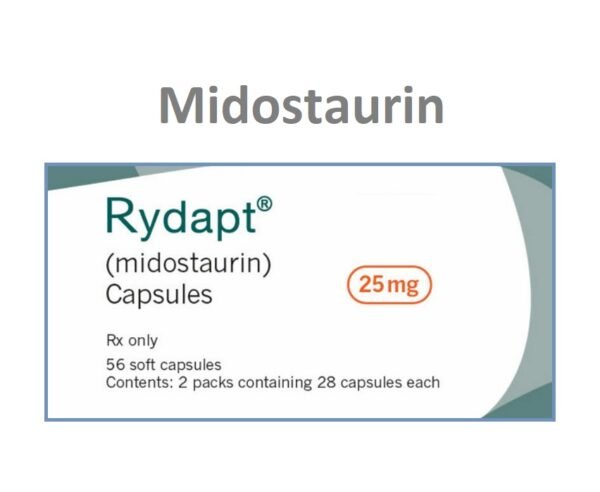
Midostaurin (Rydapt) is a multi-targeted tyrosine kinase inhibitor that is used in the treatment of various hematological diseases such as acute myeloid leukemia and mast cell leukemia.
Midostaurin (Rydapt) Uses:
-
Acute myeloid leukemia, FLT3-positive:
- It is used in the treatment of adult patients with newly diagnosed FLT3 mutation-positive (as detected by a standard test) acute myeloid leukemia (AML), in addition to standard cytarabine and daunorubicin induction and cytarabine consolidation chemotherapy.
- Limitations of use: It should Notbe used as single-agent induction therapy for the treatment of patients with AML.
-
Mast cell leukemia:
- It is also used in the management of adult patients with mast cell leukemia (MCL)
-
Systemic mastocytosis:
- It is used to treat aggressive systemic mastocytosis (ASM) or systemic mastocytosis associated with hematological neoplasm (SM-AHN)
Midostaurin Dose in Adults:
Note: Midostaurin is associated with moderate symptoms of nausea and vomiting. antiemetics should be given prior to treatment to prevent such symptoms.
Midostaurin (Rydapt) Dose in the treatment of Acute myeloid leukemia (AML), FLT3-positive: Oral:
-
Induction:
- 50 mg twice a day on days 8 to 21 of each induction cycle (in combination with daunorubicin and cytarabine). Administer a second induction cycle if there is definitive evidence of significant residual leukemia.
-
Consolidation:
- 50 mg twice a day on days 8 to 21 of each 28-day consolidation cycle in combination with high-dose cytarabine for 4 consolidation cycles.
-
Maintenance (off- label):
- 50 mg twice a day on days 1 to 28 of each 28-day maintenance cycle for 12 cycles or until relapse of the disease, whichever occurs first.
Midostaurin (Rydapt) Dose in the treatment of Mast cell leukemia:
- Orally it can be given as 100 mg twice a day till disease progression or unacceptable toxicity.
Midostaurin (Rydapt) Dose in the treatment of Systemic mastocytosis (aggressive systemic mastocytosis or systemic mastocytosis with associated hematological neoplasm):
- Orally it can be given as 100 mg twice a day until disease progression or unacceptable toxicity is noted.
-
Missed doses:
- If a dose is missed or vomited out, then a repeat dose is not recommended. Take the next dose at the usually scheduled time.
Use in Children:
Not indicated.
Midostaurin (Rydapt) Pregnancy Category: N
- In animal studies, fetal harm in utero was documented. Therefore, pregnancy is not recommended.
- You should not become pregnant within seven days of therapy initiation.
- Effective double contraception should be used by females with reproductive potential and males who have female partners of reproductive years. This should be done during therapy as well as for at least four months following the last dose.
- Contact the Novartis Pharmaceuticals Corporation at 1 888669-6682 or at.
Use of midostaurin during breastfeeding
- It is unknown whether breast milk contains it.
- Due to the risk of serious adverse reactions in breastfed infants, the manufacturer does not recommend lactation during therapy or for more than 4 months after the last dose.
Midostaurin (Rydapt) Dose in Kidney Disease:
- CrCl ≥30 mL/minute:
- No dose adjustment required. However, the pharmacokinetics of midostaurin and active metabolites were not significantly distorted.
- CrCl 15 to 29 mL/minute:
- Below CrcL of 29ml/minute, studies have not been done to ensure its safety profile.
Midostaurin (Rydapt) Dose in Liver disease:
- Mild (total bilirubin >1 to 1.5 times ULN or AST > ULN) or moderate (total bilirubin 1.5 to 3 times ULN and any AST) impairment:
- No dose adjustments are required according to the manufacturer. However, the pharmacokinetics of midostaurin and active metabolites were not significantly changed in CLD.
- Severe impairment (total bilirubin >3 times ULN and any AST):
- Dose adjustments in severe liver disease have not yet been studied.
Common Side Effects of Midostaurin (Rydapt):
-
Cardiovascular:
- Edema
- Prolonged Q-T Interval On ECG
-
Central Nervous System:
- Headache
- Fatigue
- Dizziness
- Insomnia
-
Dermatologic:
- Hyperhidrosis
- Skin Rash
-
Endocrine & Metabolic:
- Hyperglycemia
- Hypocalcemia
- Hyperuricemia
- Increased Gamma-Glutamyl Transferase
- Hyponatremia
- Hypoalbuminemia
- Hypokalemia
- Hyperkalemia
- Hypophosphatemia
- Hypernatremia
- Hypomagnesemia
-
Gastrointestinal:
- Nausea
- Vomiting
- Mucositis
- Diarrhea
- Increased Serum Lipase
- Abdominal Pain
- Constipation
- Increased Serum Amylase
- Hemorrhoids
- Gastrointestinal Hemorrhage
-
Genitourinary:
- Urinary Tract Infection
-
Hematologic & Oncologic:
- Febrile Neutropenia
- Lymphocytopenia
- Leukopenia
- Anemia
- Thrombocytopenia
- Neutropenia
- Petechia
- Prolonged Partial Thromboplastin Time
-
Hepatic:
- Increased Serum ALT
- Increased Serum Alkaline Phosphatase
- Increased Serum AST
- Hyperbilirubinemia
-
Infection:
- Localized Infection
-
Neuromuscular & Skeletal:
- Musculoskeletal Pain
- Arthralgia
-
Renal:
- Increased Serum Creatinine
- Renal Insufficiency
-
Respiratory:
- Upper Respiratory Tract Infection
- Epistaxis
- Dyspnea
- Cough
- Pleural Effusion
-
Miscellaneous:
- Fever
Less Common Side Effects of Midostaurin (Rydapt):
-
Cardiovascular:
- Hypotension
- Hypertension
- Cardiac Failure
- Thrombosis
- Pericardial Effusion
- Ischemia
- Myocardial Infarction
-
Central Nervous System:
- Disturbance In Attention
- Chills
- Vertigo
- Mental Status Changes
-
Dermatologic:
- Xeroderma
- Cellulitis
- Erysipelas
-
Endocrine & Metabolic:
- Weight Gain
- Hypercalcemia
-
Gastrointestinal:
- Dyspepsia
- Gastritis
-
Hematologic & Oncologic:
- Bruise
- Hematoma
-
Hypersensitivity:
- Hypersensitivity
-
Infection:
- Herpes Virus Infection
- Sepsis
- Fungal Infection
-
Neuromuscular & Skeletal:
- Tremor
-
Ophthalmic:
- Eyelid Edema
-
Respiratory:
- Pneumonia
- Bronchitis
- Oropharyngeal Pain
- Pulmonary Edema
- Interstitial Pulmonary Disease
- Pneumonitis
Contraindications to Midostaurin (Rydapt):
The drug should not be used if hypersensitivity develops.
Warnings and precautions
-
Suppression of bone marrow
- Patients with systemic mastocytosis have often experienced anemia, neutropenia and leukopenia.
- Concurrent chemotherapy may cause hematologic toxicities in patients with acute myeloid leukemia.
- Patients with AML who received chemotherapy plus midostaurin had a slightly higher rate of febrile neutropenia (as opposed to patients receiving chemotherapy plus placebo).
- It is important to monitor blood counts regularly.
-
Toxicity to the GI:
- Midostaurin may cause mild symptoms such as nausea and vomiting. To prevent nausea or vomiting, you can give antiemetic medication before treatment.
- Other symptoms include constipation, diarrhea, and abdominal pain.
- It is also possible to have mucositis.
-
Hypersensitivity
- Reports of hypersensitivity reactions including anaphylactic shock and angioedema, dyspnea chest pain, flushing, and dyspnea have been made.
-
Extension of QT
- QT prolongation has been observed. Patients taking concurrent drugs that can prolong the QT interval should take ECG into consideration.
-
Toxicity in the lungs:
- Midostaurin has been used in a variety of studies to treat interstitial lung disease (ILD) and pneumonitis. It can be administered as monotherapy or combined with other chemotherapy. In some cases, death has been reported.
- If you experience pulmonary symptoms, stop taking the drug
- Without clinically significant infection, signs and symptoms of interstitial pulmonary disease or pneumonitis can be observed.
Midostaurin: Drug Interaction
|
Antidiabetic Agents |
Hyperglycemia-Associated Agents may diminish the therapeutic effect of Antidiabetic Agents. |
|
Aprepitant |
May increase the serum concentration of CYP3A4 Substrates (High risk with Inhibitors). |
|
Bosentan |
May decrease the serum concentration of CYP3A4 Substrates (High risk with Inducers). |
|
Chloramphenicol (Ophthalmic) |
May enhance the adverse/toxic effect of Myelosuppressive Agents. |
|
Chloroquine |
QT-prolonging Miscellaneous Agents (Moderate Risk) may enhance the QTcprolonging effect of Chloroquine. Management: Monitor for QTc interval prolongation and ventricular arrhythmias when these agents are combined. Patients with additional risk factors for QTc prolongation may be at even higher risk. |
|
Clofazimine |
QT-prolonging Miscellaneous Agents (Moderate Risk) may enhance the QTcprolonging effect of Clofazimine. Management: Monitor for QTc interval prolongation and ventricular arrhythmias when these agents are combined. Patients with additional risk factors for QTc prolongation may be at even higher risk. |
|
Clofazimine |
May increase the serum concentration of CYP3A4 Substrates (High risk with Inhibitors). |
|
CYP3A4 Inducers (Moderate) |
May decrease the serum concentration of CYP3A4 Substrates (High risk with Inducers). |
|
CYP3A4 Inhibitors (Moderate) |
May decrease the metabolism of CYP3A4 Substrates (High risk with Inhibitors). |
|
Deferasirox |
May decrease the serum concentration of CYP3A4 Substrates (High risk with Inducers). |
|
Duvelisib |
May increase the serum concentration of CYP3A4 Substrates (High risk with Inhibitors). |
|
Erdafitinib |
May decrease the serum concentration of CYP3A4 Substrates (High risk with Inducers). |
|
Erdafitinib |
May increase the serum concentration of CYP3A4 Substrates (High risk with Inhibitors). |
|
Fosaprepitant |
May increase the serum concentration of CYP3A4 Substrates (High risk with Inhibitors). |
|
Fosnetupitant |
May increase the serum concentration of CYP3A4 Substrates (High risk with Inhibitors). |
|
Gadobenate Dimeglumine |
QT-prolonging Miscellaneous Agents (Moderate Risk) may enhance the QTc-prolonging effect of Gadobenate Dimeglumine. Management: Monitor for QTc interval prolongation and ventricular arrhythmias when these agents are combined. Patients with additional risk factors for QTc prolongation may be at even higher risk. |
|
Halofantrine |
QT-prolonging Miscellaneous Agents (Moderate Risk) may enhance the QTcprolonging effect of Halofantrine. Management: Monitor for QTc interval prolongation and ventricular arrhythmias when these agents are combined. Patients with additional risk factors for QTc prolongation may be at even higher risk. |
|
Haloperidol |
QT-prolonging Miscellaneous Agents (Moderate Risk) may enhance the QTcprolonging effect of Haloperidol. Management: Monitor for QTc interval prolongation and ventricular arrhythmias when these agents are combined. Patients with additional risk factors for QTc prolongation may be at even higher risk. |
|
Larotrectinib |
May increase the serum concentration of CYP3A4 Substrates (High risk with Inhibitors). |
|
Lofexidine |
QT-prolonging Miscellaneous Agents (Moderate Risk) may enhance the QTcprolonging effect of Lofexidine. Management: Monitor for QTc interval prolongation and ventricular arrhythmias when these agents are combined. Patients with additional risk factors for QTc prolongation may be at even higher risk. |
|
Mesalamine |
May enhance the myelosuppressive effect of Myelosuppressive Agents. |
|
Netupitant |
May increase the serum concentration of CYP3A4 Substrates (High risk with Inhibitors). |
|
Ondansetron |
QT-prolonging Miscellaneous Agents (Moderate Risk) may enhance the QTcprolonging effect of Ondansetron. Management: Monitor for QTc interval prolongation and ventricular arrhythmias when these agents are combined. Patients with additional risk factors for QTc prolongation may be at even higher risk. |
|
Palbociclib |
May increase the serum concentration of CYP3A4 Substrates (High risk with Inhibitors). |
|
Pentamidine (Systemic) |
QT-prolonging Miscellaneous Agents (Moderate Risk) may enhance the QTc-prolonging effect of Pentamidine (Systemic). Management: Monitor for QTc interval prolongation and ventricular arrhythmias when these agents are combined. Patients with additional risk factors for QTc prolongation may be at even higher risk. |
|
Promazine |
May enhance the myelosuppressive effect of Myelosuppressive Agents. |
|
QT-prolonging Antidepressants (Moderate Risk) |
May enhance the QTc-prolonging effect of QTprolonging Miscellaneous Agents (Moderate Risk). Management: Monitor for QTc interval prolongation and ventricular arrhythmias when these agents are combined. Patients with additional risk factors for QTc prolongation may be at even higher risk. |
|
QT-prolonging Antipsychotics (Moderate Risk) |
QT-prolonging Miscellaneous Agents (Moderate Risk) may enhance the QTc-prolonging effect of QT-prolonging Antipsychotics (Moderate Risk). Management: Monitor for QTc interval prolongation and ventricular arrhythmias when these agents are combined. Patients with additional risk factors for QTc prolongation may be at even higher risk. Exceptions: Pimozide. |
|
QT-prolonging Class IC Antiarrhythmics (Moderate Risk) |
QT-prolonging Miscellaneous Agents (Moderate Risk) may enhance the QTc-prolonging effect of QT-prolonging Class IC Antiarrhythmics (Moderate Risk). Management: Monitor for QTc interval prolongation and ventricular arrhythmias when these agents are combined. Patients with additional risk factors for QTc prolongation may be at even higher risk. |
|
QT-prolonging Kinase Inhibitors (Moderate Risk) |
May enhance the QTc-prolonging effect of QTprolonging Miscellaneous Agents (Moderate Risk). Management: Monitor for QTc interval prolongation and ventricular arrhythmias when these agents are combined. Patients with additional risk factors for QTc prolongation may be at even higher risk. |
|
QT-prolonging Miscellaneous Agents (Moderate Risk) |
May enhance the QTc-prolonging effect of Midostaurin. Management: Monitor for QTc interval prolongation and ventricular arrhythmias when these agents are combined. Patients with additional risk factors for QTc prolongation may be at even higher risk. Exceptions: Chloroquine; Clofazimine; Domperidone; Gadobenate Dimeglumine; Halofantrine; Lofexidine. |
|
QT-prolonging Moderate CYP3A4 Inhibitors (Moderate Risk) |
May enhance the QTc-prolonging effect of QT-prolonging Miscellaneous Agents (Moderate Risk). QT-prolonging Moderate CYP3A4 Inhibitors (Moderate Risk) may increase the serum concentration of QT-prolonging Miscellaneous Agents (Moderate Risk). Management: Monitor for QTc interval prolongation and ventricular arrhythmias when these agents are combined. Patients with additional risk factors for QTc prolongation may be at even higher risk. |
|
QT-prolonging Quinolone Antibiotics (Moderate Risk) |
QT-prolonging Miscellaneous Agents (Moderate Risk) may enhance the QTc-prolonging effect of QT-prolonging Quinolone Antibiotics (Moderate Risk). Management: Monitor for QTc interval prolongation and ventricular arrhythmias when these agents are combined. Patients with additional risk factors for QTc prolongation may be at even higher risk. |
|
Sarilumab |
May decrease the serum concentration of CYP3A4 Substrates (High risk with Inducers). |
|
Siltuximab |
May decrease the serum concentration of CYP3A4 Substrates (High risk with Inducers). |
|
Simeprevir |
May increase the serum concentration of CYP3A4 Substrates (High risk with Inhibitors). |
|
Tocilizumab |
May decrease the serum concentration of CYP3A4 Substrates (High risk with Inducers). |
|
Risk Factor D (Consider therapy modification) |
|
|
Conivaptan |
May increase the serum concentration of Midostaurin. Management: Seek alternatives to the concomitant use of midostaurin and conivaptan if possible. If concomitant use cannot be avoided, monitor patients for increased risk of adverse reactions. |
|
CYP3A4 Inhibitors (Strong) |
|
|
Dabrafenib |
May decrease the serum concentration of CYP3A4 Substrates (High risk with Inducers). Management: Seek alternatives to the CYP3A4 substrate when possible. If concomitant therapy cannot be avoided, monitor clinical effects of the substrate closely (particularly therapeutic effects). |
|
Deferiprone |
Myelosuppressive Agents may enhance the neutropenic effect of Deferiprone. Management: Avoid the concomitant use of deferiprone and myelosuppressive agents whenever possible. If this combination cannot be avoided, monitor the absolute neutrophil count more closely. |
|
DilTIAZem |
May increase the serum concentration of Midostaurin. Management: Seek alternatives to the concomitant use of midostaurin and diltiazem if possible. If concomitant use cannot be avoided, monitor patients for increased risk of adverse reactions. |
|
Domperidone |
QT-prolonging Agents (Moderate Risk) may enhance the QTc-prolonging effect of Domperidone. Management: Consider alternatives to this drug combination. If combined, monitor for QTc interval prolongation and ventricular arrhythmias. Patients with additional risk factors for QTc prolongation may be at even higher risk. |
|
Grapefruit Juice |
May increase the serum concentration of Midostaurin. Management: Seek alternatives to the concomitant use of midostaurin and grapefruit juice if possible. If concomitant use cannot be avoided, monitor patients for increased risk of adverse reactions |
|
Lorlatinib |
May decrease the serum concentration of CYP3A4 Substrates (High risk with Inducers). Management: Avoid concurrent use of lorlatinib with any CYP3A4 substrates for which a minimal decrease in serum concentrations of the CYP3A4 substrate could lead to therapeutic failure and serious clinical consequences. |
|
MiFEPRIStone |
May increase the serum concentration of CYP3A4 Substrates (High risk with Inhibitors). Management: Minimize doses of CYP3A4 substrates, and monitor for increased concentrations/toxicity, during and 2 weeks following treatment with mifepristone. Avoid cyclosporine, dihydroergotamine, ergotamine, fentanyl, pimozide, quinidine, sirolimus, and tacrolimus. |
|
QT-prolonging Agents (Highest Risk |
May enhance the QTc-prolonging effect of Midostaurin. Management: Consider alternatives to this combination. If combined, monitor for QTc interval prolongation and ventricular arrhythmias. Patients with additional risk factors for QTc prolongation may be at even higher risk. |
|
QT-prolonging Strong CYP3A4 Inhibitors (Moderate Risk) |
May enhance the QTc-prolonging effect of Midostaurin. QT-prolonging Strong CYP3A4 Inhibitors (Moderate Risk) may increase the serum concentration of Midostaurin. Management: Consider alternatives to this drug combination. If combined, monitor for QTc interval prolongation and ventricular arrhythmias. Patients with additional risk factors for QTc prolongation may be at even higher risk. |
|
Stiripentol |
May increase the serum concentration of CYP3A4 Substrates (High risk with Inhibitors). Management: Use of stiripentol with CYP3A4 substrates that are considered to have a narrow therapeutic index should be avoided due to the increased risk for adverse effects and toxicity. Any CYP3A4 substrate used with stiripentol requires closer monitoring. |
|
Risk Factor X (Avoid combination) |
|
|
BCG (Intravesical) |
Myelosuppressive Agents may diminish the therapeutic effect of BCG (Intravesical). |
|
Cladribine |
May enhance the myelosuppressive effect of Myelosuppressive Agents. |
|
CYP3A4 Inducers (Strong) |
May decrease the serum concentration of Midostaurin. |
|
Dipyrone |
May enhance the adverse/toxic effect of Myelosuppressive Agents. Specifically, the risk for agranulocytosis and pancytopenia may be increased |
|
Fexinidazole [INT] |
May enhance the QTc-prolonging effect of QT-prolonging Agents (Moderate Risk). |
|
Fusidic Acid (Systemic) |
May increase the serum concentration of CYP3A4 Substrates (High risk with Inhibitors). |
|
Idelalisib |
May increase the serum concentration of CYP3A4 Substrates (High risk with Inhibitors). |
|
Lefamulin |
May enhance the QTc-prolonging effect of QT-prolonging CYP3A4 Substrates. Management: Do not use lefamulin tablets with QT-prolonging CYP3A4 substrates. Lefamulin prescribing information lists this combination as contraindicated. |
|
Pimozide |
May enhance the QTc-prolonging effect of QT-prolonging Agents (Moderate Risk). |
|
Posaconazole |
May increase the serum concentration of QT-prolonging CYP3A4 Substrates. Such increases may lead to a greater risk for proarrhythmic effects and other similar toxicities. |
|
St John's Wort |
May decrease the serum concentration of Midostaurin. |
Monitoring parameters:
- It is important to confirm the FLT3 mutation status in AML.
- CBC with differential count (in patients suffering from systemic mastocytosis, at least weekly for the initial 4 weeks, every two weeks for the next 8 and monthly thereafter, or as clinically indicated).
- Women with reproductive potential should have their pregnancy status checked within seven days of the initiation of therapy.
- Pulmonary toxicity symptoms should be excluded, such as interstitial lung disease or pneumonitis.
- Patients taking concurrent drugs that can prolong the QT interval should consider ECG.
- For compliance, monitor
How to administer Midostaurin (Rydapt)?
Oral: It should be administered with food at approximately 12-hour intervals. Do not open or crush the capsules.
Mechanism of action of Midostaurin (Rydapt):
- Midostaurin, a tyrosinekinase inhibitor, inhibits multiple receptors such as FLT3 mutant kinases FLT3 wild type, ITD andTKD, and PDGFRa/b and VEGFR2, as well members of the Serine/Threonine Protein Kinase C (PKC).
- Midostaurin blocks FLT3 receptor signaling, cell proliferation and induces death in ITDandTKD-mutant expressing leukemic and wild type FLT3 cells. It may also inhibit KIT signaling and cell proliferation.
Absorption:
- Exposure was increased 1.2- or 1.6-fold when administered with a standard or high-fat meal, respectively, compared to the fasted state.
- Midostaurin C was reduced by 20% and 27%, respectively, when administered with a standard or high-fat meal compared to a fasted state.
Distribution: 95.2 L Protein binding:
- >99.8% is bound to plasma proteins (parent drug, CGP62221, and CGP52421). midostaurin is mainly bound to α1-acid glycoprotein
Metabolism:
- Primarily hepatic via CYP3A4 to active metabolites CGP62221 and CGP52421
Half-life elimination:
- 19 hours (midostaurin). 32 hours for (CGP62221) and 482 hours for (CGP52421)
Time to peak:
- 1 to 3 hours (fasted state). And 2.5 to 3 hours (with standard or high-fat meal)
Excretion:
- Feces (95%; 91% as metabolites and 4% as unchanged drug). Via urine (5%)
International Brand Names of Midostaurin:
- Rydapt
Midostaurin Brand Names in Pakistan:
No Brands Available in Pakistan.
.png)