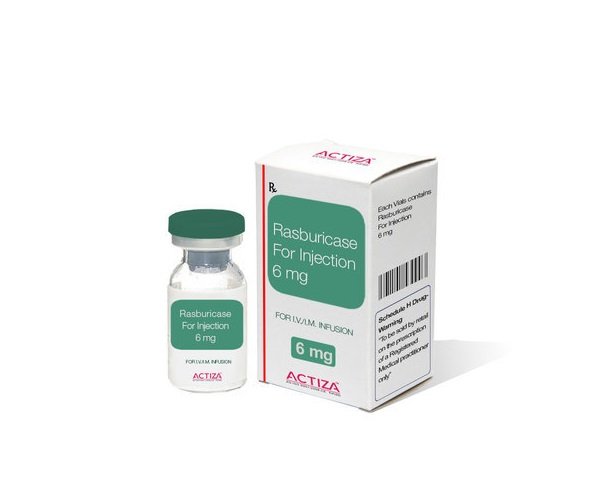
Rasburicase is a urate oxidase enzyme prepared by recombinant technology, which converts uric acid to allantoin (an inactive and soluble metabolite of uric acid).
-
It is used in the initial management of plasma uric acid levels in pediatric and adult patients with:
- leukemia,
- lymphoma, and
- solid tumor malignancies getting chemotherapy expected to result in tumor lysis and elevation of plasma uric acid
-
It is indicated only for a single course of treatment
Read: Asymptomatic Hyperuricemia Guidelines
Rasburicase Dose in Adults
Rasburicase Dosage in the treatment of Hyperuricemia associated with malignancy:
-
- 0.05 to 0.2 mg/kg once daily for 1 to 7 days is given (average of 2 to 3 days) with the duration of treatment dependent on plasma uric acid levels and clinical judgment.
- Patients with a high tumor burden may require twice daily or an increase in the dose
-
The following dose levels are recommended according to risk of tumor lysis syndrome (TLS):
-
High risk:
- 2 mg/kg once daily is given (duration is based on plasma uric acid levels)
-
Intermediate risk:
- 1.5 mg/kg once daily is given (duration is based on plasma uric acid levels)
-
Low risk:
- 1 mg/kg once daily is given(duration is based on clinical judgment).
- Doses as low as 0.05 mg/kg have been used effectively in studies.
-
-
Off label Single-dose rasburicase :
- 15 mg/kg or 3 to 7.5 mg as a single dose is given
- repeat doses (1.5 to 6 mg) might be needed based on serum uric acid levels.
- if the uric acid level is less than 12 mg/dL, then single doses of 3 mg or 4.5 mg may be considered with close monitoring and if needed, repeat doses.
-
Prevention of hyperuricemia in high-risk patients with hematologic malignancies (off-label dosing):
- 3 mg intravenous as a single dose is given
-
Manufacturer’s labeling:
- 0.2 mg/kg once a day for up to 5 days.
- Use beyond 5 days or administration of more than 1 course is not recommended.
Rasburicase Dose in Childrens
Rasburicase Dosage in the treatment of Hyperuricemia associated with malignancy:
- Infants, Children, and Adolescents:
- Multiple-dosing:
-
Manufacturer's labeling (Elitek):
- 0.2 mg/kg/dose intravenous once daily is given for up to 5 days
-
Alternate dosing
- 0.05 to 0.2 mg/kg/dose intravenous once daily is given for 1 to 7 days (average: 2 to 3 days) with the duration of treatment according to plasma uric acid levels and clinical judgment.
- Patients with a high tumor burden may require twice daily or an increase in the dose.
-
-
The following dose levels are adjusted based on risk of tumor lysis syndrome (TLS):
-
High risk and baseline uric acid level of greater than 7.5 mg/dL:
- 2 mg/kg/dose once daily is given(duration is based on plasma uric acid levels)
-
Intermediate risk and baseline uric acid level of less than 7.5 mg/dL:
- 1.5 mg/kg/dose once daily is given (duration is based on plasma uric acid levels); may consider managing initially with a single dose
-
Low risk and baseline uric acid level <7.5 mg/dL:
- 1 mg/kg/dose once daily is given (duration is based on clinical judgment)
-
- Multiple-dosing:
-
Single-dose:
- 0.15 mg/kg/dose intravenous is given; additional doses may be needed based on serum uric acid levels
-
Prevention in high-risk patients with hematologic malignancies:
- 0.2 mg/kg/dose IV as a single dose is given
Pregnancy Risk Factor C
- Animal reproduction studies showed adverse effects.
- Only use during pregnancy if the benefits to the mother exceed the risks to the fetus.
Rasburicase use during breastfeeding:
- It is unknown if breast milk contains rasburicase.
- The potential for serious adverse reactions in breastfed infants should be considered.
Dose in kidney disease:
- There are no dosage adjustments given in the manufacturer's labeling.
Dose in Liver disease:
- There are no dosage adjustments given in the manufacturer's labeling.
Common Side Effects of Rasburicase Include:
-
Cardiovascular:
- Peripheral Edema
-
Central Nervous System:
- Headache
- Anxiety
-
Dermatologic:
- Rash
-
Endocrine & Metabolic:
- Hypophosphatemia
- Hypervolemia
-
Gastrointestinal:
- Nausea
- Vomiting
- Abdominal Pain
- Constipation
- Diarrhea
- Mucositis
-
Hepatic:
- Hyperbilirubinemia
- Increased Serum ALT
-
Immunologic:
- Antibody Development
- Development Of Igg Antibodies
-
Infection:
- Sepsis
-
Respiratory:
- Pharyngolaryngeal Pain
-
Miscellaneous:
- Fever
Less Common Side Effects Of Rasburicase Include:
-
Cardiovascular:
- Ischemic Heart Disease
- Supraventricular Arrhythmia
-
Endocrine & Metabolic:
- Hyperphosphatemia
-
Gastrointestinal:
- Gastrointestinal Infection
-
Hematologic & Oncologic:
- Pulmonary Hemorrhage
-
Hypersensitivity:
- Hypersensitivity
-
Infection:
- Infection
-
Respiratory:
- Respiratory Failure
Contraindications to Rasburicase Include:
- History of anaphylaxis, severe hypersensitivity to the formulation or any component thereof;
- History of hemolytic reaction or methemoglobinemia caused by rasburicase
- glucose-6phosphatase dehydrogenase (G6PD) deficiency
Warnings and precaution
-
Hemolysis: [US Boxed Warning]
- Patients with G6PD deficiency are advised to avoid rasburicase due to the potential for hemolysis (1%).
- If hemolysis is developing, stop immediately and continue to treat the patient.
- Before starting therapy, it is important to screen patients at greater risk of G6PD deficiency (eg, those with Mediterranean or African descent).
- Within 2 to 4 days after rasburicase is initiated, severe hemolytic reactions may occur.
-
Hypersensitivity [US Boxed Warning]
- There have been cases of fatal and serious hypersensitivity reactions, including anaphylaxis.
- Patients with severe hypersensitivity reactions must stop immediately and permanently.
- Any time treatment is initiated, reactions can occur.
- Signs and symptoms include bronchospasm or chest tightness, dyspnea/hypotension, hypoxia, shock, and urticaria.
- We haven't been able to determine if more than one course is safe and effective.
-
Methemoglobinemia: [US Boxed Warning]:
- Methemoglobinemia (1%) has been observed.
- Stop immediately and permanently if a patient develops methemoglobinemia.
- start appropriate treatment (eg, transfusion, methylene blue) if methemoglobinemia occurs.
Monitor:
- Plasma uric acid levels are done (4 hours after rasburicase administration, then every 6 to 8 hours until TLS resolution),
- CBC,
- G6PD deficiency screening (in patients at high risk for deficiency)
- Also, monitor for hypersensitivity reactions
How to administer Rasburicase?
- The intravenous infusion is given over 30 minutes
- do not give as a bolus.
- Do not filter during infusion.
- If not possible to GIVE through a separate line, IV line should be flushed with at least 15 mL saline prior to and following rasburicase infusion.
- The optimal timing of rasburicase administration (with respect to chemotherapy administration) is not given in the manufacturer's labeling.
- rasburicase generally can be administered irrespective of chemotherapy timing.
Mechanism of action of Rasburicase:
- Rasburicase, a recombinant enzyme for urate oxidation, converts uric acids to allantoin (an inactive metabolite and soluble form of uric Acid).
- It doesn't inhibit the formation uric acid.
Onset: Uric acid levels decrease within 4 hours after administration
Distribution: Pediatric patients: 110 - 127 mL/kg; Adults: 76 - 138 mL/kg
Half-life elimination: almost 16 to 23 hours
International Brands of Rasburicase:
- Elitek
- Fasturtec
- Rasuritek
Rasburicase brand names in Pakistan:
Rasburicase is not available in Pakistan.
.png)


