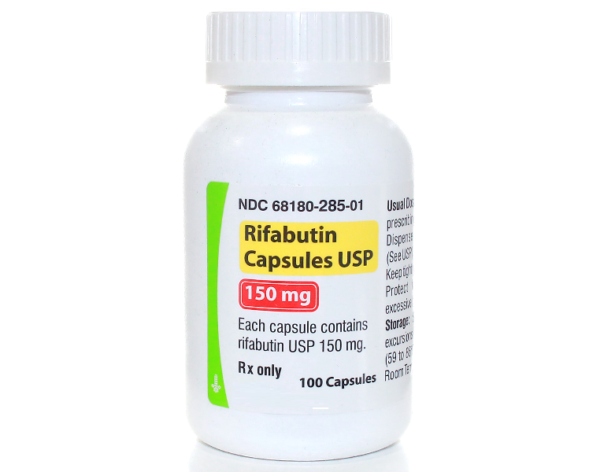
Rifabutin is an antibiotic medicine used to treat mycobacterial tuberculosis and mycobacterial avium complex. It does so by inhibiting DNA dependent RNA polymerase. It is used to treat the following infections:
-
Prophylaxis of Mycobacterium avium complex (MAC):
-
It is used in the prevention of disseminated MAC disease in patients with advanced human immunodeficiency virus (HIV) infection
-
-
Off Label Usage of Rifabutin in Adults:
-
Mycobacterium avium complex disease (disseminated) treatment in HIV-infected patients
-
Treatment of drug-susceptible tuberculosis (excluding meningitis)
-
Tuberculosis treatment in HIV-infected patients
-
Latent tuberculosis (LTBI) in HIV-infected patients
-
Rifabutin dose in Adults
Dosage in the treatment of Mycobacterium avium complex (MAC) disease (disseminated) in HIV-infected patients:
Note: Rule out active tuberculosis before starting rifabutin
-
Primary prophylaxis (patients with CD4 count <50 cells/mm who are not initiated on fully suppressive antiretroviral therapy [ART]) (alternative agent):
- 300 mg orally once daily
- It may be discontinued when patient is initiated on effective ART .
-
Treatment (off-label use):
- Orally 300 mg once daily is given as optional adjunct therapy with clarithromycin or azithromycin (plus ethambutol) .
-
Secondary prophylaxis:
- Orally 300 mg once daily is given as optional adjunct therapy with clarithromycin or azithromycin (plus ethambutol)
- It can be discontinued when patient has completed ≥12 months of therapy, has no signs/symptoms of MAC disease, and has sustained (>6 months) CD4 count >100 cells/mm in response to ART .
Dosage in the treatment of Tuberculosis (off-label):
-
Latent tuberculosis (LTBI) treatment (to prevent TB) in HIV-infected patients:
- Daily dose is based on concomitant ART for 4 months
- LTBI treatment is recommended in HIV-infected patients testing positive for LTBI (but have no evidence of TB disease or no previous history of treatment for active or LTBI) or in HIV-infected contacts of individuals who have infectious TB (regardless of screening tests for LTBI)
-
Treatment of drug-susceptible mycobacterial tuberculosis excluding tuberculous meningitis as an alternative or a substitute for rifampin ):
-
-
Non-HIV-infected patients:
- 5 mg/kg/dose is given once daily
- The usual dose is 300 mg once daily as part of a multidrug regimen
-
HIV-infected patients (and not receiving protease inhibitors, efavirenz, rilpivirine, tenofovir alafenamide, or an elvitegravir/cobicistat containing regimen):
- 5 mg/kg/dose daily
- The usual dose is 300 mg once daily for 5 to 7 days/week as part of a multidrug regimen
-
-
Rifabutin dose in Childrens
Dose in the treatment of Tuberculosis; active TB, treatment of drug-susceptible (excluding meningitis):
-
- For changing recommmendations and updates, consult CDC and WHO for latest recommednations.
- Always use it as part of a multidrug regimen.
- Regimens using less than 5 times weekly dosing should give dosing as directly observed therapy (DOT).
-
Non-HIV-exposed/-positive:
- Infants, Children, and Adolescents:
- 5 mg/kg/dose orally once daily is given
- It can also be given 5-times-weekly (DOT)
- The maximum dose is 300 mg/dose
- Infants, Children, and Adolescents:
-
HIV-exposed/-positive: Note:
- It is not appropriate for all HIV patients due to drug-drug interactions with some anti-retrovirals
-
Infants and Children:
- 10 to 20 mg/kg/dose once daily is given
- It can also be given 3-times-weekly (DOT)
- The maximum dose is 300 mg/dose
Dose in the treatment of Mycobacterium avium complex infection (MAC):
-
Treatment, add-on therapy for severe infection:
-
Infants and Children:
- 10 to 20 mg/kg/dose given orally once daily
- The maximum dose is 300 mg/dose
- Given in combination with a macrolide (clarithromycin or azithromycin) and ethambutol
-
Adolescents:
- 300 mg once daily given in combination with a macrolide (clarithromycin or azithromycin) and ethambutol
-
-
Primary prophylaxis:
-
Non-HIV-exposed/-positive:
- Infants, Children, and Adolescents:
- 5 mg/kg/dose given once daily
- The maximum dose is 300 mg/dose
- Infants, Children, and Adolescents:
-
HIV-exposed/-positive:
-
Children ≥6 years and Adolescents:
- 300 mg given once daily
- active TB should be ruled out before initiation of Chronic suppressive therapy in HIV-exposed/-positive.
-
Children ≥6 years:
- 5 mg/kg/dose given once daily
- The maximum dose is 300 mg/dose for patients who received rifabutin as part of initial MAC treatment regimen
-
Adolescents: Oral:
- 300 mg once daily is given for patients who received rifabutin as part of initial MAC treatment regimen
-
-
Pregnancy Risk Factor: B
- According to human placenta perfusion research, rifabutin crosses the placenta
Use of rifabutin while breastfeeding
- It is unknown if breast milk contains rifabutin or not.
- According to the manufacturer breastfeeding during therapy should be considered in light of the risks to infants and the benefits to mothers.
- To reduce the risk of HIV transmission, pregnant women with HIV should stop breastfeeding.
Rifabutin dose in kidney disease:
- CrCl ≥30 mL/minute:
- No dosage adjustment required.
- CrCl <30 mL/minute:
- Reduce dose by 50%
Rifabutin dose in Liver disease:
- Mild impairment:
- No dosage adjustment required.
- Moderate to severe impairment:
- There are no dosage adjustments given in the manufacturer's labeling
Common Side Effects of Rifabutin Include:
-
Dermatologic:
- Skin rash
-
Genitourinary:
- Discoloration of urine
-
Hematologic & oncologic:
- Neutropenia
- Leukopenia
Less Common Side Effects of Rifabutin Include:
-
Gastrointestinal:
- Nausea
- Abdominal Pain
- Dysgeusia
- Dyspepsia
- Eructation
- Vomiting
- Flatulence
-
Hematologic & oncologic:
- Thrombocytopenia
-
Neuromuscular & skeletal:
- Myalgia
-
Miscellaneous:
- Fever
Contraindication to Rifabutin Include:
- Clinically significant hypersensitivity (or other rifamycins) to rifabutin or any component of the formulation
Warnings and precautions
-
Hematologic toxicities:
- Rarely, it may also be associated with thrombocytopenia and/or neutropenia.
- Consider periodic monitoring of your hematologic parameters. If you notice signs of thrombocytopenia, such as petechial skin rash, stoppermanently.
-
Hypersensitivity reactions
- Rifamycins can cause hypersensitivity reactions such as anaphylaxis and conjunctivitis.
- If hypersensitivity develops, discontinue use and provide supportive care.
-
Superinfection
- Extended use can lead to fungal and bacterial superinfections, such as C. difficile-associated diarrhea(CDAD), or pseudomembranous collitis.
- CDAD was seen after >2 months of antibiotic treatment.
-
Uveitis:
- It is possible to also get uveitis
- When used with macrolides and azole antifungals, it is important to monitor patients.
- Refer the patient to an eye doctor if you suspect uveitis. If that happens, discontinue treatment temporarily.
-
Hepatic impairment
- Patients with hepatic impairment should be cautious. Stop using ALT >=3xULN (symptomatic) or >=5xULN (regardless if symptoms).
-
Renal impairment
- Use with caution in patients suffering from renal impairment. Dosage reduction is recommended for severe impairment (CrCl 30mL/minute).
Rifabutin: Drug Interaction
|
Abiraterone Acetate |
Rifabutin may decrease the serum concentration of Abiraterone Acetate. |
|
Barbiturates |
Rifamycin Derivatives may increase the metabolism of Barbiturates. |
|
BCG Vaccine (Immunization) |
Antibiotics may diminish the therapeutic effect of BCG Vaccine (Immunization). |
|
Benzhydrocodone |
CYP3A4 Inducers (Moderate) may decrease the serum concentration of Benzhydrocodone. Specifically, the serum concentrations of hydrocodone may be reduced. |
|
Bosentan |
May decrease the serum concentration of CYP3A4 Substrates (High risk with Inducers). |
|
Cabozantinib |
Rifabutin may decrease the serum concentration of Cabozantinib. |
|
CloZAPine |
CYP3A4 Inducers (Moderate) may decrease the serum concentration of CloZAPine. |
|
Codeine |
CYP3A4 Inducers (Moderate) may decrease serum concentrations of the active metabolite(s) of Codeine. |
|
Crizotinib |
Rifabutin may decrease the serum concentration of Crizotinib. |
|
CYP3A4 Inducers (Moderate) |
May decrease the serum concentration of CYP3A4 Substrates (High risk with Inducers). |
|
CYP3A4 Substrates (High risk with Inducers) |
CYP3A4 Inducers (Moderate) may decrease the serum concentration of CYP3A4 Substrates (High risk with Inducers). Exceptions: Apixaban; Rivaroxaban. |
|
Dapsone (Systemic) |
Rifabutin may decrease the serum concentration of Dapsone (Systemic). |
|
Deferasirox |
May decrease the serum concentration of CYP3A4 Substrates (High risk with Inducers). |
|
Enzalutamide |
Rifabutin may decrease the serum concentration of Enzalutamide. |
|
Estriol (Systemic) |
CYP3A4 Inducers (Moderate) may decrease the serum concentration of Estriol (Systemic). |
|
Estriol (Topical) |
CYP3A4 Inducers (Moderate) may decrease the serum concentration of Estriol (Topical). |
|
Everolimus |
Rifabutin may decrease the serum concentration of Everolimus. |
|
FentaNYL |
CYP3A4 Inducers (Moderate) may decrease the serum concentration of FentaNYL. |
|
Glecaprevir and Pibrentasvir |
CYP3A4 Inducers (Moderate) may decrease the serum concentration of Glecaprevir and Pibrentasvir. |
|
HYDROcodone |
CYP3A4 Inducers (Moderate) may decrease the serum concentration of HYDROcodone. |
|
Ibrutinib |
CYP3A4 Inducers (Moderate) may decrease the serum concentration of Ibrutinib. |
|
Ifosfamide |
CYP3A4 Inducers (Moderate) may decrease serum concentrations of the active metabolite(s) of Ifosfamide. CYP3A4 Inducers (Moderate) may increase serum concentrations of the active metabolite(s) of Ifosfamide. |
|
Irinotecan Products |
Rifabutin may decrease serum concentrations of the active metabolite(s) of Irinotecan Products. Specifically, serum concentrations of SN-38 may be reduced. Rifabutin may decrease the serum concentration of Irinotecan Products. |
|
Isoniazid |
Rifamycin Derivatives may enhance the hepatotoxic effect of Isoniazid. Even so, this is a frequently employed combination regimen. |
|
Ivacaftor |
Rifabutin may decrease the serum concentration of Ivacaftor. |
|
Ivosidenib |
May decrease the serum concentration of CYP3A4 Substrates (High risk with Inducers). |
|
Lactobacillus and Estriol |
Antibiotics may diminish the therapeutic effect of Lactobacillus and Estriol. |
|
Mirodenafil |
CYP3A4 Inducers (Moderate) may decrease the serum concentration of Mirodenafil. |
|
Naldemedine |
CYP3A4 Inducers (Moderate) may decrease the serum concentration of Naldemedine. |
|
Nevirapine |
Rifabutin may decrease the serum concentration of Nevirapine. Nevirapine may decrease the serum concentration of Rifabutin. Nevirapine may increase the serum concentration of Rifabutin. |
|
Nilotinib |
Rifabutin may decrease the serum concentration of Nilotinib. |
|
Pexidartinib |
CYP3A4 Inducers (Moderate) may decrease the serum concentration of Pexidartinib. |
|
Pitolisant |
CYP3A4 Inducers (Moderate) may decrease the serum concentration of Pitolisant. |
|
Raltegravir |
Rifabutin may decrease the serum concentration of Raltegravir. Specifically, minimum serum concentrations (Cmin) may be reduced. Total raltegravir exposure (i.e., AUC) may be increased. |
|
Rolapitant |
CYP3A4 Inducers (Moderate) may decrease the serum concentration of Rolapitant. |
|
RomiDEPsin |
Rifabutin may decrease the serum concentration of RomiDEPsin. |
|
Sarilumab |
May decrease the serum concentration of CYP3A4 Substrates (High risk with Inducers). |
|
Siltuximab |
May decrease the serum concentration of CYP3A4 Substrates (High risk with Inducers). |
|
Sirolimus |
Rifabutin may decrease the serum concentration of Sirolimus. |
|
Tocilizumab |
May decrease the serum concentration of CYP3A4 Substrates (High risk with Inducers). |
|
Upadacitinib |
CYP3A4 Inducers (Moderate) may decrease the serum concentration of Upadacitinib. |
|
VinCRIStine (Liposomal) |
Rifabutin may decrease the serum concentration of VinCRIStine (Liposomal). |
|
Vitamin K Antagonists (eg, warfarin) |
Rifamycin Derivatives may increase the metabolism of Vitamin K Antagonists. |
|
Zolpidem |
CYP3A4 Inducers (Moderate) may decrease the serum concentration of Zolpidem. |
|
Risk Factor D (Consider therapy modification) |
|
|
Alfentanil |
Rifamycin Derivatives may decrease the serum concentration of Alfentanil. Management: Monitor closely for decreased alfentanil effectiveness. Increased alfentanil doses will likely be needed. Alternatively, changing from alfentanil to a different opioid anesthetic (e.g., sufentanil) may also be considered. |
|
Antifungal Agents (Azole Derivatives, Systemic) |
May increase the serum concentration of Rifamycin Derivatives. Only rifabutin appears to be affected. Rifamycin Derivatives may decrease the serum concentration of Antifungal Agents (Azole Derivatives, Systemic). Management: Avoid these combinations when possible. Voriconazole and isavuconazonium are considered contraindicated. |
|
Atazanavir |
|
|
Brigatinib |
CYP3A4 Inducers (Moderate) may decrease the serum concentration of Brigatinib. Management: Avoid concurrent use of brigatinib with moderate CYP3A4 inducers when possible. If combined, increase the daily dose of brigatinib in 30 mg increments after 7 days of treatment with the current brigatinib dose, up to maximum of twice the dose. |
|
Calcium Channel Blockers |
Rifamycin Derivatives may decrease the serum concentration of Calcium Channel Blockers. This primarily affects oral forms of calcium channel blockers. Management: The labeling for some US and Canadian calcium channel blockers contraindicate use with rifampin, however recommendations vary. Consult appropriate labeling. Exceptions: Clevidipine. |
|
Clarithromycin |
CYP3A4 Inducers (Moderate) may increase serum concentrations of the active metabolite(s) of Clarithromycin. CYP3A4 Inducers (Moderate) may decrease the serum concentration of Clarithromycin. Management: Consider alternative antimicrobial therapy for patients receiving a CYP3A inducer. Drugs that enhance the metabolism of clarithromycin into 14-hydroxyclarithromycin may alter the clinical activity of clarithromycin and impair its efficacy. |
|
Cobicistat |
May increase the serum concentration of Rifabutin. Management: Reduce rifabutin dose. Clinical guidelines recommend administering rifabutin 150 mg daily or 300 mg 3 times per week when used with cobicistat. Cobicistat labeling recommends decreasing the rifabutin dose to 150 mg every other day. |
|
CycloSPORINE (Systemic) |
Rifamycin Derivatives may increase the metabolism of CycloSPORINE (Systemic). |
|
CYP3A4 Inducers (Strong) |
May increase the metabolism of CYP3A4 Substrates (High risk with Inducers). Management: Consider an alternative for one of the interacting drugs. Some combinations may be specifically contraindicated. Consult appropriate manufacturer labeling. |
|
Dabrafenib |
May decrease the serum concentration of CYP3A4 Substrates (High risk with Inducers). Management: Seek alternatives to the CYP3A4 substrate when possible. If concomitant therapy cannot be avoided, monitor clinical effects of the substrate closely (particularly therapeutic effects). |
|
Daclatasvir |
CYP3A4 Inducers (Moderate) may decrease the serum concentration of Daclatasvir. Management: Increase the daclatasvir dose to 90 mg once daily if used with a moderate CYP3A4 inducer. |
|
Darunavir |
May increase serum concentrations of the active metabolite(s) of Rifabutin. Rifabutin may increase the serum concentration of Darunavir. Darunavir may increase the serum concentration of Rifabutin. Management: Reduce rifabutin doses. Darunavir US labeling recommends a decrease of at least 75%, to 150 mg every other day or 3 times per week for adults. Clinical guidelines recommend 150 mg/day or 300 mg 3 times per week when used with darunavir/ritonavir. |
|
Doravirine |
Rifabutin may decrease the serum concentration of Doravirine. Management: Increase doravirine dose to 1 tablet (100 mg) twice daily when combined with rifabutin. If taking the combination product doravirine/lamivudine/tenofovir, an additional tablet of doravirine (100 mg) should be given 12 hours after the combination product. |
|
Efavirenz |
May decrease the serum concentration of Rifabutin. Rifabutin may decrease the serum concentration of Efavirenz. Management: If efavirenz is to be used with daily rifabutin, increase the planned rifabutin adult dose by 50%. If used with regimens where rifabutin is administered 2-3 times per week, consider doubling the rifabutin dose. |
|
Erdafitinib |
CYP3A4 Inducers (Moderate) may decrease the serum concentration of Erdafitinib. Management: Dose modifications of erdafitinib may be required. See full monograph for details. |
|
Erlotinib |
Rifabutin may decrease the serum concentration of Erlotinib. Management: Avoid combination if possible. If combination must be used, increase erlotinib dose by 50 mg increments every 2 weeks as tolerated, to a maximum of 450 mg/day. |
|
Estrogen Derivatives (Contraceptive) |
Rifamycin Derivatives may decrease the serum concentration of Estrogen Derivatives (Contraceptive). Contraceptive failure is possible. Management: Use of an alternative, nonhormonal contraceptive is recommended. |
|
Fosamprenavir |
May increase serum concentrations of the active metabolite(s) of Rifabutin. Rifabutin may increase the serum concentration of Fosamprenavir. Fosamprenavir may increase the serum concentration of Rifabutin. Management: Reduce rifabutin doses. See full monograph for specific recommendations. |
|
GuanFACINE |
CYP3A4 Inducers (Moderate) may decrease the serum concentration of GuanFACINE. Management: Increase the guanfacine dose by up to double when initiating guanfacine in a patient taking a moderate CYP3A4 inducer. Increase guanfacine dose gradually over 1 to 2 weeks if initiating a moderate CYP3A4 inducer in a patient already taking guanfacine. |
|
HMG-CoA Reductase Inhibitors (Statins) |
Rifamycin Derivatives may decrease the serum concentration of HMG-CoA Reductase Inhibitors (Statins). Management: Consider use of noninteracting antilipemic agents (note: pitavastatin concentrations may increase with rifamycin treatment). Monitor for altered HMG-CoA reductase inhibitor effects. Rifabutin and fluvastatin, or possibly pravastatin, may pose lower risk. Exceptions: Pitavastatin; Rosuvastatin. |
|
Imatinib |
Rifamycin Derivatives may decrease the serum concentration of Imatinib. Management: Avoid concurrent use of imatinib with the rifamycin derivatives when possible. If such a combination must be used, increase imatinib dose by at least 50% and monitor the patient's clinical response closely. |
|
Indinavir |
May increase serum concentrations of the active metabolite(s) of Rifabutin. Rifabutin may decrease the serum concentration of Indinavir. Indinavir may increase the serum concentration of Rifabutin. Management: Reduce rifabutin dose by 50% and increase adult indinavir dose to 1 g every 8 hours, per US labeling. Consistent with this, clinical guidelines recommend a rifabutin dose of 150 mg/day or 300 mg 3 times per week when used with indinavir/ritonavir. |
|
Lefamulin |
CYP3A4 Inducers (Moderate) may decrease the serum concentration of Lefamulin. Management: Avoid concomitant use of lefamulin with moderate CYP3A4 inducers unless the benefits outweigh the risks. |
|
Lefamulin (Intravenous) |
CYP3A4 Inducers (Moderate) may decrease the serum concentration of Lefamulin (Intravenous). Management: Avoid concomitant use of lefamulin (intravenous) with moderate CYP3A4 inducers unless the benefits outweigh the risks. |
|
Lopinavir |
May increase serum concentrations of the active metabolite(s) of Rifabutin. Rifabutin may increase the serum concentration of Lopinavir. Lopinavir may increase the serum concentration of Rifabutin. Management: Reduce rifabutin doses. Lopinavir/ritonavir US labeling recommends a decrease of at least 75%, to 150 mg every other day or 3 times per week for adults, while clinical guidelines recommend 150 mg/day or 300 mg 3 times per week. |
|
Lorlatinib |
CYP3A4 Inducers (Moderate) may enhance the hepatotoxic effect of Lorlatinib. CYP3A4 Inducers (Moderate) may decrease the serum concentration of Lorlatinib. Management: Avoid use of lorlatinib with moderate CYP3A4 inducers. If such a combination must be used, monitor AST, ALT, and bilirubin within 48 hours of starting the combination and at least three times within the first week of combined use. |
|
Lorlatinib |
May decrease the serum concentration of CYP3A4 Substrates (High risk with Inducers). Management: Avoid concurrent use of lorlatinib with any CYP3A4 substrates for which a minimal decrease in serum concentrations of the CYP3A4 substrate could lead to therapeutic failure and serious clinical consequences. |
|
Lurasidone |
CYP3A4 Inducers (Moderate) may decrease the serum concentration of Lurasidone. Management: Monitor for decreased lurasidone effects if combined with moderate CYP3A4 inducers and consider increasing the lurasidone dose if coadministered with a moderate CYP3A4 inducer for 7 or more days. |
|
Macrolide Antibiotics |
May decrease the metabolism of Rifamycin Derivatives. Exceptions: Azithromycin (Systemic); Fidaxomicin; Roxithromycin; Spiramycin. |
|
Meperidine |
CYP3A4 Inducers (Moderate) may decrease the serum concentration of Meperidine. Management: Consider increasing meperidine dose if concomitant use with moderate CYP3A4 inducers is required. Monitor for signs and symptoms of opioid withdrawal. |
|
Mitotane |
May decrease the serum concentration of CYP3A4 Substrates (High risk with Inducers). Management: Doses of CYP3A4 substrates may need to be adjusted substantially when used in patients being treated with mitotane. |
|
Nelfinavir |
May increase serum concentrations of the active metabolite(s) of Rifabutin. Rifabutin may decrease the serum concentration of Nelfinavir. Nelfinavir may increase the serum concentration of Rifabutin. Management: Nelfinavir US prescribing information recommends decreasing the usual rifabutin dose by at least 50% when used with nelfinavir. Additionally, the preferred dose of nelfinavir when used in combination with rifabutin is 1250 mg twice daily. |
|
Palbociclib |
CYP3A4 Inducers (Moderate) may decrease the serum concentration of Palbociclib. Management: The US label does not provide specific recommendations concerning use with moderate CYP3A4 inducers, but the Canadian label recommends avoiding use of moderate CYP3A4 inducers. |
|
Perampanel |
CYP3A4 Inducers (Moderate) may decrease the serum concentration of Perampanel. Management: Increase the perampanel starting dose to 4 mg/day when perampanel is used concurrently with moderate and strong CYP3A4 inducers. |
|
Pitavastatin |
Rifamycin Derivatives may increase the serum concentration of Pitavastatin. Management: Limit pitavastatin dose to a maximum of 2 mg/day with concurrent rifampin. |
|
Progestins (Contraceptive) |
Rifamycin Derivatives may decrease the serum concentration of Progestins (Contraceptive). Contraceptive failure is possible. Management: Contraceptive failure is possible. Use of an alternative, nonhormonal contraceptive is recommended. |
|
QuiNIDine |
Rifamycin Derivatives may decrease the serum concentration of QuiNIDine. Management: Consider alternatives to combination treatment with quinidine and rifampin due to large potential decreases in quinidine concentrations. Monitor for decreased quinidine concentrations/effects with initiation/dose increase of any rifamycin derivative. |
|
Rilpivirine |
Rifabutin may decrease the serum concentration of Rilpivirine. Management: Increase the rilpivirine adult dose to 50 mg/day during rifabutin treatment. Decrease back to 25 mg/day following rifabutin discontinuation. Use of rifabutin with the emtricitabine/rilpivirine/tenofovir alafenamide combination product is not recommended. |
|
Ritonavir |
May increase serum concentrations of the active metabolite(s) of Rifabutin. Ritonavir may increase the serum concentration of Rifabutin. Management: Ritonavir US prescribing information recommends reducing rifabutin doses by at least 75%. Refer to drug interaction monographs addressing concomitantly administered protease inhibitors for dosing recommendations specific to ritonavir-boosted regimens. |
|
Saquinavir |
May increase serum concentrations of the active metabolite(s) of Rifabutin. Saquinavir may increase the serum concentration of Rifabutin. Rifabutin may decrease the serum concentration of Saquinavir. Management: Reduce rifabutin doses. Saquinavir US labeling recommends a decrease of at least 75%, to 150 mg every other day or 3 times per week for adults. Clinical guidelines recommend 150 mg daily or 300 mg 3 times per week when used with saquinavir/ritonavir. |
|
Sodium Picosulfate |
Antibiotics may diminish the therapeutic effect of Sodium Picosulfate. Management: Consider using an alternative product for bowel cleansing prior to a colonoscopy in patients who have recently used or are concurrently using an antibiotic. |
|
St John's Wort |
May decrease the serum concentration of CYP3A4 Substrates (High risk with Inducers). Management: Consider an alternative for one of the interacting drugs. Some combinations may be specifically contraindicated. Consult appropriate manufacturer labeling. |
|
Tacrolimus (Systemic) |
Rifamycin Derivatives may decrease the serum concentration of Tacrolimus (Systemic). Management: Consider alternatives when possible. If these combination are used, monitor for reduced tacrolimus concentrations/effects following rifamycin initiation/dose increase, or increased concentrations/effects following rifamycin discontinuation/dose decrease. |
|
Tamoxifen |
Rifamycin Derivatives may increase the metabolism of Tamoxifen. |
|
Temsirolimus |
Rifamycin Derivatives may decrease the serum concentration of Temsirolimus. Rifamycins will likely cause an even greater decrease in the concentration of the active metabolite sirolimus. Management: Temsirolimus prescribing information recommends against coadministration with strong CYP3A4 inducers such as rifampin; however, if concurrent therapy is necessary, an increase in temsirolimus adult dose to 50 mg/week should be considered. |
|
Tipranavir |
May increase serum concentrations of the active metabolite(s) of Rifabutin. Tipranavir may increase the serum concentration of Rifabutin. Management: Reduce rifabutin doses. Tipranavir US labeling recommends a decrease of at least 75%, to 150 mg every other day or 3 times per week for adults. Clinical guidelines recommend 150 mg daily or 300 mg 3 times per week when used with tipranavir/ritonavir. |
|
Typhoid Vaccine |
Antibiotics may diminish the therapeutic effect of Typhoid Vaccine. Only the live attenuated Ty21a strain is affected. Management: Vaccination with live attenuated typhoid vaccine (Ty21a) should be avoided in patients being treated with systemic antibacterial agents. Use of this vaccine should be postponed until at least 3 days after cessation of antibacterial agents. |
|
Risk Factor X (Avoid combination) |
|
|
Abemaciclib |
CYP3A4 Inducers (Moderate) may decrease the serum concentration of Abemaciclib. |
|
Antihepaciviral Combination Products |
CYP3A4 Inducers (Moderate) may decrease the serum concentration of Antihepaciviral Combination Products. |
|
Asunaprevir |
CYP3A4 Inducers (Moderate) may decrease the serum concentration of Asunaprevir. |
|
Atovaquone |
Rifamycin Derivatives may decrease the serum concentration of Atovaquone. |
|
Axitinib |
CYP3A4 Inducers (Moderate) may decrease the serum concentration of Axitinib. |
|
BCG (Intravesical) |
Antibiotics may diminish the therapeutic effect of BCG (Intravesical). |
|
Bedaquiline |
CYP3A4 Inducers (Moderate) may decrease the serum concentration of Bedaquiline. |
|
Bictegravir |
Rifabutin may decrease the serum concentration of Bictegravir. |
|
Bosutinib |
CYP3A4 Inducers (Moderate) may decrease the serum concentration of Bosutinib. |
|
Cholera Vaccine |
Antibiotics may diminish the therapeutic effect of Cholera Vaccine. Management: Avoid cholera vaccine in patients receiving systemic antibiotics, and within 14 days following the use of oral or parenteral antibiotics. |
|
Cobimetinib |
CYP3A4 Inducers (Moderate) may decrease the serum concentration of Cobimetinib. |
|
Dasabuvir |
CYP3A4 Inducers (Moderate) may decrease the serum concentration of Dasabuvir. |
|
Deflazacort |
CYP3A4 Inducers (Moderate) may decrease serum concentrations of the active metabolite(s) of Deflazacort. |
|
Delavirdine |
Rifamycin Derivatives may increase the metabolism of Delavirdine. Delavirdine may increase the serum concentration of Rifamycin Derivatives. Specifically, Rifabutin serum concentration may be increased. |
|
Elbasvir |
CYP3A4 Inducers (Moderate) may decrease the serum concentration of Elbasvir. |
|
Elvitegravir |
May increase serum concentrations of the active metabolite(s) of Rifabutin. Rifabutin may decrease the serum concentration of Elvitegravir. Management: For single-agent elvitegravir, a rifabutin dose reduction of at least 75% is required (ie, reduction to adult dose of 150 mg every other day or three times/week). Use of elvitegravir combination products with rifabutin is not recommended. |
|
Encorafenib |
CYP3A4 Inducers (Moderate) may decrease the serum concentration of Encorafenib. |
|
Entrectinib |
CYP3A4 Inducers (Moderate) may decrease the serum concentration of Entrectinib. |
|
Etravirine |
Rifabutin may decrease the serum concentration of Etravirine. Management: Avoid use of rifabutin with etravirine in patients also taking a protease inhibitor/ritonavir. Rifabutin (300 mg daily) may be used with etravirine if etravirine is administered without a protease inhibitor/ritonavir. |
|
Fedratinib |
CYP3A4 Inducers (Moderate) may decrease the serum concentration of Fedratinib. |
|
Flibanserin |
CYP3A4 Inducers (Moderate) may decrease the serum concentration of Flibanserin. |
|
Grazoprevir |
CYP3A4 Inducers (Moderate) may decrease the serum concentration of Grazoprevir. |
|
Ledipasvir |
Rifabutin may decrease the serum concentration of Ledipasvir. |
|
Mycophenolate |
Rifamycin Derivatives may decrease the serum concentration of Mycophenolate. Specifically, rifamycin derivatives may decrease the concentration of the active metabolite mycophenolic acid. |
|
Neratinib |
CYP3A4 Inducers (Moderate) may decrease the serum concentration of Neratinib. |
|
Nisoldipine |
CYP3A4 Inducers (Moderate) may decrease the serum concentration of Nisoldipine. |
|
Olaparib |
CYP3A4 Inducers (Moderate) may decrease the serum concentration of Olaparib. |
|
Pimavanserin |
CYP3A4 Inducers (Moderate) may decrease the serum concentration of Pimavanserin. |
|
Pretomanid |
CYP3A4 Inducers (Moderate) may decrease the serum concentration of Pretomanid. |
|
Ranolazine |
CYP3A4 Inducers (Moderate) may decrease the serum concentration of Ranolazine. |
|
Simeprevir |
CYP3A4 Inducers (Moderate) may decrease the serum concentration of Simeprevir. |
|
Sofosbuvir |
Rifabutin may decrease the serum concentration of Sofosbuvir. |
|
Sonidegib |
CYP3A4 Inducers (Moderate) may decrease the serum concentration of Sonidegib. |
|
Tenofovir Alafenamide |
Rifabutin may decrease the serum concentration of Tenofovir Alafenamide. |
|
Velpatasvir |
CYP3A4 Inducers (Moderate) may decrease the serum concentration of Velpatasvir. |
|
Venetoclax |
CYP3A4 Inducers (Moderate) may decrease the serum concentration of Venetoclax. |
|
Voriconazole |
May increase the serum concentration of Rifamycin Derivatives. Rifamycin Derivatives may decrease the serum concentration of Voriconazole. |
Monitor:
- Periodic liver function tests
- CBC with differential
- platelet count
- signs/symptoms of hypersensitivity or uveitis
How to administer Rifabutin?
- May be administered with meals to minimize nausea or vomiting.
Mechanism of action of Rifabutin:
It Inhibits DNA-dependent RNA polymerase at the beta subunit which prevents chain initiation
Absorption:
- Readily, 53%
Distribution: V : Adults:
- 9.3 ± 1.5 L/kg
Protein binding:
- 85%
Metabolism:
- To 5 metabolites
- predominantly 25-O-desacetyl-rifabutin (antimicrobial activity equivalent to parent drug; contributes ≤10% of antimicrobial activity) and 31-hydroxy-rifabutin
Bioavailability:
- Absolute: HIV: 20%
Half-life elimination:
- Terminal: 45 hours
Time to peak, serum:
- 2 to 4 hours
Excretion:
- Via Urine (53% as metabolites); feces (30%)
International Brands of Rifabutin:
- Mycobutin
- Alfacid
- Ansatipin
- Ansatipine
- Macbutin
- Ributin
- Rifabutin, ”Pharmacia”
- Tambux
Rifabutin Brands in Pakistan:
Rifabutin is not available in Pakistan.
.png)


