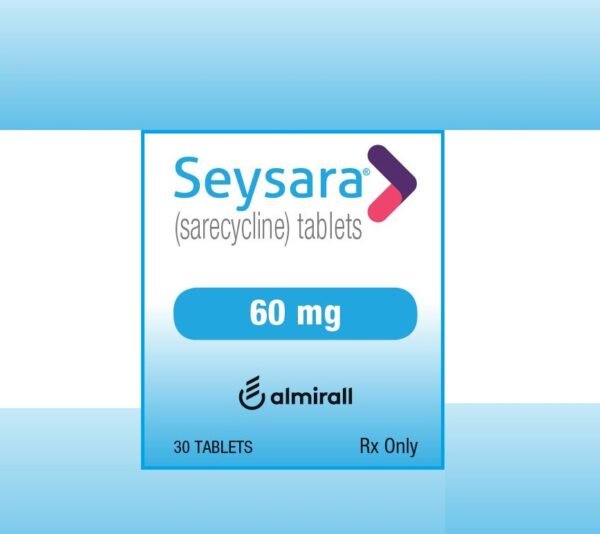
Sarecycline (Seysara) is a tetracycline antibiotic that is administered orally in the management of patients with moderately to severely non-nodular acne-vulgaris.
Sarecycline Uses:
-
Acne vulgaris, non-nodular, moderate to severe:
- It is indicated for the treatment of inflammatory lesions of non-nodular moderate to severe acne vulgaris in patients 9 years or older.
Read: Doxycycline (Vibramycin)
Sarecycline (Seysara) Dose in Adults
Sarecycline (Seysara) Dose in the treatment of non-nodular moderate to severe Acne vulgaris:
- Note: The dosage is based on body weight. The treatment should be reassessed if no improvement is noted after 12 weeks:
- 33 to 54 kg: 60 mg once daily
- 55 to 84 kg: 100 mg once daily
- 85 to 136 kg: 150 mg once daily
Sarecycline (Seysara) Dose in Childrens
Sarecycline (Seysara) Dose in the treatment of non-nodular moderate to severe Acne vulgaris:
Note: The treatment should be reassessed if no improvement is noted after twelve weeks of therapy.
-
Children ≥9 years and Adolescents: Oral:
- 33 to <55 kg: 60 mg once daily
- 55 to <85 kg: 100 mg once daily
- 85 to 136 kg: 150 mg once daily
Pregnancy Risk Category: N
- Tetracyclines can accumulate in the developing teeth of the fetus and in long tubular bones.
- After maternal exposure in utero, it can cause permanent yellowing, greying, or brownishing of infant teeth.
- Pregnant women who are in their second or third trimester may experience an inhibition of bony growth.
- When pregnancy is confirmed, it is recommended that you immediately stop using the medication.
Use during breastfeeding:
- It is unknown if the drug is found in breast milk. Tetracyclines should not be used in breastfeeding because they can cause damage to the teeth and skeleton of the fetus.
- It can cause tooth discoloration, and it can also inhibit skeletal growth.
- Breastfeeding mothers should not use it because of possible adverse drug reactions.
Dose in Kidney Disease:
- There are no dosage adjustments provided in the manufacturer's labeling
- However, no significant differences in the pharmacokinetics of the drug have been observed.
Dose in Liver disease:
- Mild to moderate impairment (Child-Pugh class A or B):
- There are no dosage adjustments provided in the manufacturer's labeling.
- However, no significant pharmacokinetic differences have been observed.
- Severe impairment (Child-Pugh class C):
- There are no dosage adjustments provided in the manufacturer’s labeling (it has not been studied).
Side Effects of Sarecycline (Seysara):
-
Gastrointestinal:
- Nausea
Contraindications to Sarecycline (Seysara):
Allergy to sarecycline, Tetracyclines, and any component of the formulation
Warnings and precautions
-
CNS effects
- It has been associated with neurological side effects, especially after treatment began.
- Some patients may experience dizziness, vertigo and lightheadedness. These symptoms may resolve with continued treatment or discontinuation.
- It is important to warn patients about neurological side effects, especially when they are required to drive or operate heavy machinery.
-
Intracranial hypertension
- Tetracyclines have been linked to benign intracranial hypertension or pseudotumor cerebri. Some patients may experience headaches, blurred vision, hypertension, and even papilledema.
- Patients with obesity, women who use oral contraceptives and women in their twenties are particularly at risk.
- The concomitant use of vitamin A derivatives such as isotretinoin and tetracyclines should be avoided.
- The majority of intracranial hypertension symptoms will improve with treatment discontinuation.
- However, visual loss can be permanent. A new onset or worsening of visual symptoms, such as impaired vision, should prompt an ophthalmologic examination.
-
Photosensitivity
- Photosensitivity has been linked to tetracyclines. If there is any redness or other photosensitive reactions, the treatment should be stopped.
- Patients should be instructed to protect their skin, not use tanning equipment and to avoid prolonged exposure to the sun.
-
Superinfection
- Long-term antibiotic use has been linked to serious fungal and bacterial superinfections.
- Clostridium difficile (formerly Clostridium)-associated diarrhea (CDAD) has been reported, even after only two months of antibiotic treatment.
Sarecycline: Drug Interaction
|
Aminolevulinic Acid (Topical) |
Photosensitizing Agents may enhance the photosensitizing effect of Aminolevulinic Acid (Topical). |
|
BCG Vaccine (Immunization) |
Antibiotics may diminish the therapeutic effect of BCG Vaccine (Immunization). |
|
Digoxin |
Sarecycline may increase the serum concentration of Digoxin. |
|
Lactobacillus and Estriol |
Antibiotics may diminish the therapeutic effect of Lactobacillus and Estriol. |
|
Magnesium Dimecrotate |
May interact via an unknown mechanism with Tetracyclines. |
|
Mipomersen |
Tetracyclines may enhance the hepatotoxic effect of Mipomersen. |
|
Neuromuscular-Blocking Agents |
Tetracyclines may enhance the neuromuscular-blocking effect of Neuromuscular-Blocking Agents. |
|
Porfimer |
Photosensitizing Agents may enhance the photosensitizing effect of Porfimer. |
|
Verteporfin |
Photosensitizing Agents may enhance the photosensitizing effect of Verteporfin. |
|
Vitamin K Antagonists (eg, warfarin) |
Tetracyclines may enhance the anticoagulant effect of Vitamin K Antagonists. |
|
Risk Factor D (Consider therapy modification) |
|
|
Antacids |
May decrease the absorption of Tetracyclines. Management: Separate administration of antacids and oral tetracycline derivatives by several hours when possible to minimize the extent of this potential interaction. |
|
Bile Acid Sequestrants |
|
|
Bismuth Subcitrate |
May decrease the serum concentration of Tetracyclines. Management: Avoid administration of oral tetracyclines within 30 minutes of bismuth subcitrate administration. This is of questionable significance for at least some regimens intended to treat H. pylori infections. |
|
Bismuth Subsalicylate |
May decrease the serum concentration of Tetracyclines. Management: Consider dosing tetracyclines 2 hours before or 6 hours after bismuth. The need to separate doses during Helicobacter pylori eradication regimens is questionable. |
|
Calcium Salts |
May decrease the serum concentration of Tetracyclines. Management: If coadministration of oral calcium with oral tetracyclines can not be avoided, consider separating administration of each agent by several hours. |
|
Iron Salts |
Tetracyclines may decrease the absorption of Iron Salts. Iron Salts may decrease the serum concentration of Tetracyclines. Exceptions: Ferric Carboxymaltose; Ferric Gluconate; Ferric Hydroxide Polymaltose Complex; Ferric Pyrophosphate Citrate; Ferumoxytol; Iron Dextran Complex; Iron Isomaltoside; Iron Sucrose. |
|
Lanthanum |
May decrease the serum concentration of Tetracyclines. Management: Administer oral tetracycline antibiotics at least two hours before or after lanthanum. |
|
Magnesium Salts |
May decrease the absorption of Tetracyclines. Only applicable to oral preparations of each agent. |
|
Multivitamins/Minerals (with ADEK, Folate, Iron) |
May decrease the serum concentration of Tetracyclines. Management: If coadministration of a polyvalent cation-containing multivitamin with oral tetracyclines can not be avoided, separate administration of each agent by several hours. |
|
Multivitamins/Minerals (with AE, No Iron) |
May decrease the serum concentration of Tetracyclines. Management: If coadministration of a polyvalent cation-containing multivitamin with oral tetracyclines can not be avoided, separate administration of each agent by several hours. |
|
Penicillins |
Tetracyclines may diminish the therapeutic effect of Penicillins. |
|
Quinapril |
May decrease the serum concentration of Tetracyclines. Management: Separate doses of quinapril and oral tetracycline derivatives by at least 2 hours in order to reduce the risk of interaction. Monitor for reduced efficacy of the tetracycline if these products are used concomitantly. |
|
Sodium Picosulfate |
Antibiotics may diminish the therapeutic effect of Sodium Picosulfate. Management: Consider using an alternative product for bowel cleansing prior to a colonoscopy in patients who have recently used or are concurrently using an antibiotic. |
|
Sucralfate |
May decrease the absorption of Tetracyclines. Management: Administer the tetracycline derivative at least 2 hours prior to sucralfate in order to minimize the impact of this interaction. |
|
Sucroferric Oxyhydroxide |
May decrease the serum concentration of Tetracyclines. Management: Administer oral/enteral doxycycline at least 1 hour before sucroferric oxyhydroxide. Specific dose separation guidelines for other tetracyclines are not presently available. No interaction is anticipated with parenteral administration of tetracyclines. |
|
Typhoid Vaccine |
Antibiotics may diminish the therapeutic effect of Typhoid Vaccine. Only the live attenuated Ty21a strain is affected. Management: Vaccination with live attenuated typhoid vaccine (Ty21a) should be avoided in patients being treated with systemic antibacterial agents. Use of this vaccine should be postponed until at least 3 days after cessation of antibacterial agents. |
|
Zinc Salts |
May decrease the absorption of Tetracyclines. Only a concern when both products are administered orally. Management: Consider doxycycline as a noninteracting tetracycline derivative. Separate dose administration of oral tetracycline derivative and oral zinc salts by at least 2 hours to minimize interaction. Exceptions: Zinc Chloride. |
|
Risk Factor X (Avoid combination) |
|
|
Aminolevulinic Acid (Systemic) |
Photosensitizing Agents may enhance the photosensitizing effect of Aminolevulinic Acid (Systemic). |
|
BCG (Intravesical) |
Antibiotics may diminish the therapeutic effect of BCG (Intravesical). |
|
Cholera Vaccine |
Antibiotics may diminish the therapeutic effect of Cholera Vaccine. Management: Avoid cholera vaccine in patients receiving systemic antibiotics, and within 14 days following the use of oral or parenteral antibiotics. |
|
Mecamylamine |
Tetracyclines may enhance the neuromuscular-blocking effect of Mecamylamine. |
|
Methoxyflurane |
Tetracyclines may enhance the nephrotoxic effect of Methoxyflurane. |
|
Retinoic Acid Derivatives |
Tetracyclines may enhance the adverse/toxic effect of Retinoic Acid Derivatives. The development of pseudotumor cerebri is of particular concern. Exceptions: Adapalene; Bexarotene (Topical); Tretinoin (Topical). |
|
Strontium Ranelate |
May decrease the serum concentration of Tetracyclines. Management: In order to minimize any potential impact of strontium ranelate on tetracycline antibiotic concentrations, it is recommended that strontium ranelate treatment be interrupted during tetracycline therapy. |
Monitoring parameters:
An ophthalmologic evaluation may be necessary if visual disturbances are reported.
How to administer Sarecycline (Seysara)?
- It is administered orally with or without meals.
- It is better administered with meals or plenty of water to reduce the risk of esophageal ulceration and irritation.
- It should not be administered with antacids (containing aluminum, magnesium, and calcium), iron-containing preparations, and bismuth subsalicylates
Mechanism of action of Sarecycline (Seysara):
It is a tetracycline antibacterial that inhibits protein synthesis through binding to the 30S or 50S ribosomal ribosomal units of susceptible bacteria organisms.
Protein binding:
- 62.5% to 74.7%
Metabolism:
- Minimal (<15%) in vitro
Half-life elimination:
- 21 to 22 hours
Time to peak:
- 1.5 to 2 hours;
- The time to peak is delayed by about half an hour if administered with a fat or a high-calorie meal including milk.
Excretion:
- Feces (42.6%; 14.9% as unchanged drug);
- Urine (44.1%; 24.7% as unchanged drug)
International Brand Names of Sarecycline:
- Seysara
Sarecycline Brand Names in Pakistan:
No Brands Available in Pakistan.
.png)


