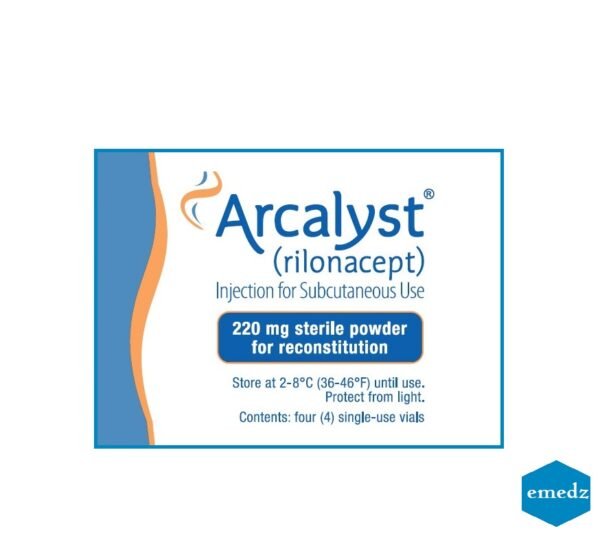
Rilonacept (Arcalyst) inhibits inflammation by binding to Interleukin 1B receptors in patients with Cryopyrin-associated periodic syndromes (CAPS) which is a rare hereditary inflammatory condition.
Rilonacept Uses:
-
Cryopyrin-associated periodic syndromes:
- It is indicated for the treatment of cryopyrin-associated periodic syndromes in adults and children older than 12 years of age.
- These include:
- Familial cold autoinflammatory syndrome
- Muckle-Wells syndrome.
- Neonatal-onset multisystem inflammatory disease (NOMID).
Rilonacept (Arcalyst) Dose in Adults
Rilonacept (Arcalyst) Dose in the treatment of Cryopyrin-associated periodic syndromes: SubQ:
-
Initial:
- 320 mg administered subcutaneously as 2 separate injections of 160 mg or 2 mL per injection on the same day at two different sites
-
Maintenance:
- 160 mg once a week.
Note: Begin maintenance dose one week after the loading dose. Do not administer more than once a week.
Rilonacept (Arcalyst) Dose in Childrens
Rilonacept (Arcalyst) Dose in the treatment of Cryopyrin-associated periodic syndromes (CAPS):
-
Children ≥12 years and Adolescents ≤17 years:
- An initial loading dose of 4.4 mg/kg is administered subcutaneously. The maximum dose is 320 mg per dose.
- Note: The loading dose may be divided into one or two separate injections administered on the same day at different sites. The maximum volume of injection should not exceed 2 mL or 160 mg/injection.
- Maintenance dose:
- Begin one week after the loading dose:
- SubQ: 2.2 mg/kg/dose once a week up to a maximum dose of 160 mg/dose;
- Note: Do not administer more than once a week.
- Begin one week after the loading dose:
-
Adolescents ≥18 years:
- Initial: Loading dose:
- 320 mg administered as two separate subcutaneous injections of 160 mg each on the same day at different sites.
- Maintenance:
- Begin one week after the loading dose: 160 mg once a week;
- Note: Do not administer more than once a week.
- Initial: Loading dose:
Pregnancy Risk Factor C
- Animal reproduction studies have shown that adverse events can be observed.
Use during breastfeeding:
- It is unknown if rilonacept can be excreted in breastmilk.
- It is recommended that you use it with caution if you are lactating.
Dose in Kidney Disease:
There are no dosage adjustments provided in the manufacturer’s labeling (it has not been studied in patients with kidney disease).
Dose in Liver disease:
There are no dosage adjustments provided in the manufacturer’s labeling (it has not been studied in patients with liver disease).
Common Side Effects of Rilonacept (Arcalyst):
-
Immunologic:
- Antibody Development
-
Infection:
- Increased Susceptibility To Infection
-
Local:
- Injection Site Reaction
-
Respiratory:
- Upper Respiratory Tract Infection
Less Common Side Effects of Rilonacept (Arcalyst):
-
Central Nervous System:
- Hypoesthesia
-
Respiratory:
- Cough
- Sinusitis
Contraindication to Rilonacept (Arcalyst):
The manufacturer's labeling does not list any contraindications.
Warnings and precautions
-
Anaphylaxis or hypersensitivity reactions
- Hypersensitivity reactions can be severe for patients, including anaphylaxis.
- Appropriate treatment should be initiated (including epinephrine) after discontinuation of the drug (prompt discontinuation of the drug is important).
-
Infections
- Patients could become more susceptible to infection. Patients with a history or ongoing infection should not use it.
- If patients develop signs that could indicate infection, they should be closely monitored. If the infection is severe, treatment should be stopped.
- Patients with active infections and patients with underlying chronic conditions should not be treated.
- Therapy increases the risk of latent tuberculosis reactivation. Before starting treatment, patients should be closely monitored for signs of reactivation.
-
Malignancy
- Although the impact of the drug's use on malignant conditions is not known, it could impair anti-malignancy defenses.
-
Hyperlipidemia:
- The lipid profile should be monitored regularly by patients as the drug can cause an increase in total cholesterol, HDL and LDL.
- For hyperlipidemia treatment, statins might be necessary.
Rilonacept: Drug Interaction
|
Coccidioides immitis Skin Test |
Immunosuppressants may diminish the diagnostic effect of Coccidioides immitis Skin Test. |
|
Denosumab |
May enhance the adverse/toxic effect of Immunosuppressants. Specifically, the risk for serious infections may be increased. |
|
Ocrelizumab |
May enhance the immunosuppressive effect of Immunosuppressants. |
|
Pidotimod |
Immunosuppressants may diminish the therapeutic effect of Pidotimod. |
|
Siponimod |
Immunosuppressants may enhance the immunosuppressive effect of Siponimod. |
|
Tertomotide |
Immunosuppressants may diminish the therapeutic effect of Tertomotide. |
|
Trastuzumab |
May enhance the neutropenic effect of Immunosuppressants. |
|
Risk Factor D (Consider therapy modification) |
|
|
Baricitinib |
Immunosuppressants may enhance the immunosuppressive effect of Baricitinib. Management: Use of baricitinib in combination with potent immunosuppressants such as azathioprine or cyclosporine is not recommended. Concurrent use with antirheumatic doses of methotrexate or nonbiologic disease modifying antirheumatic drugs (DMARDs) is permitted. |
|
Echinacea |
|
|
Fingolimod |
Immunosuppressants may enhance the immunosuppressive effect of Fingolimod. Management: Avoid the concomitant use of fingolimod and other immunosuppressants when possible. If combined, monitor patients closely for additive immunosuppressant effects (eg, infections). |
|
Leflunomide |
Immunosuppressants may enhance the adverse/toxic effect of Leflunomide. Specifically, the risk for hematologic toxicity such as pancytopenia, agranulocytosis, and/or thrombocytopenia may be increased. Management: Consider not using a leflunomide loading dose in patients receiving other immunosuppressants. Patients receiving both leflunomide and another immunosuppressant should be monitored for bone marrow suppression at least monthly. |
|
Nivolumab |
Immunosuppressants may diminish the therapeutic effect of Nivolumab. |
|
Roflumilast |
May enhance the immunosuppressive effect of Immunosuppressants. |
|
Sipuleucel-T |
Immunosuppressants may diminish the therapeutic effect of Sipuleucel-T. Management: Evaluate patients to see if it is medically appropriate to reduce or discontinue therapy with immunosuppressants prior to initiating sipuleucel-T therapy. |
|
Tofacitinib |
Immunosuppressants may enhance the immunosuppressive effect of Tofacitinib. Management: Concurrent use with antirheumatic doses of methotrexate or nonbiologic disease modifying antirheumatic drugs (DMARDs) is permitted, and this warning seems particularly focused on more potent immunosuppressants. |
|
Vaccines (Inactivated) |
Immunosuppressants may diminish the therapeutic effect of Vaccines (Inactivated). Management: Vaccine efficacy may be reduced. Complete all age-appropriate vaccinations at least 2 weeks prior to starting an immunosuppressant. If vaccinated during immunosuppressant therapy, revaccinate at least 3 months after immunosuppressant discontinuation. |
|
Risk Factor X (Avoid combination) |
|
|
Anti-TNF Agents |
May enhance the adverse/toxic effect of Rilonacept. |
|
BCG (Intravesical) |
Immunosuppressants may diminish the therapeutic effect of BCG (Intravesical). |
|
Canakinumab |
Interleukin-1 Inhibitors may enhance the adverse/toxic effect of Canakinumab. Whether such a combination will also alter the therapeutic response to one or both agents is unclear. |
|
Cladribine |
May enhance the immunosuppressive effect of Immunosuppressants. |
|
Natalizumab |
Immunosuppressants may enhance the adverse/toxic effect of Natalizumab. Specifically, the risk of concurrent infection may be increased. |
|
Pimecrolimus |
May enhance the adverse/toxic effect of Immunosuppressants. |
|
Tacrolimus (Topical) |
May enhance the adverse/toxic effect of Immunosuppressants. |
|
Vaccines (Live) |
Immunosuppressants may enhance the adverse/toxic effect of Vaccines (Live). Immunosuppressants may diminish the therapeutic effect of Vaccines (Live). Management: Avoid use of live organism vaccines with immunosuppressants; live-attenuated vaccines should not be given for at least 3 months after immunosuppressants. |
Monitoring parameters:
- Monitor CBC with differential counts and signs of infection
- Lipid profile,
- C-reactive protein (CRP),
- serum amyloid A;
- Signs of infection
How to administer Rilonacept (Arcalyst)?
- It is administered as a subcutaneous injection.
- The injection site should be rotated.
- It is best to administer in the anterior thighs, abdomen, and upper arm.
- Avoid injections at bruised sites, and sites that are tender, hard, or red.
- If two or more injections are needed to complete the loading dose, administer at different sites on the same day.
- Unused portions should be discarded.
Mechanism of action of Rilonacept (Arcalyst):
- Cryopyrin-associated period syndromes (CAPS), a rare hereditary inflammatory condition, encompasses three distinct genetic syndromes.
- Familial cold autoinflammatory syndrome (FCAS)
- Muckle-Wells syndrome (MWS),
- Neonatal-onset multisystem inflammation disease (NOMID).
- Recurrent urticaria, fever, and arthralgias are the symptoms.
- It can be caused by mutations in the nucleotide binding domain, leucine rich family (NLR) and pyrin domain containing (3 (NLRP-33) genes or cold-induced immunoinflammatory syndrome-1 (CIAS1) genes.
- Cryopyrin, a protein that regulates interleukin-1b (IL-1b), activation.
- Rilonacept binds IL-1b (some binding to IL-1a receptor antagonist and IL-1 receptor antagonist) but prevents it from interfering with cell surface receptors inhibiting inflammation.
The beginning of action:
- Steady-state reached by six weeks
Half-life elimination:
- 8.6 days.
International Brand Names of Rilonacept:
- Arcalyst
Rilonacept Brand Names in Pakistan:
No Brands Available in Pakistan.
.png)


