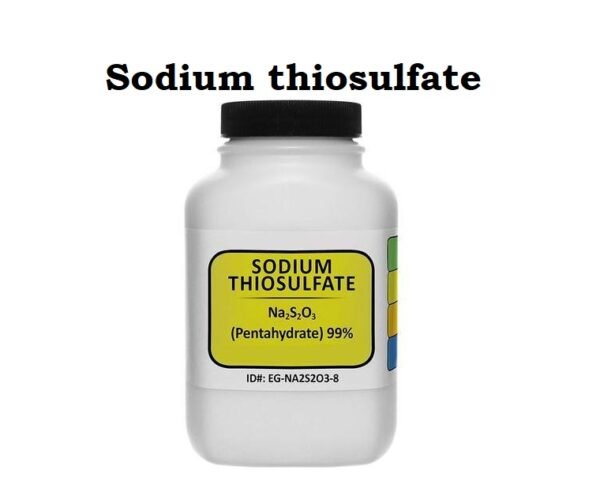
Sodium thiosulfate is an inorganic salt that is used in the treatment of cyanide poisoning and extravasation of chemotherapeutic agents.
Sodium thiosulfate Uses:
-
Cyanide poisoning:
- Treatment of acute, life-threatening conditions due to cyanide poisoning in combination with sodium nitrite.
-
Off Label Uses in Adults:
- Calciphylaxis;
- Management of mechlorethamine extravasation;
- Management of delayed calcium extravasation (calcinosis cutis);
- Management of concentrated cisplatin (≥0.4 mg/mL) extravasation;
- Management of bendamustine extravasation
Sodium thiosulfate Dose in Adults
Dose in the treatment of Cyanide poisoning: IV:
Note:
- Administer in conjunction with sodium nitrite.
- Administer sodium nitrite first, followed immediately by the administration of sodium thiosulfate:
- 5 g (50 mL of a 25% solution);
- The dose may be repeated at one-half of the original dose if symptoms of cyanide toxicity reoccur
Note:
- Monitor the patient for 24 to 48 hours; if symptoms reappear, repeat both sodium nitrite and sodium thiosulfate at one-half of the original doses.
Sodium thiosulfate dose in the treatment of Calciphylaxis (off-label): IV:
Note: Optimal dose is not established.
-
Dialysis patients:
- 25 g administered 3 times per week during the last hour of or after the hemodialysis session.
- Therapy should be continued till there is complete resolution of symptoms.
- Patients who are not on dialysis (normal renal function or mildly reduced GFR): 25 g administered 3 times a week.
Dose in the management of extravasation (off-label):
-
Mechlorethamine: SubQ (off-label route):
- Inject 2 mL of a 1/6 M (approximately 4%) sodium thiosulfate solution into the site of extravasation for each mg of mechlorethamine which is suspected to have extravasated.
-
Concentrated cisplatin:
- Inject 2 mL of a 1/6 M (~4%) sodium thiosulfate solution into maintained IV line for each 100 mg of cisplatin extravasated at that time;
- Consider also injecting 1 mL of a 1/6 M (~4%) sodium thiosulfate solution as 0.1 mL subcutaneous injections (clockwise) into the area around the extravasation, may repeat subcutaneous injections several times over the next 3-4 hours.
-
Bendamustine:
- SubQ: Bendamustine extravasation may be managed with 1/6 M (approximately 4%) sodium thiosulfate solution in the same way as mechlorethamine extravasation.
Sodium thiosulfate dose in the Management of delayed calcium extravasation (calcinosis cutis) (off-label):
- IV: 12.5 g over 30 minutes;
- may increase the dose gradually to 25 g 3 times per week;
- monitor for non-anion gap acidosis, low calcium, and severe nausea.
- Additional data may be necessary to further define its role in this condition.
Sodium thiosulfate Dose in Childrens
Sodium thiosulfate dose in Cyanide poisoning:
Note:
- Administer in conjunction with sodium nitrite. Administer sodium nitrite first, then followed immediately by sodium thiosulfate.
-
Infants, Children, and Adolescents:
- IV: 250 mg/kg (1 mL/kg or 30 to 40 mL/m of a 25% solution);
- Maximum dose: 12.5 g/dose (50 mL of a 25% solution).
- Monitor patients for 24 to 48 hours;
- If symptoms reappears, repeat both sodium nitrite and sodium thiosulfate at one-half of the original doses.
Sodium thiosulfate dose in the management of extravasation:
-
Mechlorethamine extravasation:
-
Children and Adolescents:
- SubQ: 1/6 M (~4%) solution: Inject 2 mL for each mg of mechlorethamine which is suspected to have extravasated, and administer immediately into the extravasation site.
-
-
Concentrated Cisplatin extravasation:
-
Infants, Children, and Adolescents:
- Inject 2 mL of a 1/6 M (~4%) sodium thiosulfate solution into maintained IV line for each 100 mg of cisplatin extravasated;
- Also, consider injecting 1 mL of a 1/6 M (~4%) sodium thiosulfate solution as 0.1 mL subcutaneous injections (clockwise) into the area around the extravasation, may repeat subcutaneous injections several times over the next 3 to 4 hours.
-
Pregnancy Risk Factor C
- Animal reproduction studies did not show any teratogenic effects.
- Antidotes that are used for their intended purpose should be considered the mother's health and prognosis.
- Pregnant women should only receive antidotes if they have a clear indication of use. They should not be withheld or stopped because of concerns of teratogenicity.
Use during breastfeeding:
- It is unknown if the drug is found in breast milk.
- Breastfeeding is not contraindicated because it can be used in life-threatening situations as an antidote.
- The manufacturer does not know when breastfeeding can be resumed safely after administration.
- They recommend that breastfeeding mothers exercise caution following administration.
Sodium thiosulfate Dose in Kidney Disease:
- There are no dosage adjustments provided in the drug maker's labeling; however, renal elimination is significant, and the risk of adverse effects may be increased in patients with renal impairment.
Calciphylaxis (off-label use):
- No dosage adjustment is necessary.
- When used for patients not on dialysis (normal renal function or mildly reduced GFR), because the drug is cleared by the kidney, the dose may be adjusted based on appearance
Dose in Liver disease:
- There are no dosage adjustments provided in the drug maker's labeling (it has not been studied).
Side effects of Sodium thiosulfate:
-
Cardiovascular:
- Hypotension
-
Central nervous system:
- Disorientation
- Flushing sensation
- Headache
- Salty taste
-
Gastrointestinal:
- Nausea, vomiting
-
Hematologic & oncologic:
- Prolonged bleeding time
Contraindications to Sodium thiosulfate:
- There are no contraindications listed within the drug maker's labeling.
Monitoring parameters:
- Cyanide poisoning:
- Monitor for at least 24-48 hours after administration;
- blood pressure and heart rate during and after infusion;
- hemoglobin/hematocrit;
- co-oximetry;
- serum lactate levels;
- venous-arterial PO gradient;
- serum methemoglobin and oxyhemoglobin.
- Pretreatment cyanide levels may be useful diagnostically.
- Extravasation management:
- Monitor and document the extravasation site for pain,
- blister formation,
- skin sloughing,
- arm/hand swelling/stiffness;
- monitor for fever, chills, or
- worsening pain
- When used in the management of delayed calcium extravasation known as calcinosis cutis, monitor for non-anion gap acidosis, low calcium, and severe nausea.
How to administer Sodium thiosulfate?
- IV:
- Cyanide poisoning:
- Administer by intravenous infusion over 10 to 30 minutes immediately after the sodium nitrite administration.
- Decrease the rate of infusion in the event of significant hypotension.
- Calciphylaxis (off-label use):
- Administer through an intravenous infusion over 30 to 60 minutes.
- Cyanide poisoning:
- Extravasation management (off-label use):
- Stop infusion immediately and disconnect the intravenous line (leave needle and cannula in place);
- Do not flush the IV line. Gently aspirate back the extravasated solution from the IV line.
- Then remove the needle or cannula gently (keep in place for cisplatin extravasation temporarily to allow for administration of sodium thiosulfate through the needle or cannula);
- Elevate the affected extremity.
- Mechlorethamine:
- Inject subcutaneously (off-label route) into the extravasation site using less than or equal to a 25-gauge needle;
- change needle with each and every injection.
- Concentrated Cisplatin:
- Inject into the existing IV line;
- Consider injecting 1 mL as 0.1 mL subcutaneous injections in a clockwise manner into the area around the extravasation using a new 25or 27-gauge needle for each injection.
- Bendamustine:
- Bendamustine extravasation may be managed subQ with sodium thiosulfate in the same way as that of mechlorethamine extravasation.
Mechanism of action of Sodium thiosulfate:
- Cyanide toxicity:
- It is a donor of sulfur during the rhodanese catalyzed production of thiocyanate (much safer than cyanide).
- Extravasation management:
- It neutralizes reactive mechlorethamine species, which in turn reduces formation of hydroxylradicals that can cause tissue injury.
Half-life elimination:
- Thiosulfate: 3 Hours
- Thiocyanate: 2.7 Days, prolongation with renal impairment up to 9 Days
Excretion:
- Urine (~20% to 50% thiosulfate as unchanged drug)
International Brand Names of Sodium thiosulfate:
- Seacalphyx
- Krem Ochronny z Tiosiarczanem Sodu A
- Soft Mate Consept 2
Sodium thiosulfate Brand Names in Pakistan:
No Brands Available in Pakistan.
.png)


