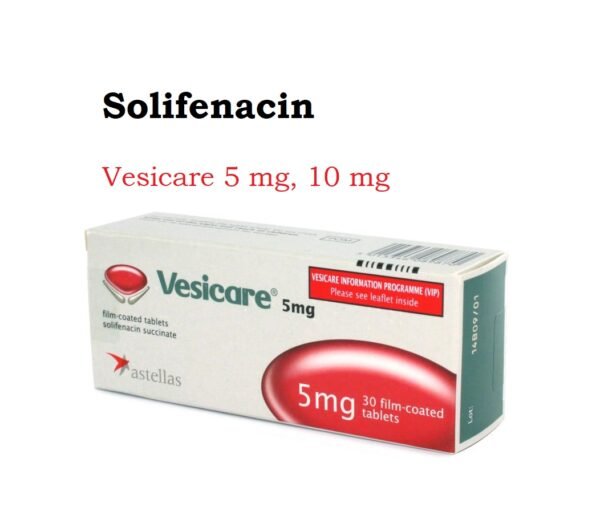
Solifenacin (Vesicare) is an antimuscarinic drug that is used to treat patients with symptoms of overactive bladder manifesting as urgency, frequency, and urinary incontinence.
Solifenacin Uses:
-
Overactive bladder:
- Treatment of overactive bladder with symptoms of increased urinary frequency, urgency, and/or urge incontinence.
Solifenacin (Vesicare) Dose in Adults
Solifenacin (Vesicare) Dose in the treatment of Overactive bladder:
- 5 mg orally once a day initially,
- if tolerated, the dose may be increased to 10 mg once daily.
Solifenacin dose adjustment with concomitant potent CYP3A4 inhibitors (eg, ketoconazole):
- Maximum dose: 5 mg/day
Solifenacin (Vesicare) Dose in Childrens
Not recommended for use in children.
Pregnancy Risk Factor C
- In some studies on animal reproduction, adverse events were reported.
Solifenacin use during breastfeeding:
- It is unknown if the drug is found in breast milk.
- Manufacturer suggests that a decision is made about whether to withhold nursing care or discontinue using the drug.
Vesicare Dose in Kidney Disease:
-
CrCl ≥30 mL/minute:
- There are no dosage adjustments provided in the drug manufacturer's labeling;
- use with caution.
-
CrCl <30 mL/minute:
- Maximum dose: 5 mg/day
Vesicare Dose in Liver disease:
-
Mild impairment (Child-Pugh class A):
- No dosage adjustment necessary;
- use with caution.
-
Moderate impairment (Child-Pugh class B):
- Maximum dose: 5 mg/day.
-
Severe impairment (Child-Pugh class C):
- Use is not recommended.
Common Side Effects of Solifenacin (Vesicare):
-
Gastrointestinal:
- Xerostomia
- Constipation
Less Common Side Effects of Vesicare:
-
Cardiovascular:
- Hypertension
- Lower Extremity Edema
-
Central Nervous System:
- Fatigue
- Depression
-
Gastrointestinal:
- Dyspepsia
- Nausea
- Upper Abdominal Pain
- Vomiting
-
Genitourinary:
- Urinary Tract Infection
- Urinary Retention
-
Ophthalmic:
- Blurred Vision
- Dry Eye Syndrome
-
Respiratory:
- Cough
-
Miscellaneous:
- Influenza
Contraindications to Solifenacin (Vesicare):
- Hypersensitivity to solifenacin and any component of the formulation
- Urinary retention
- gastric retention
- Uncontrolled narrow-angle glaucoma
- Dialysis
Warnings and precautions
-
Angioedema
- Reports of angioedema in the lips, face, tongue, or larynx were reported.
- Some cases occurred even after the first dose.
- Allergies can be life-threatening.
- If you are concerned about your tongue, hypopharynx or larynx, stop immediately and start supportive care.
-
CNS effects
- There have been reports of CNS side effects (eg headache, confusion, hallucinations and somnolence).
- Monitor for CNS effects at treatment initiation and dose increases;
- If necessary, reduce or stop taking the medication.
- This may cause blurred or drowsy vision and/or drowsiness, which can impair mental and physical abilities.
- It is important to warn patients about tasks that require mental alertness, such as operating machinery or driving.
-
Heat prostration:
- It may occur when the environment temperature is elevated
- Take care when exercising or in hot weather.
-
Hypersensitivity reactions
- Rarely have anaphylactic reactions been reported.
- If an anaphylactic reaction occurs, stop taking the medication immediately.
-
Alzheimer disease
- Preliminary data suggests that anticholinergics could potentially have an adverse effect on the clinical course Alzheimer's disease in patients who are taking cholinesterase inhibitors.
- Patients with dementia who are receiving dual therapy (acetylcholinesterase inhibitor, bladder anticholinergic) should be monitored for any changes in cognition or functional abilities.
-
Bladder outflow obstruction
- Patients with bladder obstruction (eg BPH) should be cautious.
- It could increase your risk of having urinary retention.
-
Gastrointestinal Disease:
- Patients with reduced GI motility (severe colitis, ulcerative colitis), or GI obstructive conditions (pyloric stenosis) should be cautious.
- It could increase the risk for gastric retention.
-
Glaucoma:
- Patients with narrow-angle glaucoma that has been treated (controlled) should be cautious.
- Uncontrolled narrow-angle vision impairment is a reason to avoid its use.
-
Hepatic impairment
- Patients with moderate hepatic impairment (Child Puugh class B) should be cautious.
- Patients with severe hepatic impairment (Child Pugh class C) may need to adjust their dosage.
-
Extension of QT
- Use with caution in patients with a known history of QT prolongation or other risk factors for QT prolongation (eg, concomitant use of medications known to prolong QT interval, and electrolyte abnormalities).
- Dose-related QT prolongation risk
-
Renal impairment
- Patients with impaired renal function should be cautious.
- For severe renal impairment (CrCl 30mL/minute), dosage adjustment is necessary.
Solifenacin: Drug Interaction
Note: Drug Interaction Categories:
- Risk Factor C: Monitor When Using Combination
- Risk Factor D: Consider Treatment Modification
- Risk Factor X: Avoid Concomitant Use
Risk Factor C (Monitor therapy). |
|
| Acetylcholinesterase inhibitors | Anticholinergic Agents may have a decreased therapeutic effect. Anticholinergic Agents can decrease the therapeutic effects of Acetylcholinesterase inhibitors. |
| Amantadine | Anticholinergic Agents may have an enhanced anticholinergic effect. |
| Anticholinergic Agents | Other Anticholinergic Agents may have an adverse/toxic effect. |
| Aprepitant | High risk of Inhibitors causing an increase in serum CYP3A4 Substrates concentrations |
| Bosentan | Could lower serum concentrations of CYP3A4 substrates (High Risk with Inducers). |
| Botulinum Toxin-Containing Products | Anticholinergic Agents may have an enhanced anticholinergic effect. |
| Cannabinoid-Containing Products | Anticholinergic Agents may enhance the tachycardic effect of Cannabinoid-Containing Products. Cannabidiol is an exception. |
| Chloral Betaine | Anticholinergic Agents may have an adverse/toxic effect. |
| Clofazimine | High risk of Inhibitors causing an increase in serum CYP3A4 Substrates concentrations |
| Moderate CYP3A4 Inducers | Could lower serum concentrations of CYP3A4 substrates (High Risk with Inducers). |
| Moderate CYP3A4 inhibitors | Might decrease metabolism of CYP3A4 substrates (High Risk with Inhibitors). |
| Deferasirox | Could lower serum concentrations of CYP3A4 substrates (High Risk with Inducers). |
| Duvelisib | High risk of Inhibitors causing an increase in serum CYP3A4 Substrates concentrations |
| Erdafitinib | Could lower serum concentrations of CYP3A4 substrates (High Risk with Inducers). |
| Erdafitinib | High risk of Inhibitors causing an increase in serum CYP3A4 Substrates concentrations |
| Fosaprepitant | High risk of Inhibitors causing an increase in serum CYP3A4 Substrates concentrations |
| Fosnetupitant | High risk of Inhibitors causing an increase in serum CYP3A4 Substrates concentrations |
| Gastrointestinal Agents (Prokinetic) | Anticholinergic Agents can reduce the therapeutic effects of Gastrointestinal Agents (Prokinetic). |
| Glucagon | Anticholinergic agents may increase the toxic/adverse effects of Glucagon. Particularly, there may be an increase in the likelihood of gastrointestinal adverse reactions. |
| Haloperidol | QT-prolonging agents (Indeterminate risk - Caution), may increase the QTcprolonging effects of Haloperidol. |
| Itopride | Itopride's therapeutic effects may be diminished by anticholinergic agents. |
| Ivosidenib | Could lower serum concentrations of CYP3A4 substrates (High Risk with Inducers). |
| Larotrectinib | High risk of Inhibitors causing an increase in serum CYP3A4 Substrates concentrations |
| Mianserin | Anticholinergic Agents may have an enhanced anticholinergic effect. |
| Mirabegron | Could increase the toxic/adverse effects of Solifenacin. In particular, acute urinary retention risk may be increased. |
| Netupitant | High risk of Inhibitors causing an increase in serum CYP3A4 Substrates concentrations |
| Nitroglycerin | The absorption of Nitroglycerin may be decreased by anticholinergic agents. Anticholinergic Agents may reduce the dissolution sublingual nitroglycerin tablet, which could impair or slow down nitroglycerin absorbtion. Opioid Agonists - Anticholinergic agents may increase the toxic/adverse effects of Opioid Agonists. This combination may increase the risk of constipation or urinary retention. |
| Palbociclib | High risk of Inhibitors causing an increase in serum CYP3A4 Substrates concentrations |
| QT-prolonging agents (Highest risk) | QT-prolonging agents (Indeterminate risk - Caution), may increase the QTc prolonging effect of QT Prolonging Agents. When using these agents together, be sure to monitor for QTc interval prolongation or ventricular arrhythmias. Patients at higher risk for QTc prolongation might have additional risk factors. |
| Ramosetron | Ramosetron's constipating effects may be enhanced by anticholinergic agents. |
| Sarilumab | Could lower serum concentrations of CYP3A4 substrates (High Risk with Inducers). |
| Siltuximab | Could lower serum concentrations of CYP3A4 substrates (High Risk with Inducers). |
| Simeprevir | High risk of Inhibitors causing an increase in serum CYP3A4 Substrates concentrations |
| Thiazide and Thiazide -Like Diuretics | Anticholinergic Agents can increase serum Thiazide or Thiazide-Like Diuretics. |
| Tocilizumab | Could lower serum concentrations of CYP3A4 substrates (High Risk with Inducers). |
| Topiramate | Topiramate's toxic/adverse effects may be exacerbated by anticholinergic agents. |
Risk Factor D (Regard therapy modification) |
|
| Strong CYP3A4 Inducers | May increase metabolism of CYP3A4 substrates (High Risk with Inducers). Management: You may consider a different drug to replace one of the interacting drugs. Some combinations might be contraindicated. Consult appropriate manufacturer labeling. |
| Strong CYP3A4 inhibitors | Increased serum levels of Solifenacin may occur. Management: Solifenacin should be taken in small doses, no more than 5 mg per day when used with strong CYP3A4 inhibitors. |
| Dabrafenib | High risk of Inducers causing a decrease in serum CYP3A4 substrates. Management: If possible, seek alternatives to the CYP3A4 substrate. Concomitant therapy should be avoided if possible. Monitor the clinical effects of the substrate carefully (especially therapeutic effects). |
| Enzalutamide | High risk of Inducers causing a decrease in serum concentrations of CYP3A4 substrates. Management: Avoid concurrent use of enzalutamide and CYP3A4 substrates with a narrow therapeutic index. You should exercise caution when using enzalutamide or any other CYP3A4 sub-substance. |
| Itraconazole | Increased serum concentrations of Solifenacin may occur. Itraconazole and solifenacin should be used together only at 5 mg per day. Patients with severe renal impairment or moderate to severe liver impairment should not take solifenacin with itraconazole. |
| Lorlatinib | High risk of Inducers causing a decrease in serum concentrations of CYP3A4 substrates. Management: Do not use lorlatinib concurrently with any CYP3A4 Substrates. Even a slight decrease in serum concentrations could cause therapeutic failure or serious clinical consequences. |
| MiFEPRIStone | High risk of Inhibitors causing an increase in serum concentrations of CYP3A4 substrates. Management: Minimize doses of CYP3A4 substrates, and monitor for increased concentrations/toxicity, during and 2 weeks following treatment with mifepristone. Avoid dihydroergotamine and ergotamine. |
| Mitotane | High risk of Inducers causing a decrease in serum concentrations of CYP3A4 substrates. Treatment: Patients receiving mitotane may require significant adjustments in the dosage of CYP3A4 Substrates. |
| Pramlintide | Anticholinergic Agents may have an enhanced anticholinergic effect. These effects are only for the GI tract. |
| Secretin | Secretin's therapeutic effects may be diminished by anticholinergic agents. Concomitant use: Secretin and anticholinergic agents should be avoided. Stop using anticholinergic drugs for at least five half-lives before administering secretin. |
| St John's Wort | High risk of Inducers causing a decrease in serum CYP3A4 Substrates. Management: You may consider a different drug to replace one of the interacting drugs. Some combinations might be contraindicated. Consult appropriate manufacturer labeling. |
| Stiripentol | High risk of Inhibitors causing an increase in serum concentrations of CYP3A4 substrates. Management: Avoid stiripentol use with CYP3A4 Substrates that have a narrow therapeutic Index. This is to avoid adverse effects and toxicities. Monitoring of any CYP3A4 substrate that is used with stiripentol should be closely done. |
Risk Factor X (Avoid Combination) |
|
| Aclidinium | Anticholinergic Agents may have an enhanced anticholinergic effect. |
| Cimetropium | Cimetropium may have an anticholinergic effect that can be enhanced by the use of anticholinergic agents. |
| Conivaptan | High risk of Inhibitors causing an increase in serum CYP3A4 Substrates concentrations |
| Eluxadoline | Eluxadoline may cause constipation by using anticholinergic agents. |
| Fusidic Acid (Systemic). | High risk of Inhibitors causing an increase in serum CYP3A4 Substrates concentrations |
| Glycopyrrolate (Oral Inhalation) | Anticholinergic agents may increase the anticholinergic effects of Glycopyrrolate (Oral inhalation). |
| Glycopyrronium (Topical) | Anticholinergic Agents may have an enhanced anticholinergic effect. |
| Idelalisib | High risk of Inhibitors causing an increase in serum CYP3A4 Substrates concentrations |
| Oral Inhalation with Ipratropium | Anticholinergic Agents may have an enhanced anticholinergic effect. |
| Levosulpiride | Anticholinergic Agents can reduce the therapeutic effects of Levosulpiride. |
| Oxatomide | Anticholinergic Agents may have an enhanced anticholinergic effect. |
| Potassium Chloride | Potassium Chloride may have an ulcerogenic effect that can be exacerbated by anticholinergic agents. Treatment: Patients taking drugs that have significant anticholinergic effects should not consume any oral dose form of potassium chloride. |
| Potassium Citrate | Potassium Citrate may be more ulcerogenic if it is given to anticholinergic agents. |
| Revefenacin | Revefenacin may be enhanced by anticholinergic agents. |
| Tiotropium | Anticholinergic agents may increase the anticholinergic effects of Tiotropium. |
| Umeclidinium | Anticholinergic Agents may have an enhanced anticholinergic effect. |
Monitoring parameters:
- Anticholinergic effects including:
- CNS effects such as headache, confusion, hallucinations, somnolence),
- fixed and dilated pupils
- blurred vision
- tremors
- dry skin
- creatinine clearance
- hepatic function
- post-void residuals when added to alpha-blocker therapy for BPH.
How to administer Solifenacin (Vesicare)?
- Administer with water without regard to food.
- Swallow whole. Do not crush or chew.
Mechanism of action of Solifenacin (Vesicare):
- It blocks the muscarinic receptors, resulting in decreased bladder contraction, increased urine volume, and decreased muscle pressure.
Protein binding:
- 98%, mainly due to alpha-acid glycoprotein
Metabolism:
- Hepatic disease; forms active and inactive metabolites via N-oxidation, 4 R-hydroxylation and 1 R-hydroxylation. Primary route for elimination is via CYP3A4.
Bioavailability:
- 90%
Half-life elimination:
- Chronic dosing can take 45-68 hours; prolongation in severe renal impairment (CrCl 30mL/minute) and moderate hepatic impairment (Child Pugh class B).
Plasma peak time:
- 3-8 hours
Excretion:
- Urine (69.2%; 15% as an unchanged drug);
- feces (22.5%)
International Brands of Solifenacin:
- VESIcare
- ACT-Solifenacin
- APO-Solifenacin
- Auro-Solifenacin
- JAMP-Solifenacin
- MED-Solifenacin
- MINT-Solifenacin
- PMS-Solifenacin
- RAN-Solifenacin
- SANDOZ Solifenacin
- TEVA-Solifenacin
- VESIcare
- Asolfena
- Bispec
- Slowurge
- Sofcare
- Solficare
- Solicin
- Soliten
- Somfen
- Tormeel
- Urisol
- Utrobin
- Vesicare
- Vesiker
- Vesikur
- Vesitrim
- Vesizen
- Zevesin
Solifenacin Brand Names in Pakistan:
Solifenacin succinate 5 mg Tablets |
|
| Fenaso | Highnoon Laboratories Ltd. |
| Solcina | Helix Pharma (Private) Limited |
| Solicon | Efroze Chemical Industries (Pvt) Ltd. |
| Solifen | Getz Pharma Pakistan (Pvt) Ltd. |
| Vesiwel | Ray Pharma (Pvt) Ltd |
Solifenacin 10 mg Tablets |
|
| Fenaso | Highnoon Laboratories Ltd. |
| Solicon | Efroze Chemical Industries (Pvt) Ltd. |
| Solifen | Getz Pharma Pakistan (Pvt) Ltd. |
| Vesiwel | Ray Pharma (Pvt) Ltd |
.png)


