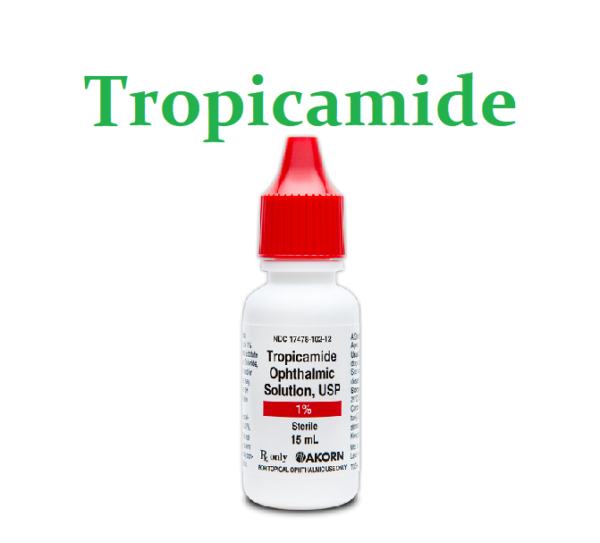
Tropicamide (Mydriacyl) causes dilatation of the pupil by blocking the ciliary muscles of the eye to respond to cholinergic stimulation.
Tropicamide (Mydriacyl) Uses:
-
Mydriasis or Cycloplegia:
- It is indicated for the brief pupillary dilatation (mydriasis and cycloplegia) that is required during diagnostic procedures. For prolonged pupillary dilation, as is required during therapeutic ophthalmic procedures, atropine is used.
Tropicamide (Mydriacyl) Dose in Adults
Note: People with dark and heavily pigmented eyes may require higher doses.
Tropicamide (Mydriacyl) Dose used for Cycloplegia:
- Ophthalmic:
- Instill one or two drops (1%) in each eye. The dose may be repeated in five minutes.
- The patient may need additional doses after every 20 to 30 minutes, if the procedure is prolonged.
Tropicamide (Mydriacyl) Dose for Mydriasis:
- Ophthalmic:
- Instill one or two drops of 0.5% solution in each eye about 15 to 20 minutes before the examination of the eye.
Tropicamide (Mydriacyl) Dose in Childrens
Note: People with highly pigmented eyes may require higher doses.
Tropicamide (Mydriacyl) Dose in the treatment of Cycloplegia:
-
Infants, Children, and Adolescents:
- Ophthalmic (1%):
- Instill one or two drops in each eye. The dose may be repeated in five minutes.
- Additional doses may be required if the examination is prolonged or the patient has not been examined within 20 to 30 minutes.
- Ophthalmic (1%):
Tropicamide (Mydriacyl) Dose in the treatment of Mydriasis:
-
Infants, Children, and Adolescents:
- Ophthalmic (0.5%):
- Instill 1 to 2 drops of 0.5% solution in each eye 15 to 20 minutes before the exam.
- Ophthalmic (0.5%):
Pergnancy Risk Category: C
- Studies on animal reproduction have not been done using tropicamide.
- To reduce the potential exposure of the fetus to the ophthalmic agent during pregnancy, it is recommended to use the lowest effective dose in conjunction with punctual occlusion.
Tropicamide use during breastfeeding:
- It is unknown if tropicamide is found in breast milk.
- If nursing mothers are concerned, the manufacturer suggests that you exercise caution.
Dose in Kidney Disease:
- No dosage adjustments have been provided in the manufacturer’s labeling.
Dose in Liver disease:
- No dosage adjustments have been provided in the manufacturer’s labeling.
Side effects of Tropicamide (Mydriacyl):
-
Cardiovascular:
- Central Nervous System Dysfunction
- Tachycardia
-
Central Nervous System:
- Headache
-
Dermatologic:
- Pallor
-
Gastrointestinal:
- Nausea
- Vomiting
- Xerostomia
-
Hypersensitivity:
- Hypersensitivity Reaction
-
Neuromuscular & Skeletal:
- Muscle Rigidity
-
Ophthalmic:
- Blurred Vision
- Photophobia
- Transient Stinging Of Eyes
- Superficial Punctate Keratitis
Contraindications to Tropicamide (Mydriacyl):
- Allergic reactions to tropicamide or any component of the formulation
- There is not much evidence of belladonna alkaloids causing allergic reactions.
- Cross-sensitivity is possible due to similarities in chemical structure, pharmacologic actions, and/or pharmacologic effects. However, this cannot be ruled out.
Warnings and Precautions
-
CNS effects
- The drug may cause blurred or drowsy vision and/or drowsiness, which can impair mental or physical abilities.
- Patients should be cautious about driving, operating machinery, and other tasks that require mental alertness.
-
Increased intraocular pressure
- This may cause an increase in intraocular pressure temporarily.
Monitoring parameters:
- Ophthalmic exam,
- Intraocular pressure,
- CNS effects (especially in pediatric patients and patients performing tasks that require mental alertness).
How to administer Tropicamide (Mydriacyl)?
Ophthalmic:
- It is to be used in the eyes only. The patient must be asked to remove contact lenses before instilling the drops.
- Before instilling the drops, wash your hands. While instilling the drops, it is advised not to touch the tip of the bottle with any surface including the eyes and eyelids.
- Systemic exposure may be avoided by gently applying pressure with a finger on the lacrimal sam for two to three minutes.
Mechanism of action of Tropicamide (Mydriacyl):
- Tropicamide prevents the sphincter muscles of the iris or the muscle of the ciliary body from responding to cholinergic stimulation.
- This results in dilation of the pupils and precludes accommodation.
Start of action:
- Cycloplegic Effect: Peak: 20 to 35 Minutes;
- Mydriatic Effect: 20-40 minutes
Time of action:
- Mydriatic effect may last up to 6 to 7 hrs;
- Cycloplegic Effect may last 6 hours
International Brand Names of Tropicamide:
- Mydriacyl
- Odan-Tropicamide
- Alcon-Mydril
- Colircusi Tropicamida
- Dilate
- Eyetrop
- Losemin
- Midric
- Minims Tropicamide
- Mydramide
- Mydrapid
- Mydriacyl
- Mydriaticum
- Mydrin-M
- Mydromide
- Mydrum
- Oftan Mydrin
- Oftan-tropicamid
- Runzheng
- Sintropic
- Topimide
- Tropamid
- Tropicam
- Tropicamet
- Tropicamid
- Tropicamidum
- Tropicil
- Tropicil Top
- Tropicol
- Tropikacil
- Tropikamid
- Tropimil
- Tropixal
- Trusil
- Visumidriatic
Tropicamide Brand Names in Pakistan:
Tropicamide Eye Drops 1 %w/v in Pakistan |
|
| Mydolate | Ethical Laboratories (Pvt) Ltd. |
| Mydriacyl | Novartis Pharma (Pak) Ltd |
| Mydromide | Remington Pharmaceutical Industries (Pvt) Ltd. |
| Mydropic | Innvotek Pharmaceuticals |
| Ophth-Dilate | Ophth-Pharma (Pvt) Ltd. |
| Tropic | Sante (Pvt) Limited |
| Tropicafin | Medipak Limited |
.png)